Roberts Holy Land
Es wurden insgesamt 71 Einträge zu 'Roberts Holy Land' gefunden (Stand: 13.05.2012).
Sehen Sie sich die aktuell angebotenen Bücher zu 'Roberts Holy Land' an.
ROBERTS, David (1796-1864): The Holy Land, Syria, Idumea, Arabia. [With:] Egypt & Nubia, from drawings made on the spot... With historical descriptions by William Brockedon,
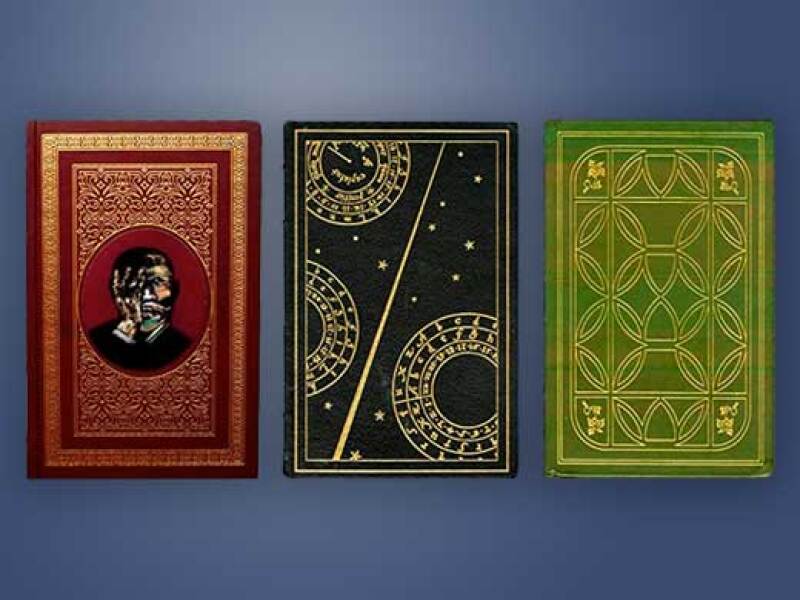
London: F.G. Moon, 1842-1843-1842; 1846-1849-1849. 6 volumes, large folio. (23 7/8 x 17 inches). [Holy Land:] Mounted on guards throughout. 4pp. list of subscribers. Lithographic portrait of Roberts by C. Baugniet on india paper mounted, 3 hand-coloured mounted lithographic titles, 120 hand- coloured lithographic plates, all cut to the edge of the image and mounted on card in imitation of watercolours, as issued, all drawn on stone by Louis Haghe after David Roberts. [Egypt:] Mounted on guards throughout. 3 hand-coloured mounted lithographic titles, 121 hand-coloured lithographic plates, all cut to the edge of the image and mounted in imitation of watercolours, as issued, all drawn on stone by Louis Haghe after David Roberts, 1 engraved map. [Holy Land:] Contemporary green morocco gilt by Charles Lewis, the covers with an outer gilt border built up from numerous small tools including arabesques, stylised foliage, crescent moons, flowerheads, etc., the upper covers lettered in gilt with author and title, spines in six compartments with double raised bands, the bands highlighted in gilt, the second and third compartments lettered in gilt, the remaining compartments with repeat overall tooling using tools which echo those used on the covers, gilt turn-ins, cream glazed endpapers, gilt edges. [Egypt:] Contemporary red morocco gilt by Charles Lewis, the covers with an outer gilt border made up from fillets and roll tools, all surrounding an elaborate inner border tooled to a rococco design incorporating shells, scrolling styised foliage and irregularly-shaped panels with overall tooling of lattice work with small tools, the upper covers lettered in gilt with author, title and volume number, spines in six compartments with dou. Very fine subscriber's copies of the deluxe hand-coloured editions of Roberts' monumental works on the Middle East: the Holy Land, Syria, Idumea, Arabia and Egypt. The greatest lithographically illustrated work of the 19th century, here in stunning contemporary bindings. Roberts' masterpiece was issued in 41 parts over seven years. It is beautifully lithographed by Louis Haghe, to whom Roberts paid tribute in glowing terms, "Haghe has not only surpassed himself, but all that has hitherto been done of a similar nature. He has rendered the views in a style clear, simple and unlaboured, with a masterly vigour and boldness which none but a painter like him could have transferred to stone." Abbey regarded the work as "one of the most important and elaborate ventures of nineteenth-century publishing." David Roberts was born at Stockbridge near Edinburgh, and at the early age of 10 apprenticed to Gavin Buego, a house painter. He continued to work for Buego after his apprenticeship had been completed, carrying out work on imitation stone-work and paneling at Scone Palace and Abercairney Abbey. By 1818 Roberts had become assistant scene painter at the Pantheon theater in Edinburgh, moving on to work in theatres in Glasgow and finally in late 1821 to Drury Lane theatre in London, where he worked with Clarkson Stanfield. Both artists exhibited at the Society of British Artists, Royal Academy and British Institution, and by 1830 Roberts was firmly established as a topographical artist and was able to give up his theatre work. In these early years he toured the continent and Scotland, and in 1832-33 visited Spain. In 1838 he made plans for his journey to the Near East, inspired by a love of artistic adventure; departing in August 1839 for Alexandria, he spent the remaining part of the year in Cairo, visiting the numerous tombs and sites. In February of the following year he set out to cross the desert for the Holy Land by way of Suez, Mount Sinai and Petra arriving in Gaza, and then on to Jerusalem, concluding his tour spending several months visiting the biblical sites of the Holy Land, and finally returning to England at the end of 1839. The drawings of his tour were submitted to F.G. Moon in 1840 who arranged to bring out a work illustrative of Scripture History, paying Roberts 3,000 for copyright to the sketches, and for his labour in supervising Louis Haghe's lithography. Both the exhibition of his original watercolours and the subsequent published work were an immediate success and confirmed his reputation as an architectural and landscape artist of the highest order. It is clear that these two works should be considered as a set. They were supplied to the same original subscriber: H.C. Robarts, a London banker and evidently a collector of some taste. He employed the firm of Charles Lewis to bind the work, resulting in these unique and dramatic red and green highly-decorative bindings.
ROBERTS, After David (1796-1864): The Pool of Bethesda,
[London: Day & Son, 1842-1849]. Tinted lithograph by Louis Haghe. Very good condition apart from some light soiling in the lower margin. 14 x 19 1/4 inches. 16 3/4 x 23 1/2 inches. A fine example from David Roberts' monumental works on the Middle East: 'The Holy Land' and 'Egypt & Nubia', considered the greatest lithographically illustrated works issued in the 19th century. Roberts' masterpiece was issued in 41 parts over seven years. It is beautifully lithographed by Louis Haghe, to whom Roberts paid tribute in glowing terms, 'Haghe has not only surpassed himself, but all that has hitherto been done of a similar nature. He has rendered the views in a style clear, simple and unlaboured, with a masterly vigour and boldness which none but a painter like him could have transferred to stone'. Abbey regarded the work as 'one of the most important and elaborate ventures of nineteenth-century publishing, and...the apotheosis of the tinted lithograph'. David Roberts was born at Stockbridge near Edinburgh, and at the early age of 10 apprenticed to Gavin Buego, a house painter. He continued to work for Buego after his apprenticeship had been completed, carrying out work on imitation stone-work and paneling at Scone Palace and Abercairney Abbey. By 1818 Roberts had become assistant scene painter at the Pantheon theatre in Edinburgh, moving on to work in theatres in Glasgow and finally in late 1821 to Drury Lane theatre in London, where he worked with Clarkson Stanfield. Both artists exhibited at the Society of British Artists, Royal Academy and British Institution, and by 1830 Roberts was firmly established as a topographical artist and was able to give up his theatre work. In these early years he toured the continent and Scotland, and in 1832-33 visited Spain. In 1838 he made plans for his journey to the Near East, inspired by a love of artistic adventure; departing in August 1839 for Alexandria, he spent the remaining part of the year in Cairo, visiting the numerous tombs and sites. In February of the following year he set out to cross the desert for the Holy Land by way of Suez, Mount Sinai and Petra arriving in Gaza, and then on to Jerusalem, concluding his tour spending several months visiting the biblical sites of the Holy Land, and finally returning to England at the end of 1839. The drawings of his tour were submitted to F.G. Moon in 1840 who arranged to bring out a work illustrative of Scripture History, paying Roberts 3,000. for the copyright of the sketches, and for his labour in supervising Louis Haghe's lithography. Both the exhibition of his original watercolours and the subsequent published work were an immediate success and confirmed his reputation as an architectural and landscape artist of the highest order. Cf. Abbey Travel I, 272 & II, 385; cf. Blackmer 1432; cf. Gay 2216; cf. Ibrahim-Hilmy II,p.176; cf. Lipperheide Ma 27; cf. Röhrict 1984; cf. Tobler p. 229; cf. Tooley 402.
ROBERTS, After David (1796-1864): St. Jean D'Acre,
[London: Day & Son, 1842-1849]. Tinted lithograph by Louis Haghe, with later professional hand-colouring. Very good condition apart from a small loss in the lower left-hand corner, a 1/2" tear in the upper left-hand corner, and a bit of excess ink in the left margin. 15 x 20 1/8 inches. 16 3/8 x 23 3/4 inches. A fine example from David Roberts' monumental works on the Middle East: 'The Holy Land' and 'Egypt & Nubia', considered the greatest lithographically illustrated works issued in the 19th century. Roberts' masterpiece was issued in 41 parts over seven years. It is beautifully lithographed by Louis Haghe, to whom Roberts paid tribute in glowing terms, 'Haghe has not only surpassed himself, but all that has hitherto been done of a similar nature. He has rendered the views in a style clear, simple and unlaboured, with a masterly vigour and boldness which none but a painter like him could have transferred to stone'. Abbey regarded the work as 'one of the most important and elaborate ventures of nineteenth-century publishing, and...the apotheosis of the tinted lithograph'. David Roberts was born at Stockbridge near Edinburgh, and at the early age of 10 apprenticed to Gavin Buego, a house painter. He continued to work for Buego after his apprenticeship had been completed, carrying out work on imitation stone-work and paneling at Scone Palace and Abercairney Abbey. By 1818 Roberts had become assistant scene painter at the Pantheon theatre in Edinburgh, moving on to work in theatres in Glasgow and finally in late 1821 to Drury Lane theatre in London, where he worked with Clarkson Stanfield. Both artists exhibited at the Society of British Artists, Royal Academy and British Institution, and by 1830 Roberts was firmly established as a topographical artist and was able to give up his theatre work. In these early years he toured the continent and Scotland, and in 1832-33 visited Spain. In 1838 he made plans for his journey to the Near East, inspired by a love of artistic adventure; departing in August 1839 for Alexandria, he spent the remaining part of the year in Cairo, visiting the numerous tombs and sites. In February of the following year he set out to cross the desert for the Holy Land by way of Suez, Mount Sinai and Petra arriving in Gaza, and then on to Jerusalem, concluding his tour spending several months visiting the biblical sites of the Holy Land, and finally returning to England at the end of 1839. The drawings of his tour were submitted to F.G. Moon in 1840 who arranged to bring out a work illustrative of Scripture History, paying Roberts 3,000. for the copyright of the sketches, and for his labour in supervising Louis Haghe's lithography. Both the exhibition of his original watercolours and the subsequent published work were an immediate success and confirmed his reputation as an architectural and landscape artist of the highest order. Cf. Abbey Travel I, 272 & II, 385; cf. Blackmer 1432; cf. Gay 2216; cf. Ibrahim-Hilmy II,p.176; cf. Lipperheide Ma 27; cf. Röhrict 1984; cf. Tobler p. 229; cf. Tooley 402.
ROBERTS, After David (1796-1864): Askelon,
[London: Day & Son, 1842-1849]. Tinted lithograph by Louis Haghe, with later professional hand-colouring. Very good condition. 13 7/8 x 19 inches. 16 3/4 x 23 3/4 inches. A fine example from David Roberts' monumental works on the Middle East: 'The Holy Land' and 'Egypt & Nubia', considered the greatest lithographically illustrated works issued in the 19th century. Roberts' masterpiece was issued in 41 parts over seven years. It is beautifully lithographed by Louis Haghe, to whom Roberts paid tribute in glowing terms, 'Haghe has not only surpassed himself, but all that has hitherto been done of a similar nature. He has rendered the views in a style clear, simple and unlaboured, with a masterly vigour and boldness which none but a painter like him could have transferred to stone'. Abbey regarded the work as 'one of the most important and elaborate ventures of nineteenth-century publishing, and...the apotheosis of the tinted lithograph'. David Roberts was born at Stockbridge near Edinburgh, and at the early age of 10 apprenticed to Gavin Buego, a house painter. He continued to work for Buego after his apprenticeship had been completed, carrying out work on imitation stone-work and paneling at Scone Palace and Abercairney Abbey. By 1818 Roberts had become assistant scene painter at the Pantheon theatre in Edinburgh, moving on to work in theatres in Glasgow and finally in late 1821 to Drury Lane theatre in London, where he worked with Clarkson Stanfield. Both artists exhibited at the Society of British Artists, Royal Academy and British Institution, and by 1830 Roberts was firmly established as a topographical artist and was able to give up his theatre work. In these early years he toured the continent and Scotland, and in 1832-33 visited Spain. In 1838 he made plans for his journey to the Near East, inspired by a love of artistic adventure; departing in August 1839 for Alexandria, he spent the remaining part of the year in Cairo, visiting the numerous tombs and sites. In February of the following year he set out to cross the desert for the Holy Land by way of Suez, Mount Sinai and Petra arriving in Gaza, and then on to Jerusalem, concluding his tour spending several months visiting the biblical sites of the Holy Land, and finally returning to England at the end of 1839. The drawings of his tour were submitted to F.G. Moon in 1840 who arranged to bring out a work illustrative of Scripture History, paying Roberts 3,000. for the copyright of the sketches, and for his labour in supervising Louis Haghe's lithography. Both the exhibition of his original watercolours and the subsequent published work were an immediate success and confirmed his reputation as an architectural and landscape artist of the highest order. Cf. Abbey Travel I, 272 & II, 385; cf. Blackmer 1432; cf. Gay 2216; cf. Ibrahim-Hilmy II,p.176; cf. Lipperheide Ma 27; cf. Röhrict 1984; cf. Tobler p. 229; cf. Tooley 402.