Pugin

Es wurden insgesamt 286 Einträge zu 'Pugin' gefunden (Stand: 22.12.2009).

Sehen Sie sich die aktuell angebotenen Bücher zu 'Pugin' an.

PUGIN, Augustus Charles (1762-1832): Paris, Notre Dame prise de L'isle Louvier,

London: R.Ackermann, January 1821. Hand-coloured aquatint engraving by Havell from J.Gendall's drawing after Pugin. Printed on wove paper. In excellent condition with the exception of a expertly mended tear on the bottom margin. Image size: 13 7/8 x 18 7/8 inches. 19 x 23 1/4 inches. A highly dynamic view, emphasizing the cathedral of Notre Dame's position at the heart of the city of Paris Notre Dame, before the addition of Violett le Duc's central spire, is shown dominating the skyline in this view taken from the south side of the Ile de St. Louis, looking north west upriver to the Pont la Tournelle with the Cathedral beyond. The foreground includes a number of barges loaded with timber, probably for furl, bargees wrestle with the newly arrived vessels, positioning them using long poles, unloading of the moored barges is already underway, with workmen trudging up well-worn paths in the river bank. Much activity can be seen on the wide 'beach' of the far left bank. Pugin (1762-1832) 'architect, archaeologist, and architectural artist, was born in France, and claimed descent from a distinguished French family. Driven from his country either by the horrors of the revolution or by private reasons connected with a duel, he came to London about 1798, and soon found employment as a draughtsman in the office of John Nash . To increase his powers as an artist, he entered the schools of the Royal Academy He further revived acquaintance with Merigot, an aquatint engraver, who formerly had been a drawing-master to his father's family, and studied under him with advantage. Nash, who treated his pupils and assistants with great kindness and hospitality, discovered in Pugin a valuable subordinate... The truthfulness of Pugin's drawings in form and colour at once attracted attention. A change was then coming over water-colour art. The old style of brown or Indian ink outline with a low-toned wash was giving way to the more modern practice of representation in full colour, and Pugin, though he limited his palette to indigo, light red, and yellow ochre, was an active supporter of the new movement, and to his influence its ultimate predominance was largely due. In 1808 Pugin was elected an associate of the Old Water-colour Society, which had been founded in 1805, and he was a frequent exhibitor at the annual exhibitions held first in Lower Brook Street and subsequently in Pall Mall About the same time Pugin was employed on Ackermann's publications, notably the 'Microcosm,' for which he supplied the architectural portions of the illustrations, Rowlandson executing the figures. .Meanwhile Nash and his works were not altogether neglected. Pugin in 1824 was asked to make the drawings for a volume illustrating the Brighton Pavilion, and while he was engaged upon the work George IV, who came to watch, accidentally upset the colour-box, and, mindful perhaps of illustrious parallels in the past, picked it up with an apology that greatly gratified the artist.' (DNB). The present separately issued plate led to a latter publication 'Views of Paris and Environs,' (London: 1828-1831), with plates of similar subjects but published in a much smaller quarto format.

[SW: Topographical Views 02682.jpg]

Details

PUGIN, Augustus Charles (1762-1832): Paris, taken from the Pont-Neuf,

London: R.Ackermann, January 1821. Hand-coloured aquatint engraving by T.Sutherland after Pugin. 19 x 23 ½ inches. A fine architectural view of Paris and the river Seine, looking north-west and enlivened by much period detail of everyday life. Hand-coloured aquatint engraving by T.Sutherland after Pugin. This view from the Pont Neuf, which cuts across the tail of the Ile de la Cite, presents a spectacular panorama of the city up-stream from Notre Dame: to the right is the Louvre with trees of the Tuileries gardens just visible beyond, of the two bridges, one is a foot-bridge giving easy access to the Louvre, and beyond the more substantial structure of the Pont Royal. In the foreground there is much activity on the river: a makeshift barge balanced with barrels is poled downriver, to the left a more traditional craft is about to pass out of view, in the mid-ground the establishments of the washerwomen can be seen, clothes hang out to dry while the next batch of laundry is scrubbed in the river. Pugin (1762-1832) 'architect, archaeologist, and architectural artist, was born in France, and claimed descent from a distinguished French family. Driven from his country either by the horrors of the revolution or by private reasons connected with a duel, he came to London about 1798, and soon found employment as a draughtsman in the office of John Nash . To increase his powers as an artist, he entered the schools of the Royal Academy He further revived acquaintance with Merigot, an aquatint engraver, who formerly had been a drawing-master to his father's family, and studied under him with advantage. Nash, who treated his pupils and assistants with great kindness and hospitality, discovered in Pugin a valuable subordinate... The truthfulness of Pugin's drawings in form and colour at once attracted attention. A change was then coming over water-colour art. The old style of brown or Indian ink outline with a low-toned wash was giving way to the more modern practice of representation in full colour, and Pugin, though he limited his palette to indigo, light red, and yellow ochre, was an active supporter of the new movement, and to his influence its ultimate predominance was largely due. In 1808 Pugin was elected an associate of the Old Water-colour Society, which had been founded in 1805, and he was a frequent exhibitor at the annual exhibitions held first in Lower Brook Street and subsequently in Pall Mall About the same time Pugin was employed on Ackermann's publications, notably the 'Microcosm,' for which he supplied the architectural portions of the illustrations, Rowlandson executing the figures. .Meanwhile Nash and his works were not altogether neglected. Pugin in 1824 was asked to make the drawings for a volume illustrating the Brighton Pavilion, and while he was engaged upon the work George IV, who came to watch, accidentally upset the colour-box, and, mindful perhaps of illustrious parallels in the past, picked it up with an apology that greatly gratified the artist.' (DNB). The present separately issued plate led to a latter publication 'Views of Paris and Environs,' (London: 1828-1831), with plates of similar subjects but published in a much smaller quarto format.

[SW: Topographical Views 02686.jpg]

Details

ACKERMANN, R.: The Microcosm of London; or, London in Miniature.

3 vols. London: T. Bensley 1808-10. (Watermarks 1807 and 1816). With 104 beautifully coloured plates by Augustus Pugin and Thomas Rowlandson showing the Insides and the Outsides of Public Buildings in London and of the Manners, Customs, etc. of its Inhabitants of the beginning of the Century, with full and interesting Descriptions. 4to. VI+(IV)+231; (6)+(VI)+239; (6)+IV+280+(6) pp. Finely bound in modern smooth marbled brown morocco in old style, back richly gilt and with dark green labels, outside gilt border and inside a a la greek border and new tissue guards. Tall and fine copy. * Magnificent work on London. Of increasing value and interest for bringing back aspects of English life now for ever passed away. Especially interesting for the many literary and graphic delineations of the manners of the time, among the plates being those of the Pillory at Charing Cross, Bartholomew Fair, with Richardson's Show, the Prisons for Debtors, the Royal Cockpit, and other obsolete institutions. The combination of Rowlandson's humorous figures with Pugin's correct representations of the architecture has a peculiarly happy effect. "The collaboration of Rowlandson, Pugin, and Ackermann brought forth one of the best color plate books, The Microcosm of London. The aquatint color plates have background settings by August Charles Pugin (1762-1832) and figures added by Rowlandson. Pugin's precise architectural drawings are surprisingly strong for the lively energy of Rowlandson's figures." (Roylance. European Graphic Arts, Princeton University 1986). According to Abbey no. 212 this is an early issue in which only 2 of the 13 errata mentioned in vol. 3 have been corrected.

Details

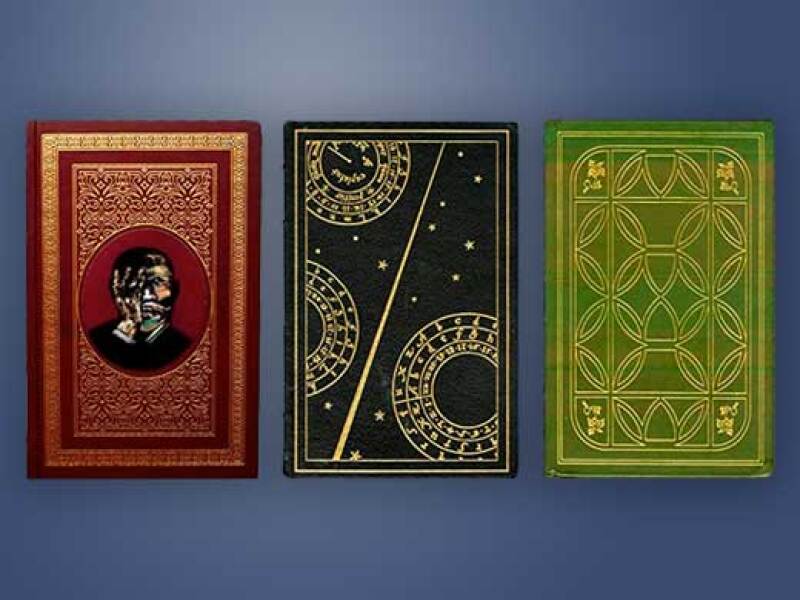
PUGIN, Augustus Charles. Gothic Furniture; consisting of twenty-seven coloured engravings, from designs by A. Pugin. London. R. Ackerman. c.1828.
The first separate publication of the designs for Gothic style furniture supplied by the elder Pugin to Ackermann's Repository, where they had appeared between 1 June 1825 and 1 Oct 1827. Includes a Gothic sofa, whist-table, window curtains and 'an horizontal grand piano-forte'. Many of the designs are probably drawn by A. W. Pugin, who, although very young, was already working on the Windsor Castle furniture [Belcher, Pugin: An Annotated Bibliography, 1987].

Small 4to. Engraved title frontispiece, letterpress title, & Preface (1 leaf). pp. 26 text. Complete with 27 aquatint plates (each with imprint of Ackermann; plate numbers refer to the Repository of Arts, from where these plates are taken). Each engraving is accompanied by descriptive text. Original embossed cloth, gilt title to front board. Spine slightly faded, otherwise a very fine copy.

Details