
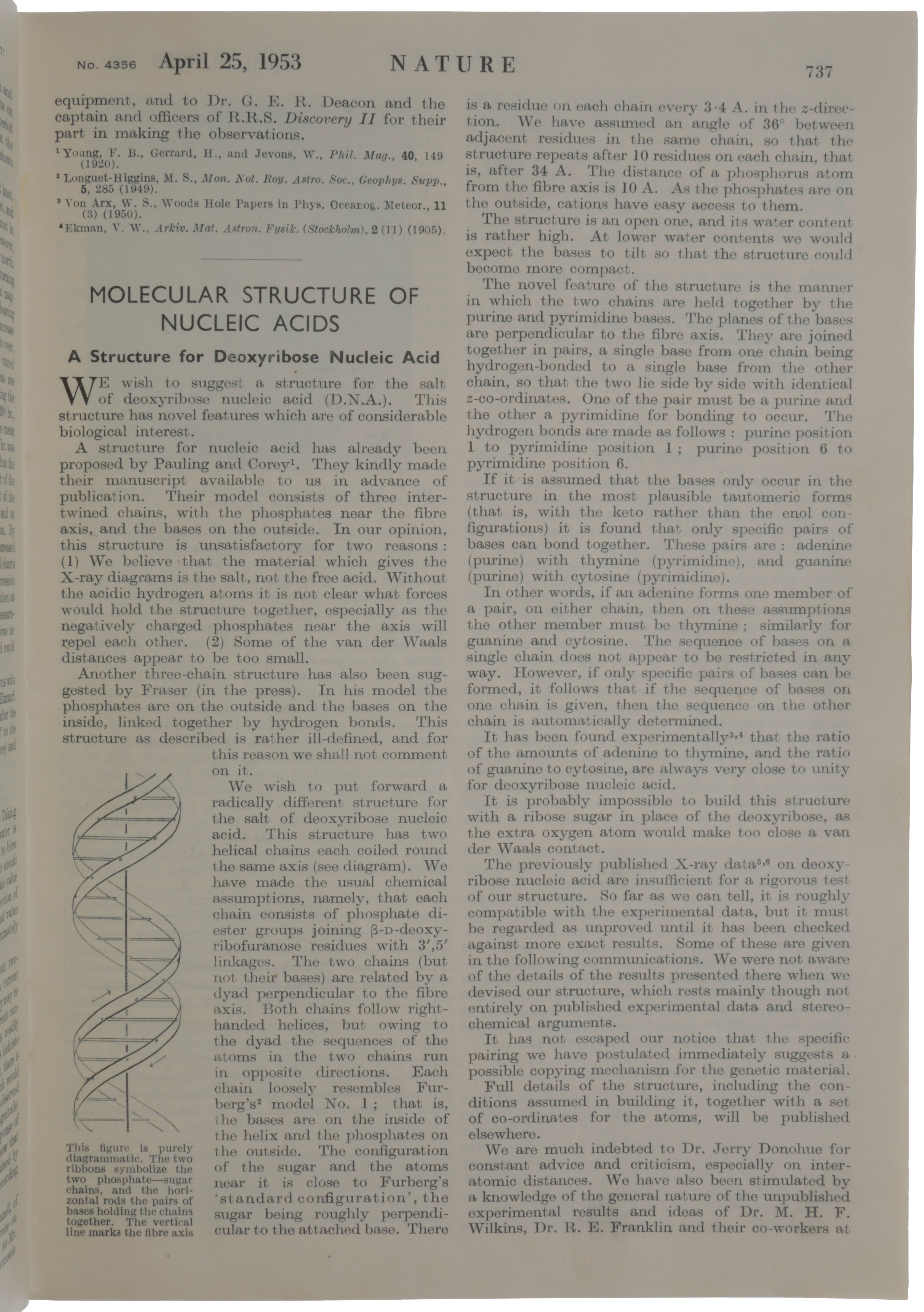


'Molecular Structure of Nucleic Acids: A Structure for Deoxyribose Nucleic Acid,' pp. 737-738; WILKINS, M. H. F., STOKES, A. R. & WILSON, H. R. 'Molecular Structure of Deoxypentose Nucleic Acids,' pp. 738-740; FRANKLIN, R. E. & GOSLING, R. G. 'Molecular Configuration in Sodium Thymonucleate,' pp. 740-741. Three papers in: Nature, Vol. 171, No. 4356, April 25, 1953
WATSON, J. D. & CRICK, F. H. C.
Verlag: Macmillan, London, 1953
Gebraucht
Verkäufer
SOPHIA RARE BOOKS, Koebenhavn V, Dänemark
Verkäuferbewertung 5 von 5 Sternen

AbeBooks-Verkäufer seit 18. Januar 2013
Dieses Buch ist nicht mehr verfügbar. AbeBooks führt Millionen von Büchern. Bitte geben Sie unten Suchbegriffe ein, um ähnliche Exemplare zu finden.
Beschreibung
Beschreibung:
ONE OF THE MOST IMPORTANT SCIENTIFIC DISCOVERIES OF THE 20TH CENTURY. First edition, in the form in which it first appeared, of one of the most important scientific papers of the twentieth century, which "records the discovery of the molecular structure of deoxyribonucleic acid (DNA), the main component of chromosomes and the material that transfers genetic characteristics in all life forms. Publication of this paper initiated the science of molecular biology. Forty years after Watson and Crick's discovery, so much of the basic understanding of medicine and disease has advanced to the molecular level that their paper may be considered the most significant single contribution to biology and medicine in the twentieth century" (One Hundred Books Famous in Medicine, p. 362). The paper ended with one of the most famous understatements in the history of science: "It has not escaped our notice that the specific pairing we have postulated immediately suggests a possible copying mechanism for the genetic material." The double helix describing the molecular structure of DNA has not only reshaped biology, it has become a cultural icon, represented in sculpture, visual art, jewellery, and toys. In 1962, Watson, Crick, and Wilkins shared the Nobel Prize in Physiology or Medicine "for their discoveries concerning the molecular structure of nucleic acids and its significance for information transfer in living material" (Franklin had died in 1958 and so was not eligible for the prize). This journal issue is actually much rarer at auction than the offprint. DNA was first isolated by the Swiss physician Friedrich Miescher in 1869, and over the succeeding years many researchers investigated its structure and function, with some arguing that it may be involved in genetic inheritance. In 1944 Oswald Avery, Maclyn McCarty, and Colin MacLeod published a paper showing how genes are composed of DNA, and Erwin Chargaff would observe that DNA contained equal amounts of adenine to thymine and of cytosine to guanine. But no one knew what it looked like or how it was copied. By the early 1950s this had become one of the most important questions in biology. After moving to King's College, London in 1947, Maurice Wilkins began research on the structure of DNA. In January 1951, Rosalind Franklin also moved to King's. Both worked on the structure of nucleic acids, but they clashed and one could not abide the other. Also working in King's were Alec Stokes and Bruce Fraser. By July 1951, Stokes had convincing mathematical evidence that DNA had a helical structure. In November 1951, Fraser built a model that turned out to have all the key elements correct-a helical shape, phosphates on the outside, and stacked bases separated by a distance of 3.4 angstroms-except for the number of chains. This research was completed before Watson began working with Crick. But neither Stokes nor Fraser published their findings. Having no one to talk to about his work, Wilkins discussed his frustrations-and research findings-with an old friend, Francis Crick, working at Cambridge University. Crick had a junior collaborator, James Watson, and the two had a warm and buoyant relationship in contrast to the antipathy between Franklin and Wilkins. Crick and Watson began their own investigation at the Cavendish Laboratory in Cambridge, in 1952, focusing on building molecular models. After one failed attempt in which they postulated a triple-helix structure, they were banned by the Cavendish from spending any additional time on the subject. On January 30, 1953, Watson visited King's. Without Franklin's permission, Wilkins showed her data to Watson-in particular, an X-ray crystallograph (of May 1952), the famous 'Photo 51' (which is reproduced in the third paper), that provided unquestionable evidence of the helical structure of DNA. The photograph struck Watson with the force of revelation. He sketched the pattern on the margin of his newspaper, and brought it back to Crick. Within four w. Bestandsnummer des Verkäufers 5049
Bibliografische Details
Titel: 'Molecular Structure of Nucleic Acids: A ...
Verlag: Macmillan, London
Erscheinungsdatum: 1953
Auflage: First edition.
ZVAB ist ein Internet-Marktplatz für neue, gebrauchte, antiquarische und vergriffene Bücher. Bei uns finden Sie Tausende professioneller Buchhändler weltweit und Millionen Bücher. Einkaufen beim ZVAB ist einfach und zu 100% sicher — Suchen Sie nach Ihrem Buch, erwerben Sie es über unsere sichere Kaufabwicklung und erhalten Sie Ihr Buch direkt vom Händler.
Millionen neuer und gebrauchter Bücher bei tausenden Anbietern
Antiquarische Bücher

Von seltenen Erstausgaben bis hin zu begehrten signierten Ausgaben – beim ZVAB finden Sie eine große Anzahl seltener, wertvoller Bücher und Sammlerstücke.
Erstausgaben
Erstausgaben sind besondere Bücher, die den ersten Abdruck des Textes in seiner ursprünglichen Form darstellen. Hier finden sie Erstausgaben von damals bis heute.
Gebrauchte Bücher

Ob Bestseller oder Klassiker, das ZVAB bietet Ihnen eine breite Auswahl an gebrauchten Büchern: Stöbern Sie in unseren Rubriken und entdecken Sie ein Buch-Schnäppchen.