
Gesamtpreis (1 Artikel Artikel):
Versandziel:

machine learning knowledge acquisition (17 Ergebnisse)
Direkt zu den wichtigsten Suchergebnissen
Suchfilter
Produktart
- Alle Product Types
- Bücher (17)
- Magazine & Zeitschriften (Keine weiteren Ergebnisse entsprechen dieser Verfeinerung)
- Comics (Keine weiteren Ergebnisse entsprechen dieser Verfeinerung)
- Noten (Keine weiteren Ergebnisse entsprechen dieser Verfeinerung)
- Kunst, Grafik & Poster (Keine weiteren Ergebnisse entsprechen dieser Verfeinerung)
- Fotografien (Keine weiteren Ergebnisse entsprechen dieser Verfeinerung)
- Karten (Keine weiteren Ergebnisse entsprechen dieser Verfeinerung)
- Manuskripte & Papierantiquitäten (Keine weiteren Ergebnisse entsprechen dieser Verfeinerung)
Zustand Mehr dazu
Einband
Weitere Eigenschaften
- Erstausgabe (1)
- Signiert (Keine weiteren Ergebnisse entsprechen dieser Verfeinerung)
- Schutzumschlag (Keine weiteren Ergebnisse entsprechen dieser Verfeinerung)
- Angebotsfoto (6)
Sprache (2)
Gratisversand
- Kostenloser Versand nach USA (Keine weiteren Ergebnisse entsprechen dieser Verfeinerung)
Land des Verkäufers
Verkäuferbewertung
-

Foundations of Knowledge Acquisition: Machine Learning
Buch 74 von 260: The Springer International Series in Engineering and Computer ScienceSprache: Englisch
Verlag: Kluwer Academic Pub, Norwell, Massachusetts, U.S.A., 1993
ISBN 10: 0792392787 ISBN 13: 9780792392781
Anbieter: Doss-Haus Books, Redondo Beach, CA, USA
Verkäuferbewertung 5 von 5 Sternen

Hardcover. Zustand: Good+. Hardcover 1993 edition. Ex-library book with stamps and labels attached. Binding firm. Pages unmarked and clean. Covers show minor wear to corners and edges. Text in good plus condition. {334 pages}.
-

Machine Learning and Knowledge Acquisition: Integrated Approaches (Knowledge-Based Systems Book Series)
Anbieter: Anybook.com, Lincoln, Vereinigtes Königreich
Verkäuferbewertung 5 von 5 Sternen
EUR 2,97
EUR 15,45 Versand
Versand von Vereinigtes Königreich nach USAAnzahl: 1 verfügbar
In den WarenkorbZustand: Poor. This is an ex-library book and may have the usual library/used-book markings inside.This book has soft covers. In poor condition, suitable as a reading copy. No dust jacket. Please note the Image in this listing is a stock photo and may not match the covers of the actual item,700grams, ISBN:9780126851205.
-
Machine Learning and Knowledge Acquisition: Integrated Approaches
Anbieter: Anybook.com, Lincoln, Vereinigtes Königreich
Verkäuferbewertung 5 von 5 Sternen
EUR 2,97
EUR 15,45 Versand
Versand von Vereinigtes Königreich nach USAAnzahl: 1 verfügbar
In den WarenkorbZustand: Good. This is an ex-library book and may have the usual library/used-book markings inside.This book has hardback covers. In good all round condition. No dust jacket. Please note the Image in this listing is a stock photo and may not match the covers of the actual item,700grams, ISBN:9780126851205.
-
Machine Learning and Knowledge Acquisition: Integrated Approaches
Anbieter: Anybook.com, Lincoln, Vereinigtes Königreich
Verkäuferbewertung 5 von 5 Sternen
EUR 2,97
EUR 15,45 Versand
Versand von Vereinigtes Königreich nach USAAnzahl: 1 verfügbar
In den WarenkorbZustand: Good. This is an ex-library book and may have the usual library/used-book markings inside.This book has hardback covers. In good all round condition. No dust jacket. Please note the Image in this listing is a stock photo and may not match the covers of the actual item,700grams, ISBN:9780126851205.
-

Knowledge Acquisition and Machine Learning: Theory, Methods and Applications
Anbieter: Anybook.com, Lincoln, Vereinigtes Königreich
Verkäuferbewertung 5 von 5 Sternen
EUR 4,05
EUR 15,45 Versand
Versand von Vereinigtes Königreich nach USAAnzahl: 1 verfügbar
In den WarenkorbZustand: Fair. This is an ex-library book and may have the usual library/used-book markings inside.This book has hardback covers. With usual stamps and markings, In fair condition, suitable as a study copy. Please note the Image in this listing is a stock photo and may not match the covers of the actual item,700grams, ISBN:9780125062305.
-

Applying a MacHine Learning Algorithm in a Knowledge Acquisition ccenario. Bericht 276 Von Juni 1993 in Englischer Sprache.
Verlag: Universität Karlsruhe, karlsruhe, 1993
Anbieter: alt-saarbrücker antiquariat g.w.melling, Saarbrücken, Deutschland
Verkäuferbewertung 4 von 5 Sternen

Erstausgabe
Hardcover. Zustand: Sehr gut. 1. auflage. oktav paberback. Sehr Gutes Exemplar. ungelesen, geklammerte broschur, etwas mit knickung ecken rechts, sonst noch sehr gut erhalten, 19 seiten mit einigen grafischen darstellungen im text. reihe: universität karlsruhe ( th ) institut für angewandte informatik und formale beschreibungsverfahren. hrsg. von h. schmeck, w. stucky und r. studer. format 21 x 14,8 cm. /D1121.
-
Zustand: Hervorragend. Zustand: Hervorragend | Seiten: 334 | Sprache: Englisch | Produktart: Bücher | One of the most intriguing questions about the new computer technology that has appeared over the past few decades is whether we humans will ever be able to make computers learn. As is painfully obvious to even the most casual computer user, most current computers do not. Yet if we could devise learning techniques that enable computers to routinely improve their performance through experience, the impact would be enormous. The result would be an explosion of new computer applications that would suddenly become economically feasible (e. g. , personalized computer assistants that automatically tune themselves to the needs of individual users), and a dramatic improvement in the quality of current computer applications (e. g. , imagine an airline scheduling program that improves its scheduling method based on analyzing past delays). And while the potential economic impact of successful learning methods is sufficient reason to invest in research into machine learning, there is a second significant reason: studying machine learning helps us understand our own human learning abilities and disabilities, leading to the possibility of improved methods in education. While many open questions remain about the methods by which machines and humans might learn, significant progress has been made.
-
Zustand: Sehr gut. Zustand: Sehr gut | Seiten: 334 | Sprache: Englisch | Produktart: Bücher | One of the most intriguing questions about the new computer technology that has appeared over the past few decades is whether we humans will ever be able to make computers learn. As is painfully obvious to even the most casual computer user, most current computers do not. Yet if we could devise learning techniques that enable computers to routinely improve their performance through experience, the impact would be enormous. The result would be an explosion of new computer applications that would suddenly become economically feasible (e. g. , personalized computer assistants that automatically tune themselves to the needs of individual users), and a dramatic improvement in the quality of current computer applications (e. g. , imagine an airline scheduling program that improves its scheduling method based on analyzing past delays). And while the potential economic impact of successful learning methods is sufficient reason to invest in research into machine learning, there is a second significant reason: studying machine learning helps us understand our own human learning abilities and disabilities, leading to the possibility of improved methods in education. While many open questions remain about the methods by which machines and humans might learn, significant progress has been made.
-
Machine Learning and Knowledge Acquisition
Anbieter: Majestic Books, Hounslow, Vereinigtes Königreich
Verkäuferbewertung 4 von 5 Sternen
EUR 72,57
EUR 7,49 Versand
Versand von Vereinigtes Königreich nach USAAnzahl: 1 verfügbar
In den WarenkorbZustand: New. pp. 325.
-

EUR 124,02
EUR 48,99 Versand
Versand von Deutschland nach USAAnzahl: Mehr als 20 verfügbar
In den WarenkorbGebunden. Zustand: New. What follows is a sampler of work in knowledge acquisition. It comprises three technical papers and six guest editorials. The technical papers give an in-depth look at some of the important issues and current approaches in knowledge acquisition. The editori.
-

Knowledge Acquisition: Selected Research and Commentary : A Special Issue of Machine Learning on Knowledge Acquisition
Anbieter: AHA-BUCH GmbH, Einbeck, Deutschland
Verkäuferbewertung 5 von 5 Sternen
Taschenbuch. Zustand: Neu. Druck auf Anfrage Neuware - Printed after ordering - What follows is a sampler of work in knowledge acquisition. It comprises three technical papers and six guest editorials. The technical papers give an in-depth look at some of the important issues and current approaches in knowledge acquisition. The editorials were pro duced by authors who were basically invited to sound off. I've tried to group and order the contributions somewhat coherently. The following annotations emphasize the connections among the separate pieces. Buchanan's editorial starts on the theme of 'Can machine learning offer anything to expert systems ' He emphasizes the practical goals of knowledge acquisition and the challenge of aiming for them. Lenat's editorial briefly describes experience in the development of CYC that straddles both fields. He outlines a two-phase development that relies on an engineering approach early on and aims for a crossover to more automated techniques as the size of the knowledge base increases. Bareiss, Porter, and Murray give the first technical paper. It comes from a laboratory of machine learning researchers who have taken an interest in supporting the development of knowledge bases, with an emphasis on how development changes with the growth of the knowledge base. The paper describes two systems. The first, Protos, adjusts the training it expects and the assistance it provides as its knowledge grows. The second, KI, is a system that helps integrate knowledge into an already very large knowledge base.
-
Zustand: Sehr gut. Zustand: Sehr gut | Seiten: 305 | Sprache: Englisch | Produktart: Bücher | Keine Beschreibung verfügbar.
-

Knowledge Acquisition: Selected Research and Commentary : A Special Issue of Machine Learning on Knowledge Acquisition
Anbieter: AHA-BUCH GmbH, Einbeck, Deutschland
Verkäuferbewertung 5 von 5 Sternen
Buch. Zustand: Neu. Neuware - What follows is a sampler of work in knowledge acquisition. It comprises three technical papers and six guest editorials. The technical papers give an in-depth look at some of the important issues and current approaches in knowledge acquisition. The editorials were pro duced by authors who were basically invited to sound off. I've tried to group and order the contributions somewhat coherently. The following annotations emphasize the connections among the separate pieces. Buchanan's editorial starts on the theme of 'Can machine learning offer anything to expert systems ' He emphasizes the practical goals of knowledge acquisition and the challenge of aiming for them. Lenat's editorial briefly describes experience in the development of CYC that straddles both fields. He outlines a two-phase development that relies on an engineering approach early on and aims for a crossover to more automated techniques as the size of the knowledge base increases. Bareiss, Porter, and Murray give the first technical paper. It comes from a laboratory of machine learning researchers who have taken an interest in supporting the development of knowledge bases, with an emphasis on how development changes with the growth of the knowledge base. The paper describes two systems. The first, Protos, adjusts the training it expects and the assistance it provides as its knowledge grows. The second, KI, is a system that helps integrate knowledge into an already very large knowledge base.
-
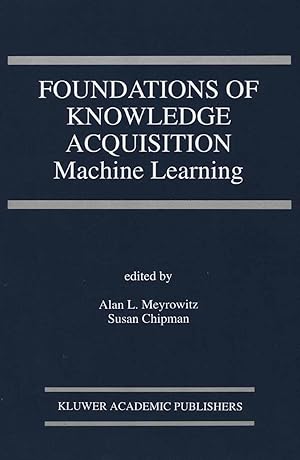
Foundations of Knowledge Acquisition: Machine Learning
Buch 74 von 260: The Springer International Series in Engineering and Computer ScienceEUR 178,14
EUR 48,99 Versand
Versand von Deutschland nach USAAnzahl: Mehr als 20 verfügbar
In den WarenkorbGebunden. Zustand: New. One of the most intriguing questions about the new computer technology that has appeared over the past few decades is whether we humans will ever be able to make computers learn. As is painfully obvious to even the most casual computer user, most current co.
-

Foundations of Knowledge Acquisition : Machine Learning
Buch 74 von 260: The Springer International Series in Engineering and Computer ScienceAnbieter: AHA-BUCH GmbH, Einbeck, Deutschland
Verkäuferbewertung 5 von 5 Sternen
Taschenbuch. Zustand: Neu. Druck auf Anfrage Neuware - Printed after ordering - One of the most intriguing questions about the new computer technology that has appeared over the past few decades is whether we humans will ever be able to make computers learn. As is painfully obvious to even the most casual computer user, most current computers do not. Yet if we could devise learning techniques that enable computers to routinely improve their performance through experience, the impact would be enormous. The result would be an explosion of new computer applications that would suddenly become economically feasible (e. g. , personalized computer assistants that automatically tune themselves to the needs of individual users), and a dramatic improvement in the quality of current computer applications (e. g. , imagine an airline scheduling program that improves its scheduling method based on analyzing past delays). And while the potential economic impact of successful learning methods is sufficient reason to invest in research into machine learning, there is a second significant reason: studying machine learning helps us understand our own human learning abilities and disabilities, leading to the possibility of improved methods in education. While many open questions remain about the methods by which machines and humans might learn, significant progress has been made.
-

Foundations of Knowledge Acquisition: Machine Learning (The Springer International Series in Engineering and Computer Science)
Buch 74 von 260: The Springer International Series in Engineering and Computer ScienceAnbieter: Revaluation Books, Exeter, Vereinigtes Königreich
Verkäuferbewertung 5 von 5 Sternen
EUR 233,81
EUR 11,53 Versand
Versand von Vereinigtes Königreich nach USAAnzahl: 2 verfügbar
In den WarenkorbPaperback. Zustand: Brand New. reprint edition. 345 pages. 9.26x6.11x0.80 inches. In Stock.
-

Foundations of Knowledge Acquisition : Machine Learning
Buch 74 von 260: The Springer International Series in Engineering and Computer ScienceAnbieter: AHA-BUCH GmbH, Einbeck, Deutschland
Verkäuferbewertung 5 von 5 Sternen
Buch. Zustand: Neu. Neuware - One of the most intriguing questions about the new computer technology that has appeared over the past few decades is whether we humans will ever be able to make computers learn. As is painfully obvious to even the most casual computer user, most current computers do not. Yet if we could devise learning techniques that enable computers to routinely improve their performance through experience, the impact would be enormous. The result would be an explosion of new computer applications that would suddenly become economically feasible (e. g. , personalized computer assistants that automatically tune themselves to the needs of individual users), and a dramatic improvement in the quality of current computer applications (e. g. , imagine an airline scheduling program that improves its scheduling method based on analyzing past delays). And while the potential economic impact of successful learning methods is sufficient reason to invest in research into machine learning, there is a second significant reason: studying machine learning helps us understand our own human learning abilities and disabilities, leading to the possibility of improved methods in education. While many open questions remain about the methods by which machines and humans might learn, significant progress has been made.


