

Gesamtpreis (1 Artikel Artikel):
Versandziel:

perion joachim (5 Ergebnisse)
Direkt zu den wichtigsten Suchergebnissen
Suchfilter
Produktart
- Alle Product Types
- Bücher (5)
- Magazine & Zeitschriften (Keine weiteren Ergebnisse entsprechen dieser Verfeinerung)
- Comics (Keine weiteren Ergebnisse entsprechen dieser Verfeinerung)
- Noten (Keine weiteren Ergebnisse entsprechen dieser Verfeinerung)
- Kunst, Grafik & Poster (Keine weiteren Ergebnisse entsprechen dieser Verfeinerung)
- Fotografien (Keine weiteren Ergebnisse entsprechen dieser Verfeinerung)
- Karten (Keine weiteren Ergebnisse entsprechen dieser Verfeinerung)
- Manuskripte & Papierantiquitäten (Keine weiteren Ergebnisse entsprechen dieser Verfeinerung)
Zustand Mehr dazu
- Neu (1)
- Wie Neu, Sehr Gut oder Gut Bis Sehr Gut (1)
- Gut oder Befriedigend (2)
- Ausreichend oder Schlecht (Keine weiteren Ergebnisse entsprechen dieser Verfeinerung)
- Wie beschrieben (1)
Einband
Weitere Eigenschaften
- Erstausgabe (1)
- Signiert (Keine weiteren Ergebnisse entsprechen dieser Verfeinerung)
- Schutzumschlag (Keine weiteren Ergebnisse entsprechen dieser Verfeinerung)
- Angebotsfoto (4)
Sprache (2)
Preis
- Beliebiger Preis
- Weniger als EUR 20 (Keine weiteren Ergebnisse entsprechen dieser Verfeinerung)
- EUR 20 bis EUR 45
- Mehr als EUR 45
Gratisversand
Land des Verkäufers
Verkäuferbewertung
-

EUR 39,48
EUR 48,99 Versand
Versand von Deutschland nach USAAnzahl: Mehr als 20 verfügbar
In den WarenkorbZustand: New. KlappentextJoachimi Perionii Benedictini Cormoeriaceni De Sanctorum Virorum, Qui Patriar Chaeab Ecclesia Appellantur (1555) est liber qui de vita et virtutibus Sanctorum Virorum, qui Patriarchae Ecclesiae appellantur, tractat. Auctor, Jo.
-
A Sammelband: The Sack of Rome in its historical context -- De Monarchia Gallorum campi aurei. . . -- De Monarchia ac Triplici Imperio. . . -- Romanorum et Græcorum magistratibus libri tres. . . -- Historia Expugnatæ et direptæ urbis Romæ per exercitum Caroli V. Imp. . .
Verlag: Melchior and Gaspard Trechsel et al., Lyon, 1537
Erstausgabe
Hardcover. Zustand: Very good. First. FROM THE DISTINGUISHED LIBRARY OF THE FRÈRES SAINTE-MARTHE. Quarto (8 ¾" x 6 5/16", 220mm x 160mm). [Full collation available.] Bound in XVIIc stab-bound vellum over boards. Titles and authors ink manuscript to spine. Some darkening to the spine. Shelf-label affixed to the front cover (partially obliterated). Printer's device and lower-edge of the title-page of no. 2 (A1) excised and restored. Marginal damp-stain to the margins of the first two works. A little tanning, and very occasional mild foxing. Ownership signatures of Louis and Scévole de Sainte-Marthe (known as the frères Sainte-Marthe) -- "De Sainte Marthe" flanking the printer's device, "Ex Bibliotheca Fratrum Sammarthanorum" at the lower edge -- of the title-page of nos. 1 and 4 (and doubtless excised from no. 2). Engraved armorial bookplate of Sainte-Marthe to the front paste-down. The sack of Rome, initiated on 6 May 1527, was one of the most consequential events in modern European history. The army of Charles V, Holy Roman Emperor (a Catholic), had a great many Lutheran soldiers. Charles had run short of funds, and the unpaid soldiers mutinied and formed a detachment under the Duke of Bourbon, forcing him to lead them to the walls of Rome and to pursue the heart of the Catholic Church. For a month they ransacked and pillaged the city till at last Pope Clement VII -- born Giulio de' Medici -- surrendered, succumbing to a great many of the demands of Charles, who disavowed any role in the sack. The consolidation of power in a single figure, ruling over more of Europe than any man since the fall of the Western Roman Empire in 476, signalled a new phase in the European Renaissance. Gathering together four works written over 100 years (the earliest just ten years after the sack), the volume explains the "triplex imperium" -- the tripartite Holy Roman Empire, comprising the Roman, French (Frankish) and German territories -- that was flourishing in the XVIc and XVIIc. Symphorien Champier (1471-1539) is best known as a medical writer, but in his later years he wrote nationalist accounts of the role of France vis à vis the Holy Roman Empire. Joachim Périon (1499-1559) was a French humanist who "de-medievalized" classical texts, and was one of the pivotal philologists of the Renaissance. Published the year after his death, this study of the magistracies of Greece and Rome was edited by his nephew François, having been found among his papers. The treatise was dedicated to Odet de Coligny, known as the Cardinal de Châtillon, but the epistle dedicatory is addressed to Scévole de Sainte-Marthe. This is the father (1536-1623) of the owners of the Sammelband: a distinguished poet, humanist and financier to Henry III and IV. Was this the copy of the dedicatee, inherited by his sons? César Grolier (ca. 1510-ca. 1595) was the son of the incomparable bibliophile Jean Grolier, and went to make his name in the Roman Curia. Only 17, César witnessed first-hand the destruction of Rome, and, his father's son, lamented the damage done to the Vatican library in particular. The work --published here for the first time, 110 years after its authorship -- is in the form of a letter to his father. It is intensely vivid and personal, although its Latinity is perhaps indicative of his tender age. Louis (1571-1656) and Scévole (II, 1571-1650) were twin brothers. Humanists, poets, historians, they were named jointly as historians to the king. From 1626 to their deaths they worked on the massive Gallia Christiana, cataloguing the dioceses, abbeys and personnel of the church in France from the introduction of Christianity; the volumes began to appear in 1715, and the project was not completed until well into the XIXc. The works collected (doubtless by the Sammarthani, as the ink ownership inscription to item 4 has offset onto the final leaf of item 3) must have been of great use in the preparation of this massive work. Brunet, I.1769 (Champier), II.1761 (Grolier).
-
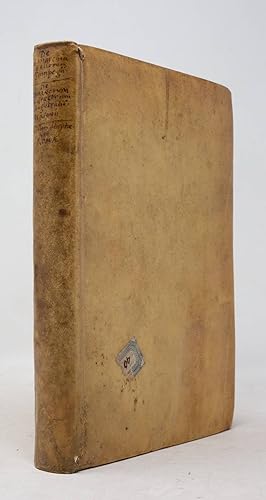
De Optimo genere interpretandi, in Aristotelis X. libros Ethicorum, siue de Moribus, à se latinitate donatos, Commentarij In quibus & de optima imitandi ratione, & de conuertendis coniugendisq[ue] Graecis cum Latinis praecepta traduntur, ad utriusque linguae proprietatem & copiam
Verlag: Robert Winter, 1542
Anbieter: Chaco 4ever Books, Montevideo, MO, Uruguay
Verkäuferbewertung 5 von 5 Sternen

Encuadernación de tapa dura. Zustand: Muy bien. 8vo, (12), 447, (40), pp, Engraved head piece.Bound in full contemporary vellum, inked on spine. A rare copy in good condition. In the summer of 1540, a Latin translation of the Nicomachean Ethics of Aristotle by the French Benedictine, theologian and philologist Joachim Périon appeared in Paris (Cormery in Touraine 1499 - Abbey Cormery 1559), also intended as a model for translations of Greek philosophy into Latin, which is why Périon has given the work a lengthy essay on the best way of translating and translating Cicero and other Romans. The work is divided into four parts: the translation of the ten books of ethics, the comment Périon's with, preceded by a brief second dedication, the treatise on translation, the fragments of the Timaeus translation Cicero and, also "eregione", i. printed synoptically with the Greek text of the Sphaira, the fragments of the Aratübersetzungen Cicero, Vergils and Germanicus, again with a short comment Périon's. The work is immediately reprinted in Basel in 1542 by Robert Winter, whereby the title of the second part has been slightly misleadingly modified.
-

B. Clementis Romani pontificis de rebus gestis, peregrinationibus & predicationibus B. Petri Apostolorum principis Epitome, sive compendium.; Eiusdem Clementis Vita, sicut in Ecclesia catholica recitatur
Verlag: Guillaume Morel, Paris, 1555
Anbieter: Argosy Book Store, ABAA, ILAB, New York, NY, USA
Verkäuferbewertung 5 von 5 Sternen
hardcover. Zustand: very good. First. [4], 128 pages. Decorated with a woodcut headpiece, floriated initials and Morel device on title (Renouard 786). Short slim 4to, old vellum over paper boards (front outer joint cracked but still firmly sewn; internally clean). Paris: Guillaume Morel, 1555. First latin edition. Overall a very good copy. First edition of the Latin translation by Joachim Perion (1499-1559) of this 2nd century revision of the most important component of Clementine literature: the recounting of how Clementine became travelling companion of St. Peter, synopses of the later's discourses and some biographical information on Clement's own life and family history. Although from its earliest circulation many of the stories were regarded as heretical, they enjoyed considerable authority and in the present form, expunged of their controversial aspects as the apostolic church evolved, were wholly accepted into the corpus of Christian historical writings. OCLC lists 20 copies including those at Yale, Cambridge, Oxford & The British Library. -- Adams C2122; Shaaber C501; Cioranescu 17411.
-

Conciones Et Orationes Ex Historicis Latinis Excerptae. Argumenta Singulis Praefixa Sunt, Quae Causam Cujusque & Summam Ex Rei Gestae Occasione Explicant. Opus Recognitum Recensitumque in Usum Scholarum Hollandiae & Westfrisiae / Ex Decreto Illustriss. D
Verlag: Amstelodami : Apud Ludovicum Elzevirium, 1652
1st Edition in this form. Very good copy in contemporary vellum. Minor, generalized wear to the bands and panel edges. Remains uncommonly well-preserved overall; tight, bright, clean and strong; 8vo 8" - 9" tall; 420 pages; Physical desc. : [12], 420, [12] p ; 12o. With an additional engraved titlepage misdated 1653. Revised edition of 16th century collections selected by J. Perion and H. Estienne. Cf. Ad lectorem, prelim. P. [5]. Subject: Latin language - Readers - Early works to 1800. Speeches, addresses, etc. , Latin. Latin literature 3 Kg.

![Bild des Verkäufers für De Optimo genere interpretandi, in Aristotelis X. libros Ethicorum, siue de Moribus, à se latinitate donatos, Commentarij In quibus & de optima imitandi ratione, & de conuertendis coniugendisq[ue] Graecis cum Latinis praecepta traduntur, ad utriusque linguae proprietatem & copiam zum Verkauf von Chaco 4ever Books](https://pictures.abebooks.com/inventory/md/md30007717976.jpg)
