
Krupnik baruch (22 Ergebnisse)

Verlag: Buchhandlung Rubin Mass, Berlin, 1932
- Hardcover
Anbieter: Henry Hollander, Bookseller, Los Angeles, CA, USAHenry Hollander, Bookseller
Verkäufer/-in kontaktierenVerkäufer/-in mit 4 SternenZustand: Gebraucht - Gut
EUR 13,60
EUR 6,18 VersandVersand innerhalb von USAAnzahl: 1 verfügbar
In den WarenkorbHardbound. Zustand: Very Good. Octavo, small mustard cloth with blue lettering, 36, 36 pp. A dictionary of Hebrew idioms. Text is in German and Hebrew.

- Softcover
Anbieter: PBShop.store US, Wood Dale, IL, USAPBShop.store US
Verkäufer/-in kontaktierenVerkäufer/-in mit 5 SternenZustand: Neu
EUR 34,66
Versand gratisVersand innerhalb von USAAnzahl: Mehr als 20 verfügbar
PAP. Zustand: New. New Book. Shipped from UK. Established seller since 2000.
- Softcover
Anbieter: PBShop.store UK, Fairford, GLOS, Vereinigtes KönigreichPBShop.store UK
Verkäufer/-in kontaktierenVerkäufer/-in mit 5 SternenZustand: Neu
EUR 30,59
EUR 5,88 VersandVersand von Vereinigtes Königreich nach USAAnzahl: Mehr als 20 verfügbar
PAP. Zustand: New. New Book. Shipped from UK. Established seller since 2000.

- Hardcover
Anbieter: Books From California, Simi Valley, CA, USABooks From California
Verkäufer/-in kontaktierenVerkäufer/-in mit 4 SternenZustand: Gebraucht - Gut
EUR 39,60
EUR 4,41 VersandVersand innerhalb von USAAnzahl: 3 verfügbar
hardcover. Zustand: Very Good.

- Hardcover
Anbieter: PBShop.store US, Wood Dale, IL, USAPBShop.store US
Verkäufer/-in kontaktierenVerkäufer/-in mit 5 SternenZustand: Neu
EUR 44,89
Versand gratisVersand innerhalb von USAAnzahl: Mehr als 20 verfügbar
HRD. Zustand: New. New Book. Shipped from UK. Established seller since 2000.
- Hardcover
Anbieter: PBShop.store UK, Fairford, GLOS, Vereinigtes KönigreichPBShop.store UK
Verkäufer/-in kontaktierenVerkäufer/-in mit 5 SternenZustand: Neu
EUR 39,42
EUR 6,87 VersandVersand von Vereinigtes Königreich nach USAAnzahl: Mehr als 20 verfügbar
HRD. Zustand: New. New Book. Shipped from UK. Established seller since 2000.
- Hardcover
Anbieter: PBShop.store US, Wood Dale, IL, USAPBShop.store US
Verkäufer/-in kontaktierenVerkäufer/-in mit 5 SternenZustand: Neu
EUR 66,28
Versand gratisVersand innerhalb von USAAnzahl: 1 verfügbar
HRD. Zustand: New. New Book. Shipped from UK. Established seller since 2000.
- Hardcover
Anbieter: PBShop.store UK, Fairford, GLOS, Vereinigtes KönigreichPBShop.store UK
Verkäufer/-in kontaktierenVerkäufer/-in mit 5 SternenZustand: Neu
EUR 57,98
EUR 8,94 VersandVersand von Vereinigtes Königreich nach USAAnzahl: 1 verfügbar
HRD. Zustand: New. New Book. Shipped from UK. Established seller since 2000.
Sprache: Englisch
Verlag: Shapiro Vallentine and Co., 1970
- Hardcover
Anbieter: Sifrey Sajet, STRASBOURG, FrankreichSifrey Sajet
Verkäufer/-in kontaktierenVerkäufer/-in mit 4 SternenZustand: Gebraucht - Sehr gut
EUR 45,00
EUR 30,00 VersandVersand von Frankreich nach USAAnzahl: 1 verfügbar
In den WarenkorbHardcover. Zustand: Very good. With quotations from the sources. 2-volumes set.

- Softcover
Anbieter: AHA-BUCH GmbH, Einbeck, DeutschlandAHA-BUCH GmbH
Verkäufer/-in kontaktierenVerkäufer/-in mit 5 SternenZustand: Neu
EUR 42,10
EUR 35,00 VersandVersand von Deutschland nach USAAnzahl: 2 verfügbar
Taschenbuch. Zustand: Neu. Neuware - 'A dictionary of the Talmud, the Midrash and the Targum' is a monumental reference work designed to provide scholars and students with a comprehensive guide to the linguistic complexities of classical Jewish literature. This second volume continues the meticulous exploration of the Aramaic and Hebrew terms found throughout the Babylonian and Jerusalem Talmuds, the various Midrashic compilations, and the Targumim.Compiled by Baruch Krupnik, this dictionary serves as an essential bridge for understanding the nuances of Rabbinic thought, legal discourse, and biblical interpretation. Each entry offers deep insights into the etymology and usage of words that define centuries of Jewish intellectual and spiritual life. By providing clear definitions and contextual references, the work facilitates a more profound engagement with the primary sources of Jewish law and lore.This scholarly resource is invaluable for those researching Jewish history, theology, and linguistics. It remains a significant achievement in the field of Semitic philology, preserving the vocabulary necessary to unlock the treasures of the Oral Torah and its associated commentaries.This work has been selected by scholars as being culturally important, and is part of the knowledge base of civilization as we know it. This work was reproduced from the original artifact, and remains as true to the original work as possible. Therefore, you may see the original copyright references, library stamps (as most of these works have been housed in our most important libraries around the world), and other notations in the work.This work is in the public domain in the United States of America, and possibly other nations. Within the United States, you may freely copy and distribute this work, as no entity (individual or corporate) has a copyright on the body of the work.As a reproduction of a historical artifact, this work may contain missing or blurred pages, poor pictures, errant marks, etc. Scholars believe, and we concur, that this work is important enough to be preserved, reproduced, and made generally available to the public. We appreciate your support of the preservation process, and thank you for being an important part of keeping this knowledge alive and relevant.…
- Hardcover
Anbieter: Ria Christie Collections, Uxbridge, Vereinigtes KönigreichRia Christie Collections
Verkäufer/-in kontaktierenVerkäufer/-in mit 5 SternenZustand: Neu
EUR 64,43
EUR 17,50 VersandVersand von Vereinigtes Königreich nach USAAnzahl: Mehr als 20 verfügbar
Zustand: New. In English.
Verlag: Shapiro Vallentine London, 1927
- Hardcover
Anbieter: John Trotter Books, london, Vereinigtes KönigreichJohn Trotter Books
Verkäufer/-in kontaktierenVerkäufer/-in mit 5 SternenZustand: Gebraucht
EUR 30,15
EUR 22,84 VersandVersand von Vereinigtes Königreich nach USAAnzahl: 1 verfügbar
In den WarenkorbHardback. Good Condition.
The City of Zloczow (Zolochiv, Ukraine)
Karu (Krupnik), Baruch (Editor)/ Kolokoff Hopper, Rachel (Cover Art)/ Kuten, Moshe (Translator)
- Hardcover
Anbieter: Revaluation Books, Exeter, Vereinigtes KönigreichRevaluation Books
Verkäufer/-in kontaktierenVerkäufer/-in mit 5 SternenZustand: Neu
EUR 77,22
EUR 17,57 VersandVersand von Vereinigtes Königreich nach USAAnzahl: 2 verfügbar
Hardcover. Zustand: Brand New. 428 pages. 8.50x0.94x11.00 inches. In Stock.

- Hardcover
Anbieter: AHA-BUCH GmbH, Einbeck, DeutschlandAHA-BUCH GmbH
Verkäufer/-in kontaktierenVerkäufer/-in mit 5 SternenZustand: Neu
EUR 58,70
EUR 35,00 VersandVersand von Deutschland nach USAAnzahl: 2 verfügbar
Buch. Zustand: Neu. Neuware - 'A dictionary of the Talmud, the Midrash and the Targum' is a monumental reference work designed to provide scholars and students with a comprehensive guide to the linguistic complexities of classical Jewish literature. This second volume continues the meticulous exploration of the Aramaic and Hebrew terms found throughout the Babylonian and Jerusalem Talmuds, the various Midrashic compilations, and the Targumim.Compiled by Baruch Krupnik, this dictionary serves as an essential bridge for understanding the nuances of Rabbinic thought, legal discourse, and biblical interpretation. Each entry offers deep insights into the etymology and usage of words that define centuries of Jewish intellectual and spiritual life. By providing clear definitions and contextual references, the work facilitates a more profound engagement with the primary sources of Jewish law and lore.This scholarly resource is invaluable for those researching Jewish history, theology, and linguistics. It remains a significant achievement in the field of Semitic philology, preserving the vocabulary necessary to unlock the treasures of the Oral Torah and its associated commentaries.This work has been selected by scholars as being culturally important, and is part of the knowledge base of civilization as we know it. This work was reproduced from the original artifact, and remains as true to the original work as possible. Therefore, you may see the original copyright references, library stamps (as most of these works have been housed in our most important libraries around the world), and other notations in the work.This work is in the public domain in the United States of America, and possibly other nations. Within the United States, you may freely copy and distribute this work, as no entity (individual or corporate) has a copyright on the body of the work.As a reproduction of a historical artifact, this work may contain missing or blurred pages, poor pictures, errant marks, etc. Scholars believe, and we concur, that this work is important enough to be preserved, reproduced, and made generally available to the public. We appreciate your support of the preservation process, and thank you for being an important part of keeping this knowledge alive and relevant.…
Anbieter: Antiquariaat Spinoza, Amsterdam, NiederlandeAntiquariaat Spinoza
Verkäufer/-in kontaktierenVerkäufer/-in mit 5 SternenZustand: Gebraucht
EUR 16,80
EUR 16,00 VersandVersand von Niederlande nach USAAnzahl: 1 verfügbar
In den WarenkorbBerlin, Jüdischer Verlag, 1919. 31 pp. Yellowing paper. Frakturschrift. Orig. wraps. Lower corner slightly damaged.

- Hardcover
Anbieter: AHA-BUCH GmbH, Einbeck, DeutschlandAHA-BUCH GmbH
Verkäufer/-in kontaktierenVerkäufer/-in mit 5 SternenZustand: Neu
EUR 73,96
EUR 44,31 VersandVersand von Deutschland nach USAAnzahl: 1 verfügbar
Buch. Zustand: Neu. Neuware - This book describes the life of the people of Zloczew, the foundation of the town until after the tragedy. Life duringthe two World Wars has been particularly emphasized, for it was during these decades that Jewish life reached itssummit.Suddenly, at the outbreak of World War II, life stopped and one of the centres of the Diaspora was not more.Zloczew lies in the south-eastern part of Poland which is called Little Poland. A piece of land which, under theAustro-Hungarian Empire, was called Galicia. An agricultural level country partly covered with forests.The natural borders of the town were in the south, the hills of Vorniaky; in the north the Zloczowka river and inthe west and east, the town came together with neighbourhood villages.Four wooden bridges crossed the river and a railroad, about 2km from town, connected the place in the west withLwow and in the south-east with Tarnopol. A railroad-branch led northward to the city of Brody. Three paved roadsalso connected Zloczew with these cities.The town of Zloczew was surrounded by many villages: Vorniaky, Polorky, Bianiov, Zazola, Jalochoviczy, Chicic,Lacka and a chain of small towns: Bialokamin, Busk, Sasov, Olesko and Goligory.Zloczew was a part of the Tarnopol region. In it central institutions could be found which served the whole region:The Governor's offices; the Tribunal Court, Land Registry, Post, hospital and colleges. Since the town was near thefrontier, two regiments were stationed there.Corresponding with the municipal and governmental foundations, there were also Jewish ones which served theJewish inhabitants: the Communal Committee, rabbis, judges, hospitals, synagogues, schools and social relief.The town was known for its cleanliness and beautiful appearance. The houses were mostly of bricks and only inthe suburbs could wood or clay houses be seen.…
Verlag: Shapiro Vallentine London, 1927
- Hardcover
Anbieter: John Trotter Books, london, Vereinigtes KönigreichJohn Trotter Books
Verkäufer/-in kontaktierenVerkäufer/-in mit 5 SternenZustand: Gebraucht
EUR 54,28
EUR 22,84 VersandVersand von Vereinigtes Königreich nach USAAnzahl: 1 verfügbar
In den WarenkorbHardback's. 2 Vols. Scuffed, Good Condition.
Anbieter: Antiquariaat Spinoza, Amsterdam, NiederlandeAntiquariaat Spinoza
Verkäufer/-in kontaktierenVerkäufer/-in mit 5 SternenZustand: Gebraucht
EUR 28,80
EUR 16,00 VersandVersand von Niederlande nach USAAnzahl: 1 verfügbar
In den WarenkorbBerlin, Buchhandlung Rubin Mass, 1932. IV, 36, IV, 34 pp. Slight foxing. On the whole still a well preserved copy. Orig. cloth, slightly stained, wear to corners. Hebrew - German.
??????? : ??????? ?????? ?????????? ????????????. ??????? ???????? ????????? ?'-? = RIMON : A MAGAZINE OF ART AND LETTERS. VOLUME ONE, ISSUES 1-6
Wischnitzer, Mark, 1882-1955; Krupnik, Baruch; Wischnitzer, Rachel, 1885-1989 [editors]
Verlag: Jewish Art and Literature Publiching Company 1922-1924, Berlin, 1922
- Hardcover
- Magazin / Zeitschrift
Anbieter: Second Story Books, ABAA, Rockville, MD, USASecond Story Books, ABAA
Verkäufer/-in kontaktierenVerkäufer/-in mit 4 SternenZustand: Gebraucht
EUR 341,00
EUR 6,18 VersandVersand innerhalb von USAAnzahl: 1 verfügbar
In den WarenkorbHardcover. Quarto, variously paged. In Fair condition. Spine is cream without print. Boards quarter bound with cream cloth to spine and pink paper to boards; wear to spine caps and corners, blemishes, shelf wear. Text block has intermittent spine breaks. Illustrated: b&w and color. Text in Hebrew with added title pages in English. [Oversized book(s). Additional postage necessary for expedited/international orders. Economy International shipping unavailable due to size/weight restrictions. For international/expedited customers, please inquire for rates]. NOTE: Shelved in Locked Annex Area, Netdesk Column QB (ND-QB). 1411356. FP New Rockville Stock.…
Rimon Me'asef eti Ivri le-Omanut ule-Sifrut, Hoveret 1, 1922 - Hoveret 6, 1924/ Rimon: Zeitschrift für Kunst und Literatur, Heft 1, 1922 - Heft 6, 1924. Six Issues, complete.
Vishnitzer, M., editor [Wischnitzer, M.] and Krupnik, Baruch.
Verlag: Rimon Publishing Company 1922-1924, Berlin, London, 1922
- Hardcover
Anbieter: Henry Hollander, Bookseller, Los Angeles, CA, USAHenry Hollander, Bookseller
Verkäufer/-in kontaktierenVerkäufer/-in mit 4 SternenZustand: Gebraucht - Gut
EUR 409,20
EUR 6,18 VersandVersand innerhalb von USAAnzahl: 1 verfügbar
In den WarenkorbHardbound. Zustand: Very Good-. Quarto, soiled green cloth with faded gold spine lettering and with fraying at the spine ends, all original wraps bound in, 52, 48, 52, 52, 44, 40 pp., color plates, b/w illustrations, drawings and photos Text is in Yiddish. Literary Editors of the first issue are David Bergelson and Der Nister. Art Editor throughout is Rachel Vishnitzer. A later co-editors is M. Kleinmann. Articles in Number One are "Moderne Kunst und wir," Rachel Vishnitzer, "Cezanne und sein Werk," J. Meier=Graefe, "Lichter," W. Korolenko, "Stimmung. Gedicht," J. Kacenelson, "Gedichte," M. Goldenberg, "Georg Brandes," Dr. H. Bieber, "Biblische Erzählungen. äesthetisch analysiert, " Prof. E. Taeubler, L. Sew. Ein Nachruf," S. Posner, "Am Ufer der Desna. Erzählung," J. Steinberg, "Ethik und Aesthetik," M.J. Berdyczewski, "Abendwind. Gedicht," J. Fichmann, "Die Broschüre. Zu L. Pinsker's 100. Geburtstag," Z. Wojsalwski, "Der Untergang des Abendlandes," Dr. J. Kaufman, Im Banne. Gedichte," J. Koplowitz, "Korolenko," Dr. D.A. Freidmann. Articles in Number 2 are "On Mediaeval and Modern Art," F. Landsberger, "To the Daughter (Sonnets)," S. Ben-Zion, "The Modern Portrait," G. Marzynski, "The Lithograph, A Chapter from the History of Graphic Art," R. Inbar, "Max Liebermann. On the occasion of his 75th Anniversary," R. Vishnitzer, "On the Threshold. A Story," A. Feuerstein, "In the Dusk. A poem," Zuri=li, "The Mystery of Conversation. An Essay, M.A.Z.=K., "Walter Rathenau and his Teaching," Prof. A. Kulishcher, "The Origins of Jewish Mysticism," S.A. Horodetzki, "The Knight of our Literature," Z. Woislawski, "On Exaggeration in Journalism," M. Kleinmann, "Arthur Schnitzler. 60th Anniversary," H. Bieber, "Guide to the Mediaeval Illuminations." Article in Number 3 are "Wall Paintings in Synagogues of the 17th and 18th Centuries," E. Toeplitz, "The Synagogue of Mohilev, with illustrations," El. L[issitzky], "Jewish Artists in Russia, with reproductions of works by Chagall, Altman, Sterenberg and Lissitzki," Henryk Berlewi, "Habimah. The Hebrew Theatre in Moscow, with illustrations," A. Patkin, "The Magen David, with the reproduction of an amulat from the genizah," M. Gaster, "Reminiscences of the Late Hebrew Author S.J. Hurwitz, with a portrait," S. Dubnow, "Under the Spell of the Sun. A Poem" Avigdor Feuerstein, "On the Posthumous Work of Israel Wachser," Ch. N. Bialik, "Seven Days. A Fairy Tale," Israel Wachser, "Last Year. A Fairy Tale," Wachser, "The Orphan and the Widow. A Story," S.J. Agnon, "Bialik's Fiftieth Anniversary. A Tribute," M. Kleinman, "Bialik, The Master Poet. An Essay," Saul Tshernichovski, "Johann Reuchlin. On the Occasion of the 400th Anniversary of His Death," Dr. Simon Bernfeld, "On Taine's Philosophy of Art," Rachel Vishnitzer, "Art and Letters," R.V. Articles in Number 4 are "The Motive of the Porch in Book Ornamentation, with illustrations," Rachel Vishnitzer, "The Engraving. A Chapter from the History of Graphic Arts, with reproductions of works by Rembrandt, Jozef Israels, Max Liebermann, Hermann Struck, H. Glicenstein and Jacob Steinhardt," Hermann Struck, "An Amorite Version of the Deluge Story," Professor G. Selikovitz, "Hymnes of the Egyptian King Akhnaton and the Queen Nepher-Nephru-Aton, translated from the English Version in Breasted's Religion and Thought in Ancient Egypt," S. Tshernichovski, "Leonardo Da Vinci. A Biographical Study, with a portrait of Leonardo," Olga Pevsner-Schatz, "A Poem," Jacob Koplevitz, "Amor Dei Sentimentalis," Dr. R. Seligman, "From Max Nordau's Criticisms on Art," "Max Nordau as an Art Critic," Rachel Vishnitzer, "Asriel Moses. A Story," S. Agnin, "poems," Samuel Loites, "Simmel's Theory of Modern Civilization," M. Schwarz, "The Rotten Tree. A Legend," Rachel Feigenberg, "Art and Letter," R.V. and H.B. Articles in Number 5 are "David and Samcon Slaying the Lion, with illustrations," Rachel Vishnitzer, "Moslem Binding, with a coloured palte," "Early Jewish Ornamented and Gilded Glasses, with illustrations,".…
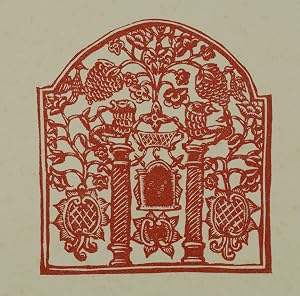 Weitere Bilder
RIMON. Zeitschrift Fur Kunst Und Literatur (A Magazine of Art and Letters) Volume 1, Issues 1-6 (Complete - all published)
Vischnitzer, Mark; Baruch Krupnik (eds.) Rachel Vischnitzer (art editor)
Verlag: Rimon-Verlag, Berlin, 1924
- Hardcover
- Erstausgabe
Anbieter: ERIC CHAIM KLINE, BOOKSELLER (ABAA ILAB), Santa Monica, CA, USAERIC CHAIM KLINE, BOOKSELLER (ABAA ILAB)
Verkäufer/-in kontaktierenVerkäufer/-in mit 4 SternenZustand: Gebraucht
EUR 909,33
EUR 4,41 VersandVersand innerhalb von USAAnzahl: 1 verfügbar
In den WarenkorbHardcover. Zustand: g+ to vg. First edition. Quarto. vii (i) 48, vi (ii) 48, (4) 48, (4) 48, (4) 40, (4) 40pp. Serial publication; all six issues bound here as one. Original gray cloth-backed red paper covered boards with elaborate gilt tooling and and lettering on spine, gilt decor on cover, protected by modern mylar. Red endpaper. Each issue with color-illustrated cover with black lettering. Red illustrated half-title page. Color illustrated frontispiece. Bimonthly first periodical devoted to the study of "Jewish art." Rimon # 1, 1922, with contribution by German classical scholar and historian Theodor Mommsen on "Judea and the Jews." Rimon # 3, 1923, with cover design and all reproductions of the wall paintings in the synagogue of Mohilev have been made from copies by El Lissitzki. Rimon # 4 with contribution by Hermann Struck on engraving. The content of the magazine includes the fields of art, literature, philosophy and religion. It is illustrated with color and b/w reproductions of artwork. Text in Hebrew, table of contents in English. Binding with light wear along edges, small chips at corners and these bumped extending into the block at top. Gilt decor on front cover slightly fading. Some discoloration along edges of back cover. Slightly starting at bottom of inside front cover. Bright text and images. Binding in overall good+, interior in very good condition. …
 Weitere Bilder
Rimon: A Hebrew Magazine of Art and Letters No. 1- No.6
Edited by Dr. M. Vishnitzer, M. Kleinman, and Baruch Krupnik; Art Editor Rachel Vishnitzer
Verlag: Rimon 1922-1924, Berlin, 1922
- Erstausgabe
Anbieter: William Chrisant & Sons, ABAA, ILAB. IOBA, ABA, Ephemera Society, Fort Lauderdale, FL, USAWilliam Chrisant & Sons, ABAA, ILAB. IOBA, ABA, Ephemera Society
Verkäufer/-in kontaktierenVerkäufer/-in mit 5 SternenZustand: Gebraucht - Gut
EUR 454,66
EUR 7,95 VersandVersand innerhalb von USAAnzahl: 1 verfügbar
In den WarenkorbZustand: Very Good. First Edition. All six issues bound as one. Hebrew text. Blue cloth with faded spine and original decorative wrappers bound in. Numerous colored and black/white plates. Occasional "Printed in Germany" stamp to botton. Wear to cloth on corners of binding. No. 1 missing prefatory pages. Occasional tape remnants. Issues are not bound chronologically, with the book beginning with No. 6, jumping to No. 2-No. 5, and then ending with No. 1. Page 1 of No. 1 loose. Table of contents in English. Overall a nice copy regarding the study of Jewish art. No. 6 [viii] 48 [iv] No. 5 [iv] 40 [iv] No. 4 [iv] 48 [iv] No. 3 [iv] 48 [iv] No. 2 [viii] 48 No. 1 40. E. Boehm (illustrator).…


