Gesamtpreis (1 Artikel Artikel):
Versandziel:

color printing (9 Ergebnisse)
Direkt zu den wichtigsten Suchergebnissen
Suchfilter
Produktart
- Alle Product Types
- Bücher (8)
- Magazine & Zeitschriften (Keine weiteren Ergebnisse entsprechen dieser Verfeinerung)
- Comics (Keine weiteren Ergebnisse entsprechen dieser Verfeinerung)
- Noten (Keine weiteren Ergebnisse entsprechen dieser Verfeinerung)
- Kunst, Grafik & Poster (1)
- Fotografien (Keine weiteren Ergebnisse entsprechen dieser Verfeinerung)
- Karten (Keine weiteren Ergebnisse entsprechen dieser Verfeinerung)
- Manuskripte & Papierantiquitäten (Keine weiteren Ergebnisse entsprechen dieser Verfeinerung)
Zustand Mehr dazu
- Neu (2)
- Wie Neu, Sehr Gut oder Gut Bis Sehr Gut (1)
- Gut oder Befriedigend (Keine weiteren Ergebnisse entsprechen dieser Verfeinerung)
- Ausreichend oder Schlecht (Keine weiteren Ergebnisse entsprechen dieser Verfeinerung)
- Wie beschrieben (6)
Einband
- alle Einbände
- Hardcover (3)
- Softcover (Keine weiteren Ergebnisse entsprechen dieser Verfeinerung)
Weitere Eigenschaften
- Erstausgabe (6)
- Signiert (Keine weiteren Ergebnisse entsprechen dieser Verfeinerung)
- Schutzumschlag (1)
- Angebotsfoto (7)
Sprache (2)
Gratisversand
- Kostenloser Versand nach USA (Keine weiteren Ergebnisse entsprechen dieser Verfeinerung)
Land des Verkäufers
Verkäuferbewertung
-

Terraces, Balconies, Roof Gardens & Patios
Anbieter: Majestic Books, Hounslow, Vereinigtes Königreich
Verkäuferbewertung 4 von 5 Sternen

EUR 23,38
EUR 7,52 Versand
Versand von Vereinigtes Königreich nach USAAnzahl: 1 verfügbar
In den WarenkorbZustand: New.
-

The Bar Sinister
Sprache: Englisch
Verlag: Charles Scribner's Sons, New York, 1903
Anbieter: Arroyo Seco Books, Pasadena, Member IOBA, Pasadena, CA, USA
Verbandsmitglied: IOBA
Verkäuferbewertung 4 von 5 Sternen
Erstausgabe
Hardcover. Zustand: Near Fine. First Separate Edition. 108 Pp. Tan Cloth, Lettering Gilt, Bar Sinister In Gilt, Top Edge Gilt. First Printing Of This First Separate Edition, With The Color Plates. A Tight Copy, Light Wear Without Any Fraying, All Gilt Brilliant, Near Fine Except Some Speckled Lightening Of Color Of Boards. Binding Tight. Small Printed Information About Previous Owner, Dr. Louis A. Rodenstein Of New York (1834-1915) On Preliminary Blank, With Gift Card From Mrs. James Paul O'shea.
-

Terraces, Balconies, Roof Gardens & Patios
Sprache: Englisch
Verlag: koenemann.com GmbH 08.2018., 2018
ISBN 10: 3741920452 ISBN 13: 9783741920455
Anbieter: buch & töne GmbH, München, BY, Deutschland
Verkäuferbewertung 4 von 5 Sternen
Kunst / Grafik / Poster
Zustand: Neu. 360 Seiten Neu. Ungelesen. Ein Rechnungsbeleg mit ausgew. MwSt. liegt der Lieferung bei. O_7.4 9783741920455 . Bei Mehrfachbestellungen bei uns, reduziert sich für Sie der Versandkostenanteil pro Titel. Sprache: Englisch Gewicht in Gramm: 794 gebundene Ausgabe, mit Original-Schutzumschlag.
-

Histoire Archéologique, Descriptive et Graphique
Verlag: Ve. A. Morel, Paris, 1875
Anbieter: James Cummins Bookseller, ABAA, New York, NY, USA
Verkäuferbewertung 5 von 5 Sternen

Erstausgabe
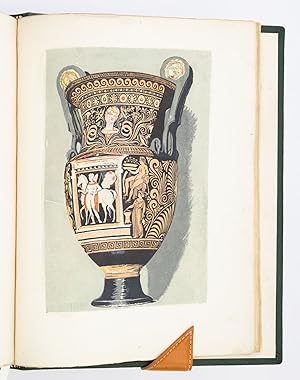
First edition. First edition. 20 chromolithographic plates, 5 uncolored architectural views. 1 vols. Folio. Very fine plates by Lemercier of Paris. Half red morocco. Some rubbing and chipping with head of spine missing, corners repaired with red cloth (not unattractive). 2 Photographs of Sainte Chapelle loosely inserted, paste marks to front free endpaper. Text and plates bright 20 chromolithographic plates, 5 uncolored architectural views. 1 vols. Folio.
-
GALATÉE, ROMAN PASTORAL; IMITÉ DE CERVANTES . . . ÉDITION ORNÉE DE FIGURES EN COULEURS, D'APRÈS LES DESSINS DE M. MONSIAU
Verlag: Defer de Maisonneuve, Paris, 1793
Anbieter: Phillip J. Pirages Rare Books (ABAA), McMinnville, OR, USA
Verkäuferbewertung 3 von 5 Sternen

Erstausgabe
First Edition with these Illustrations. 350 x 262 mm. (13 3/4 x 10 1/4"). 125 pp. VERY PRETTY 19TH CENTURY CRIMSON MOROCCO, ELEGANTLY GILT, covers framed with floral tools, raised bands, spine panels filled with rows of flower-and-lozenge roll, gilt lettering, gilt turn-ins, top edges gilt. FOUR FINE STIPPLE-ENGRAVED PLATES by Colibert and Cazenave after Monsiau, PRINTED IN COLORS. A Large Paper Copy. Cohen-de Ricci 400; Furstenberg 122; Lewine, p. 188; Maggs 1930 Catalogue of French Illustrated Books 84; Ray, p. 145. Occasional minor foxing (the margins of one plate foxed a bit more), otherwise a fine copy, clean and fresh internally with immense margins, the plates with pleasing colors, and the unworn binding bright with gilt. This is an especially tall copy of Florian's pastoral romance in imitation of Cervantes, one of the grander French books to be printed in colors when the vogue for such productions took hold during the last years of the 18th century. Ours is one of six such books, all printed after 1786, that Ray singles out for praise as "handsome and imposing volumes." A noted painter of both classical and modern subjects, Monsiau (1754-1837) was also an illustrator whose "abundant and interesting work in this line" is underrated, even though it has the merits of being simple, natural, lively, and piquant. (Ray) Monsiau's obscurity, says Ray, may be owing to the fact that he most often worked as a secondary collaborator on major illustrated works; the present book is one of the few he did on his own, and it is among his best. Publisher Defer de Maisonneuve did not originate the technique of stipple engraving on copper plates, but he did perfect the process, which allowed for gradual tonal changes in hues and intensities of color, rather than the "stained glass" effect of separately printed patches of color. Given the turmoil of the period when this book was published, it is quite likely that it did not have an especially decorative original binding, and may have remained in publisher's boards, as was often the case. Happily, a later owner supplied a period-appropriate binding here that matches the opulence of the contents. While our copy has the engraver's name just visible beneath the plates, perhaps disqualifying them as the "avant la lettre" versions used in the Large Paper Copies (per Cohen-de Ricci), the size of the margins here and the quality of the paper certainly argue for that designation.
-
TWO SYSTEMS OF ASTRONOMY: FIRST, THE NEWTONIAN SYSTEM . . . : SECOND, THE SYSTEM IN ACCORDANCE WITH THE HOLY SCRIPTURES
Verlag: [Printed by Catchpool & Trent for] Simpkin, Marshall, & Co, London, 1846
Anbieter: Phillip J. Pirages Rare Books (ABAA), McMinnville, OR, USA
Verkäuferbewertung 3 von 5 Sternen
Erstausgabe
FIRST EDITION. 320 x 255 mm. (12 1/2 x 10"). xiii, [3], 96 pp. Publisher's original blind-decorated dun-colored cloth, gilt titling to upper cover, smooth spine, newer endpapers. WITH 11 COLOR ENGRAVINGS after Frost by W. P. Chubb & Son, printed in oil colors by George Baxter, all with original tissue guards. Front free endpaper with small ink signature of John Hill. See: Francis Reid, "Isaac Frost's 'Two Systems of Astronomy' (1846): Plebeian Resistance and Scriptural Astronomy," in "The British Journal for the History of Science," Vol. 38, No. 2 (Jun., 2005), pp. 161-177. Cloth rather spotted, corners bumped, but the binding solid, with no wear to joints or hinges. A few spots of foxing to title page, half of the tissue guards with overall very faint foxing/browning, the illustrations with minor foxing at edges and in margins, but the images themselves clean and bright, and, all in all, a really excellent copy, the text wide-margined and quite clean and fresh, and the plates with rich coloring. Illustrated with beautiful color plates, this anti-Newtonian work promotes a view of the universe based on the backward-looking beliefs professed by a Protestant sect known as the Muggletonians. Named after co-founder Lodowicke Muggleton, the Muggletonians emerged in London in 1651 based on the claims of two tailors who professed to be the "Last Witnesses" described in the Book of Revelation. Rejecting the new directions in philosophical reason, Muggletonians believed in a purely scriptural interpretation of the universe. According to E. P. Thompson's 1994 "Witness Against the Beast," the Muggletonians had curious notions quite contrary to other Protestant denominations: they believed that the soul is mortal, that Jesus and God are one and the same, that Heaven was left without divine supervision from Jesus' death until the day of judgment, that Heaven resides six miles above the Earth, that God stands between five and six feet tall, and other unconventional things. Although the sect initially avoided both worship and evangelizing, during the 19th century some followers became more outspoken about their beliefs, and even published books appealing to the general public. Our author, Isaac Frost (1793-1858), was a prominent Muggletonian and successful owner of a brass foundry, who, along with his brother Joseph, invested large sums to promote their belief system--the present work being an especially notable example. Divided into two main sections, the text first describes the Newtonian system of heliocentric astronomy, and then turns to Frost's scriptural interpretation and geocentric views. As Reid tells us, "According to Frost, Scripture clearly states that the Sun, the Moon and the Stars are embedded in a firmament made of congealed water and revolve around the Earth, that Heaven has a physical reality above and beyond the stars, and that the planets and the Moon do not reflect the Sun's rays but are themselves independent sources of light. [Our] book was apparently written as a reaction against the lecturers who expressed Newtonian astronomy--which was often for them and their audiences, simply shorthand for heliocentrism." The 11 plates that illustrate these extraordinary ideas are the work of George Baxter, a pioneering printer who revolutionized color printing techniques by combining metal engravings with woodblock printing using oil-based inks to produce high-quality, affordable prints. The plates here are appropriately ethereal and otherworldly, utilizing a beautiful palette with subtle gradations and esoteric figures to create memorable pseudo-scientific imagery. Although this work appears at auction with some regularity, it is almost always incomplete, no doubt because the attractiveness of its plates encourages harvesting. Useful price comparisons include a complete copy (said to be in fine condition) selling for £7,500 in 2016, and six loose prints from the book fetching £6,875 in 2015.
-
PRACTICAL HINTS ON DECORATIVE PRINTING, WITH ILLUSTRATIONS ENGRAVED ON WOOD, AND PRINTED IN COLOURS
Verlag: Published for the Proprietor by Longman, Hurst, Rees, Orme, and Brown 1822 [1823], London, 1822
Anbieter: Phillip J. Pirages Rare Books (ABAA), McMinnville, OR, USA
Verkäuferbewertung 3 von 5 Sternen
Erstausgabe
FIRST EDITION, ONE OF 227 COPIES. 288 x 220 mm. (11 3/8 x 8 5/8"). 3 p.l., vi, [2], 100, [8], [103]-118 pp., [2] leaves. Pleasing 20th century rich green crushed morocco, gilt-framed covers and smooth spine, gilt lettering to spine, edges untrimmed. In a burgundy calf-backed clamshell box (meant for this book, but for some reason substantially larger), green morocco title label on spine. WITH 60 ENGRAVED ILLUSTRATIONS, as called for in Abbey, 48 PRINTED IN COLORS, including decorative title page, dedication with Earl Spencer's coat of arms, six plates with a total of 18 color ink specimens, two type specimen plates, four engravings of printing presses (Columbian Press in two states, one before letters), nine defaced plates printed recto-verso, and six headpieces, three color printed, 28 engraved plates printed in colors: five in a single block, six in two to four blocks, 14 in five to nine blocks, and three full-color in 13, 14, and 29 blocks, respectively, as called for in the contents and in Abbey. Front pastedown with the bookplate of the Robin Collection. Abbey Life 233; Ray, "England" 99. Occasional mild thumbing, otherwise nothing but the most trivial imperfections--quite a fine copy, internally clean and fresh, with pleasing colors, in a very appealing unworn binding. This virtuoso production was, in Ray's opinion, Savage's magnum opus, a work that was "both a highly idiosyncratic volume and a notable landmark in the history of color printing from wood." Printer and engraver William Savage (1770-1843) was, in Ruari McLean's words, "the first true colour printer of the nineteenth century in England." One of his great innovations, which made possible color printing as seen here, was a new formulation of ink. DNB reports, "Printing ink in England at that time was of a very poor quality and Savage, by various experiments, made a printing ink without any oil in its composition. This made it more serviceable for artistic work and easier to manufacture." Savage's inks transferred so cleanly from the engraved wooden block to the paper that the blocks did not have to be wiped between impressions--speeding up the process considerably, especially when (as here) one image could require up to 29 colored blocks. The oil-free inks were also less inclined to smear or to bleed through the paper. While Savage's elaborate methods were not economically viable for mass printing of color-illustrated works, his improvements to printing ink and his use of multiple blocks paved the way for the use of chromolithography. The engravings in this work are rare, because the work was strictly limited and because Savage, despite some protests, fulfilled his promise to subscribers that all the blocks would be destroyed. While the plate count in the work can vary from copy to copy, the present item collates as indicated by the table of contents and includes Clymer's Columbian Press plate in two states, as called for by Abbey. This work appears on the market from time to time, but seldom in the kind of agreeable condition seen here.
-
RECHERCHES SUR LES COSTUMES ET SUR LES THÉATRES DE TOUTES LES NATIONS, TANT ANCIENNES QUE MODERNES
Verlag: Drouhin, Paris, 1790
Anbieter: Phillip J. Pirages Rare Books (ABAA), McMinnville, OR, USA
Verkäuferbewertung 3 von 5 Sternen
Erstausgabe
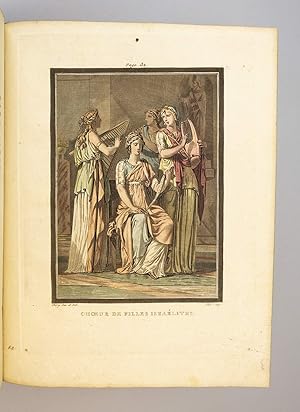
FIRST EDITION. 265 x 205 mm. (10 3/8 x 8"). Two volumes. VERY ATTRACTIVE CONTEMPORARY MARBLED CALF, GILT IN A NEOCLASSICAL DESIGN, covers with a cresting palmette frame featuring ornate urn ornaments at corners, flat spine divided into compartments by Greek key roll, floral spray centerpieces, one green and one black label, marbled endpapers. With 55 PLATES OF COSTUMES designed by Philippe Chéry and engraved by Pierre-Michel Alix, 50 of these PRINTED IN COLOR, five in black and white (a couple of these with color highlights applied by hand), and with a color portrait of the author (from the 1802 edition) tipped in at front. Colas 717; Hiler, p. 542; Lipperheide 3203; Cohen-de Ricci 227; Brunet IV, 1135. One corner worn to board, joints and extremities lightly rubbed, but the bindings lustrous and generally very attractive. First volume slightly browned throughout, second volume occasionally so, volume II with two-inch marginal stain to upper gutter, affecting four quires and six plates (but not touching text or images), two plates with pen marks in margins, touching lettering but not image, other trivial defects, but still an excellent copy internally, the colors especially clear and pleasing. This is an elegant production, with the Neoclassical binding being the perfect complement to the color engravings of ancient Greek and Roman costumes that illustrate the present history of theatrical attire. In the two volumes here, theater critic and historian Jean Charles Le Vacher de Charnois (1749-92?) covers Classical tragedies and comedies as well as later interpretations of these dramas by playwrights including Racine. Le Vacher de Charnois intended a series of books encompassing, as the title indicates, theatrical costumes from all nations and from the ancient to the modern; however, the French Revolution interrupted his scheme, and as a monarchist, he was imprisoned in 1792 for his writings in support of the aristocracy. It was long thought that he had died in the massacres at the Abbaye prison in September of that year, but later research indicates that he may have been executed during the Reign of Terror in 1794. The artists who illustrated this work were at the opposite end of the political spectrum. Painter Philippe Chéry (1759-1838) studied with Jacques-Louis David, and adopted his master's passionate support for the Revolution as well as his Neoclassical style. Engraver Pierre-Michel Alix (1762-1817) was a specialist in color printing best known for his portraits of leaders of the French Revolution, and later of Napoleon and First Empire dignitaries. While the handsome binding here is unsigned, the palmette roll on the covers is very similar (but not identical) to one used by Bozerian (see Culot, "Jean-Claude Bozerian," roll #44 and plate #XXIV). Perhaps our binder had trained in that atelier, as the design and workmanship are certainly of that level.
-
LE TEMPLE DE GNIDE, SUIVI D'ARSACE ET ISMÉNIE
Verlag: P. Didot l'aîné, Paris, 1796
Anbieter: Phillip J. Pirages Rare Books (ABAA), McMinnville, OR, USA
Verkäuferbewertung 3 von 5 Sternen
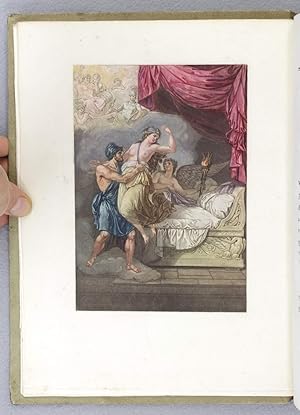
ONE OF 100 COPIES. 330 x 235 mm. (13 x 9 1/4"). 2 p.l., 165, [1] pp. (Original?) gray boards, flat spine, dark gray paper title label, two-thirds of the leaves UNOPENED. Engraved printer's device on title page and SEVEN FINE COLOR-PRINTED ENGRAVINGS AFTER PEYRON BY CHAPUY AND LAVALLÉE, SOME FINISHED BY HAND. Cohen-de Ricci 730; Brunet III, 1860. âA couple of very small brown spots and just a hint of soiling as well as minor abrasions to covers, corners somewhat mashed (as expected), isolated trivial foxing to text, but A VERY FINE COPY, clean and bright internally, with vividly colored plates, and in a surprisingly sturdy and generally well-preserved original temporary publisher's binding. This is the fine Levy copy of a strictly limited Large Paper edition of a handsomely illustrated work, offered here in what seem to be the publisher's temporary boards, mostly unopened and virtually untouched internally. Attractively printed with enormous margins, the text of the first (and by far the most important) work here is a prose poem on love (supposedly translated from the Greek) by one of the great political philosophers of the Enlightenment, Charles de Secondat, Baron de Montesquieu (1689-1755). In its own day, the work was popular largely because of its racy content; today, it is considered as a more serious accomplishment by modern scholars, who are inclined to see it as a philosophical fable. The colophon informs us that this limited edition was printed with a new type cut and cast by Firmin Didot "with such perfection that up to this moment none other can equal it." The dramatic and animated plates are strikingly different from the Eisen engravings in other editions of this work, and are more modern in sensibility than the usual 18th century French engravings. The colophon notes that the plates were broken after the 100 copies of this edition were printed. Our copy was in the outstanding library of American bibliophile Jacques Levy (1905-80), a man of wide-ranging interests who assembled an eclectic collection over 40 years, always with a discriminating eye toward visually pleasing and historically important bindings and illustration. In his sale, Sotheby's described our binding as being publisher's boards, and although the volume seems almost too well preserved to be original, we are persuaded by the collector's reputation that this is the correct characterization.