

Gesamtpreis (1 Artikel Artikel):
Versandziel:

controlled diffusion processes von krylov (8 Ergebnisse)
Direkt zu den wichtigsten Suchergebnissen
Suchfilter
Produktart
- Alle Product Types
- Bücher (8)
- Magazine & Zeitschriften (Keine weiteren Ergebnisse entsprechen dieser Verfeinerung)
- Comics (Keine weiteren Ergebnisse entsprechen dieser Verfeinerung)
- Noten (Keine weiteren Ergebnisse entsprechen dieser Verfeinerung)
- Kunst, Grafik & Poster (Keine weiteren Ergebnisse entsprechen dieser Verfeinerung)
- Fotografien (Keine weiteren Ergebnisse entsprechen dieser Verfeinerung)
- Karten (Keine weiteren Ergebnisse entsprechen dieser Verfeinerung)
- Manuskripte & Papierantiquitäten (Keine weiteren Ergebnisse entsprechen dieser Verfeinerung)
Zustand Mehr dazu
- Neu (7)
- Wie Neu, Sehr Gut oder Gut Bis Sehr Gut (Keine weiteren Ergebnisse entsprechen dieser Verfeinerung)
- Gut oder Befriedigend (1)
- Ausreichend oder Schlecht (Keine weiteren Ergebnisse entsprechen dieser Verfeinerung)
- Wie beschrieben (Keine weiteren Ergebnisse entsprechen dieser Verfeinerung)
Einband
Weitere Eigenschaften
- Erstausgabe (Keine weiteren Ergebnisse entsprechen dieser Verfeinerung)
- Signiert (Keine weiteren Ergebnisse entsprechen dieser Verfeinerung)
- Schutzumschlag (Keine weiteren Ergebnisse entsprechen dieser Verfeinerung)
- Angebotsfoto (5)
Sprache (2)
Preis
- Beliebiger Preis
- Weniger als EUR 20 (Keine weiteren Ergebnisse entsprechen dieser Verfeinerung)
- EUR 20 bis EUR 40
- Mehr als EUR 40
Gratisversand
- Kostenloser Versand nach USA (Keine weiteren Ergebnisse entsprechen dieser Verfeinerung)
Land des Verkäufers
Verkäuferbewertung
-
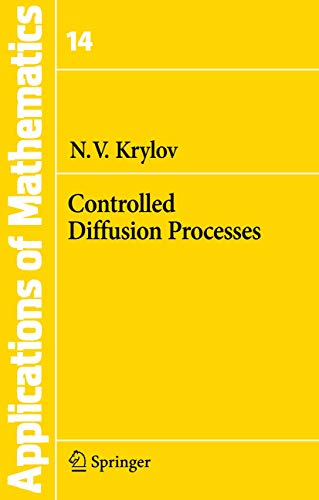
Controlled Diffusion Processes
Anbieter: Majestic Books, Hounslow, Vereinigtes Königreich
Verkäuferbewertung 4 von 5 Sternen

EUR 62,54
EUR 7,46 Versand
Versand von Vereinigtes Königreich nach USAAnzahl: 1 verfügbar
In den WarenkorbZustand: New. pp. 324 49:B&W 6.14 x 9.21 in or 234 x 156 mm (Royal 8vo) Perfect Bound on White w/Gloss Lam.
-

Controlled diffusion processes. (=Applications of mathematics ; 14)
Sprache: Deutsch
Verlag: New York ; Heidelberg ; Berlin : Springer, 1980
Anbieter: Antiquariat Thomas Haker GmbH & Co. KG, Berlin, Deutschland
Verbandsmitglied: GIAQ
Verkäuferbewertung 5 von 5 Sternen

Cloth. Zustand: Gut. XII, 308 p. Good. Ex-library with usual markings. Clean pages. Sprache: Deutsch Gewicht in Gramm: 660.
-
Controlled Diffusion Processes
Sprache: Englisch
Verlag: Springer-Verlag Berlin And Heidelberg Gmbh & Co. Kg, 2008
ISBN 10: 3540709134 ISBN 13: 9783540709138
Anbieter: Revaluation Books, Exeter, Vereinigtes Königreich
Verkäuferbewertung 5 von 5 Sternen
EUR 149,61
EUR 14,34 Versand
Versand von Vereinigtes Königreich nach USAAnzahl: 2 verfügbar
In den WarenkorbPaperback. Zustand: Brand New. reprint edition. 307 pages. 9.25x6.25x0.75 inches. In Stock.
-

Controlled Diffusion Processes
Sprache: Englisch
Verlag: Springer Berlin Heidelberg, 2008
ISBN 10: 3540709134 ISBN 13: 9783540709138
Anbieter: AHA-BUCH GmbH, Einbeck, Deutschland
Verkäuferbewertung 5 von 5 Sternen
Taschenbuch. Zustand: Neu. Druck auf Anfrage Neuware - Printed after ordering - Stochastic control theory is a relatively young branch of mathematics. The beginning of its intensive development falls in the late 1950s and early 1960s. ~urin~ that period an extensive literature appeared on optimal stochastic control using the quadratic performance criterion (see references in Wonham [76]). At the same time, Girsanov [25] and Howard [26] made the first steps in constructing a general theory, based on Bellman's technique of dynamic programming, developed by him somewhat earlier [4]. Two types of engineering problems engendered two different parts of stochastic control theory. Problems of the first type are associated with multistep decision making in discrete time, and are treated in the theory of discrete stochastic dynamic programming. For more on this theory, we note in addition to the work of Howard and Bellman, mentioned above, the books by Derman [8], Mine and Osaki [55], and Dynkin and Yushkevich [12]. Another class of engineering problems which encouraged the development of the theory of stochastic control involves time continuous control of a dynamic system in the presence of random noise. The case where the system is described by a differential equation and the noise is modeled as a time continuous random process is the core of the optimal control theory of diffusion processes. This book deals with this latter theory.
-

Controlled Diffusion Processes
Sprache: Englisch
Verlag: Springer Berlin Heidelberg, Springer Berlin Heidelberg Okt 2008, 2008
ISBN 10: 3540709134 ISBN 13: 9783540709138
Anbieter: buchversandmimpf2000, Emtmannsberg, BAYE, Deutschland
Verkäuferbewertung 5 von 5 Sternen
Taschenbuch. Zustand: Neu. Neuware -Stochastic control theory is a relatively young branch of mathematics. The beginning of its intensive development falls in the late 1950s and early 1960s. ~urin~ that period an extensive literature appeared on optimal stochastic control using the quadratic performance criterion (see references in Wonham [76]). At the same time, Girsanov [25] and Howard [26] made the first steps in constructing a general theory, based on Bellman's technique of dynamic programming, developed by him somewhat earlier [4]. Two types of engineering problems engendered two different parts of stochastic control theory. Problems of the first type are associated with multistep decision making in discrete time, and are treated in the theory of discrete stochastic dynamic programming. For more on this theory, we note in addition to the work of Howard and Bellman, mentioned above, the books by Derman [8], Mine and Osaki [55], and Dynkin and Yushkevich [12]. Another class of engineering problems which encouraged the development of the theory of stochastic control involves time continuous control of a dynamic system in the presence of random noise. The case where the system is described by a differential equation and the noise is modeled as a time continuous random process is the core of the optimal control theory of diffusion processes. This book deals with this latter theory.Springer Verlag GmbH, Tiergartenstr. 17, 69121 Heidelberg 324 pp. Englisch.
-

Controlled Diffusion Processes
Sprache: Englisch
Verlag: Springer New York, Springer New York Nov 1980, 1980
ISBN 10: 0387904611 ISBN 13: 9780387904610
Anbieter: buchversandmimpf2000, Emtmannsberg, BAYE, Deutschland
Verkäuferbewertung 5 von 5 Sternen
Buch. Zustand: Neu. Neuware -Stochastic control theory is a relatively young branch of mathematics. The beginning of its intensive development falls in the late 1950s and early 1960s. During that period an extensive literature appeared on optimal stochastic control using the quadratic performance criterion (see references in W onham [76J). At the same time, Girsanov [25J and Howard [26J made the first steps in constructing a general theory, based on Bellman's technique of dynamic programming, developed by him somewhat earlier [4J. Two types of engineering problems engendered two different parts of stochastic control theory. Problems of the first type are associated with multistep decision making in discrete time, and are treated in the theory of discrete stochastic dynamic programming. For more on this theory, we note in addition to the work of Howard and Bellman, mentioned above, the books by Derman [8J, Mine and Osaki [55J, and Dynkin and Yushkevich [12]. Another class of engineering problems which encouraged the development of the theory of stochastic control involves time continuous control of a dynamic system in the presence of random noise. The case where the system is described by a differential equation and the noise is modeled as a time continuous random process is the core of the optimal control theory of diffusion processes. This book deals with this latter theory. 324 pp. Englisch.
-

Controlled Diffusion Processes
Sprache: Englisch
Verlag: Springer New York, Springer New York, 2011
ISBN 10: 1461260531 ISBN 13: 9781461260530
Anbieter: AHA-BUCH GmbH, Einbeck, Deutschland
Verkäuferbewertung 5 von 5 Sternen
Taschenbuch. Zustand: Neu. Druck auf Anfrage Neuware - Printed after ordering - Stochastic control theory is a relatively young branch of mathematics. The beginning of its intensive development falls in the late 1950s and early 1960s. During that period an extensive literature appeared on optimal stochastic control using the quadratic performance criterion (see references in W onham [76J). At the same time, Girsanov [25J and Howard [26J made the first steps in constructing a general theory, based on Bellman's technique of dynamic programming, developed by him somewhat earlier [4J. Two types of engineering problems engendered two different parts of stochastic control theory. Problems of the first type are associated with multistep decision making in discrete time, and are treated in the theory of discrete stochastic dynamic programming. For more on this theory, we note in addition to the work of Howard and Bellman, mentioned above, the books by Derman [8J, Mine and Osaki [55J, and Dynkin and Yushkevich [12]. Another class of engineering problems which encouraged the development of the theory of stochastic control involves time continuous control of a dynamic system in the presence of random noise. The case where the system is described by a differential equation and the noise is modeled as a time continuous random process is the core of the optimal control theory of diffusion processes. This book deals with this latter theory.
-

Controlled Diffusion Processes
Sprache: Englisch
Verlag: Springer New York, Springer US, 1980
ISBN 10: 0387904611 ISBN 13: 9780387904610
Anbieter: AHA-BUCH GmbH, Einbeck, Deutschland
Verkäuferbewertung 5 von 5 Sternen
Buch. Zustand: Neu. Druck auf Anfrage Neuware - Printed after ordering - Stochastic control theory is a relatively young branch of mathematics. The beginning of its intensive development falls in the late 1950s and early 1960s. During that period an extensive literature appeared on optimal stochastic control using the quadratic performance criterion (see references in W onham [76J). At the same time, Girsanov [25J and Howard [26J made the first steps in constructing a general theory, based on Bellman's technique of dynamic programming, developed by him somewhat earlier [4J. Two types of engineering problems engendered two different parts of stochastic control theory. Problems of the first type are associated with multistep decision making in discrete time, and are treated in the theory of discrete stochastic dynamic programming. For more on this theory, we note in addition to the work of Howard and Bellman, mentioned above, the books by Derman [8J, Mine and Osaki [55J, and Dynkin and Yushkevich [12]. Another class of engineering problems which encouraged the development of the theory of stochastic control involves time continuous control of a dynamic system in the presence of random noise. The case where the system is described by a differential equation and the noise is modeled as a time continuous random process is the core of the optimal control theory of diffusion processes. This book deals with this latter theory.


