

Gesamtpreis (1 Artikel Artikel):
Versandziel:

great soviet encyclopedia (36 Ergebnisse)
Stichwörter:
great soviet encyclopedia
Mit der Detailsuche verfeinern
Direkt zu den wichtigsten Suchergebnissen
Suchfilter
Produktart
- Alle Product Types
- Bücher (33)
- Magazine & Zeitschriften (1)
- Comics (Keine weiteren Ergebnisse entsprechen dieser Verfeinerung)
- Noten (Keine weiteren Ergebnisse entsprechen dieser Verfeinerung)
- Kunst, Grafik & Poster (Keine weiteren Ergebnisse entsprechen dieser Verfeinerung)
- Fotografien (Keine weiteren Ergebnisse entsprechen dieser Verfeinerung)
- Karten (Keine weiteren Ergebnisse entsprechen dieser Verfeinerung)
- Manuskripte & Papierantiquitäten (2)
Zustand Mehr dazu
Weitere Eigenschaften
Sprache (4)
Gratisversand
Land des Verkäufers
Verkäuferbewertung
-

A Soviet View of the American Past An Annotated Translaction of the Section on American History in the Great Soviet Encyclopedia
Verlag: State Historical Society of Wisconsin, Madison, WI, 1960
Anbieter: True Oak Books, Highland, NY, USA
Verbandsmitglied: IOBA
Verkäuferbewertung 5 von 5 Sternen

Paperback. Zustand: Good+. Translation. 64 pages; light fading and a couple of very tiny smudges on the covers. Minor shelf rubbing on spine. Minor stain on the bottom exterior edge of textblock. Very Good condition otherwise. No other noteworthy defects. No markings. Light yellowing on pages. ; Your satisfaction is our priority. We offer free returns and respond promptly to all inquiries. Your item will be packaged with care and ship on the same or next business day. Buy with confidence.
-

Year Book Great Soviet Encyclopedia 1965 [IN RUSSIAN]
Verlag: Publishing House "Soviet Encyclopedia", 1965
Anbieter: Eryops Books, Stephenville, TX, USA
Verkäuferbewertung 5 von 5 Sternen
Hardcover. Zustand: Good. IN RUSSIAN; hardcover; minor shelfwear w/ corners bumped and light fading/soiling of covers; light browning of leaves; o/w in good condition. Book.
-
Great Soviet Encyclopedia (Volume 14)
Verlag: Macmillan, 1977
Anbieter: Anybook.com, Lincoln, Vereinigtes Königreich
Verkäuferbewertung 5 von 5 Sternen
EUR 27,60
EUR 20,36 Versand
Versand von Vereinigtes Königreich nach USAAnzahl: 1 verfügbar
In den WarenkorbZustand: Good. Volume 14. This is an ex-library book and may have the usual library/used-book markings inside.This book has hardback covers. Clean from markings In good all round condition. Please note the Image in this listing is a stock photo and may not match the covers of the actual item,2200grams, ISBN:
-

The Turkic peoples : selected Russian entries from the Great Soviet encyclopedia with an index in English / edited by John R. Krueger
Verlag: Surrey: Curzon Press, 1997
ISBN 10: 0700703802 ISBN 13: 9780700703807
Erstausgabe
First Edition. Fine copy in the original gilt-blocked cloth. Slightest suggestion only of dust-dulling to the panel edges. Remains particularly well-preserved overall; tight, bright, clean and strong. Physical description: vi, 440 p: illus., maps, music, tables ; 23 cm. Series: Uralic and Altaic series ; v. 32. Subjects: Turks; Turkic peoles Soviet Union; török népek Szovjetunió. 1 Kg.
-

Engineers of Victory; The Problem Solvers Who Turned the Tide in the Second World War
Anbieter: Ground Zero Books, Ltd., Silver Spring, MD, USA
Verkäuferbewertung 5 von 5 Sternen
Hardcover. Zustand: Very good. Zustand des Schutzumschlags: Very good. Third Printing [stated]. xxvi, 436 pages. Includes Maps and Tables, Introduction, Footnotes, Acknowledgments, Notes, Bibliography, Credits, and Index. Includes chapters on How to Get Convoys Safely Across the Atlantic, How to Win Command of the Air, How to Stop a Blitzkrieg, How to Seize an Enemy-Held Shore, How to Defeat the "Tyranny of Distance," and Conclusion: Problem Solving in History. Paul Michael Kennedy CBE FBA (born 17 June 1945) is a British historian specializing in the history of international relations, economic power and grand strategy. He has published prominent books on the history of British foreign policy and Great Power struggles. He emphasizes the changing economic power base that undergirds military and naval strength, noting how declining economic power leads to reduced military and diplomatic weight. His most famous book, The Rise and Fall of the Great Powers, assesses the interaction between economics and strategy over the past five centuries. The book was very well received by fellow historians, with A. J. P. Taylor labeling it "an encyclopedia in itself" and Sir Michael Howard crediting it as "a deeply humane book in the very best sense of the word." It has been translated into 23 languages. The author suggests a new and unique look at how World War II was won, in this fascinating nuts-and-bolts account of the strategic factors that led to Allied victory. Without the forgotten scientists, technicians, and logisticians who gave the allies the tactical edge, the Allies could not have achieved victory. Derived from a Kirkus review: Kennedy presents what he calls "a new way of treating that epic conflict," World War II. The author begins with the agenda and priorities of the 1943 Casablanca Conference, and his inquiry traces the interrelationships among strategic decision-making, the accomplishment of the five major tasks identified by conference attendees, and the capacities and weapons systems that made the achievement of the goals possible. The aim was to overcome obstacles to the successful invasion of Western Europe, with five ranked top priorities: winning the battle against U-boats in the North Atlantic, securing control of the airspace over Europe, developing ways to counter the Nazi blitzkrieg, learning how to coordinate landings and establish secure beachheads on enemy-held coastlines, and mastering the technology and skills required to coordinate and fight combined arms warfare over thousands of miles. Kennedy's fine-grained analysis and suspicion of any one single cause-like cipher cracking, intelligence and deception operations, or specific weapons systems, like the Soviet T-34 tank-permit him to persuasively array his supporting facts. He discusses key elements in each of the five areas and the commonalities among the different global theaters of war. The succession of accomplishments highlights the special importance of control of the air. Kennedy rebuts those who argue that the second front could have been opened in 1943, by showing what was learned from the succession of amphibious landings and their impact on the D-Day preparations and ultimate success. The author introduces many individuals whose inventions and capacities contributed profoundly. An absorbing new approach. From information provided by Random House: Paul Kennedy, award-winning author of The Rise and Fall of the Great Powers and one of today's most renowned historians, now provides a new and unique look at how World War II was won. Engineers of Victory is a fascinating nuts-and-bolts account of the strategic factors that led to Allied victory. Kennedy reveals how the leaders' grand strategy was carried out by the ordinary soldiers, scientists, engineers, and businessmen responsible for realizing their commanders' visions of success. In January 1943, FDR and Churchill convened in Casablanca and established the Allied objectives for the war: to defeat the Nazi blitzkrieg; to control the Atlantic sea lanes and the air over western and central Europe; to take the fight to the European mainland; and to end Japan's imperialism. Astonishingly, a little over a year later, these ambitious goals had nearly all been accomplished. With riveting, tactical detail, Engineers of Victory reveals how. Kennedy recounts the inside stories of the invention of the cavity magnetron, a miniature radar "as small as a soup plate," and the Hedgehog, a multi-headed grenade launcher that allowed the Allies to overcome the threat to their convoys crossing the Atlantic; the critical decision by engineers to install a super-charged Rolls-Royce engine in the P-51 Mustang, creating a fighter plane more powerful than the Luftwaffe's; and the innovative use of pontoon bridges (made from rafts strung together) to help Russian troops cross rivers and elude the Nazi blitzkrieg. He takes readers behind the scenes, unveiling exactly how thousands of individual Allied planes and fighting ships were choreographed to collectively pull off the invasion of Normandy, and illuminating how crew chiefs perfected the high-flying and inaccessible B-29 Superfortress that would drop the atomic bombs on Japan. The story of World War II is often told as a grand narrative, as if it were fought by supermen or decided by fate. Here Kennedy uncovers the real heroes of the war, highlighting for the first time the creative strategies, tactics, and organizational decisions that made the lofty Allied objectives into a successful reality. In an even more significant way, Engineers of Victory has another claim to our attention, for it restores "the middle level of war" to its rightful place in history.
-
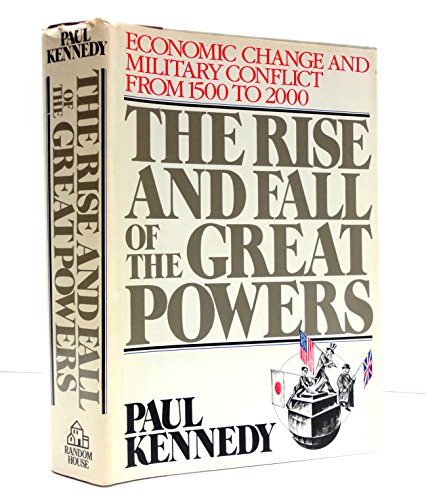
The Rise and Fall of the Great Powers; Economic Change and Military Conflict from 1500 to 2000
Anbieter: Ground Zero Books, Ltd., Silver Spring, MD, USA
Verkäuferbewertung 5 von 5 Sternen
Hardcover. Zustand: Very good. Zustand des Schutzumschlags: Very good. Jean Paul Tremblay (Maps) and Van Howell (Jacket A (illustrator). Second printing [stated]. 25 cm. xxv,[1], 677, [3] pages. Maps Tables and Charts. Notes. Bibliography. Index. DJ has slight wear and soiling. Paul Michael Kennedy CBE FBA (born 17 June 1945) is a British historian specializing in the history of international relations, economic power and grand strategy. He has published prominent books on the history of British foreign policy and great power struggles. He emphasizes the changing economic power base that undergirds military and naval strength, noting how declining economic power leads to reduced military and diplomatic weight. In 1983 he was named the J. Richardson Dilworth professor of British History at Yale. He is now also the Director of International Security Studies and along with John Lewis Gaddis and Charles Hill, teaches the Studies in Grand Strategy course there. In 2012, Professor Kennedy began teaching a course at Yale entitled "Military History of the West Since 1500", elaborating on his presentation of military history as inextricably intertwined with economic power and technological progress. His most well known book, The Rise and Fall of the Great Powers, assesses the interaction between economics and strategy over the past five centuries. The book was very well received by fellow historians, with A. J. P. Taylor labeling it "an encyclopedia in itself" and Sir Michael Howard crediting it as "a deeply humane book in the very best sense of the word". It has been translated into 23 languages. I The Rise and Fall of the Great Powers: Economic Change and Military Conflict from 1500 to 2000, by Paul Kennedy, first published in 1987, explores the politics and economics of the Great Powers from 1500 to 1980 and the reason for their decline. It then continues by forecasting the positions of China, Japan, the European Economic Community (EEC), the Soviet Union and the United States through the end of the 20th century. Kennedy argues that the strength of a Great Power can be properly measured only relative to other powers, and he provides a straightforward thesis: Great Power ascendancy (over the long term or in specific conflicts) correlates strongly to available resources and economic durability; military overstretch and a concomitant relative decline are the consistent threats facing powers whose ambitions and security requirements are greater than their resource base can provide for. Throughout the book he reiterates his early statement (page 71): "Military and naval endeavors may not always have been the raison d'être of the new nations-states, but it certainly was their most expensive and pressing activity", and it remains such until the power's decline. He concludes that declining countries can experience greater difficulties in balancing their preferences for guns, butter and investments. Extracted from a Publishers Weekly article: Kennedy assesses the interaction between economics and strategy over the past five centuries; the correlation between productive and revenue-sharing capacities on the one hand and military strength on the other. The book is a vigorous entry in the debate over the extent to which national wealth should be used for military purposes. It reveals how the Hapsburg monarchs overextended themselves in repeated conflicts, becoming militarily top-heavy while their economic base dwindled, an imbalance that ultimately proved fatal. In a final section, Kennedy explores the implications of today's economic and technological trends in relation to the balance of military power, and the problems and opportunities in this regard facing China, Japan, the European Economic Community, the Soviet Union and the United States.
-
The Turkic Peoples. Selected Russian entries from the Great Soviet Encyclopedia, with an index in English
Verlag: Bloomington, Indiana University Publications 1963, 1963
Anbieter: Antiquariaat Pieter Judo (De Lezenaar), Hasselt, Belgien
Verbandsmitglied: ILAB
Verkäuferbewertung 5 von 5 Sternen
vi + 440pp.with ills., 28cm., original edition , in the series "Uralic and Altaic series" vol.32, softcover, [introduction in English, text in Russian in Cyrillic script], X74839.
-
The Holocaust & the exile of Yiddish: a history of the Algemeyne entsiklopedye.
Sprache: Englisch
Verlag: Rutgers University Press, New Brunswick, 2022
Anbieter: Steven Wolfe Books, Newton Centre, MA, USA
Verkäuferbewertung 5 von 5 Sternen
hardcover. Zustand: Fine. Zustand des Schutzumschlags: includes dust-jacket. DETAILS: very good dust-jacket with slight shelf wear rubbing, attractive copy, near fine brown hardcover. TRACHTENBERG, BARRY. The Holocaust & the exile of Yiddish: a history of the Algemeyne entsiklopedye. New Brunswick: Rutgers University Press, 2022, 293pp., . "The Nazi Holocaust & the Exile of Yiddish is a history of the Algemeyne Entsiklopedye (General Encyclopedia, Berlin, Paris, & New York, 1932-1966), the only attempt to publish a comprehensive encyclopedia of universal knowledge in the Yiddish language. In the decade after World War I, the potential for Yiddish was seemingly limitless. The global number of speakers of Yiddish was estimated at between nine and ten million, with major communities in Poland, the Soviet Union, and the United States. But by the early 1930s, as Jews were becoming invested in their host states, a dramatic rise in antisemitism from the political right threatened their new status. Extreme nationalists sought to undo Jewish participation in civic life, limit Jewish migration and settlement, and contain - or even purge - Jews' political, economic, cultural, and racial influence. This combination of factors led many within the Yiddishist camp both to reassert their commitment to the language and to a distinct Jewish national identity, increasing the urgency for the Entsiklopedye's architects to embark upon their project. Uncertainty over the Jewish future began to be reflected in the Entsiklopedye itself. The volumes of 1936 and 1937 contain otherwise out-of-place monograph-length entries on the specifically Jewish topics of "Antisemitism" and "Land of Israel," presaging a shift away from general subjects and toward more specifically Jewish content. In September 1939, the German invasion of Poland cut the Entsiklopedye off from its major source of readers and trapped many of its contributors who were based there. Just as the second Yidn volume was being sent to subscribers in Spring 1940, Germany invaded France. Making matters even worse, the copies of the second Yidn volume were sent to the United States, and but most copies were lost at sea. A few volumes that had been sent via the regular mail arrived safely in New York, however. The encyclopedia's editors themselves fled and, after making a harrowing escape via Spain and Portugal, arrived in New York by late summer / early autumn 1940. With the end of World War II and as the enormity of the Nazi Holocaust was becoming understood, the editors decided that the Entsiklopedye should continue. The post-war Yidn volumes contain descriptive essays on Jewish life on the eve of the Holocaust, a study of Jewish life in the Americas, and the last two volumes (1964 and 1966) are historical overviews of the Holocaust. By the release of the final volume in 1966, few of the original editors of The Algemeyne Entsiklopedye were still alive. Many of the great Jewish scholars who contributed to the project had also passed. In the Foreword, the administrator of the Entsiklopedye Iser Goldberg outlined the task of future Jewish scholarship as one of creating a new corpus of work dedicated to the Holocaust. He declared that this project that once was to guide millions of Yiddish readers into the modern world was now dedicated to "the thousands of readers and subscribers in Jewish communities" with the much more modest goal of making "an important contribution to the growing khurbn [Holocaust] literature." By bringing this neglected and unique work of Jewish scholarship back into studies of modern Jewish history, Trachtenberg makes a significant contribution to current historiographical debates on the content and boundaries of Jewish knowledge in the tumultuous middle decades of the twentieth-century. In large measure because of the lack of researchers able to work in the Yiddish language, the significance and history of the Algemeyne Entsiklopedye has been overlooked, despite the fact that it was one of the great (and few) collaborative projects involving the twentieth century's most influential Jewish scholars. This monograph will inform recent scholarly discussions on the function of Yiddish before, during, and after World War II, on the extent to which Eastern European Jews turned away from Diaspora Nationalism on the eve of war, and to what degree Jews in the United States were "silent" in the decades following the Nazi Holocaust" - CONTENTS: A Bible for the New Age: Berlin, 1930-1933 -- Man Plans, and Hitler Laughs: Paris, 1933-1940 -- Spinning the Historical Threads: New York, 1940-1966. ISBN 9781978825451.
-
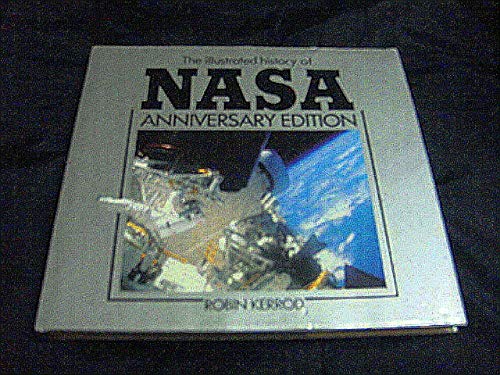
The illustrated history of NASA; Anniversary Edition
Sprache: Englisch
Verlag: Gallery Books, New York City, 1988
ISBN 10: 0831748788 ISBN 13: 9780831748784
Anbieter: Ground Zero Books, Ltd., Silver Spring, MD, USA
Verkäuferbewertung 4 von 5 Sternen

Erstausgabe
Hardcover. Zustand: Very good. Zustand des Schutzumschlags: Very good. 256 pages. Illustrations (most in color). Index. Format is approximately 11 .75 inches by 11 inches. DJ has slight wear and soiling. Robin Kerrod, a Fellow of Britain's Royal Astronomical Society, writes extensively on astronomy and space, and travels the world to visit observatories and space centers. Among his previous books are Book of Constellations and The Sky at Night. He is a former winner of a COPUS (Committee on the Public Understanding of Science) Science Book Prize, he was a major contributor to the DK Science Encyclopedia. The National Aeronautics and Space Administration (NASA) is an independent agency of the executive branch of the United States federal government responsible for the civilian space program, as well as aeronautics and aerospace research. President Dwight D. Eisenhower established NASA in 1958 with a distinctly civilian (rather than military) orientation encouraging peaceful applications in space science. The National Aeronautics and Space Act was passed on July 29, 1958, disestablishing NASA's predecessor, the National Advisory Committee for Aeronautics (NACA). The new agency became operational on October 1, 1958. Since that time, most US space exploration efforts have been led by NASA, including the Apollo Moon landing missions, the Skylab space station, and later the Space Shuttle. Currently, NASA is supporting the International Space Station and is overseeing the development of the Orion Multi-Purpose Crew Vehicle, the Space Launch System and Commercial Crew vehicles. The agency is also responsible for the Launch Services Program (LSP) which provides oversight of launch operations and countdown management for unmanned NASA launches. NASA science is focused on better understanding Earth through the Earth Observing System, advancing heliophysics through the efforts of the Science Mission Directorate's Heliophysics Research Program, exploring bodies throughout the Solar System with advanced robotic spacecraft missions such as New Horizons, and researching astrophysics topics, such as the Big Bang, through the Great Observatories and associated programs. NASA shares data with various national and international organizations such as from the Greenhouse Gases Observing Satellite. From 1946, the National Advisory Committee for Aeronautics (NACA) had been experimenting with rocket planes such as the supersonic Bell X-1. In the early 1950s, there was challenge to launch an artificial satellite for the International Geophysical Year (1957-58). An effort for this was the American Project Vanguard. After the Soviet launch of the world's first artificial satellite (Sputnik 1) on October 4, 1957, the attention of the United States turned toward its own fledgling space efforts. The US Congress, alarmed by the perceived threat to national security and technological leadership (known as the "Sputnik crisis"), urged immediate and swift action; President Dwight D. Eisenhower and his advisers counseled more deliberate measures. On January 12, 1958, NACA organized a "Special Committee on Space Technology", headed by Guyford Stever. On January 14, 1958, NACA Director Hugh Dryden published "A National Research Program for Space Technology" Revised Edition [stated] Presumed first printing.
-

The Turkic Peoples (Uralic and Altaic) Selected Russian Entries from the great Soviet Encyclopedia with an Index in English
Sprache: Deutsch
Verlag: Indiana University Publications, 1963
ISBN 10: 0700708324 ISBN 13: 9780700708321
Anbieter: NEPO UG, Rüsselsheim am Main, Deutschland
Verkäuferbewertung 5 von 5 Sternen
Taschenbuch Ausgabe. Zustand: Gut. Grossformatiges Buch, Ecken abgestossen, in kyrillischer Schrift Sprache: Deutsch Gewicht in Gramm: 550 Volume 32 of the Uralic and Altaic Series.
-

The Soviet Century: Archaeology of a Lost World
Sprache: Englisch
Verlag: Princeton University Press, Princeton and Oxford, 2023
ISBN 10: 0691183740 ISBN 13: 9780691183749
Anbieter: Round Table Books, LLC, Gurnee, IL, USA
Verbandsmitglied: MWABA
Verkäuferbewertung 4 von 5 Sternen
Erstausgabe
Hard Cover. Zustand: Fine. Zustand des Schutzumschlags: Fine. First Edition (?). First Printing. Includes extensive Notes and Index. An encyclopedic and richly detailed history of everyday life in the Soviet Union. The Soviet Union is gone, but its ghostly traces remain, not least in the material vestiges left behind in its turbulent wake. What was it really like to live in the USSR? What did it look, feel, smell, and sound like? In The Soviet Century, Karl Schloegel, one of the world's leading historians of the Soviet Union, presents a spell-binding epic that brings to life the everyday world of a unique lost civilisation. A museum of, and travel guide to, the Soviet past, The Soviet Century explores in evocative detail both the largest and smallest aspects of life in the USSR, from the Gulag, the planned economy, the railway system, and the steel city of Magnitogorsk, to cookbooks, military medals, prison camp tattoos, and the ubiquitous perfume Red Moscow. The book examines iconic aspects of Soviet life, including long queues outside shops, cramped communal apartments, parades, and the Lenin mausoleum, as well as less famous but important parts of the USSR, including the Great Soviet Encyclopedia, the voice of Radio Moscow, graffiti, and even the typical toilet, which became a pervasive social and cultural topic. Drawing on Schloegel's decades of travel in the Soviet and post-Soviet world, and featuring more than eighty illustrations, The Soviet Century is vivid, immediate, and grounded in firsthand encounters with the places and objects it describes. The result is an unforgettable account of the Soviet Century. Both the volume and the unclipped dust jacket are in virtually perfect condition; unmarked, tight, square, and clean. A large, heavy book (five pounds) - additional shipping charges may apply. FINE/FINE. Photographs. Large 8vo 9" - 10" tall. xx, (i), 906 pp.
-
Jewish Currents Vol. 28, No. 1 (304), March, 1974 - Vol. 26, No. 11 (314), Dec., 1974.
Verlag: Jewish Currents Inc., New York, 1974
Anbieter: Henry Hollander, Bookseller, Los Angeles, CA, USA
Verkäuferbewertung 4 von 5 Sternen
Hardbound. Zustand: Good. Octavo, brown cloth with gold lettering, 48, 48, 48, 48, 48, 48, 48, 48, 48, 48 , 80 pp., cummulative index Articles in the issue 1 are, "At the Geneva Conference Table David Ben Gurion (1886-1973)," An Editorial, "Progressie Jewish Youth in Motion," An Editorial, Six on Progressive Jewish Youth: "1. The New 'Jewish Socialist Community," Paul Shneyer, "2. From Chutzpah, About Chutzpah," "3. 'Uncharted Jewsh Libo,' Doanld Altschuler, "4. Five Poems," Marjoria Agosin, "Two Poems," Issaac E. Mozeson, "Being Jewish," Richard Ruth, "Rabbi Eisendrath's Farewell Sermon,."Articles in issue #2 are Peace and the Israeli Election," An Editorial, "Jewish Encounter with black Publisher," W.S., "A Philadelphia Story," Sherman Labovitz, "Affirmative Action and Quotas," Max Cohen, "The Jewish Bund Revisited: !," Louis Harap, "The Way We Were,' Film Review by David Platt.Articles in Issue # 3 are "Back to Geneva," An Editorial, "The Bund Revisited: II," Louis Harap, "Yiddish Song - Then an Now," David Platt, "Recorded Yiddish Folksong: A Selection," D.P., "Writings About Women," Reviw by Carol Jochnowitz.Articles in issue # 4 are :Days of Reckoning and Resistance," An Editorial, "The Story of the Warsaw GHetto Uprising," "Visiting the Charnel House," Simon Federman, "I Walked on Warsaw Ghetto Streets," Poem by Harry Block, "Judenrat Selections vs. Resistance," S. David Kaplan, "Mein Shtetle Brent, Poem by Elsie Levitan, "Three Poems from the Lodz Ghetto," Rachmil Bryks, The Bund Revisited III," Louis Harap, "Uncle Msha Fights Back," Review by Tess Swerdlow.Articles in issue #5 are "Israel Rocked on All Fronts," An Editorial, "Zionism Seen Out of Focus," A.B. Magil, "Two Poems," Roby P. Bird, "Bridging a Chasm of History," Poem by Nathan C. Goldman, "Kaddish," Poem by Aaron Kurtz, "The Bund Revisited IV," Louis Harap, "The Legacy of Hannah Senesh," Revew by Isabel Pearlman.Articles in Issue # 6 are "De Funis Issue Not Moot," An Editorial, "Reopening the Rosenberg Case," "For Michael and Robby Meeropol," Poem by Elsie Levitan, "The Bund Revisited V," Louis Harap, "Stephen S. Wise (1874-1949)," "Once Again in October," Poem by Marjorie Agosin, "'The Exorcist' Excorcized," Flm Review by David Platt, "Jewsh Women in Congress," Book Review by Joseph Drew.Articles in Issue #7 are "What are 'Palestinian Legitimate Rights,?" An Editorial, "Observations in Israel," Herman Pollack, "Hear, O Israel," Poem by Howard Ostwind, "Soviet Jewish Situation - 1974," An Editorial, "'Jews' in the Great Jewish Encyclopedia," Michael Mirski, "At Night," Story by Dovid Bergelson, "PRague Radio Broadcasts Anti-Semitic Attacks on Zionism," "A Seection of Poems and Prose," Emma Lazarus, "The Heretic," Poem by Aaro E. Bulman, "Grandpa Cohen," Poem by Theodore Dashman, "Nigun: A Fantasy," Yuri Prizel, "Meyer Levin's Search," Review by Irwin Shapiro, "Harlem Weekly Amsterdam News on Maalot," "Readers' Forum on Black-Jewish Relations." Articles in issue # 8 are "Ford In, Nixon Out - Jaworski, Right On!" an Edtorial, Our Annual Dinner, May 19, 1974: "1. Louis Harap at 70," Sam Pevzner, "2. Response," Louis Harap, "3. Introduction." Schappes, "4. Black/Jewish Relations," Stephen A. Schwerner, "5. Comment," Anette T. Rubinstein, "Eliav" Israel's Leading Dve," Max Gordon, "The Market: Poem by Sholem Shtern, "The Journey," Poem by Norman Smith.Articles in issue #9 are "Yom Kippur War: One Year Later," An Editorial, "Desegregation 20 Years Later," Eleanor Holmes Norton, "The Defunis Isssue: More Ado," Naomi Levine an Schappes, "Ford's First Fumblings," An Editorial "Anti-Semitism Old and New," Sam Pevzner, "Chile Rules by Army: Unions Destroyed," Abe Feinglass, "Too Late for Declarations." George Wald, "Ford's Unpardonable Pardon," An Editorial "Justice, Justice Shall You Seek," Poem by Elsie Levitan, "My Mother's Hands," Poem by Rachel Fialkoff, "Old German Jewish Folkways," Review by Harry Zorn.Articles in issue #10 are "Detente is Not entente," An Editorial, "'Gulag,' Solzhenitsyn and the Jews," Louis Harap, "Malaise," Poem by Linda C. Rosen, "Recipe for Nixon Tashen," Poem by Elsie Levitan, "Yom Kippur War - And After," Review by Richard J. Walton, "About Southern Jews: Personal and Political," Review by Arnold Shankman. Articles in issue #11 are "Announcemnet," New Union Press, "PLO, No! Israel Must Live!" An Editorial, "Humbertus Strughld, Nazi in USA," Chlares R. Allen, Jr., "Rabbi Joshua Ben Levi and the Angel of Death," Poem by Danel H. Friedman, "Arnold Schoenberg, Musical Pathbreaker," David platt, "Report From Romania," Elsie Levitan, "The Inquisition and Jews," Review by George Jochnowitz, "'Justice, Justice Shalt Thou Pursue," Rabbi Robert E. Goldberg.
-
Ermeni meselesi. Böyük Sovet ensiklopediyasinin 1926-ci il nesrinden makale.= Armianskiy vopros. Stat'i¿a¿ iz Bolsho Sovetskoi ent¿s¿iklopediy 1926 goda izdanii¿a¿. Translated by R. Nagiyev.
Verlag: Azerbaycan KG MK-nin Kommünist Nesriyyati, Baki, 1990
Anbieter: Khalkedon Rare Books ABA, ILAB, IOBA, ESA, Istanbul, Türkei
Verbandsmitglied: ABA ESA ILAB IOBA
Verkäuferbewertung 5 von 5 Sternen
Soft cover. Zustand: Very Good. 2nd Edition. Paperback. Pbo. Demy 8vo. (22 x 15 cm). In Azerbaijani (Cyrillic) and Russian. 32 p. Ermeni meselesi. Böyük Sovet ensiklopediyasinin 1926-ci il nesrinden makale.= Armenskiy vopros. Translated by R. Nagiyev. Armenian question: An article from Great Soviet Encyclopedia in 1926 (First Edition) by Kriazhin. This is Second Edition.
-

When the Steam Railroads Electrified
Buch 4 von 62: Railroads Past and PresentSprache: Englisch
Verlag: Kalmbach Publishing Co, Milwaukee, WI, 1974
ISBN 10: 0890240280 ISBN 13: 9780890240281
Anbieter: Ground Zero Books, Ltd., Silver Spring, MD, USA
Verkäuferbewertung 5 von 5 Sternen
Erstausgabe
Hardcover. Zustand: Very good. Zustand des Schutzumschlags: Very good. Presumed First Edition, First printing. 439, [1] pages. Oversize Book, measuring 11-1/2 inches by 8-1/2 inches. Name and address of the previous owner of this book written inside the front free endpaper. THe previous owner had a long and distinguished career with the Federal Railroad Administration. Profusely illustrated in black and white; also contains several black and white railway maps. DJ is in a plastic sleeve with a brown border, slightly taped to the boards. Illustrated endpapers. The index has entries for Canadian Car & Foundry, Canadian General Electric, Canadian National Electrification (several entries, including pages 183-190), Canadian Northern, Canadian Pacific, and Canadian Vickers, as well as Great Western Ry (Canada), Quebec and the Montreal, Quebec central railroad station. William D. Middleton (March 25, 1928 - July 10, 2011) was an American reporter, writer and photographer. The majority of his work was on the subject of railroad history and operation. He published over 20 books and approximately 700 articles for magazines and newspapers, accompanied by photographs. His work as a photographer was profiled in the Spring 2011 issue of Classic Trains magazine. He was one of the lead editors, along with George M. Smerk and Roberta L. Diehl, for the Encyclopedia of North American Railroads This volume is the third and final work by this author in his survey of electric transportation. At a time when the future of railway electrification spreads out before us, an interest in railway electrifications of the past inevitably is reawakened. The historical and technical information on which this book is largely based is drawn from a great body of printed material including the journals of the electric railway and railroad trade press, the several periodicals of the railway enthusiast fraternity, publications of the electrical manufacturing companies, and scores of books and other works on the subject, both technical and popular in nature. The was when published the most comprehensive history of North American railroad electrification, For most of the first half of the twentieth century, the United States led the world in railroad electrification. Before the outbreak of World War II, it had some 2400 route-miles and more than 6300 track-miles operating under electric power -- far more than any other country, and more than 20 percent of the world total. In almost every instance, electrification was a huge success, Running times were reduced. Tonnage capacities were increased. Fuel and maintenance costs were lowered, and the service lives of electric locomotives promised to be twice as long as those of steam locomotives. In many cases, the savings resulting from electric operation were sufficient to repay the cost of electrification in as little as five years. Yet despite its many triumphs, electrification of U.S. railroads failed to achieve the wide application that once was so confidently predicted. By the 1970s, it was the Soviet Union, with almost 22,000 electrified route miles, that led the way, and the U.S. had declined to 17th place, behind such countries as Czechoslovakia, Austria, Norway, and Brazil. For a while, the prospects for electric operation of U.S. railroads brightened during the energy crisis of the 1970s, and as power companies began to consider the major market represented by railroads, but then faded away again.
-
Information U.S.S.R.: An Authoritative Encyclopaedia about the Union of Soviet Socialist Republics
Verlag: Pergamon Press, New York, 1962
Anbieter: Ground Zero Books, Ltd., Silver Spring, MD, USA
Verkäuferbewertung 5 von 5 Sternen
Zustand: good. 27 cm, 982, illus., maps, chronological tables, index, "Special Reference Edition" sticker on front endpaper, slightly shaken. Pages 1-763 in this volume were translated from Volume 50 of the Great Soviet Encyclopedia by J. T. McDermott.
-
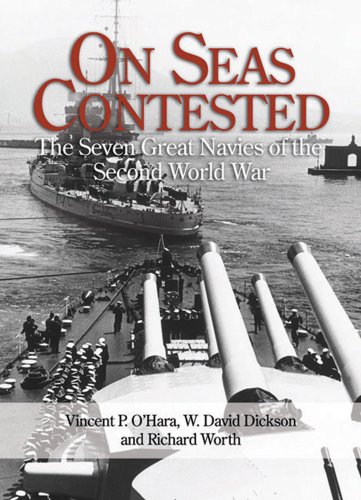
On Seas Contested; The Seven Great Navies of the Second World War
Sprache: Englisch
Verlag: Naval Institute Press, Annapolis, Maryland, 2010
ISBN 10: 1591146461 ISBN 13: 9781591146469
Anbieter: Ground Zero Books, Ltd., Silver Spring, MD, USA
Verkäuferbewertung 5 von 5 Sternen
Erstausgabe
Hardcover. Zustand: Very good. Zustand des Schutzumschlags: Very good. First Printing [Stated]. Includes List of Illustrations, Acknowledgments, and an Introduction, as well as Notes, Bibliography, and Index. Chapters cover France: The Marine Nationale; Germany: The Kriegsmarine; Great Britain: The Royal Navy; Italy: The Regia Marina; Japan: The Teikoku Kaigun; USA: The United States Navy; and USSR: The Voenno-morskoi Flot SSSR. Also contains Notes, Bibliography, and an Index, as well as appendixes on Guns and Torpedoes, Comparative Ranks, and Conversions and Abbreviations, Contains 30 photographs, 32 tables, 10 charts, and 7 maps. This book contains much rarely encountered information that the specialist will find valuable, yet it is written in an accessible style and covers topics that will appeal to the general reader. It's multi-national orientation delivers a fresh view of the Naval War in contrast to many English-language accounts that are written from the perspective of the American and British victors. Vincent P. O'Hara (born 24 December 1951) is a naval author and historian. Vincent O'Hara is an independent scholar with a degree in History from the University of California, Berkeley. O'Hara has authored, co-authored or edited twelve books and contributed articles to publications, including Naval War College Review, MHQ, Storia Militare, Seaforth World Naval Review, America in WWII, World War II, and World War II History. He was an assistant editor of ABC Clio's Encyclopedia of World War II at Sea and has written introductions to two volumes of the U.S. Naval Operations in World War II series by Samuel E. Morison republished by the U.S. Naval Institute. An international team of naval historians and scholars, including John Jordan (France), Peter Schenk with Karsten Klein, Dr. Axel Niestle, Dieter Thomaier and Berndt R. Wenzel (Germany), David Wragg (Great Britain), Enrico Cernuschi and Vincent O'Hara (Italy) Mark Peattie (Japan), Trent Hone (United States) and Stephen McLaughliln (USSR) has pooled their expertise for this definitive reference on how the great navies of World War II were organized and how they trained, operated, and fought. They provide a point-by-point evaluation on the inner workings of the navies of the United States, the United Kingdom and Commonwealth, Japan, Germany, Italy, France, and the Soviet Union. Each navy has its own chapter, which covers such key features as weaponry, training, logistics, and doctrine. In bringing together data buried in specialized works in various languages, the authors deliver a fresh, multinational view of the naval war.
-

The Conquest of the Artic
Verlag: Foreign Languages Publishing House Moscow, 1939
Anbieter: Joe Orlik Books, Manchester, Vereinigtes Königreich
Verkäuferbewertung 5 von 5 Sternen
Erstausgabe
EUR 35,71
EUR 17,33 Versand
Versand von Vereinigtes Königreich nach USAAnzahl: 1 verfügbar
In den WarenkorbSoft cover. Zustand: Very Good. 1st Edition. Pictorial card covers, stapled, 3 photos pp44. Soviet propaganda published for the New York Worlds Fair 1939. Design B.Schwartz. The author was employed as the director of the State Publishing House (Gosizdat) from 1921 to 1924, and chief editor of the Great Soviet Encyclopedia from 1924 to 1941. From 1923 he was a professor at the Second Moscow State University and later at the Moscow State University, and from 1930 to 1932, Schmidt was the head of the Arctic Institute. Condition Near Fine marred by inscribed number to front cover top right corner. Covers light dust dulling. Page block tight, bright and clean. Sharp edges and corners.
-
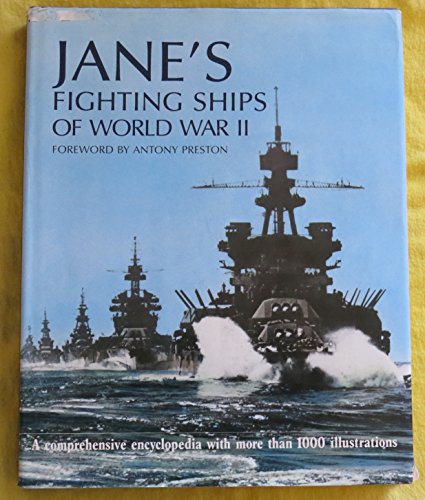
Jane's Fighting Ships of World War II
Anbieter: Ground Zero Books, Ltd., Silver Spring, MD, USA
Verkäuferbewertung 5 von 5 Sternen
Hardcover. Zustand: Very good. Zustand des Schutzumschlags: Very good. 320 pages. Foreword by Anthony Preston. Format is approximately 10.25 by 12.75 inches. Pencil erasure residue on fep. DJ is in a plastic sleeve. This work is drawn primarily from the Jane's 1919 edition, augmented with material from the 1914 edition. This is a comprehensive encyclopedia with over 1000 illustrations and a review of 39 navies. . Large, coffee-table style book covers the Second World War period with photographs, line drawings and data tables of warships. This volume includes submarines and the aircraft that were integrated into the naval efforts. Comparisons of the fleets of Great Britain, Germany, the United States, Japan, France, Italy, Austro-Hungary and Soviet Union reveal similarities as well as differences. These pages document design considerations and the rise of the aircraft carrier. An extraordinary one-volume encyclopedia of World War II warships. Reprint edition, 1997 second printing of 1989 reprint.
-

Jacques the Frenchman : Memories of the Gulag
Sprache: Englisch
Verlag: University Of Toronto Press Feb 2020, 2020
ISBN 10: 1487524064 ISBN 13: 9781487524067
Anbieter: AHA-BUCH GmbH, Einbeck, Deutschland
Verkäuferbewertung 5 von 5 Sternen
Taschenbuch. Zustand: Neu. Neuware - Jacques Rossi is one of Stalin's most well-known victims. Author of The Gulag Handbook, a fascinating encyclopedia of the Soviet forced labor camps, Rossi spent twenty years in interrogation, prison, and Gulag detention. Born to a prominent Polish father and French mother, the young Jacques became attracted to communism as a blueprint for radical social reform. He spent years in the communist underground in interwar Europe, agitating for the revolution, but he was arrested during Stalin's Great Purges in 1937. This book represents a conversation between Jacques Rossi and Michèle Sarde, professor emerita at Georgetown University, and weaves together personal reflections and historical analysis. Rossi's remarkable life (1909-2004) spanned the twentieth century and sheds important light on the tumultuous history of Europe - the appeal of communism in the interwar period and beyond, the mentality of party members, the effects of mass repression, everyday life in Stalin's Gulag, and the problem of rights for former prisoners during the Khrushchev era. As he abandoned his internationalist communist beliefs, Rossi increasingly identified as French, embracing the name his fellow prisoners gave him in the Gulag, 'Jacques the Frenchman.' Rossi's reflections on his own political beliefs, his frustrations with those who could not accept the truth of his brutal experiences in the Soviet Union, and his life as a witness to one of the twentieth century's worst crimes offer a fascinating history of Stalinism and its legacies.
-

The Aral Sea Encyclopedia
Sprache: Englisch
Verlag: Springer Berlin Heidelberg, 2010
ISBN 10: 3642098770 ISBN 13: 9783642098772
Anbieter: AHA-BUCH GmbH, Einbeck, Deutschland
Verkäuferbewertung 5 von 5 Sternen
Taschenbuch. Zustand: Neu. Druck auf Anfrage Neuware - Printed after ordering - The ''Aral Sea Encyclopedia'' is the first one in the new series of encyclopedias about the seas of the former Soviet Union. Preparing it we faced certain difficulties. The thing is that this encyclopedia is a monument to the sea that is disappearing during our lifetime. The world community considers the situation with the Aral Sea and all changes that occurred in its whereabouts in the recent decades as one of the most serious, if not disastrous anthropogenic environmental crises of the 20th century. Before 1960, this was a water-abundant sea-lake that was fourth among world lakes after the Caspian Sea (USSR, Iran), the Great Lakes (USA, Canada) and Victoria Lake (Africa). This was a real ''pearl'' among the sands of the largest deserts, the Karakums and the Kyzylkums. Navigation between the sea ports Muinak and Aralsk and fisheries famous for the Aral breams, barbells, sturgeons, shemaya, and others were developed here. One could find beautiful recreational zones and beaches here. The deltas of the Amudarya, the major river of Central Asia, and the Syrdarya bringing their waters into the Aral Sea were famous for their biodiversity, fishery, muskrat rearing, reed prod- tion. The local population found occupations related to the water infrastructure.
-

The Aral Sea Encyclopedia
Anbieter: AHA-BUCH GmbH, Einbeck, Deutschland
Verkäuferbewertung 5 von 5 Sternen
Buch. Zustand: Neu. Druck auf Anfrage Neuware - Printed after ordering - The ''Aral Sea Encyclopedia'' is the first one in the new series of encyclopedias about the seas of the former Soviet Union. Preparing it we faced certain difficulties. The thing is that this encyclopedia is a monument to the sea that is disappearing during our lifetime. The world community considers the situation with the Aral Sea and all changes that occurred in its whereabouts in the recent decades as one of the most serious, if not disastrous anthropogenic environmental crises of the 20th century. Before 1960, this was a water-abundant sea-lake that was fourth among world lakes after the Caspian Sea (USSR, Iran), the Great Lakes (USA, Canada) and Victoria Lake (Africa). This was a real ''pearl'' among the sands of the largest deserts, the Karakums and the Kyzylkums. Navigation between the sea ports Muinak and Aralsk and fisheries famous for the Aral breams, barbells, sturgeons, shemaya, and others were developed here. One could find beautiful recreational zones and beaches here. The deltas of the Amudarya, the major river of Central Asia, and the Syrdarya bringing their waters into the Aral Sea were famous for their biodiversity, fishery, muskrat rearing, reed prod- tion. The local population found occupations related to the water infrastructure.
-

Zustand: Hervorragend. Zustand: Hervorragend | Seiten: 300 | Sprache: Englisch | Produktart: Bücher | The ¿¿Aral Sea Encyclopediä¿ is the first one in the new series of encyclopedias about the seas of the former Soviet Union. Preparing it we faced certain difficulties. The thing is that this encyclopedia is a monument to the sea that is disappearing during our lifetime. The world community considers the situation with the Aral Sea and all changes that occurred in its whereabouts in the recent decades as one of the most serious, if not disastrous anthropogenic environmental crises of the 20th century. Before 1960, this was a water-abundant sea-lake that was fourth among world lakes after the Caspian Sea (USSR, Iran), the Great Lakes (USA, Canada) and Victoria Lake (Africa). This was a real ¿¿pearl¿¿ among the sands of the largest deserts, the Karakums and the Kyzylkums. Navigation between the sea ports Muinak and Aralsk and fisheries famous for the Aral breams, barbells, sturgeons, shemaya, and others were developed here. One could find beautiful recreational zones and beaches here. The deltas of the Amudarya, the major river of Central Asia, and the Syrdarya bringing their waters into the Aral Sea were famous for their biodiversity, fishery, muskrat rearing, reed prod- tion. The local population found occupations related to the water infrastructure.
-
![Bild des Verkäufers für Encyclopedia of the great composers and their music [by] Milton Cross and David Ewen. zum Verkauf von Joseph Valles - Books](https://pictures.abebooks.com/inventory/md/md31949679847.jpg)
Encyclopedia of the great composers and their music [by] Milton Cross and David Ewen.
Verlag: Garden City, N.Y., Doubleday, 1962., 1962
Anbieter: Joseph Valles - Books, Stockbridge, GA, USA
Verkäuferbewertung 5 von 5 Sternen
Erstausgabe
Hardcover. Zustand: Very Good. Zustand des Schutzumschlags: Good. 1st Edition. New rev. ed. ; 2 v. (viii, 1009 p.) 22 cm. ; LCCN: 62008097 ; OCLC 966146344 ; LOC Call No: ML385 .C7 1962 ; "Basically it is about the foremost composers of the past and present (seventy-eight in number) and their music. Here will be found exhaustive biographies not only of the giant figures but also of secondary composers about whom biographical and critical material is not so readily accessible; thirty contemporaries are include din the gallery of composers, among them seven representative Americans." ; Contents: V. 1. pt. I. Before Bach - pt. II. The composers and their music. Johann Sebastian Bach ; Samuel Barber ; Be?la Barto?k ; Ludwig van Beethoven ; Alban Berg ; Hector Berlioz ; Georges Bizet ; Ernest Bloch ; Alexander Borodin ; Johannes Brahms ; Benjamin Britten ; Anton Bruckner ; Ernest Chausson ; Fre?de?ric Chopin ; Aaron Copland ; Claude Debussy ; Frederick Delius ; Ernst von Dohna?nyi ; Gaetano Donizetti ; Paul Dukas ; Antoni?n Dvor?a?k ; Sir Edward Elgar ; Georges Enesco ; Manuel de Falla ; Gabriel Faure? ; Ce?sar Franck ; George Gershwin ; Christoph Willibald Gluck ; Charles Gounod ; Edvard Grieg ; George Frideric Handel ; Howard Hanson ; Roy Harris ; Joseph Haydn ; Paul Hindemith ; Arthur Honegger ; Vincent d'Indy ; Aram Khatchaturian ; Zolta?n Koda?ly ; Edouard Lalo ; Ruggiero Leoncavallo ; Franz Liszt ; Gustav Mahler ; Pietro Mascagni ; Jules Massenet ; Felix Mendelssohn ; Gian-Carlo Menotti ; Giacomo Meyerbeer. V. 2. [Pt. II. cont.] Darius Milhaud ; Wolfgang Amadeus Mozart ; Modest Mussorgsky ; Jacques Offenbach ; Niccolo` Paganini ; Serge Prokofiev ; Giacomo Puccini ; Serge Rachmaninoff ; Maurice Ravel ; Ottorino Respighi ; Nicholas Rimsky-Korsakov ; Gioacchino Rossini ; Camille Saint-Sae?ns ; Arnold Schoenberg ; Franz Schubert ; Robert Schumann ; Alexander Scriabin ; Dmitri Shostakovich ; Jean Sibelius ; Bedr?ich Smetana ; Richard Strauss ; Igor Stravinsky ; Peter Ilitch Tchaikovsky ; Ralph Vaughan Williams ; Giuseppi Verdi ; Heito Villa-Lobos ; Richard Wagner ; William Walton ; Karl Maria von Weber ; Hugo Wolf - pt. III. A brief history of music since Bach - pt. IV. One hundred basic works for the record library (with recommended recordings) - pt. V. The anatomy of the symphony orchestra - pt. VI. A dictionary of musical forms - pt. VII. A glossary of musical terms; Milton John Cross was an American radio announcer famous for his work on the NBC and ABC radio networks. He was best known as the voice of the Metropolitan Opera, hosting its Saturday afternoon radio broadcasts for 43 years, from the time of their inception on December 25, 1931, until his death in 1975. ; Austrian-born American writer David Ewen (1907-1985) was the author of dozens of books about music, including "Composers of Today," "Composers of Yesterday" and "The Encyclopedia of Musical Masterpieces."; number on front endpaper ; dustjackets sunned ; else VG/G in slipcase. Book.
-

Encyclopedia of the Alkaloids : Volume 3
Anbieter: AHA-BUCH GmbH, Einbeck, Deutschland
Verkäuferbewertung 5 von 5 Sternen
Taschenbuch. Zustand: Neu. Neuware - Volume 3 of the Encyclopedia of the Alkaloids covers the literature to the end of October 1976 and includes a large number of these compounds which have been discovered since the first two volumes were published in 1975. There are some entries where recent work has resulted in new structures being put forward or where additional details regarding compounds have been provided. Additional references to compounds given in the first two volumes are marked with an asterisk. The opportunity has also been taken to provide a formula index covering all three volumes. It is a great pleasure to thank Academician Professor S. Yu. Yunusov of the Institute of Chemistry at the University of Tashkent, Uzbekistan, for pointing out a number of errors in the two previous volumes and for kindly providing me with invaluable detailed information of the alkaloids which have been isolated and studied by Soviet chemists over many years.
-

????????? ? ?????????????? ??????????????. Iskusstvo I Khudozhestvennaia Promyshlennost'. Art And The Art Industry. Vol I No 1, October 1898
Sprache: Russisch
Verlag: Obshchestvo Pooshchrenii?a? Khudozhestv, (St. Petersburg / Leningrad), 1898
Anbieter: Arroyo Seco Books, Pasadena, Member IOBA, Pasadena, CA, USA
Verbandsmitglied: IOBA
Verkäuferbewertung 4 von 5 Sternen
Erstausgabe
Soft cover. Zustand: Fair. Color And B/W Plates And B/W Illustrations (illustrator). 1st Edition. 36, 7. Illustrated Wrappers. Cover In Gilt And Color, First Page In Color, Elaborate Red-Orange Borders On Pages, Illustrations Throughout, Plates In Color Or B/W Tipped In, With B/W Illustrations Throughout. First Issue Of "Art And The Art Industry" , A Monthly Illustrated Magazine Published From October 1898 To May 1902 In St. Petersburg By The Society For The Encouragement Of Arts, Under The Editorship Of N. P. Sobko. The Great Soviet Encyclopedia States That It "Defended The Traditions Of The Wanderers And Opposed The Positions Of The Magazine "World Of Art". The Task Was To Spread Into The People Masses Of Knowledge About Art And The Art Industry." It Published Materials About The Artistic Life Of Russia And Foreign (Slavic) Countries (Including Bulgaria And Romania), With Articles And Notes Of Prominent Artists And Critics (Vv Stasov, Mm Antokolsky, Vv Vereshchagin And Others). It Includes A 7 Pp Appendix "The Chronicle Of The Journal Of The Claim And Art Industry. Very Scarce, Like Most Pre-Revolutionary Russian Publications, As Almost All Were Pulped In The Years Immediately Following The Revolution To Meet An Acute Shortage Of Paper. This Example Quite Worn, Prelims And Signatures Detached, But Complete Including Tipped In Color Plates. Oclc 10553561. The Editor, Nikolai Petrovich Sobko, (1851-1906), The Son Of An Art Historian, Collected Vast And Remarkably Informative Materials, Including Biographies Of Russian Artists And Bibliographical Data On Russian Art. He Published Parts Of These Materials In His Dictionary Of Russian Artists. Only The Following Sections Appeared In Print: Vol. 1, Fasc. 1 ("A," 1893), Vol. 2, Fasc. 1 ("I," 1895), And Vol. 3, Fasc. 1 ("P," 1899). Sobko Was Also Editor Of The Journal Iskusstvo I Khudozhestvennaia Promyshlennost' (Art And The Art Industry). Influenced By V. V. Stasov, Sobko Studied And Popularized The Work Of The Peredvizhniki (The "Wanderers," A Progressive Art Movement). He Wrote Works On I. N. Kramskoi, V. G. Perov, And G. G. Miasoedov And Compiled Illustrated Catalogs Of The Exhibits Of The Peredvizhniki. [See The Great Soviet Encyclopedia, 3Rd Edition (1970-1979). ].
-
Russia and the Great War 1914 to 1924: A Brief Calendar of State.
Erscheinungsdatum: 2017
Anbieter: The Lawbook Exchange, Ltd., ABAA ILAB, Clark, NJ, USA
Verbandsmitglied: ABAA ESA ILAB
Verkäuferbewertung 5 von 5 Sternen
ISBN-13: 9781616192754. ISBN-10: 1616192755. Macalister-Smith, Peter and Joachim Schwietzke. Russia and the Great War 1914 to 1924: A Brief Calendar of State Practice. liii, 238 pp. Clark, NJ: Talbot Publishing (an imprint of The Lawbook Exchange, Ltd.), 2017. ISBN-13: 978-1-61619-275-4. ISBN-10: 1-61619-275-5. Hardcover. New. $65. * Russia and the Great War 1914 TO 1924: A Brief Calendar of State Practice is a chronicle of events in diplomacy and international relations combined with references to sources and documentary extracts. A key to several kinds of distinctive information, it: - locates 200 official acts in time and place, - names the party or parties to each act, - supplies a title in English for each instrument, - cites versions in authentic languages and translations, - refers to reliable source materials systematically, - offers notes and explanations for further guidance, - includes references to related acts and instruments, within and beyond the core reporting period, and - reproduces 75 documentary extracts of central passages from the instruments cited in English language versions. The book is a baseline chronology documenting events from global history intended for study, research and ready reference. Russia, the Russian Soviet Federative Socialist Republic, and the Union of Soviet Socialist Republics are represented in Russia and the Great War as a party to over 85 transactions and as the location of some 45 forty-five acts concluded from 1914 to 1924. Russia and the Great War: A Brief Calendar of State Practice 1914 to 1924 is an interactive repertory of practice within and beyond the reporting period from 1914 to 1924. Joachim Schwietzke is Library Director emeritus at the Max Planck Institute for Comparative Public Law and International Law, Heidelberg, Germany. Peter Macalister-Smith is known internationally as the assistant general editor of the consolidated library edition of the Encyclopedia of Public International Law (1992-2003) and as the principal editor at the Max Planck Institute for Comparative Public Law and International Law, Heidelberg, Germany, of the Journal of the History of International Law (2004-2015). Peter is a member of the editorial board of JUS GENTIUM, Journal of International Legal History, published by Talbot Publishing.
-
Entsiklopedija vysokogo uma. Zvezdy mirovoj filosofii (Entsiklopediya - Russian edition)
Anbieter: Bildungsbuch, Flensburg, Deutschland
Verkäuferbewertung 5 von 5 Sternen
Hardcover. Zustand: Wie neu. Hardback, new (auf russisch: Die großen Geister. Eine Enzyklopädie der berühmtesten Philosophen der Weltgeschichte. Lehren, Gedankenwelt, Schicksale der Weisen und großen Denker von Diogenes bis Kant) (in Russian language: The Great Philosophers. An Encyclopedia of the most world known philosophers from Diogenes to Kant. Their theories, ideas and destinies); numerous illustr., 592 pp., clean pages, no inscriptions, no markings, binding tight, in stock, sofort lieferbar.
-
Zemlia-narodu : k voprosu o sotsializatsii zemli [bound together with two other pamphlets on Tsarist Russian agrarian reforms]
Verlag: [various], S.-Peterburg, 1905
Anbieter: Expatriate Bookshop of Denmark, Svendborg, Dänemark
Verkäuferbewertung 5 von 5 Sternen
Later boards. Zustand: Some light foxing. VG. 21x14cm, 70 + 34 +32 pp, Recent binder's blind boards. This is a single volume containing 3 pamphlets -all published in 1905, all concerning agrarian reform - bound together. Includes: 1) L. Bukh "Zemlia- narodu : k voprosu o sotsializatsii zemli" [S.-Peterburg, V.I. IAkovennko, 1905, series: Sotsialisticheskaia biblioteka]; 2) I. I. Petrunkevich "K agrarnomu voprosu" [Moskva, Izd. redaktsii "Viestnik selskago khoziaistva",1905, 34 pp]; 3) Dmitrii Samsonovich Kossovich "K'riesheniiu agrarnago voprosa : formy melkago zemlevladieniia v Rossii s selsko-khoziaistvennoi tochki zrieniia" [Moskva : Arendatory Gubernskoi Tipografii - Tvo skoropechatni A.A. Levenson, 1905, 32 pp]. [Petrunkevich: "Russian political figure and landowner. Petrunkevich graduated from the law faculty of the University of St. Petersburg in 1866. In the late 1870's he joined the zemstvo movement in Chernigov Province, later participating in the same movement in Tver' Province; he was often administratively exiled for his activities. He was the organizer and chairman of the Union of Liberation in 1904. A founder of the Constitutional Democratic Party, he served as chairman of the Central Committee from 1909 to 1915 and also as editor of the newspaper Rech'. From 1904 to 1906 he attended city and zemstvo congresses, aligning himself with the left wing. A deputy to the First State Duma, he was imprisoned for signing the Vyborg Appeal. After the October Revolution of 1917, Petrunkevich hid in Gaspra in the Crimea. He emigrated in 1919 and engaged in literary activity" - Great Soviet Encyclopedia].
-
Legkaia atletika dlia zheshchin [Athletics for Women]
Verlag: Fizkultura i Sport, Moskva, Skt. Peterburg,, 1930
Anbieter: PY Rare Books, London, Vereinigtes Königreich
Verkäuferbewertung 2 von 5 Sternen

Erstausgabe
EUR 446,34
EUR 23,11 Versand
Versand von Vereinigtes Königreich nach USAAnzahl: 1 verfügbar
In den WarenkorbThe beginning of Soviet female champions --- Scarce first edition of this early, richly illustrated booklet about Soviet women in sports. It was republished later the same year. Apparently no copies traced in Western libraries. The text is divided into chapters by type of competition covering various forms of running, jumping, and discus throw, as well as physical conditioning exercises with detailed explanations and diagrams illustrating the correct technique. It concludes with a recognition of the achievements of Soviet women athletes in the early era of women's sporting tournaments. Numerous photographs of Soviet women athletes offer a lively sense of what such competitions looked like. Something of a handbook and a monograph, the book is a fine witness to the important role that physical exercise and competition played in the Soviet educational system. The authors of the text were the young Maria Shamanova (190894), a Soviet athlete, 14-time (!) champion of the USSR and "the first Soviet athlete to win victories in international track-and-field competitions" (Great Soviet Encyclopaedia); and Iuri Vonzblein, a prolific author of numerous publications across a wide range of sporting disciplines. The editor was Georgii Duperron (18771934), a sports theoretician and journalist, one of the founders of the football movement in the Russian Empire, a professor at the Lesgaft Institute of Physical Education and curator of its museum. He also served as chief librarian and head of the celebrated "Russica" department at the National Public Library. Provenance: Physical description:Octavo (22.5 x 15 cm). 109 pp. incl. title, one leaf t.o.c. and ads to recto, with 90 black-and-white intext illustrations. Original publisher's printed wrappers. Condition:Wrappers spotted, with water stains closer to edges, spine restored; spotting to some pages inside, upper angle of few pages creased with a light water stains not affecting the text. Bibliography:Duperron G. A. / Russian National Library's Employees Scientists and Cultural Workers. T. 14. Biographical dictionary. Electronic version.; Shamanova Maria Gavrilovna // Great Soviet Encyclopedia, in 30 v.; 3rd edition; Moskva: Sovetskaia Entsiklopediia.".
-
Bezbozhnik u stanka (The Atheist at the Machine)
Verlag: Moscow: M.K.R.K.P., 1924
Anbieter: Michael Fagan Fine Art & Rare Books, Newton, MA, USA
Verkäuferbewertung 5 von 5 Sternen
Magazin / Zeitschrift Erstausgabe
Soft cover. Zustand: Very Good. 1st Edition. Folio 34.5x26 cm., original wrappers, each number ca. 22 pp. Bezbozhnik u stanka was a monthly and later biweekly antireligious magazine of the Moscow Committee of the AUCP. Published from December 1923 to 1931, it circulated with roughly 35 thousand to 70 thousand copies per issue. It was a monthly until 1929, then bimonthly. The magazine criticized religion from a Marxist view. On its pages the questions of socialist construction, culture, and the campaign of anti-religious propaganda in the USSR were highlighted in a popular form for mass readership, targeting the connection of religious organizations with class exploitation. Criticism was directed at the Christian, Jewish, Muslim, Buddhist and any other religion. The magazine had the following sections: 1) the class essence of religion, 2) religion and the class struggle abroad, 3) eastern religions, 4) in the camp of white emigrants, 5) the significance of religion in the USSR seen as brakes on material and spiritual culture, 6) the reactionary role of religions in family life, 7) religion and class struggle under tsarism, 8) religion and revolution, 9) pioneer page, 10) methods of anti-religious propaganda, 11) materialism and idealism (religion), as two class systems of understanding of nature, human and social life, 12) questions and answers, 13) a bibliography. The magazine enjoyed a sparky and exciting visual environment, commissioning works by highly talented artists --- A. Deneika, N. F. Denisovsky, M. M. Cheremnykh, D. S. Moor, K. S. Eliseev, Nikolai Kogout, and others with half-and full-page color satires, visually very exciting. The first edition of the Great Soviet Encyclopedia reports that the magazine from the moment of its appearance began to penetrate abroad, especially to America, and met with lively interest from workers. In 1924, in The House of Lords, the Archbishop of Canterbury railed against the presence of the magazine in England, saying that the Bolsheviks "encroached on the highest achievement of human culture" (religion); from the spring of 1925 the magazine in England was banned. Condition very good+ to fine. 1924-1 through 12 in 11 issues 1925-2 through 12, 11 numbers 1926-1 through 12, 12 numbers 1928-3, 4, 5/6; 4 numbers in 3 issues. Offered as a set of 39 numbers.


![Bild des Verkäufers für Zemlia-narodu : k voprosu o sotsializatsii zemli [bound together with two other pamphlets on Tsarist Russian agrarian reforms] zum Verkauf von Expatriate Bookshop of Denmark](https://pictures.abebooks.com/inventory/md/md6322533908.jpg)
![Bild des Verkäufers für Legkaia atletika dlia zheshchin [Athletics for Women] zum Verkauf von PY Rare Books](https://pictures.abebooks.com/inventory/md/md32429122488.jpg)

