
Inhaltsangabe
NEW YORK TIMES BESTSELLER
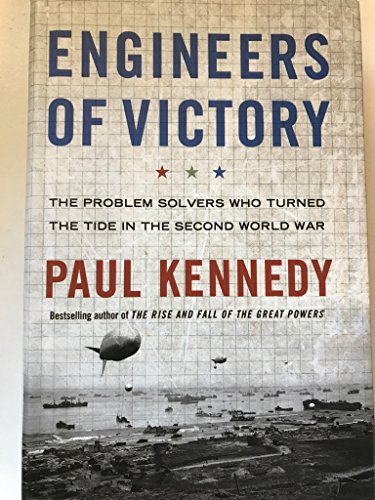
Paul Kennedy, award-winning author of The Rise and Fall of the Great Powers and one of today’s most renowned historians, now provides a new and unique look at how World War II was won.Engineers of Victory is a fascinating nuts-and-bolts account of the strategic factors that led to Allied victory. Kennedy reveals how the leaders’ grand strategy was carried out by the ordinary soldiers, scientists, engineers, and businessmen responsible for realizing their commanders’ visions of success.
In January 1943, FDR and Churchill convened in Casablanca and established the Allied objectives for the war: to defeat the Nazi blitzkrieg; to control the Atlantic sea lanes and the air over western and central Europe; to take the fight to the European mainland; and to end Japan’s imperialism. Astonishingly, a little over a year later, these ambitious goals had nearly all been accomplished. With riveting, tactical detail,Engineers of Victory reveals how.
Kennedy recounts the inside stories of the invention of the cavity magnetron, a miniature radar “as small as a soup plate,” and the Hedgehog, a multi-headed grenade launcher that allowed the Allies to overcome the threat to their convoys crossing the Atlantic; the critical decision by engineers to install a super-charged Rolls-Royce engine in the P-51 Mustang, creating a fighter plane more powerful than the Luftwaffe’s; and the innovative use of pontoon bridges (made from rafts strung together) to help Russian troops cross rivers and elude the Nazi blitzkrieg. He takes readers behind the scenes, unveiling exactly how thousands of individual Allied planes and fighting ships were choreographed to collectively pull off the invasion of Normandy, and illuminating how crew chiefs perfected the high-flying and inaccessible B-29 Superfortress that would drop the atomic bombs on Japan.
The story of World War II is often told as a grand narrative, as if it were fought by supermen or decided by fate. Here Kennedy uncovers the real heroes of the war, highlighting for the first time the creative strategies, tactics, and organizational decisions that made the lofty Allied objectives into a successful reality. In an even more significant way,Engineers of Victory has another claim to our attention, for it restores “the middle level of war” to its rightful place in history.
Praise for Engineers of Victory
“Superbly written and carefully documented . . . indispensable reading for anyone who seeks to understand how and why the Allies won.”—The Christian Science Monitor
“An important contribution to our understanding of World War II . . . Like an engineer who pries open a pocket watch to reveal its inner mechanics, [Paul] Kennedy tells how little-known men and women at lower levels helped win the war.”—Michael Beschloss,The New York Times Book Review
“Histories of World War II tend to concentrate on the leaders and generals at the top who make the big strategic decisions and on the lowly grunts at the bottom. . . . [Engineers of Victory] seeks to fill this gap in the historiography of World War II and does so triumphantly. . . . This book is a fine tribute.”—The Wall Street Journal
“[Kennedy] colorfully and convincingly illustrates the ingenuity and persistence of a few men who made all the difference.”—The Washington Post
“This superb book is Kennedy’s best.”—Foreign Affairs
Die Inhaltsangabe kann sich auf eine andere Ausgabe dieses Titels beziehen.
Über die Autorin bzw. den Autor
Paul Kennedy is internationally known for his writings and commentaries on global political, economic, and strategic issues. He earned his B.A. at Newcastle University and his doctorate at the University of Oxford. Since 1983, he has been the Dilworth Professor of History and director of international security studies at Yale University. He is on the editorial board of numerous scholarly journals and writes forThe New York Times, Los Angeles Times, The Atlantic, and many foreign-language newspapers and magazines. Kennedy is the author and editor of nineteen books, includingThe Rise and Fall of the Great Powers, which has been translated into more than twenty languages, followed byPreparing for the Twenty-first Century (1993), and The Parliament of Man (2006).
Auszug. © Genehmigter Nachdruck. Alle Rechte vorbehalten.
Chapter One
How to Get Convoys Safely Across the Atlantic
Thus was the stage set for Germany to fling into the Atlantic struggle the greatest possible strength. . . . It was plain to both sides that the U-boats and the convoy escorts would shortly be locked in a deadly, ruthless series of fights, in which no mercy would be expected and little shown. Nor would one battle, or a week’s or a month’s fighting, decide the issue. It would be decided by which side could endure the longer; by whether the stamina and strength of purpose of the crews of the Allied escort vessels and aircraft, watching and listening all the time for the hidden enemy, outlasted the will-power of the U-boat crews, lurking in the darkness or the depths, fearing the relentless tap of the asdic, the unseen eye of the radar and the crash of the depth charges. It depended on whether the men of the Merchant Navy, themselves almost powerless to defend their precious cargoes of fuel, munitions and food, could stand the strain of waiting day after day and night after night throughout the long, slow passages for the rending detonation of the torpedoes, which could send their ships to the bottom in a matter of seconds, or explode their cargoes in a searing sheet of flame from which there could be no escape. It was a battle between men, aided certainly by all the instruments and devices which science could provide, but still one that would be decided by the skill and endurance of men, and by the intensity of the moral purpose which inspired them. In all the long history of sea warfare there has been no parallel to this battle, whose field was thousands of square miles of ocean, and to which no limits in time or space could be set.
—S. W. Roskill, The War at Sea, 1939–1945
As Churchill and Roosevelt journeyed to and from Casablanca in January 1943, the weather in the North Atlantic had become as violent as any experienced sailor could remember. For much of December and January, huge storms at sea cramped naval and air activity. Merchant ships, pounded by giant waves, had heavy cargoes breaking loose and sliding around inside their hulls. Smaller warship escorts such as corvettes were tossed around like corks. Warships with heavier upperworks and gun turrets rolled from side to side. German U-boats, when they surfaced, could see nothing across the hundred-foot-high waves and were happy to submerge into quieter waters or to head south. Hundreds, perhaps thousands, of sailors were hurt, and not a few killed by accidents or washed overboard. In some extreme cases, the commander of a convoy was forced to order a return to base, or at least to send damaged ships back. General Sir Alan Brooke (later Viscount Alanbrooke) records in his diary that he, the other British Chiefs of Staff, and Churchill himself had their flight (or surface sailing) plans from London to Casablanca changed time and again.
The result, quite naturally, was that convoy activity upon the storm-whipped North Atlantic routes was much less than normal in these midwinter months. Quite separate from this physical interruption, there was a second and cheerier reason the regular convoy traffic fell away at this time. Operation Torch itself demanded a vast number of escorts to assist the occupation of the Vichy states of Morocco and Algeria—the Royal Navy contributed 160 warships of various types to it—and in consequence the Gibraltar, Sierra Leone, and Arctic convoys had to be temporarily suspended.1 Since ships carrying Allied troops, landing equipment, and immediate supplies were bound to get the highest level of naval protection, and the Axis was ill-prepared for the Operation Torch invasion because of its obsessions with the Eastern Front and Egypt, it is scarcely surprising that the invading forces met with little or no U-boat opposition on North African shores.
The other, understandable consequence was that Allied losses to enemy submarine attacks fell dramatically during midwinter. If there were fewer Atlantic convoys at sea in the first place, those that did sail, while battered by storms, were often protected by the same lousy weather conditions. Some were routed far to the north in a sort of great circle, trading physical damage by ice floes for distance from the wolf packs. The Admiralty’s monthly toll of shipping losses captured this dramatic decline well. For example, in November 1942 the Allies lost 119 merchant ships totaling 729,000 tons, and while many of these vessels were sunk in more distant waters, off South America, those supply lines were also part of an integrated effort aimed at sustaining and enhancing Anglo-American power in the British Isles. The sinking of British oil tankers coming from Trinidad would, as a consequence, hurt the buildup of the U.S. bomber groups in East Anglia; everything hung on command of the seas.
Because of the rough weather, U-boat sinkings in December and January fell to a mere 200,000 tons of Allied shipping, most of which also occurred on more southern routes (e.g., Trinidad to Gibraltar, to supply the Operation Torch armies). But the tallies for those months were exceptional, for the reasons explained above, and thus when the prime minister and president met at Casablanca they were under no illusion as to how serious the crisis over shipping losses had become. The Allied merchant fleets had lost a staggering 7.8 million tons in the course of 1942, almost 6.3 million of which had been sunk by that most formidable weapon, the U-boat. The amazing American mass production shipyards were still gearing up to full strength, but even their output in 1942 (around 7 million tons) meant that total available Allied shipping capacity had declined in absolute terms, and now had to compete with the even greater demands of the Pacific War. By early 1943, therefore, British imports were one-third less than those in 1939, and U.S. Army trucks and box-bound aircraft now competed with colonial foodstuffs, ores, and petroleum for space on the endangered merchant vessels. This grim fact imperiled everything in the European war strategy. It threatened the British war effort; if things got worse, it threatened mass malnutrition for the islanders. The heavy losses suffered by oil tankers meant that only two to three months of fuel remained in Britain’s storage tanks, but how could the country fight, or live, without fuel? This crisis also threatened the Arctic convoys to aid Russia, and the Mediterranean convoys to aid Malta and Egypt. It threatened, by extension, the entire Egyptian campaign, for Britain could scarcely send military reinforcements via Sierra Leone and the Cape of Good Hope to Suez if its own lifelines were being crushed. It even threatened unrest in parts of East Africa and India that had come to rely upon seaborne food imports. And it absolutely threatened the assumptions behind Operation Bolero (later renamed Overlord), which called for a rapid and massive buildup of the U.S. Army and the Army Air Forces in the British Isles in preparation for a second front in Europe; it would have been ironic to have sent 2,000 American heavy bombers and millions of GIs to England only to find that they had no fuel. Churchill later stated in his memoirs that, of all struggles of the war, it was the Battle of the Atlantic that he most worried about; if it was lost, so too might be Britain’s gamble to fight on in 1940.
In addition, although the Admiralty did not possess an exact tally of the enemy’s U-boats, there did seem to be an awful lot more of them. In the course of 1942 Allied warships and aircraft had destroyed eighty-seven German and twenty-two Italian submarines. But the Third Reich was also gearing up its war production and had added seventeen new U-boats each month during that year. By the end of 1942, therefore, Doenitz commanded a total of 212 submarines that were...
„Über diesen Titel“ kann sich auf eine andere Ausgabe dieses Titels beziehen.
Weitere beliebte Ausgaben desselben Titels

Suchergebnisse für Engineers of Victory: The Problem Solvers Who Turned...

Beispielbild für diese ISBN
Engineers of Victory The Probl
Anbieter: World of Books (was SecondSale), Montgomery, IL, USA
Verkäuferbewertung 5 von 5 Sternen

Zustand: Acceptable. Item in acceptable condition! Textbooks may not include supplemental items i.e. CDs, access codes etc. Artikel-Nr. 00101399601
Gebraucht kaufen
EUR 5,51
Versand gratis
Versand innerhalb von USA
Versand innerhalb von USA
Anzahl: 2 verfügbar
Beispielbild für diese ISBN
Engineers of Victory The Probl
Anbieter: World of Books (was SecondSale), Montgomery, IL, USA
Verkäuferbewertung 5 von 5 Sternen
Zustand: Good. Item in good condition. Textbooks may not include supplemental items i.e. CDs, access codes etc. Artikel-Nr. 00101078881
Gebraucht kaufen
EUR 5,51
Versand gratis
Versand innerhalb von USA
Versand innerhalb von USA
Anzahl: 3 verfügbar
Beispielbild für diese ISBN
Engineers of Victory: The Problem Solvers Who Turned The Tide in the Second World War
Anbieter: ThriftBooks-Phoenix, Phoenix, AZ, USA
Verkäuferbewertung 5 von 5 Sternen
Hardcover. Zustand: Good. No Jacket. Pages can have notes/highlighting. Spine may show signs of wear. ~ ThriftBooks: Read More, Spend Less. Artikel-Nr. G1400067618I3N00
Gebraucht kaufen
EUR 6,09
Versand gratis
Versand innerhalb von USA
Versand innerhalb von USA
Anzahl: 1 verfügbar
Beispielbild für diese ISBN
Engineers of Victory: The Problem Solvers Who Turned The Tide in the Second World War
Anbieter: ThriftBooks-Reno, Reno, NV, USA
Verkäuferbewertung 5 von 5 Sternen
Hardcover. Zustand: Fair. No Jacket. Former library book; Readable copy. Pages may have considerable notes/highlighting. ~ ThriftBooks: Read More, Spend Less. Artikel-Nr. G1400067618I5N10
Gebraucht kaufen
EUR 6,09
Versand gratis
Versand innerhalb von USA
Versand innerhalb von USA
Anzahl: 1 verfügbar
Beispielbild für diese ISBN
Engineers of Victory: The Problem Solvers Who Turned The Tide in the Second World War
Anbieter: ThriftBooks-Reno, Reno, NV, USA
Verkäuferbewertung 5 von 5 Sternen
Hardcover. Zustand: Good. No Jacket. Pages can have notes/highlighting. Spine may show signs of wear. ~ ThriftBooks: Read More, Spend Less. Artikel-Nr. G1400067618I3N00
Gebraucht kaufen
EUR 6,09
Versand gratis
Versand innerhalb von USA
Versand innerhalb von USA
Anzahl: 1 verfügbar
Beispielbild für diese ISBN
Engineers of Victory: The Problem Solvers Who Turned The Tide in the Second World War
Anbieter: ThriftBooks-Reno, Reno, NV, USA
Verkäuferbewertung 5 von 5 Sternen
Hardcover. Zustand: Very Good. No Jacket. Former library book; May have limited writing in cover pages. Pages are unmarked. ~ ThriftBooks: Read More, Spend Less. Artikel-Nr. G1400067618I4N10
Gebraucht kaufen
EUR 6,09
Versand gratis
Versand innerhalb von USA
Versand innerhalb von USA
Anzahl: 2 verfügbar
Beispielbild für diese ISBN
Engineers of Victory: The Problem Solvers Who Turned The Tide in the Second World War
Anbieter: ThriftBooks-Phoenix, Phoenix, AZ, USA
Verkäuferbewertung 5 von 5 Sternen
Hardcover. Zustand: Very Good. No Jacket. Former library book; May have limited writing in cover pages. Pages are unmarked. ~ ThriftBooks: Read More, Spend Less. Artikel-Nr. G1400067618I4N10
Gebraucht kaufen
EUR 6,09
Versand gratis
Versand innerhalb von USA
Versand innerhalb von USA
Anzahl: 1 verfügbar
Beispielbild für diese ISBN
Engineers of Victory: The Problem Solvers Who Turned The Tide in the Second World War
Anbieter: ThriftBooks-Phoenix, Phoenix, AZ, USA
Verkäuferbewertung 5 von 5 Sternen
Hardcover. Zustand: Good. No Jacket. Former library book; Pages can have notes/highlighting. Spine may show signs of wear. ~ ThriftBooks: Read More, Spend Less. Artikel-Nr. G1400067618I3N10
Gebraucht kaufen
EUR 6,09
Versand gratis
Versand innerhalb von USA
Versand innerhalb von USA
Anzahl: 1 verfügbar
Beispielbild für diese ISBN
Engineers of Victory: The Problem Solvers Who Turned The Tide in the Second World War
Anbieter: ThriftBooks-Atlanta, AUSTELL, GA, USA
Verkäuferbewertung 5 von 5 Sternen
Hardcover. Zustand: Very Good. No Jacket. Former library book; May have limited writing in cover pages. Pages are unmarked. ~ ThriftBooks: Read More, Spend Less. Artikel-Nr. G1400067618I4N10
Gebraucht kaufen
EUR 6,10
Versand gratis
Versand innerhalb von USA
Versand innerhalb von USA
Anzahl: 2 verfügbar
Beispielbild für diese ISBN
Engineers of Victory: The Problem Solvers Who Turned The Tide in the Second World War
Anbieter: ThriftBooks-Atlanta, AUSTELL, GA, USA
Verkäuferbewertung 5 von 5 Sternen
Hardcover. Zustand: Fair. No Jacket. Former library book; Readable copy. Pages may have considerable notes/highlighting. ~ ThriftBooks: Read More, Spend Less. Artikel-Nr. G1400067618I5N10
Gebraucht kaufen
EUR 6,10
Versand gratis
Versand innerhalb von USA
Versand innerhalb von USA
Anzahl: 1 verfügbar