Gesamtpreis (1 Artikel Artikel):
Versandziel:

ars graeca (28 Ergebnisse)
Stichwörter:
ars graeca
Mit der Detailsuche verfeinern
Direkt zu den wichtigsten Suchergebnissen
Suchfilter
Produktart
- Alle Product Types
- Bücher (28)
- Magazine & Zeitschriften (Keine weiteren Ergebnisse entsprechen dieser Verfeinerung)
- Comics (Keine weiteren Ergebnisse entsprechen dieser Verfeinerung)
- Noten (Keine weiteren Ergebnisse entsprechen dieser Verfeinerung)
- Kunst, Grafik & Poster (Keine weiteren Ergebnisse entsprechen dieser Verfeinerung)
- Fotografien (Keine weiteren Ergebnisse entsprechen dieser Verfeinerung)
- Karten (Keine weiteren Ergebnisse entsprechen dieser Verfeinerung)
- Manuskripte & Papierantiquitäten (Keine weiteren Ergebnisse entsprechen dieser Verfeinerung)
Zustand Mehr dazu
Einband
Weitere Eigenschaften
- Erstausgabe (1)
- Signiert (Keine weiteren Ergebnisse entsprechen dieser Verfeinerung)
- Schutzumschlag (Keine weiteren Ergebnisse entsprechen dieser Verfeinerung)
- Angebotsfoto (15)
Sprache (3)
Gratisversand
- Kostenloser Versand nach USA (Keine weiteren Ergebnisse entsprechen dieser Verfeinerung)
Land des Verkäufers
Verkäuferbewertung
-
Hardcover. Zustand: Fair. Beschriftungen / Markierungen; Ohne Umschlag; Leichte Risse; Gebogener Buchrücken; Farbveränderung durch Alter/Sonne.
-
Hardcover. Zustand: Fine. Leichte Risse.
-

Ars Graeca. Lehr- und Übungsbuch
Sprache: Altgriechisch
Verlag: Schoeningh Verlag Im Westermann Schulbuch, 1980
ISBN 10: 314012130X ISBN 13: 9783140121309
Zustand: As New. Leichte Abnutzungen. German Book. English title is Ars textbook and exercise book for the Greek class.
-
Ars Graeca : Grammatik
Anbieter: Antiquariat im Kaiserviertel | Wimbauer Buchversand, Dortmund, NRW, Deutschland
Verkäuferbewertung 5 von 5 Sternen

Pappband. Zustand: Befriedigend. 281 Seiten Kanten stark berieben / bestossen, angegilbt, Vorsatzfalze angeplatzt, papierbedingte Seitenbräunung /// Standort Wimregal HOM-31602 ISBN 9783140121446 el Gewicht in Gramm: 590.
-

Ars Graeca : Griechische Sprachlehre : Grammatik
Sprache: Deutsch
Verlag: Paderborn : Ferdinand Schöningh, 1967
Anbieter: art4us - Antiquariat, Bonn, Deutschland
Verkäuferbewertung 4 von 5 Sternen

Gr.-8°, Original-Pappband. Zustand: Gut. Schöningh-Buch 12144. 271 S. Einband gering berieben u. begriffen, Seiten dezent gebräunt, gutes Exemplar. 10-06-33 Aufgrund der EPR-Regelung kann zur Zeit in folgende Länder KEIN Versand mehr erfolgen: Bulgarien, Griechenland, Luxemburg, Österreich, Polen, Rumänien, Schweden, Slowakei. Bitte beachten Sie: Auf Grund der vorgegebenen Versandkosten von AbeBooks / ZVAB kann es bei Büchern über 1 kg oder bei mehrbändigen Werken zu höheren Versandkosten kommen. Please note: Due to the shipping costs specified by AbeBooks / ZVAB, there may be higher shipping costs for books over 1 kg or for multi-volume works. Sprache: Deutsch Gewicht in Gramm: 550.
-

Davidis Arnoldi Conradi Cryptographia Denudata, Sive Ars Deciferandi Quae Occulte Scripta Sunt In Quocumque Linguarum Genere Praecipue In Germanica, Batava, Latina, Anglica, Gallica, Italica, Graeca
Verlag: Creative Media Partners, LLC Nov 2013, 2013
ISBN 10: 129321907X ISBN 13: 9781293219072
Anbieter: AHA-BUCH GmbH, Einbeck, Deutschland
Verkäuferbewertung 5 von 5 Sternen
Taschenbuch. Zustand: Neu. Neuware.
-

Zustand: Used: Like New. inkl. Rechnung nach §19.
-

Ars Graeca. Griechische Sprachlehre. Grammatik.
Anbieter: Majestic Books, Hounslow, Vereinigtes Königreich
Verkäuferbewertung 4 von 5 Sternen
EUR 68,57
EUR 7,49 Versand
Versand von Vereinigtes Königreich nach USAAnzahl: 1 verfügbar
In den WarenkorbZustand: New.
-

Ars Graeca : Lehr- und Übungsbuch für den griechischen Anfangsunterricht
Sprache: Altgriechisch
Verlag: Schoeningh Verlag Feb 1980, 1980
ISBN 10: 314012130X ISBN 13: 9783140121309
Anbieter: AHA-BUCH GmbH, Einbeck, Deutschland
Verkäuferbewertung 5 von 5 Sternen
Taschenbuch. Zustand: Neu. Neuware.
-
Arrianou techne taktike, ektasis kat Alanon, periplous Pontou Eyzeinou, periplous tes Eruthras thalasses, kunegetikos, Epiktetou egcheiridion, tou autou apophthegmata kai apospasmatia, a en to Ioannou Stobaiou anthologio, kai en tais agelliou agrupniais attikais sozomena [greek letters] = Arriani ars tactica, acies contra alanos [ex interpretatione Johannis Schefferi], periplus Ponti Euxini, periplus maris Erythraei [ex interpretatione Johannis Guillelmi Stuckii], liber de venatione [Luca Holstenio interprete], Epicteti enchiridion [ex interpretatione Hier. Wolfii; accedunt notae H. Wolfii et Merici Is. Casauboni. Item paraphrasis graeca quam idem Casaubonus primus vulgavit. Epicteti enchiridion ab Angelo Politiano e graeco versum], ejusdem apopthegmata [sic] et fragmenta quae in Ioannis Stobaei florilegio et in Agellii noctibus atticis [et in Marci Aurelii Antonii libris] supersunt / cum interpretibus latinis & notis, ex recensione & museo Nicolai Blancardi.
Verlag: Amstelodami, Janssonio- Waesbergios [Amsterdam]., 1683
Anbieter: Antiquariat Michael Solder, Münster, NRW, Deutschland
Verkäuferbewertung 5 von 5 Sternen
Zustand: Gut. 2 Teile in einem Band. [14 nn SS. mit gestochenem, figürlichem Titelblatt], 450 Seiten mit zwei mehrfach ausfaltbaren Karten nach Abraham Ortelius und einem mehrfach ausfaltbaren taktischem Plan, [4 nn S.], sowie zahlreichen Abbildungen im Text mit taktischen Formationen. Ebert 1230; 'the best edition' (Dibdin I, page 331 (4th ed.); Griechisch-Lateinsiche Parallel-Ausgabe von Arrians Taktischem Traktat, samt Kommentar und Praphrase, sowie des gesuchten Epitktets Enchiridions.Geschrieben 136/137 n. Chr. (Im 20. Jahr von Hadrian[34]), Techne Taktike ist eine Abhandlung über römische Kavallerie und militärische Taktiken und enthält Informationen über Art, Waffen und Disziplin der Phalanx. Das Hippika-Turnhalle ist ein besonderes Anliegen von Arrian in der Abhandlung. Mit der großen Karten des Indischen Ozeans mit zwei Kartuschen nach Abraham Ortelius. Titlepages: Engraving by Jan van den Aveele. Scenes apparently depict four of the works of Arrian: top: army tactics (Techne Taktike), middle: hunting (Cynegeticus), bottom left: ships (Periplus of the Euxine Sea), bottom right: philosopher's school (Enchiridion of Epictetus). gr Gewicht in Gramm: 2500 Groß- Oktav Ganzlederband der Zeit mit restauriertem Rücken.
-

Antonii Riccoboni Rhodogini De historia commentarius. cum fragmentis ab eodem Antonio summa diligentia collectis M. Porcii Catonis Censorii, Q. Claudii Quadrigariii, L. Sisennae, C. Crispi Salusti, M. Terentii Varronis ex scholiis Antonii in eadem fragmenta.
Verlag: Apud Ionannem Barilettum, Venetiis, 1568
Anbieter: Antiquariat Leseband, Freiburg, Deutschland
Verkäuferbewertung 4 von 5 Sternen
Erstausgabe
Hardcover. Zustand: Gut. 278 Blätter+ 4 Blätter ( "Verba graeca latinis expressa" und "Errata": dieser Teil ist offensichtlich nicht in allen Ausgaben). Kleinoktav. Ledereinband der Zeit mit einer vollständigen Schließe, die andere ist nur teilweise erhalten. Rückenschild mit Titel (handgeschrieben). Der Einband ist teilweise lädiert. Feste Buchbindung. Innen sehr sauber, keine Papierbräunung. Auf dem Titelblatt ein Stempel und einer Notiz. Titel auf dem Buchschnitt. Antonio Riccoboni (Rovigo 1541-Padua 1599) italinenischer Humanist und Literaturtheoretiker ist der Verfasser unter anderen von Kommentaren zur Ethik, Poetik, Rhetorik des Aristoteles). Er unterichtete Rhetorik in Padua; er wurde auch deren erster Stadtchronist" (vgl. Enciclopedia italiana, Trecani, sub voce). Das hier angebotene Buch vereint eine Abhandlung über die Geschichtsschreibung und die erste Fragmentensammlung der römischen Historiker überhaupt von Cato bis Varro (vor der des Antonio Agustín). Der Essay gehört zum humanistischen Genre der Abhandlungen zur Geschichtsschreibung ( "ars historica"). Bei dem Buch handelt sich um die erste Ausgabe von 1568. Im Jahr 1579 erschien eine letzte Ausgabe in Basel: nach dem Karlsruher Virtuellen Katalog sowie nach Cornell (siehe unten). Die Abhandlung wurde aber separat mit anderen ähnlichen humanistischen Traktaten ebenfalls in Basel 1576 abgedruckt. Die zweite Ausgsabe des hier angebotenen Werkes erlebte in Basel eine zweite und letzte Auflage, in der Riccoboni die Fragmente des Varro ergänzte und die Fragmente von weiteren neuen 22 Historikern hinzufügte. Zur Methode der Fragmentensammlung merken Pobjoy und Rich kritisch an: "Riccoboni supplied some explanatory comments to accompany his fragments but his collection of fragments for his chosen authors was very incomplete, in particular making little use of Greek sources and none of Dionysius of Halicarnassos, and he often merely summarized his sources rahter than quoting them verbatim" (S. 653). Anthony Grafton: "What was history? , Cambridge UP 200/. 81 erwähnt das Buch nicht ohne fehlerhafte Angaben und sagt nichts über diese relativ frühe Reflexion über die Geschichtsschreibung: grossartig! Vgl. zum angebotenem Werk . M. P. Pobjoy /J. W. Rich, in "The Fragments of the Roman Historians", T. J. Cornell (general editor), 3 Bände, Oxford UP. 2013: I 652-653. Vgl. allgemein zum Verfasser Giancarlo Mazzacurati: La crisi dell retorica umanistica nel Seicento (antonio Riccobono), Napoli 1961. Buch.
-
Ars Graeca: Lehr- und Übungsbuch für den griechischen Anfangsunterricht
Sprache: Altgriechisch
Verlag: Westermann Bildungsmedien Verlag GmbH, 1980
ISBN 10: 314012130X ISBN 13: 9783140121309
Anbieter: Studibuch, Stuttgart, Deutschland
Verkäuferbewertung 5 von 5 Sternen
paperback. Zustand: Befriedigend. 196 Seiten; 9783140121309.4 Gewicht in Gramm: 500.
-

Taschenbuch. Zustand: Neu. Ars Graeca | Lehr- und Übungsbuch für den griechischen Anfangsunterricht | Otto Leggewie (u. a.) | Taschenbuch | zahlr. Abb., mit 16 S. Erläuterungen zu den Abb.,Mit Beiheft: Erläuterungen zu den Abb. | 196 S. | Deutsch | 2001 | Schöningh Verlag | EAN 9783140121309 | Verantwortliche Person für die EU: Westermann Bildungsmedien Verlag GmbH, Georg-Westermann-Allee 66, 38104 Braunschweig, service[at]westermann[dot]de | Anbieter: preigu.
-

Ars Graeca. Griechische Sprachlehre. Grammatik
Sprache: Deutsch
Verlag: Schoeningh Verlag Dez 1981, 1981
ISBN 10: 314012144X ISBN 13: 9783140121446
Anbieter: AHA-BUCH GmbH, Einbeck, Deutschland
Verkäuferbewertung 5 von 5 Sternen
Buch. Zustand: Neu. Neuware - Die Grammatik ordnet den Stoff gelegentlich stärker von didaktischen Erwägungen her als von Gesichtspunkten streng wissenschaftlicher Systematik. Auf die übersichtliche Darbietung des Stoffs wurde sehr stark geachtet (zahlreiche tabellarische Übersichten).
-
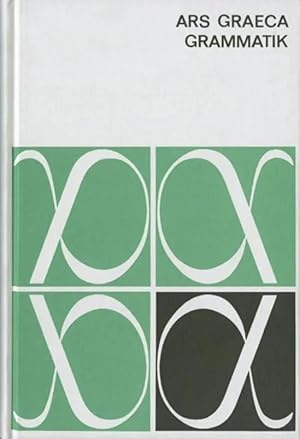
Buch. Zustand: Neu. Ars Graeca. Griechische Sprachlehre. Grammatik | Otto Leggewie | Buch | XII | Deutsch | 2001 | Schöningh Verlag | EAN 9783140121446 | Verantwortliche Person für die EU: Westermann Bildungsmedien Verlag GmbH, Georg-Westermann-Allee 66, 38104 Braunschweig, service[at]westermann[dot]de | Anbieter: preigu.
-
Zustand: good. Befriedigend/Good: Durchschnittlich erhaltenes Buch bzw. Schutzumschlag mit Gebrauchsspuren, aber vollständigen Seiten. / Describes the average WORN book or dust jacket that has all the pages present.
-
Zustand: very good. Gut/Very good: Buch bzw. Schutzumschlag mit wenigen Gebrauchsspuren an Einband, Schutzumschlag oder Seiten. / Describes a book or dust jacket that does show some signs of wear on either the binding, dust jacket or pages.
-
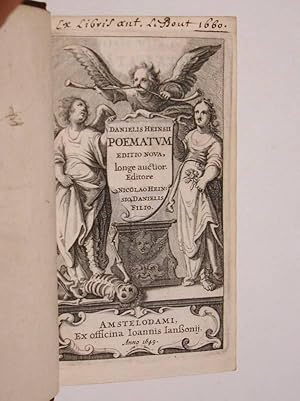
Danielis Heinsii Poemata Latina et Graeca; Editio post plurimas postrema longe auctior.
Verlag: Amsterdam (Amstelodami), Apud Joannem Janssonium, 1649., 1649
Anbieter: Antiquariaat Fragmenta Selecta, AMSTERDAM, Niederlande
Verkäuferbewertung 5 von 5 Sternen
12mo. (XII),666,(2 errata),(4 blank) p., frontispiece. Calf 13.5 cm 'Elegantly printed edition of Heinsius' collective neo-Latin & neo-Greek poetry' (Ref: STCN ppn 850068738; Cf. Willems 1613; Berghman 865; Rahir 2013; Ebert 9380; Brunet 3,84; Graesse 3,232; Ebert 9380) (Details: Back elaborately gilt, with 5 raised bands, and with a red morocco letterpiece in the second compartment. Boards with tripple fillet gilt borders, within which is another tripple fillet rectangle with cornerpieces. Marbled endpapers. Engraved frontispiece, depicting a kind of altar on which rests a shield with text; the altar is flanked by an angel and a girl; the angel tramples on a skeleton; above this scene soars a winged Fama, blowing two horns) (Condition: Joints slightly rubbed. Two small wormholes in the leather at the foot of the spine, and some damage to the lower edge of lower board for ca. one cm. Small hole in the leather of rear cover. On the blank upper margin of the frontispiece an ownership entry) (Note: The Dutch classical scholar of Flemish origin Daniel Heinsius, 1580-1655, who enjoyed international fame as an editor of classical texts, theorist of literary criticism, historian and neolatin poet, was professor of Poetics at the University of Leiden since 1603, extraordinarius Greek since 1605. After the death of J.J. Scaliger, to whose inner circle he belonged, he held the chair of Greek, from 1609 till 1647. He is best known for his edition of Aristotle's treatise on poetry (1611), which he studied in connection with the 'Ars Poetica' of Horace. This edition is 'the only considerable contribution to the criticism and eludication of the work that was ever produced in the Netherlands. (.) In his pamphlet 'De tragoediae Constitutione', published in the same year (1611), he deals with all the essential points in Aristotle's treatise, giving proof that he has thoroughly imbibed the author's spirit. (.) It was through this work that he became a centre of Aristotelian influence in Holland. His influence extended, in France, to Chaplain, and Balzac, to Racine and Corneille; in Germany to Opitz; and in England to Ben Jonson'. (J.E. Sandys, 'A history of classical scholarship, N.Y., 1964, vol. 2, p. 314) Heinsius was a representative of the great age of Neo-Latin in the Low Countries, which encompasses the 16th century, and a good part of the 17th century. Here the Anacreontic-Petrarcan love poetry in Latin was kept alive. (J. IJsewijn, 'Companion to Neo-Latin studies', vol. 1, Leuven 1990, p. 154) This volume of Heinsius' poetry, which was, as the text of the frontispiece tell us, edited by his son Nicolaus Heinsius, opens with early work, the three books of Sylvae, followed by Hipponax, an Ode to Molinus, 3 books of Elegiae, and the Monobiblos. Then comes the 'Herodes Infanticida, tragoedia', followed by Heinsius' last long Latin poem 'De contemptu mortis', a didactic poem in 4 books, wherein arguments, Platonic, Stoic and Christian, are set forth which explain why man should not fear death. Then Heinsius' Epigrams and occasional poetry, the 'Elegiarum iuvenilium libri'. At the end we find Heinsius' literary tour de force, his Greek poems, which were inspired by Theocritus and the Anthologia Graeca. It opens with 'Peplus' (Gown), a series of epigrams which Heinsius composed on Greek authors and philosophers. This part is followed by occasional poetry in Greek which Heinsius wrote for his contemporaries, like Casaubon, and by a section with Heinsius' Latin translations of Greek poetry. The collection closes with the 'Liber adoptivus', which contains occasional poetry addressed to Heinsius by J.J. Scaliger, J. Dousa, H. Grotius et alii. This edition of 1649 is a reissue of an edition of the collected greek and latin poetry of Heinsius, which was published by Heger in Leiden in 1640) (Provenance: 'Ex libris 'Ant. La Bout, 1660', or 'Ant. LaBout') (Collation: *6, A- D12, 2E-2F6 (leaves 2F5 & 2F6 blank)) (Photographs on request) 500 gr.
-
(Danielis Heinsii Poematum editio nova. Accedunt praeter alia libri, 'De Contemptu Mortis' antehac una non editi)
Verlag: Ad 1: (Leiden (Lugduni Batavorum), Sumptibus Elzeviriorum, et Ioannis Mairii, 1621) Ad 2: Leiden (Lugd. Batavorum), Ex Officina Elzeviriana, 1621., 1621
Anbieter: Antiquariaat Fragmenta Selecta, AMSTERDAM, Niederlande
Verkäuferbewertung 5 von 5 Sternen
8vo. 2 volumes in 1: (VIII),474 (recte 478),(2 blank); (VI),167 (recte 165),(19 index) p. Red morocco. 14 cm (Ref: STCN ppn 832974838; Willems 187; according to Willems 'on lit sur le dern. f.: Lugduni Batavorum, typis Isaaci Elsevirii, iurati Academiae typographi, 1622; our copy has 1621. A mistake of Willems?; Berghman 862 & 863; Rahir 158 & 159; Breugelmans p. 180, 1621:3; Brunet 3,83; Ebert 9378) (Details: Charming copy. Back with 5 raised bands and ruled gilt. Boards with gilt borders and edges. Inside gilt dentelles. Edges of the bookblock gilt. Marbled endpapers. The title-page of the first volume is lacking and has been replaced by the title-page of the second volume. This title-page is printed in red and black. Elsevier's woodcut printer's mark on the title, depicting an old man standing in the shade of a vine-entwined elmtree, symbolising the symbiotic relationship between scholar and publisher. The motto is: 'Non solus'. Engraved portrait of Homer on p. 264 of the first volume) (Condition: Title-page of the first volume is lacking and has been replaced by the title-page of the second volume. Some wear to the extremes) (Note: The Dutch classical scholar of Flemish origin Daniel Heinsius, 1580-1655, who enjoyed international fame as an editor of classical texts, theorist of literary criticism, historian and neolatin poet, was professor of Poetics at the University of Leiden since 1603, extraordinarius Greek since 1605. After the death of J.J. Scaliger, to whose inner circle he belonged, he held the chair of Greek, from 1609 till 1647. He is best known for his edition of Aristotle's treatise on poetry (1611), which he studied in connexion with the 'Ars Poetica' of Horace. (.). In his pamphlet 'De tragoediae Constitutione', published in the same year (1611), he deals with all the essential points in Aristotle's treatise, giving proof that he has thoroughly imbibed the author's spirit. (.) It was through this work that he became a centre of Aristotelian influence in Holland. His influence extended, in France, to Chaplain and Balzac, to Racine and Corneille; in Germany to Opitz; and in England to Ben Jonson (.)'. (J.E. Sandys, 'A history of classical scholarship, N.Y. 1964, vol. 2, p. 314) Heinsius was a representative of the great age of Neo-Latin in the Low Countries, which encompasses the 16th century, and a good part of the 17th century. Here the Anacreontic-Petrarcan love poetry in Latin was kept alive. (J. IJsewijn, 'Companion to Neo-Latin studies', vol. 1, Leuven 1990, p. 154). The first part of this collection of Heinsius' poetry opens with early work, the 3 books of Sylvae, followed by Hipponax, 3 books of Elegiae, and Monobiblos. Then Heinsius' Epigrams and some occasional poetry; 125 pages with Greek poems, inspired by Theocritus and the Anthologia Graeca. The part with Greek poems starts with 'Peplus' (Gown), a series of epigrams which Heinsius composed on Greek authors and philosophers. This part is followed by 40 p. of Greek poetry in Latin translation, 'Elegiarum iuvenilium reliquiae', and is concluded with the 'Liber adoptivus'. The second volume contains Heinsius' last long Latin poem 'De contemptu mortis' (1621). It is a didactic poem, the finest of its time, in 4 books, wherein arguments, Platonic, Stoic and Christian, are set forth which explain why man should not fear death) (Collation: Pagination sometimes confusing. +1 (title-page of volume 2), *4 (minus leaf *1, the title-page of volume 1), A-2G8 (Gathering P begins with p. 223, in stead of 225, i.e. doubling p. 223 & 224; gathering Q begins with 237 in stead of 239, i.e. doubling 237 & 238). +4 (minus leaf +1, which replaces the title-page of volume 1), A-L8, M4 (In gathering I the pagination 129 & 130 is skipped) (Photographs on request) 400 gr.
-
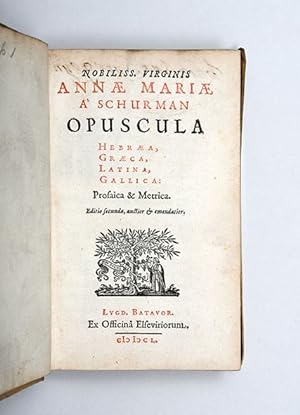
Opuscula Hebraea, Graeca, Latina, Gallica. Prosaica & Metrica.
Verlag: Leiden: Elzevir Press, 1650, 1650
Anbieter: Peter Harrington. ABA/ ILAB., London, Vereinigtes Königreich
Verbandsmitglied: ABA ILAB PBFA
Verkäuferbewertung 5 von 5 Sternen
EUR 2.078,07
EUR 25,36 Versand
Versand von Vereinigtes Königreich nach USAAnzahl: 1 verfügbar
In den WarenkorbSecond and expanded edition of the most famous work by the Dutch polymath and proto-feminist Anna Maria van Schurman, first published in 1648. Comprising over 70 letters in Latin, Greek, Hebrew and French, a striking self-portrait, and a reprint of her treatise on the rights of women to education, Opuscula definitively affirmed Van Schurman's authoritative standing in the Republic of Letters. Anna Maria van Schurman (1607-1678) was "regarded throughout the 17th century as the most learned woman not only of the Netherlands but also of Europe. She was 'the Star of Utrecht', 'the Tenth Muse', 'a miracle of her sex'. As the first woman to attend non-officially a university, she was also the first to advocate, boldly, that women should be admitted into universities. A brilliant linguist, she mastered at least 14 languages and was the first Dutch woman to seek publication of her correspondence. Her letters in several languages to the intellectual men and women of her time reveal the breadth of her interests in theology, philosophy, medicine, education, literature, painting, sculpture, embroidery, and instrumental music" (Oxford Bibliographies entry). Notable among her correspondents are Antoinette Bourignon, René Descartes, Pierre Gassendi, Bathsua Makin, and André Rivet, as well as royal figures like Queen Christina of Sweden. She also served as an academic mentor to Princess Elizabeth of the Palatinate. In later life, Van Schurman joined the Labadist religious community, for whom she composed several devotional works. Appearing at the height of Van Schurman's fame, Opuscula was instrumental in structuring her positive identity in the male-dominated sphere of artists and authors. It also established her reputation as a humanist polyglot, proficient in classical and modern languages, including Arabic and Syriac (see p. 10). The book was published by the most prestigious contemporary publisher in Leiden, and it opens with an iconic engraved self-portrait of the author, with a Latin inscription below: "Cernitis hic picta nostros in imagine vultus: si negas ars formam, gratia vestra dabit", meaning "See my features portrayed in this image; if art denies beauty, then your favour will grant it". Van Schurman had studied under the famous engraver Magdalena van de Passe and was a talented artist; here, she adopted the format of the oval with inscription, which was typical of male portraits. In addition to her Latin essays Dissertatio and De vitae termino, a selection of her letters on theological, philological, and philosophical subjects, and her poems, a significant portion of the volume is dedicated to acquaintances' praise of her abilities: "In these verses, frequent comparisons are made not only with the goddess Minerva but also with Sappho Van Schurman was labelled a 'virago', or a woman who engages in violent battle. One verse even compares her to the ancient Amazons Adolph Vorstius calls her a heroine of noble name and uncommon courage" (Peacock, pp. 121-1). This second edition was expanded with an additional laudatory poem by Van Schurman's friend the "swan" Utricia Ogle, accomplished singer and musician (p. 369), and a final letter of appreciation from Van Schurman to the editor, the theology professor Heinrich Spanheim the Elder. The book enjoyed an enormous popularity, with a third edition appearing in 1652, and subsequent editions in 1672 and 1700. In 1658 and 1678, Opuscula was included in the Index for reasons today unknown. Scholars suggest that the ban might have helped the book's popularity even more (see Beek, p. 272). This copy has contemporary Dutch provenance, with the manuscript ownership inscription dated 1655 of Johan van Sijpesteijn on the title page verso. This was possibly the soldier Jan van Sijpesteijn (1633-1669), a member of the noble van Sijpesteijn family of Amsterdam. The book was later in the library of the Leigh family of West Hall, with its 18th-century armorial bookplate engraved by Bickham the Younger (c.1706-1771) to the front pastedown; the owner was possibly Egerton Leigh (1702-1760), Anglican clergyman, landowner, and antiquary. This copy was latterly in the collection of Robert J. Hayhurst (1929-2016), noted Lancashire bibliophile and chemist. Pieta van Beek, "Alpha Virginum, Anna Maria van Schurman (1607-1678)", in Women Writing Latin: Early Modern Women Writing Latin, 2013; Bo Karen Lee & Anne Larsen, "Anna Maria van Schurman", in Oxford Bibliographies: Renaissance and Reformation; Martha Moffitt Peacock, Heroines, Harpies, and Housewives: Imaging Women of Consequence in the Dutch Golden Age, 2020. Small octavo (155 x 94 mm). Title page printed in red and black, with woodcut printer's device, woodcut floriated initials and headpieces. Contemporary vellum, yapp edges, edges sprinkled blue. Vellum soiled and gently rubbed, faint toning to head of title page, contents generally clean and fresh. A very good, crisp copy, notably square.
-
Demosthenis et Aeschinis Mutuae accusationes de ementita Legatione, et de Corona, ac contra Timarchum quinque numero, cum earum argumentis, ipsorum oratorum vita, et Aeschinis Epistola ad Athenienses, ac indice copioso. Nuper a bene docto viro traductae. Dictorum series versa pagina conintetur. Cum Privilegio Veneto.
Verlag: Venice (Venetiis), Apud Hieronymum Scotum, 1545., 1545
Anbieter: Antiquariaat Fragmenta Selecta, AMSTERDAM, Niederlande
Verkäuferbewertung 5 von 5 Sternen
EUR 1.600,00
EUR 24,00 Versand
Versand von Niederlande nach USAAnzahl: 1 verfügbar
In den Warenkorb223,(1 blank) leaves. Limp overlapping vellum. 16 cm (Ref: Edit16 CNCE 16736; Hoffmann 1,528) (Details: Latin translation only. Woodcut printer's mark on the title page and at the end of the book, depicting a branch of olive and a palm tree, graft onto a trunk, with between them an anchor; anchor and trunk are held together bij the initials SOS (Signum Octaviani Scoti); a banner runs around with the motto: 'In tenebris fulget'. Printed in italics, except for the title. Some historiated and ornamental woodcut initials) (Condition: Vellum age-tanned and slightly soiled. 2 tiny holes in both boards, because of the 2 ties which have disappeared) (Note: In the preface of this book the learned anonymous translator explains his readers that it was his aim to collect for those who are not able to read Greek (qui graeca non legerant) in one volume (in unum eundemque codicem ac seorsum ab reliquis) five speeches, translated into Latin, of Demosthenes and Aeschines, because those speeches, full of mutual accusations and attacks, belonged together (inter se sint connexae (.) ut una ab altera divelli non possit). They shared the same actors and the same subject matter, and showed to the consent of all, the power of speech, and the art of oratory in her perfection (tota ars dicendi & vis orandi). Demosthenes and Aeschines were at daggers drawn, and therefore the collections begins with the 'Contra Timarchum oratio', because this speech was the beginning of their enmity (quod inde Demosthenis & Aeschinis inimicitiae exordium habuerint). In this preface he severely criticizes the clumsy Latin translation of Leonardus Aretinus (Leonardo Aretino, known to us also as Leonardo Bruni, ca. 1370-1444). He calls his translations 'mendosae' and unreliable. The anonymous translator not only translated speeches of Demosthenes and Aeschines, he added also relevant material from other sources, such as Libanius, Philostratus, and Apollonius, which he now translates into Latin for the first time (adiunctis tam Libanii quam aliorum argumentis ad eas ipsas orationes). (Interpres lectori S.P.D., leaf 2/3) Translated are beside Aeschines' 'Contra Timarchum Oratio', the 'Oratio de ementita legatione' of Demosthenes and Aeschines, now commonly known as 'De falsa legatione', and the 'Oratio contra Ctesiphontem de Corona', and the 'Oratio de Corona pro Ctesiphonte' of both men. Added are biographic sketches, argumenta and testimonia. § The Athenian Demosthenes, 384-322 BC, was without doubt the greatest orator of his time. His surviving speeches are mostly connected with his politics. He was a fierce opponent of Philippus II, king of Macedon since 359, who gradually tried to subject the whole of Greece. In 351 he delivered his first Philippic, against him. His speeches against Philippus, known as Philippics, are one long warning against the growing Macedonian power. Demosthenes attacked also the pro-Macedonian elements in Athens, who sought peace with Philippus, and wanted to give in. One of their leaders was the orator Aeschines, 389-314 BC. In 345 Demosthenes and his Athenian ally Timarchus tried to impeach in a speech, called 'De falsa legatione' or 'On the false embassy', Aeschines 'for wilfully neglecting the interest of Athens as a member of the embassy which had negociated the peace' (H.J. Rose, A handbook of Greek literature, London 1965, p. 291). Demosthenes held Aeschines responsible for Philip's use of the peace negotiations to intervene in other Greek city-states. Demosthenes was unsuccessful and Aeschines was acquitted, having delivered a speech in which he defends himself against accusations of treason and collusion with the enemy. Instead of refuting the accusations directly, Aeschines used Athenian Civil Procedure to argue against Timarchus as a qualified prosecutor. The feud reached its peak in 330 with Demosthenes' most famous oratorical effort, the so-called speech 'On the Crown'. A member of his party, Ctesiphon, had proposed in 336 to honor Demosthenes for his services, as was customary, with a golden crown. Nothing came of it the next 6 years, mainly because Aeschines accused Ctesiphon of legal irregularities, but in effect he attacked Demosthenes' policy. In 330, after a charge of Aeschines, 'Demosthenes replied in the masterpiece, commonly known in modern times as the 'De Corona'. It is partly a formal rebuttal of the charge against Ktesiphon, but this is the weakest part of it, for technically Aischines had the law on his side. Substantially, it is a magnificent defence of the principles guiding the anti-Macedonian party, justifying them in face of failure. Less to modern taste is its bitter personal attack on Aischines, who however had not spared Demosthenes in his own speech'. (Rose, p. 292)) (Provenance: On the front flyleaf in pencil '7 januari 1961', written by the Flemish linguist Walter Couvreur, 1914-1996, who was an Orientalist, and professor of Indoeuropean linguistics at the University of Gent. It is the date of acquisition. The place of acquisition he wrote on the flyleaf at the end: 'Turijn, Bottega d'Erasmo') (Collation: A-2E8, last leaf blank, pagination sometimes irregular) (Photographs on request) 1000 gr.
-
![Bild des Verkäufers für Nicolai Leoniceni Vicentini In libros Galeni e Graeca in Latinam linguam a se translatos praefatio communis. Eiusdem in Artem medicinalem Galeni [.] praefatio [.] Galeni Ars medicinalis, quae et ars parua dicitur, Nicolao Leo. interprete [.] Eiusdem ad Franciscum Castellum [.] in opus de tribus doctrinis ordinatis secundum Galeni sententiam, praefatio. Eiusdem De tribus doctrinis ordinatis secundum Galeni sententiam opus. Galeni in aphorismos Hippocratis, cum ipsis aphorismis, eodem Nicolao Leoniceno interprete. zum Verkauf von Libreria Oreste Gozzini snc](https://pictures.abebooks.com/inventory/md/md20434395347.jpg)
Nicolai Leoniceni Vicentini In libros Galeni e Graeca in Latinam linguam a se translatos praefatio communis. Eiusdem in Artem medicinalem Galeni [.] praefatio [.] Galeni Ars medicinalis, quae et ars parua dicitur, Nicolao Leo. interprete [.] Eiusdem ad Franciscum Castellum [.] in opus de tribus doctrinis ordinatis secundum Galeni sententiam, praefatio. Eiusdem De tribus doctrinis ordinatis secundum Galeni sententiam opus. Galeni in aphorismos Hippocratis, cum ipsis aphorismis, eodem Nicolao Leoniceno interprete.
Anbieter: Libreria Oreste Gozzini snc, Firenze, FI, Italien
Verkäuferbewertung 5 von 5 Sternen
[Impressum Ferrariae, per Ioannem Macciochium Bondenum, V. nonas Octobris 1509), in-folio, cartonatura settecentesca (staccata e rovinata, volume in parte sciolto), carte da II a XXXVIII, [4], LVII, da LIX a LXXII. Mancano le carte: A1 (front.), G3, G4, G5, G6, R4 e l'intero fascicolo finale V, formato da 6 carte. Leggera gora alle prime carte, rari forellini di tarlo sempre marginali, alcune note manoscritte nel XVI secolo sui margini bianchi, una carta brunita. Biliotheca Osleriana n. 172 (anche in questo caso un frammento dell'edizione).
-

Zustand: acceptable. Ausreichend/Acceptable: Exemplar mit vollständigem Text und sämtlichen Abbildungen oder Karten. Schmutztitel oder Vorsatz können fehlen. Einband bzw. Schutzumschlag weisen unter Umständen starke Gebrauchsspuren auf. / Describes a book or dust jacket that has the complete text pages (including those with maps or plates) but may lack endpapers, half-title, etc. (which must be noted). Binding, dust jacket (if any), etc may also be worn.
-
Zustand: good. Befriedigend/Good: Durchschnittlich erhaltenes Buch bzw. Schutzumschlag mit Gebrauchsspuren, aber vollständigen Seiten. / Describes the average WORN book or dust jacket that has all the pages present.
-
Zustand: good. Befriedigend/Good: Durchschnittlich erhaltenes Buch bzw. Schutzumschlag mit Gebrauchsspuren, aber vollständigen Seiten. / Describes the average WORN book or dust jacket that has all the pages present.
-
Zustand: very good. Gut/Very good: Buch bzw. Schutzumschlag mit wenigen Gebrauchsspuren an Einband, Schutzumschlag oder Seiten. / Describes a book or dust jacket that does show some signs of wear on either the binding, dust jacket or pages.
-
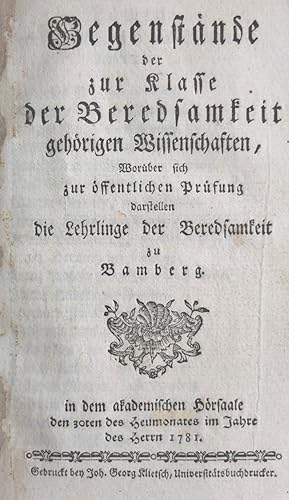
Entwurf auserlesener Gegenstände von der Beredsamkeit und den schönen Wissenschaften, über welche sich zur öffentlicher Prüfung darstellen die Lehrlinge der Beredsamkeit zu Bamberg in dem akademischen Hörsaale den 31ten des Heumonates im Jahre des Herrn 1780. Angebunden: Gegenstände der zur Klasse der Beredsamkeit gehörigen Wissenschaften, ?. 1781. Und: Introductio in Eloquentiam, Eloquentia Theoretica, Geographia, Lingua Graeca, Exercitationis, Eloquentia Profana, Eloquentia Practica Sacra, Poesis, Elementa Mathematica. Mit einem Nachwort von BELA KUN.
Sprache: Deutsch
Verlag: Gedruckt bey Joh. Georg Klietsch, Universitäts-Buchdrucker, 1780 und 1781.,, 1780
Anbieter: Antiquariat Elvira Tasbach, Berlin, Deutschland
Verkäuferbewertung 5 von 5 Sternen
Titel 1: Titelblatt, 36 Seiten. Titel 2: 10 nichtnummerierte Seiten, 29 Seiten. Titel 3: 1 weißes Blatt, 40 Seiten. (Rücken etwas fleckig und mit kleinerem Einriß, Ecken berieben), Selten, für uns über den KVK nur in Bamberg und München nachweisbar. Behandelt ausführlich und mit vielen historischen Bezügen Lobreden, Trauerreden, Ehrenreden, Strafreden, Sittenreden, Homilien, Parabel-Predigten, Geheimnisreden, Controversreden u.v.a.m. Angebunden ist ein Text in lateinischer Sprache `Introductio in Eloquentiam`. Hier wurden weiße Blätter zwischengebunden, auf denen in gut lesbarer Schrift Ergebnisse eines Unterrichts oder Lektüre festgehalten sind (`Quid est eloquentia?`, `Quid est ars?`, `Astrologia` u.a.m.). - Titelblatt mit altem Stempel, nur vereinzelt kleine Flecken, sonst wohlerhalten. Sprache: Deutsch Gewicht in Gramm: 1000 Halbpergament-Band der Zeit, Deckel mit hübschen Kleisterpapierbezügen, dreiseitiger Blauschnitt 18,5 x 11 cm.
-

Ars Graeca; Teil: Griechische Sprachlehre. neu bearb. von Rolf Mehrlein .
Anbieter: Antiquariat BehnkeBuch, Neu Kaliß, Deutschland
Verbandsmitglied: GIAQ
Verkäuferbewertung 5 von 5 Sternen
24*16 cm. OPappband. XII, 284 S. Einband fleckig und bestossen. Private Folienklebung. Besitzervermerk auf Vorsatzblatt. Seiten wasserrandig und wasserfleckig. Marginale Bleistift-Notizen, Arbeitsexemplar. L13-2 ISBN 3506121448 Wichtiger Hinweis: Aufgrund der EPR-Regelung zur Zeit KEIN Versand in EU-Länder. Due to EPR, there is currently no delivery to EU-countries. Sprache: Deutsch Gewicht in Gramm: 700.


![Bild des Verkäufers für Arrianou techne taktike, ektasis kat Alanon, periplous Pontou Eyzeinou, periplous tes Eruthras thalasses, kunegetikos, Epiktetou egcheiridion, tou autou apophthegmata kai apospasmatia, a en to Ioannou Stobaiou anthologio, kai en tais agelliou agrupniais attikais sozomena [greek letters] = Arriani ars tactica, acies contra alanos [ex interpretatione Johannis Schefferi], periplus Ponti Euxini, periplus maris Erythraei [ex interpretatione Johannis Guillelmi Stuckii], liber de venatione [Luca Holstenio interprete], Epicteti enchiridion [ex interpretatione Hier. Wolfii; accedunt notae H. Wolfii et Merici Is. Casauboni. Item paraphrasis graeca quam idem Casaubonus primus vulgavit. Epicteti enchiridion ab Angelo Politiano e graeco versum], ejusdem apopthegmata [sic] et fragmenta quae in Ioannis Stobaei florilegio et in Agellii noctibus atticis [et in Marci Aurelii Antonii libris] supersunt / cum interpretibus latinis & notis, ex recensione & museo Nicolai Blancardi. zum Verkauf von Antiquariat Michael Solder](https://pictures.abebooks.com/inventory/md/md31202099168.jpg)