

Gesamtpreis (1 Artikel Artikel):
Versandziel:

zippel e (10 Ergebnisse)
Direkt zu den wichtigsten Suchergebnissen
Suchfilter
Produktart
- Alle Product Types
- Bücher (10)
- Magazine & Zeitschriften (Keine weiteren Ergebnisse entsprechen dieser Verfeinerung)
- Comics (Keine weiteren Ergebnisse entsprechen dieser Verfeinerung)
- Noten (Keine weiteren Ergebnisse entsprechen dieser Verfeinerung)
- Kunst, Grafik & Poster (Keine weiteren Ergebnisse entsprechen dieser Verfeinerung)
- Fotografien (Keine weiteren Ergebnisse entsprechen dieser Verfeinerung)
- Karten (Keine weiteren Ergebnisse entsprechen dieser Verfeinerung)
- Manuskripte & Papierantiquitäten (Keine weiteren Ergebnisse entsprechen dieser Verfeinerung)
Zustand Mehr dazu
- Neu (3)
- Wie Neu, Sehr Gut oder Gut Bis Sehr Gut (3)
- Gut oder Befriedigend (4)
- Ausreichend oder Schlecht (Keine weiteren Ergebnisse entsprechen dieser Verfeinerung)
- Wie beschrieben (Keine weiteren Ergebnisse entsprechen dieser Verfeinerung)
Einband
Weitere Eigenschaften
- Erstausgabe (Keine weiteren Ergebnisse entsprechen dieser Verfeinerung)
- Signiert (Keine weiteren Ergebnisse entsprechen dieser Verfeinerung)
- Schutzumschlag (Keine weiteren Ergebnisse entsprechen dieser Verfeinerung)
- Angebotsfoto (3)
Sprache (2)
Gratisversand
Land des Verkäufers
Verkäuferbewertung
-

Computer Algebra and Parallelism: Second International Workshop Ithaca, USA, May 9-11, 1990 Proceedings (Lecture Notes in Computer Science 584)
Anbieter: PsychoBabel & Skoob Books, Didcot, Vereinigtes Königreich
Verkäuferbewertung 5 von 5 Sternen

EUR 7,67
EUR 14,59 Versand
Versand von Vereinigtes Königreich nach USAAnzahl: 1 verfügbar
In den WarenkorbPaperback. Zustand: Very Good. Zustand des Schutzumschlags: No Dust Jacket. Lecture Notes in Computer Science 584; Ex-Library. Previous owner's sticker on the front cover. Ink stamp on half-title page. Library catalogue sticker inside front cover. Faintly bumped spine head and rubbed corners. Foot of page block slightly grubby and marked due to age. Sound, clean book with tight binding. ADG. Ex-Library.
-

Die epiphytische Moosvegetation der Kanarischen Inseln
Sprache: Deutsch
Verlag: J. Cramer, Berlin & Stuttgart, 1998
ISBN 10: 3443620248 ISBN 13: 9783443620240
Anbieter: Acanthophyllum Books, Holywell, FLINT, Vereinigtes Königreich
Verbandsmitglied: PBFA
Verkäuferbewertung 3 von 5 Sternen

EUR 14,43
EUR 25,63 Versand
Versand von Vereinigtes Königreich nach USAAnzahl: 1 verfügbar
In den WarenkorbPaper covers. Zustand: Fine. No Jacket. Bryophytorum Bibliotheca t. 52. Scarcely used. Weight: 1.0 Language: German.
-

Computer Algebra and Parallelism: Second International Workshop, Ithaca, USA, May 9-11, 1990. Proceedings (Lecture Notes in Computer Science, 584)
Anbieter: Ria Christie Collections, Uxbridge, Vereinigtes Königreich
Verkäuferbewertung 5 von 5 Sternen
EUR 59,33
EUR 13,99 Versand
Versand von Vereinigtes Königreich nach USAAnzahl: Mehr als 20 verfügbar
In den WarenkorbZustand: New. In.
-

Effective Polynomial Computation
Anbieter: ThriftBooks-Atlanta, AUSTELL, GA, USA
Verkäuferbewertung 5 von 5 Sternen
Hardcover. Zustand: Very Good. No Jacket. May have limited writing in cover pages. Pages are unmarked. ~ ThriftBooks: Read More, Spend Less.
-
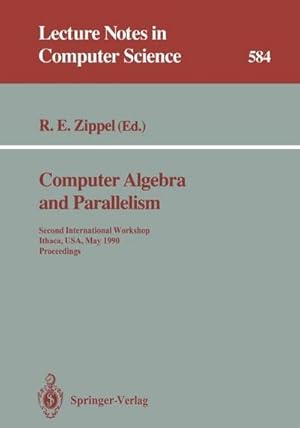
Computer Algebra and Parallelism : Second International Workshop, Ithaca, USA, May 9-11, 1990. Proceedings
Sprache: Englisch
Verlag: Springer Berlin Heidelberg, 1992
ISBN 10: 3540553282 ISBN 13: 9783540553281
Anbieter: AHA-BUCH GmbH, Einbeck, Deutschland
Verkäuferbewertung 5 von 5 Sternen
Taschenbuch. Zustand: Neu. Druck auf Anfrage Neuware - Printed after ordering - This book contains papers presented at a workshop on the useof parallel techniques in symbolic and algebraic computationheld at Cornell University in May 1990. The eight papers inthe book fall into three groups.The first three papers discuss particular programmingsubstrates for parallel symbolic computation, especially fordistributed memory machines. The next three papers discussnovel ways of computing with elements of finite fields andwith algebraic numbers. The finite field technique isespecially interesting since it uses the Connection Machine,a SIMD machine, to achievesurprising amounts ofparallelism. One of the parallel computing substrates isalso used to implement a real root isolation technique.One of the crucial algorithms in modern algebraiccomputation is computing the standard, or Gr|bner, basis ofan ideal. The final two papers discuss two differentapproaches to speeding their computation. One uses vectorprocessing on the Cray and achieves significant speed-ups.The other uses a distributed memory multiprocessor andeffectively explores the trade-offs involved with differentinterconnect topologies of the multiprocessors.
-
Zustand: Sehr gut. Zustand: Sehr gut | Seiten: 363 | Sprache: Englisch | Produktart: Bücher | Effective Polynomial Computation is an introduction to the algorithms of computer algebra. It discusses the basic algorithms for manipulating polynomials including factoring polynomials. These algorithms are discussed from both a theoretical and practical perspective. Those cases where theoretically optimal algorithms are inappropriate are discussed and the practical alternatives are explained. Effective Polynomial Computation provides much of the mathematical motivation of the algorithms discussed to help the reader appreciate the mathematical mechanisms underlying the algorithms, and so that the algorithms will not appear to be constructed out of whole cloth. Preparatory to the discussion of algorithms for polynomials, the first third of this book discusses related issues in elementary number theory. These results are either used in later algorithms (e.g. the discussion of lattices and Diophantine approximation), or analogs of the number theoretic algorithms are used for polynomial problems (e.g. Euclidean algorithm and p-adic numbers). Among the unique features of Effective Polynomial Computation is the detailed material on greatest common divisor and factoring algorithms for sparse multivariate polynomials. In addition, both deterministic and probabilistic algorithms for irreducibility testing of polynomials are discussed.
-
Zustand: Sehr gut. Zustand: Sehr gut | Sprache: Englisch | Produktart: Bücher | This book contains papers presented at a workshop on the useof parallel techniques in symbolic and algebraic computationheld at Cornell University in May 1990. The eight papers inthe book fall into three groups.The first three papers discuss particular programmingsubstrates for parallel symbolic computation, especially fordistributed memory machines. The next three papers discussnovel ways of computing with elements of finite fields andwith algebraic numbers. The finite field technique isespecially interesting since it uses the Connection Machine,a SIMD machine, to achievesurprising amounts ofparallelism. One of the parallel computing substrates isalso used to implement a real root isolation technique.One of the crucial algorithms in modern algebraiccomputation is computing the standard, or Gr|bner, basis ofan ideal. The final two papers discuss two differentapproaches to speeding their computation. One uses vectorprocessing on the Cray and achieves significant speed-ups.The other uses a distributed memory multiprocessor andeffectively explores the trade-offs involved with differentinterconnect topologies of the multiprocessors.
-
Effective Polynomial Computation Zippel, R E
Anbieter: BUCHSERVICE / ANTIQUARIAT Lars Lutzer, Wahlstedt, Deutschland
Verkäuferbewertung 5 von 5 Sternen
Hardcover. Zustand: gut. 1993. Effective Polynomial Computation In englischer Sprache. pages.
-
Computer Algebra and Parallelism
Anbieter: BUCHSERVICE / ANTIQUARIAT Lars Lutzer, Wahlstedt, Deutschland
Verkäuferbewertung 5 von 5 Sternen
Softcover. Zustand: gut. 1992. Computer Algebra and Parallelism In deutscher Sprache. pages.
-
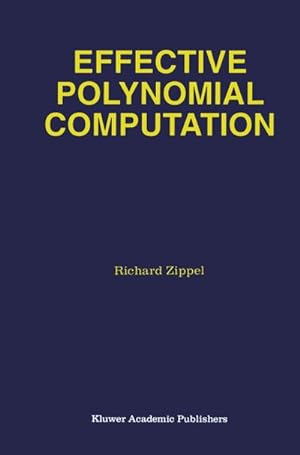
Effective Polynomial Computation
Anbieter: AHA-BUCH GmbH, Einbeck, Deutschland
Verkäuferbewertung 5 von 5 Sternen
Buch. Zustand: Neu. Neuware - Effective Polynomial Computation is an introduction to the algorithms of computer algebra. It discusses the basic algorithms for manipulating polynomials including factoring polynomials. These algorithms are discussed from both a theoretical and practical perspective. Those cases where theoretically optimal algorithms are inappropriate are discussed and the practical alternatives are explained. Effective Polynomial Computation provides much of the mathematical motivation of the algorithms discussed to help the reader appreciate the mathematical mechanisms underlying the algorithms, and so that the algorithms will not appear to be constructed out of whole cloth. Preparatory to the discussion of algorithms for polynomials, the first third of this book discusses related issues in elementary number theory. These results are either used in later algorithms (e.g. the discussion of lattices and Diophantine approximation), or analogs of the number theoretic algorithms are used for polynomial problems (e.g. Euclidean algorithm and p-adic numbers). Among the unique features of Effective Polynomial Computation is the detailed material on greatest common divisor and factoring algorithms for sparse multivariate polynomials. In addition, both deterministic and probabilistic algorithms for irreducibility testing of polynomials are discussed.

