

Gesamtpreis (1 Artikel Artikel):
Versandziel:

wolfius (19 Ergebnisse)
Direkt zu den wichtigsten Suchergebnissen
Suchfilter
Produktart
- Alle Product Types
- Bücher (18)
- Magazine & Zeitschriften (Keine weiteren Ergebnisse entsprechen dieser Verfeinerung)
- Comics (Keine weiteren Ergebnisse entsprechen dieser Verfeinerung)
- Noten (Keine weiteren Ergebnisse entsprechen dieser Verfeinerung)
- Kunst, Grafik & Poster (1)
- Fotografien (Keine weiteren Ergebnisse entsprechen dieser Verfeinerung)
- Karten (Keine weiteren Ergebnisse entsprechen dieser Verfeinerung)
- Manuskripte & Papierantiquitäten (Keine weiteren Ergebnisse entsprechen dieser Verfeinerung)
Zustand Mehr dazu
- Neu (4)
- Wie Neu, Sehr Gut oder Gut Bis Sehr Gut (Keine weiteren Ergebnisse entsprechen dieser Verfeinerung)
- Gut oder Befriedigend (1)
- Ausreichend oder Schlecht (Keine weiteren Ergebnisse entsprechen dieser Verfeinerung)
- Wie beschrieben (14)
Einband
Weitere Eigenschaften
- Erstausgabe (5)
- Signiert (Keine weiteren Ergebnisse entsprechen dieser Verfeinerung)
- Schutzumschlag (Keine weiteren Ergebnisse entsprechen dieser Verfeinerung)
- Angebotsfoto (12)
Sprache (2)
Preis
- Beliebiger Preis
- Weniger als EUR 20 (Keine weiteren Ergebnisse entsprechen dieser Verfeinerung)
- EUR 20 bis EUR 45
- Mehr als EUR 45
Gratisversand
Land des Verkäufers
Verkäuferbewertung
-

Mulierum Graecarum: Quae Oratione Prosa Vsae Sunt Fragmenta Et Elogia Graece Et Latine Cum Viror Doctorum Notis Et Indicibus... (Latin Edition)
Anbieter: Ria Christie Collections, Uxbridge, Vereinigtes Königreich
Verkäuferbewertung 5 von 5 Sternen

EUR 30,22
EUR 13,89 Versand
Versand von Vereinigtes Königreich nach USAAnzahl: Mehr als 20 verfügbar
In den WarenkorbZustand: New. In.
-

Mulierum Graecarum: Quae Oratione Prosa Vsae Sunt Fragmenta Et Elogia Graece Et Latine Cum Viror Doctorum Notis Et Indicibus... (Latin Edition)
Anbieter: Ria Christie Collections, Uxbridge, Vereinigtes Königreich
Verkäuferbewertung 5 von 5 Sternen
EUR 38,78
EUR 13,89 Versand
Versand von Vereinigtes Königreich nach USAAnzahl: Mehr als 20 verfügbar
In den WarenkorbZustand: New. In.
-

Elementa iuris feudorum, tum provincilaium, tum imperilium reipublicae Romano-Germanicae ex iure Germanico nec non Longobardico legibusque Imperii ac moribus eruta ac demonstrata, atque in usum potissimum Academicum iusto ubique ordine concinnata.
Verlag: Halle (Halae Magdeburgicae), Impensis Orphanotrophei, 1741., 1741
Anbieter: Vico Verlag und Antiquariat Dr. Otto, Frankfurt am Main, Deutschland
Verkäuferbewertung 4 von 5 Sternen

Oktav. Titelblatt in r/s-Druck, (28), 426, (38) S. Zeiotgenössischer Pappband, aufgeschnittes, unbeschnittenes Exemplar, Überzugspapier etwas defekt.
-
Philosophia Prima sive Ontologia (methodo scientifica pertracta, qua omnis cognotionis humanae principia continentur)
Verlag: Darmstadt, Wissenschaftliche Buchgesellschaft 1962, 1962
Anbieter: Antiquariaat Pieter Judo (De Lezenaar), Hasselt, Belgien
Verbandsmitglied: ILAB
Verkäuferbewertung 5 von 5 Sternen
xxiv + 18 + 776pp., Modern reprint of the 1734-edition, 23cm., publisher's hardcover in grey cloth (with few vague stains), text and interior clean and bright, text in Latin, good condition, weight: 1.4kg., F104873.
-

Mulierum Graecarum: Quae Oratione Prosa Vsae Sunt Fragmenta Et Elogia Graece Et Latine Cum Viror Doctorum Notis Et Indicibus.
Sprache: Latein
Verlag: Creative Media Partners, LLC Aug 2024, 2024
ISBN 10: 1022277758 ISBN 13: 9781022277755
Anbieter: AHA-BUCH GmbH, Einbeck, Deutschland
Verkäuferbewertung 5 von 5 Sternen
Taschenbuch. Zustand: Neu. Neuware - This fascinating work collects fragments and speeches by Greek women who wrote in prose, accompanied by translations into Latin. With in-depth analysis and historical context, Mulierum Graecarum is essential reading for classicists, historians, and anyone interested in the rich literary tradition of ancient Greece.
-
A TREATISE OF ALGEBRA With the Application of It to a Variety of Problems in Arithmetic to Geometry Trigonometry and Conic Sections with the Several Methods of Solving and Constructing Equations of the Higher Kind
Verlag: Printed for A. Bettesworth and C. Hitch, 1739, 1739
Anbieter: Rothwell & Dunworth (ABA, ILAB), Dulverton, Vereinigtes Königreich
Verkäuferbewertung 5 von 5 Sternen
Erstausgabe
EUR 238,92
EUR 14,50 Versand
Versand von Vereinigtes Königreich nach USAAnzahl: 1 verfügbar
In den Warenkorb1st edn. 8vo (8 x 4¾ ins). Contemporary polished calf, spine and part of lower board replaced in modern calf, with new gilt lettered label, red sprinkled edges (corners rather worn). Pp. (lacks prelims prior to title) xii + 340, illus with 8 folding plates and mathematical notations in text (tape residue at gutter facing title page; previous owner's neat 1771 inscriptions on front and rear paste-downs; ex academic library with blind-stamp on title page).
-
Isocratis scripta, quae quidem nunc extant, omnia, Graecolatina, postremò recognita
Verlag: Conrad Waldkirch, Basel, 1613
Anbieter: Antiquariat Narrenschiff, Trin, Schweiz
Verkäuferbewertung 1 von 5 Sternen

Untertitel: Giechisch-Latein Untergebiet: Philosophie Abbildungen: Initialen. Zustand: Titelblatt mit Riss und kleinem Ausschnitt unter der Jahreszahl, ohne Textbeeinträchtigung. Alte Besitzerverm.a.Innendeckel. Insgesamt guter Zustand Seiten: 7 Bl., 927 S. Format: Kl.-8°. Einband: Ldr. Gebiet: Latein.
-
A Discovery of the True Cause of the Wonderful Multiplication of Corn
Verlag: J.Roberts, Warwick Lane, London, 1734
Anbieter: Wadard Books PBFA, Farningham, KENT, Vereinigtes Königreich
Verbandsmitglied: PBFA
Verkäuferbewertung 4 von 5 Sternen
EUR 591,33
EUR 24,36 Versand
Versand von Vereinigtes Königreich nach USAAnzahl: 1 verfügbar
In den WarenkorbHardcover. Zustand: Good. The true cause of the wonderful multiplication of corn with some general remarks upon the nature of trees and plants by Dr.Wolfius, Member of the Royal Societies of London and Berlin, and Professor of Mathematics at the University of Marboug. viii, 50pp with an engraved frontis plate. The paper is aged but in good condition. Modern binding in full morocco with new end papers.
-
Tusculanarum qaestionum Liber II, III, IV cum explicatione Hieronimi Vvolfii
Verlag: Episcopius, Basel, 1580
Anbieter: Antiquariat Narrenschiff, Trin, Schweiz
Verkäuferbewertung 1 von 5 Sternen
Untergebiet: Literatur Abbildungen: Geprägter Renaissance-Einband, vierbündig, mit Blindpressung Portrait und Wappen von Christoff Herzog zu Würtemmberg u.Seins. Besitzereintrag u.a. v.Hercules v.Salis Zustand: Guter Zustand. Notizen zum Einband beigelegt. Beschrieben mit Abb. in Schmidt, A; Bucheinbände aus dem XIV-XIX Jahrh., Darmstadt 1921 Seiten: 258 S., 10 Bl. 108 S. , 5 Bl., 86S.4 Bl.110S,8 Bl. Format: 8°. Einband: Ldr.m.Prg. Gebiet: Alte Drucke.
-

Epistolae. Quas nunc primum maximam partem e variis codicibus, manu exaratis, edidit, Latine convertit & notis illustravit.
Verlag: Amstelaedami Amsterdam: Apud Janssonio-Waesbergios, 1738
Anbieter: Unsworth's Antiquarian Booksellers, ILAB, ABA, PBFA., London, Vereinigtes Königreich
Verbandsmitglied: ABA ILAB PBFA
Verkäuferbewertung 5 von 5 Sternen
Kunst / Grafik / Poster Erstausgabe
EUR 955,68
EUR 40,59 Versand
Versand von Vereinigtes Königreich nach USAAnzahl: 1 verfügbar
In den WarenkorbEditio princeps. Large folio, pp. [20], 865, [1], lacking final blank. With half-title, title page in red and black, engraved printer's device to title, double column in Greek and Latin. Half-title, title and a handful of other leaves slightly foxed, occasional toning. Contemporary Dutch vellum, traces of ties, gilt ruled to a panel design, gilt centrepieces with arms of Amsterdam, small gilt arms of Amsterdam to corners, raised bands, small gilt arms of Amsterdam to spine, title inked to spine, modern shelfmark label to upper cover. Corners a bit bumped. Modern stamp of Maastricht library to ffep. A sumptuously bound, large folio prize book - a clean and well-margined copy. The first collected printing of the letters of Libanius, the 4th-century AD rhetorician. More than 1500 of his letters survive, the largest extant collection from antiquity, and only brief selections had been previously edited. Wolf's magisterial volume not only prints as many as were known but also includes Latin translations for each letter; Smith called it 'the best edition' (Dict. Gr. & Rom. Bio.), and it is still cited in modern editions. Brunet III, 1050; Graesse IV, 195; Hoffman II; Spoelder, 493 (Amst. 12).
-

Mulierum Graecarum: Quae Oratione Prosa Vsae Sunt Fragmenta Et Elogia Graece Et Latine Cum Viror Doctorum Notis Et Indicibus.
Sprache: Latein
Verlag: Creative Media Partners, LLC Jul 2023, 2023
ISBN 10: 1020560584 ISBN 13: 9781020560583
Anbieter: AHA-BUCH GmbH, Einbeck, Deutschland
Verkäuferbewertung 5 von 5 Sternen
Buch. Zustand: Neu. Neuware.
-
Elementa matheseos universae. Tomus Quartus [IV].
Sprache: Latein
Verlag: Genevae : Henricum-Albertum Gosse,, 1740
Anbieter: Buchversand Jaschke, Berlin, Deutschland
Verkäuferbewertung 5 von 5 Sternen
374 pp. + V, V, V, XI, XXII Tafeln Ex Libris auf vorderem Deckel, Eintagung von alter Hand auf Titelblatt. Ecken und Kanten bestoßen, Fehlstelle an oberer Kaptale, Einband berieben (vorerer Deckel sichtl. beschabt), Gelenke aufgeplatzt, Bock fest. Papier altersbedingt wenig gebräunt, Tafeln z.T. geknickt und wenig fingerfleckig. la Gewicht in Gramm: 1900 4°, gebundene Ausgabe, Ledereinband, goldgepr. Rücken, Rotschnitt. Editio Nova. Priori multo auctior et correctior.
-
Elementa matheseos universae. Tomus Tertius [III].
Sprache: Latein
Verlag: Genevae : Henricum-Albertum Gosse,, 1740
Anbieter: Buchversand Jaschke, Berlin, Deutschland
Verkäuferbewertung 5 von 5 Sternen
581 pp. + VII, VI, VII, XII, IV, XV Tafeln Ex Libris auf vorderem Deckel, Eintagung von alter Hand auf Titelblatt. Ecken und Kanten bestoßen, Einband berieben, Gelenke aufgeplatzt, Bock fest. Papier altersbedingt wenig gebräunt, Tafeln z.T. geknickt und wenig fingerfleckig. la Gewicht in Gramm: 1900 4°, gebundene Ausgabe, Ledereinband, goldgepr. Rücken, Rotschnitt. Editio Nova. Priori multo auctior et correctior.
-
Bibliotheca Aprosiana, liber rarissimus. Jam ex lingua italica in latinam conversus.
Verlag: Abraham Vanderhoeck, Hamburgi (Hamburg), 1734
Anbieter: Cole & Contreras / Sylvan Cole Gallery, Sitges, B, Spanien
Verkäuferbewertung 5 von 5 Sternen
Erstausgabe
FIRST LATIN EDITION of the catalogue of the Bibliotheca Aprosiana. XIV, 256 pp. The catalogue, although it goes no further than the letter C, is an irreplaceable portrait of intellectual life of late 17th-century Europe. 12mo. Attractively bound in full ivory vellum. Some wear to binding, but structurally solid. Internally clean but for some old and extremely faint discoloration. This Latin edition is extremely rare. sxxi.
-
A Discovery of the true Cause of the wonderful Multiplication of Corn; with some general Remarks upon the Nature of Trees and Plants.
Verlag: Printed for J. Roberts, 1734
Anbieter: Blackwell's Rare Books ABA ILAB BA, Oxford, Vereinigtes Königreich
Verbandsmitglied: ABA ILAB PBFA
Verkäuferbewertung 5 von 5 Sternen
EUR 470,37
EUR 29,00 Versand
Versand von Vereinigtes Königreich nach USAAnzahl: 1 verfügbar
In den Warenkorbwith an attractive engraved frontispiece of a prodigious corn (wheat) plant, frontispiece offset onto title, woodcut head and tailpieces, and initials; pp. [viii], 50, 8vo; modern calf backed boards, spine lettered in gilt, very good. First edition and a very attractive copy of this scarce early eighteenth-century treatise on corn, by the eminent German philosopher Christian Freiherr von Wolff (1679-1754). Wolff references many continental books on crop husbandry - Spanish, French, and other German authors are all cited - critiquing these for their failure to derive conclusions from nature. He is conscious not to repeat these mistakes himself, and takes pains to emphasise that he has made a close study of corn in the field, beginning in the year 1716. In his chapter 'of blighted corn', he explains how he has taken blackened corn husks and kept them in his bedchamber, ascertaining that the blight is caused by an overabundance of moisture. This scientific method underpins this short treatise, which ends as both a detailed study of the plant in question, and bibliography (albeit critical) of other authors in the field. Wolff's life work spanned almost every scholarly subject of his time, displayed and unfolded according to his demonstrative-deductive, mathematical method, which perhaps represents the peak of Enlightenment rationality in Germany. This is said to be a translation of Erläuterung der Entdeckung der wahren Ursach von der wunderbahren Vermehrung des Getredes, but we have found no trace of a German publication either in WorldCat or KVK. In KVK the title is represented in German libraries solely in microforms or electronic versions of the present title. Scarce, with just fifteen copies listed on ESTC. (ESTC T131469).
-
Prolegomena ad Homerum sive de Operum Homericum prisca et genuina forma variisque mutationibus et probabili ratione emendandi. Volumen I (all that appeared). - [THE NEW PHILOLOGY - PMM 248]
Anbieter: Herman H. J. Lynge & Søn ILAB-ABF, Copenhagen, Dänemark
Verkäuferbewertung 4 von 5 Sternen
Erstausgabe
Halis Saxonum (Halle), E Libreria Orphanotrophei, 1795. 8vo. Contemporary half calf with five raised bands and gilt title-and tome-labels. Very neatly rebacked. Very nice and clean. An excellent copy. (6), CCLXXX pp. Scarce first edition of the epoch-making work that founded modern philological scholarship and began the modern debate over the date of writing of Homer's works, creating in turn the two Homeric schools of thought, the Analysts and the Unitarians. Although the work bears on the title-page the words "Volumen I", no second volume ever appeared, and Wolf never made any attempt to compose it. "When Wolf took up his professorship in 1783, a critical point in the history of education had been reached. New ideas derived from Locke and Rousseau were at work and Wolf longed to enter the fray. He found able and enlightened allies in the ministers of Frederick the Great, and with their help and by his enthusiasm he was able to carry out his long-cherished plan to give a new basis to the science of philology. To Wolf this meant philology in the original sense - love of letters, of learning and of language. He defined it as "the knowledge of human nature as exhibited in antiquity"" its matter was everything that remained of ancient culture, to which an equal care and scholarship must be devoted. The "Prolegomena to Homer", the best exposition of Wolf's beliefs, were written in a great hurry to meet the needs of a lecture course, and they have all the merits of good lectures: command of method, the gift of inspiration, penetration and breadth of view. Wolf's thesis is no theory, but a collection of great ideas, which laid the foundations for the dominance of German scholarship in the nineteenth century. They have inspired and given purpose to education ever since." (Printing and the Mind of Man).With the 18th century came major developments in classical scholarship, the greatest of the classic epics being no exception - Homeric scholarship changed dramatically, and the end of the century saw the opening of the discussion which was to dominate the 19th and 20th centuries, namely that of the "Homeric question". The Homeric question is essentially the question of the identity of the poet(s) of the Homeric epics, and the nature of the relationship between "Homer" and the epics. In the 19th century it came to be the fulcrum between two opposed schools of thought, the Analysts and the Unitarians. The issue came about in the context of 18th-century Romantic interest in popular lays and folktale, and the growing recognition that the Homeric epics must have been transmitted orally before being written down, possibly much later than "Homer" himself. The key to determining who Homer was, lay in the answer to the question of when the poems were composed.The modern debate over exactly when they took on a fixed written form, began with the present work by Wolf. According to Wolf, the date of writing is among the first questions in the textual criticism of Homer. He considers the real mode of transmission of the poems and acknowledges that it was oral, arguing that they were composed in the mid-10th century BC. He further concludes that the Iliad and the Odyssey could not have been composed in the form in which we know them without the aid of writing and that they changed considerably over time in the hands of bards performing them orally and editors adapting written versions to contemporary tastes. The apparent artistic unity of the poems must have come about after their transcription.This new form of philological scholarship completely altered the way that philology has been done ever since the appearance of the present work.
-
Prolegomena ad Homerum sive de Operum Homericum prisca et genuina forma variisque mutationibus et probabili ratione emendandi. Volumen I (all that appeared). - [THE NEW PHILOLOGY - PMM 248]
Anbieter: Herman H. J. Lynge & Søn ILAB-ABF, Copenhagen, Dänemark
Verkäuferbewertung 4 von 5 Sternen
Erstausgabe
Halis Saxonum (Halle), E Libreria Orphanotrophei, 1795. 8vo. Contemporary half calf with a bit of wear, especially to corners and edges. Gilding to title-label worn off. Paper over boards loosening at edges. Overall fine and tight. A light damp stain to upper margin and a few leaves with some light brownspotting. Scarce first edition of the epoch-making work that founded modern philological scholarship and began the modern debate over the date of writing of Homer's works, creating in turn the two Homeric schools of thought, the Analysts and the Unitarians. Although the work bears on the title-page the words "Volumen I", no second volume ever appeared, and Wolf never made any attempt to compose it. "When Wolf took up his professorship in 1783, a critical point in the history of education had been reached. New ideas derived from Locke and Rousseau were at work and Wolf longed to enter the fray. He found able and enlightened allies in the ministers of Frederick the Great, and with their help and by his enthusiasm he was able to carry out his long-cherished plan to give a new basis to the science of philology. To Wolf this meant philology in the original sense - love of letters, of learning and of language. He defined it as "the knowledge of human nature as exhibited in antiquity"" its matter was everything that remained of ancient culture, to which an equal care and scholarship must be devoted. The "Prolegomena to Homer", the best exposition of Wolf's beliefs, were written in a great hurry to meet the needs of a lecture course, and they have all the merits of good lectures: command of method, the gift of inspiration, penetration and breadth of view. Wolf's thesis is no theory, but a collection of great ideas, which laid the foundations for the dominance of German scholarship in the nineteenth century. They have inspired and given purpose to education ever since." (Printing and the Mind of Man).With the 18th century came major developments in classical scholarship, the greatest of the classic epics being no exception - Homeric scholarship changed dramatically, and the end of the century saw the opening of the discussion which was to dominate the 19th and 20th centuries, namely that of the "Homeric question". The Homeric question is essentially the question of the identity of the poet(s) of the Homeric epics, and the nature of the relationship between "Homer" and the epics. In the 19th century it came to be the fulcrum between two opposed schools of thought, the Analysts and the Unitarians. The issue came about in the context of 18th-century Romantic interest in popular lays and folktale, and the growing recognition that the Homeric epics must have been transmitted orally before being written down, possibly much later than "Homer" himself. The key to determining who Homer was, lay in the answer to the question of when the poems were composed.The modern debate over exactly when they took on a fixed written form, began with the present work by Wolf. According to Wolf, the date of writing is among the first questions in the textual criticism of Homer. He considers the real mode of transmission of the poems and acknowledges that it was oral, arguing that they were composed in the mid-10th century BC. He further concludes that the Iliad and the Odyssey could not have been composed in the form in which we know them without the aid of writing and that they changed considerably over time in the hands of bards performing them orally and editors adapting written versions to contemporary tastes. The apparent artistic unity of the poems must have come about after their transcription.This new form of philological scholarship completely altered the way that philology has been done ever since the appearance of the present work.
-
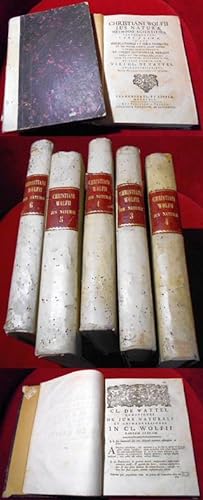
Christiani Wolfii Jus Naturae. Methodo Scientifica Pertractatum.
Verlag: Aere Societatis Venetae, Superiorum Facultate, Ac Privilegiis., Frankfurt, Leipzig 1764 - 1766, 1766
Anbieter: Antiquariat Clement, Bonn, Deutschland
Verkäuferbewertung 4 von 5 Sternen
Zustand: 0. Hier vorhanden Band I und Bände III - VI (von VIII ), insgesamt 5 Bücher. Alle Bände: Halbpergament/marmorierte Hartkarton-Einbände, montierte, goldgeprägte Rückenschildchen. Erträgliche Altersspuren, Schabespuren, Wurmlöcher nicht mehr bewohnt, keinerlei Textverlust, Bindungen alle intakt, solide, Buchschnitte 3seitig sauber eingesprenkelt, diskrete, alte, kleine, eingeklebte Vorbesitzermarkierungen. Buchblöcke erfreulich gut, weitestgehend sauber, sehr vereinzelt gering fleckig, diverse Titelvignetten und Initialen. Alle Bände mit eigenem Register. ERSTES BUCH: BAND I. Rücken im Einbandverbund, sauber vollständig gelöst, Bindung tadellos. Ersch. 1754. Pars Prima, in qua obligationes et jura connata ex ipsa hominis essentia atque natura a priori demonstrantur et totius philosophiae moralis. Omnisque Juris reliqui fundamenta solida jaciuntur, cum clarissimi auctoris vita, et nunc primum cum viri Cl. de Vattel animadversionibus. XLVIII, 432 Seiten mit 1263 §§. Inhalt: Juris Naturae Prolegomena/De Obligatione & Jure Hominum universali in genere/De officiis hominis erga seipsum & cum iis connexis Juribus/De officiis hominis erga alios & cum iis connexis Jur./De officiis hominis erga Deum & cum iis connexis Juribus. +++ ZWEITES BUCH: BAND III. Rücken, Bindung wie Band1. Ersch. 1765. Pars tertia, de modo derivativo acquirendi Dominum et jus quodcumque praesertim in re alterius: Ubi et agitur de officiis circa sermonem, juramentis ac votis, nec non usucapione et praescriptione et nunc primum. (wie Band1). XXVIII, 382 Seiten mit 1060 §§. Inhalt: De modo acquirendi Dominium & jus quodcumque praesertim in re alterius derivativo/De modo aquirendi derivativo in genere/De obligatione circa Sermonem /De Sinceritate, Simulatione & Dissimulatione/De modo sese alteri obligandi, ubi de Promissione & Pactis in genere/De Asseveratione, Jure jurando & Voto/De modo alteri constituendi jus quoddam in re sua. De Derelictione praesumpta, Usucapione & Praescriptione. +++ DRITTES BUCH: BAND IV. : Rücken, Bindung wie vor. Ersch.1765. Pars Quarta, de actibus ad aliorum utilitatem tendentibus in specie, ubi agitur de donationibus et de contractibus tam beneficis, quam onerosis praecipius, et nuc quam (wie vor). XXIV, 507 Seiten mit 1434 §§. Inhalt: De actibus mere beneficis, qui in praesens absolvuntur, ubi etiam de donationibus/De Pretio rerum & Pecunia/De actibus beneficis obligatoriis, seu Contractibus beneficis, Commodato- Mutuo- Deposito- Sequestro- Mandato- Fidejussione- Expromissione/De actibus permutatoriis, seu Contractibus onerosis Permutatione-Emtione venditione- Arrhae datione- addictione in diem- Lege commissionaria- Pacto de retrahendo- Pacto de retrovendendo & redimendo - Commodo & periculo rei emtae- Evictione- Locatione conductione- Socida - Societate- Usuris, seu contractu foenebri- Anatocismo. +++ VIERTES BUCH: BAND V. Rücken und Bindung wie vor. 1765. XX, 514 Seiten mit 1536 §§. Pars Quinta, de Contractibus onerosis reliquis, quasi contractibus, Modis tollendi obligationem ex Contractu et de jure in re sua alteri Constituto, veluti pignore, hypotheca et servitutibus, et nunc (wie vor). Inhalt: De Contractibus onerosis reliquis/De Contractibus, qui aleam continent/De quasi Contractibus & Contractibus mixtis/De modis, quibus obligatio ex contractu tollitur/De Jure Pignoris & Hypothecae /De Servitutibus. +++ FÜNFTES BUCH, BAND VI: Kleine Einrisse vorderes Rückengelenk. Ersch. 1766. XX, 363 Seiten mit 918 §§. Pars sexta, de Dominio Utili in specie de Feudo, accedit doctrina de Interpretatione, De Jure ex Communione primaeva residuo, de Officiis erga Mortuos, nondum Natos & Posteros nec non Eruditorum, et nunc (wie vor). Inhalt: De Dominio utili & ejus speciebus quibusdam/De Feudo/De Interpretatione/ De Jure ex communione primaeva residuo, & jure necessitatis in genere/De Officiis erga mortuos & Jure sepulturae/De nondum natis & Officiis erga posteros/De officiis & Jure Eruditorum. +++ je 19 x 25 cm. Gewicht insgesamt 4,2 kg. +++ Stichwörte.
-
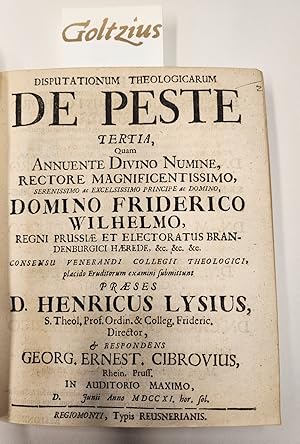
Regiomonti (Kaliningrad), Literis Reusnerianis, 1710, 4to., without binding, 96 pp., the first few pages show some wrinkles near the spine. This dissertation has three parts with seperate titlepages, each with mention of D. Henricus Lysius as professor and three different names as "respondente": Godofredo Schaevio, Abrahamus Wolfius and Georg. Ernest. Cibrovius.


![Bild des Verkäufers für Elementa matheseos universae. Tomus Quartus [IV]. zum Verkauf von Buchversand Jaschke](https://pictures.abebooks.com/inventory/md/md32371171578.jpg)
![Bild des Verkäufers für Elementa matheseos universae. Tomus Tertius [III]. zum Verkauf von Buchversand Jaschke](https://pictures.abebooks.com/inventory/md/md32371175515.jpg)

![Bild des Verkäufers für Prolegomena ad Homerum sive de Operum Homericum prisca et genuina forma variisque mutationibus et probabili ratione emendandi. Volumen I (all that appeared). - [THE NEW PHILOLOGY - PMM 248] zum Verkauf von Herman H. J. Lynge & Søn ILAB-ABF](https://pictures.abebooks.com/inventory/md/md13113955461.jpg)
![Bild des Verkäufers für Prolegomena ad Homerum sive de Operum Homericum prisca et genuina forma variisque mutationibus et probabili ratione emendandi. Volumen I (all that appeared). - [THE NEW PHILOLOGY - PMM 248] zum Verkauf von Herman H. J. Lynge & Søn ILAB-ABF](https://pictures.abebooks.com/inventory/md/md12294563253.jpg)