
Witelo (8 Ergebnisse)
Sprache: Englisch
Verlag: Ossolineum / Polish Academy of Sciences Press 1983
- Softcover
Anbieter: Leopolis, Kraków, PolenLeopolis
Verkäufer/-in kontaktierenVerkäufer/-in mit 5 SternenZustand: Gebraucht - Gut
EUR 84,98
EUR 65,00 VersandVersand von Polen nach USAAnzahl: 1 verfügbar
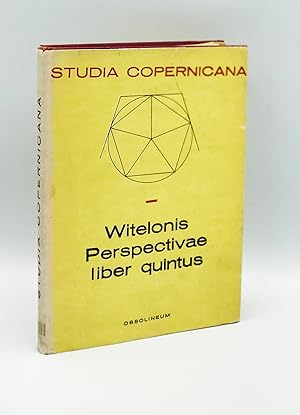
Soft cover. Zustand: Very Good. Published as Sudia Copernicana, Volume 23, this work includes a foreword by Paweł Czartoryski. The introduction comprises chapters on Witelo's life, the origins of the science of Perspectiva, sources for book V, and Witelo's theory of light and vision. A section on manuscripts and editing procedur…es includes chapters on manuscript sources, editing methods, editing procedures, critical text, translation, and notes on the critical apparatus. The English translation provided by A. Mark Smith is followed by the Latin text with variant readings, bibliography, and various indexes.

- Hardcover
Anbieter: Antiquariat Renner OHG, Albstadt, , DeutschlandAntiquariat Renner OHG
Verkäufer/-in kontaktierenVerkäufer/-in mit 5 SternenZustand: Gebraucht - Gut
EUR 30,00
EUR 45,00 VersandVersand von Deutschland nach USAAnzahl: 1 verfügbar
Hardcover. Zustand: Gut. Wroclwa, PAN 1979. gr.8°. 8 plates. 225 p. OCloth. (label on back, corners slightly bumped).- Studia Copernicana, XIX- Small stamp verso title, otherwise inside in good condition.

Sprache: Deutsch
Verlag: Münster Aschendorff, 2. Auflage 1991. - uveränderter fotomechanischer Nachdruck der 1. Auflage 1908 1991
- Softcover
Anbieter: Antiquariat Carl Wegner, Berlin, B, DeutschlandAntiquariat Carl Wegner
Verkäufer/-in kontaktierenVerkäufer/-in mit 5 SternenZustand: Gebraucht
EUR 67,00
EUR 9,00 VersandVersand von Deutschland nach USAAnzahl: 1 verfügbar
Softcover. Grüne Originalbroschur, etwas berieben. XXII, 686 Seiten. Sauberer, guter Zustand. -- Bitte Portokosten außerhalb EU erfragen! / Please ask for postage costs outside EU! / S ' il vous plait demander des frais de port en dehors de l ' UE! // Bitte beachten Sie auch unsere Fotos! / Please also note our photos! / Veuille…z noter nos photos -- Nehmen Sie sich ein gutes Buch mit auf die Sommerwiese. Bei uns werden Sie fündig! -- Wir kaufen Ihre werthaltigen Bücher! Philo.

Verlag: The Polish Academy of Sciences Press, Warsaw 1977
- Hardcover
Anbieter: San Francisco Book Company, Paris, , FrankreichSan Francisco Book Company
Verkäufer/-in kontaktierenVerkäufer/-in mit 4 SternenZustand: Gebraucht - Gut
EUR 100,00
EUR 45,00 VersandVersand von Frankreich nach USAAnzahl: 1 verfügbar
Hardcover. Zustand: Very good. Zustand des Schutzumschlags: good. purple cloth, black and gilt lettering, dust jacket, 330 pp dj worn on the edges. Cloth/dust jacket and Mylar wrapped Octavo.

Verlag: The Polish Academy of Sciences Press, Warsaw 1977
- Hardcover
Anbieter: San Francisco Book Company, Paris, , FrankreichSan Francisco Book Company
Verkäufer/-in kontaktierenVerkäufer/-in mit 4 SternenZustand: Gebraucht - Gut
EUR 125,00
EUR 45,00 VersandVersand von Frankreich nach USAAnzahl: 1 verfügbar
Hardcover. Zustand: Very good. Zustand des Schutzumschlags: good. purple cloth, black and gilt lettering, dust jacket, 380 pp dj worn on the edges inscribed by the translator on a half title page. Cloth/dust jacket and Mylar wrapped Octavo.
 Weitere Bilder
Verlag: id est de natura, ratione, & proiectione radiorum visus, luminum, colorum atque formarum, quam vulgo Perspectivam vocant, libri X. Nuremberg, Johannes Petri,1535. , Nuremberg 1535
- Hardcover
Anbieter: Libreria Antiquaria Pregliasco, Torino, TO, ItalienLibreria Antiquaria Pregliasco
Verkäufer/-in kontaktierenVerkäufer/-in mit 4 SternenZustand: Gebraucht - Gut
EUR 48.000,00
EUR 35,00 VersandVersand von Italien nach USAAnzahl: 1 verfügbar
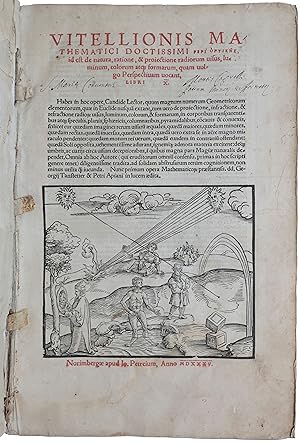
Zustand: Very Good. In-folio (mm 313x205), ff. (4), 297, frontespizio in rosso e nero con splendida vignetta xilografica che illustra diversi fenomeni ottici; stemma araldico inciso a piena pagina del Conte Palatino del Reno e Duca di Bavaria, cui l'opera è dedicata. Numerose figure geometriche nel testo. Solida legatura coeva i…n pieno vitello fulvo, piatti ornati da elaborate bordure impresse a secco, titolo e autore "Perspectiva Vitellion" impressi a secco al piatto superiore, dorso a 4 nervi abilmente rifatto. Eccezionale esemplare. Scritta in inchiostro antico in alto al foglio di titolo, lievi aloni a poche pagine. Rara prima edizione di uno dei più antichi libri di geometria ottica, pubblicato da Petrus Apianus and Georg Tanstetter.Nato in Silesia negli anni Venti del XII secolo e morto alla fine del XIII secolo, il monaco polacco Vitellione (o Witelo), canonico di Breslavia, fu uno dei tre grandi prospettivisti occidentali, insieme a Ruggero Bacone e Giovanni Pecham, che studiarono la questione dell'ottica nel Medioevo, più precisamente tra gli anni Sessanta e Settanta del XII secolo. Studiò arti a Parigi e diritto canonico a Padova e trascorse un periodo alla corte papale di Viterbo.Il De perspectiva, la sua opera più nota, fu scritta intorno al 1270 su richiesta di Guglielmo di Moerbeke, un erudito esperto di scienze e filosofia naturale che aveva conosciuto alla corte papale di Viterbo. Vitellion si rifece in larga misura all'opera del matematico e fisico Ibn al-Haytham (X-XI secolo), noto come Alhazen, che ebbe un notevole impatto sulla nuova concezione europea delle teorie ottiche. Fu questo Peri optikes, del resto, a contribuire principalmente alla diffusione dell'opera di questo studioso arabo.Il trattato di Pecham fu effettivamente pubblicato per primo, intorno al 1482 a Milano, ma la pubblicazione di Vitellion precede di diversi decenni quella della Perspectiva di Bacone, che apparve molto tardi, a Francoforte nel 1614.L'opera di Vitellion è composta da dieci libri e tratta di teoremi geometrici, della propagazione della luce e dei colori in linee rette o rifratte, della fisiologia e della psicologia della visione, della riflessione dei raggi e della formazione di immagini da parte di diverse forme di specchi. Il libro X tratta specificamente della rifrazione, in particolare della visione attraverso raggi rifratti su superfici piane o sferiche. Dibner, Heralds of Science, no. 138. Gérald Péoux, "L'Homme, l'air et les refractions à la fin du XVIe siècle", in Bulletin de l'Association Guillaume Budé, 2010/2, pp. 227-250, note 15. Book.

Verlag: Wroclaw, Wroclaw, Ossolineum/ The Polish Academy of Sciences Press, . 1983
Anbieter: Antiquariat Atlas, Hamburg, , DeutschlandAntiquariat Atlas
Verkäufer/-in kontaktierenVerkäufer/-in mit 5 SternenZustand: Gebraucht
EUR 100,00
EUR 25,00 VersandVersand von Deutschland nach USAAnzahl: 1 verfügbar
Cloth, dj, large 8vo, 267 pp, 2 sheets, 15 glossy b&w pages of facsimiles, 87 figures in the text; -dj worn, paper slightly age-yellowed, very good copy. An English translation with introduction and commentary and Latin edition of the first catoptrical book of Witelo's perspectiva. isbn 8304012081 / issn 00816701.
 Weitere Bilder
Verlag: Johann Petri, Nuremberg 1535
- Erstausgabe
Anbieter: SOPHIA RARE BOOKS, Koebenhavn V, , DänemarkSOPHIA RARE BOOKS
Verkäufer/-in kontaktierenVerkäufer/-in mit 4 SternenZustand: Gebraucht
EUR 84.328,64
Versand nach gratisVersand von Dänemark nach USAAnzahl: 1 verfügbar
First edition. THE FIRST COMPREHENSIVE EUROPEAN TREATISE ON OPTICS. First edition, rare, a copy with numerous early annotations, of the first comprehensive European treatise on optics, and the first work to contain descriptions of medieval laboratory instruments. Witelo (born ca. AD 1230) begins with the geometrical theorems req…uired for the optical demonstrations of the remaining books. He details the essential features of optical systems, including the theory of the nature of light and its propagation, reflection by plain and curved mirrors, light, colour, perspective, the rainbow, etc. Witelo's principal source was the Optics of Ibn al-Haytham; the present text, Witelo's Perspectiva, is thus the first printed source for Ibn al-Haytham's work, which was not published until 1572 (when it accompanied a reprint of Witelo's text). "The most outstanding feature of Witelo's method was his combination of manual and technical skill with mathematics for quantitative experiments with instruments. An excellent example of the use of this combination in the construction of an instrument is his work on the parabolic mirror, with which Alhazen's writings as known in Latin showed no acquaintance . The problem was to construct a burning-mirror that would concentrate the sun's rays at a single focal point . Another important example of Witelo's method is his work on the measurement of the angles of refraction at the surfaces between air and water, air and glass, and glass and water, respectively . [Witelo gave a detailed account] of the construction of [an] instrument for measuring the angle between incident and emergent rays . Witelo used this instrument to show that not only white light, but also colours travelled in straight lines in a single uniform medium . Having given an account of the refraction of light at different surfaces, Witelo went on to discuss the properties of convex and concave lenses . A more successful application of his knowledge of refraction was his study of the rainbow . The only source of knowledge of the rainbow he acknowledged by name was Aristotle's Meteorology, but his chapters contain much that is not in this work . In the atmosphere he held that drops of water would condense as spheres . Rays from the sun would meet the drops on the outside of the mist; and, of the rays falling on each drop, some would be reflected and some would be refracted . as by a spherical lens . The rainbow would be seen in the rays which, after going out from the sun to the mist in one cone, were reflected back to the eye of the observer on a shorter cone with the same base and axis . [Witelo tested his theory] by means of experiments with refraction through crystals and spherical vessels filled with water . [Witelo] made some admirably original observations on the more purely psychological aspects of vision. These related chiefly to direct perception and the effects of association and reasoning on vision, and such problems as illusions, visual beauty, and the perception of distance and size and of the third dimension of space" (Crombie). This work remained an important textbook for over 300 years: it had a great impact on the works of Regiomontanus, Leonardo da Vinci and Copernicus, and was the basis of Kepler's Ad Vitellionem paralipomena of 1604. ABPC/RBH record the sale of seven complete copies at auction: Pierre Berge 2019 (modern binding, last gathering washed and repaired); Christie's NY 2008 (Dunham-Green copy, 19th century binding); Sotheby's 2002 (De Vitry copy, later vellum-backed carta rustica); Sotheby's NY 2001 (binding restored, dampstaining and worming); Sotheby's NY 1993 (Dunham copy); Sotheby's 1981 (Honeyman copy, dampstained); Sotheby's 1973. Provenance: The Church of Santa Maria al Monte dei Cappuccini in Turin (inscription on title 'S[anta] Maria Conventus Montis Capuchine Fratrum Minor (conformator?)'). Numerous marginalia in a different hand by a careful and attentive reader highlighting the text (slightly cropped, indicating they were made before the work was bound). "By far the most important optical treatise in Witelo's day was Ibn al-Haytham's Optics or De aspectibus, rendered into Latin by an unidentified translator late in the twelfth or early in the thirteenth century. Although Witelo never refers to Ibn al-Haytham by name, there can be no doubt that the latter was his chief source: Witelo normally treats the same topics in the same fashion and sometimes even in the same words; occasionally he omits or inserts a topic, and often he seeks to clarify or supplement one of Ibn al-Haytham's points by further elaboration or an improved demonstration, but in very few respects does he escape the general framework inherited through the latter's Optics. "Yet other influences are evident. It is beyond dispute that Witelo used the Optica of Ptolemy, whose table of refraction he reproduces; the Catoptrica of Hero, whose principle of minimum distance he employs to explain reflection at equal angles: and the De speculis comburentibus (anonymous in the thirteenth century. but now attributed to Ibn al-Haytham), from which he drew his analysis of paraboloidal mirrors. There can be little doubt that he also was familiar with the widely circulated Optica (De visu) of Euclid, Catoptrica (De speculis) of Pseudo-euclid, De aspectibus of al-Kind?, and the physiological and psychological works of Galen, Hunayn ibn Ish?q, Ibn S?na; and Ibn Rushd. As for Latin authors, Alexander Birkenmajer has argued that Witelo was strongly infuenced by Robert Grosseteste's De lineis angulis et figuris and Roger Bacon's De multiplicatione specierum. In addition, it is certain that he knew Bacon's Opus maius and possible that he knew John Pecham's Perspectiva communis. Witelo also relied on a number of ancient mathematical works, including those of Euclid and Apollonius, and perhaps of Eutocius, Archimedes, Theon of Alexandria, and Pappus. "Witelo's Perspectiva is an immense folio volume . The scope of the Perspectiva is re.


