
William found (8 Ergebnisse)

- Hardcover
- Erstausgabe
Anbieter: G. & J. CHESTERS, TAMWORTH, Vereinigtes KönigreichG. & J. CHESTERS
Verkäufer/-in kontaktierenVerkäufer/-in mit 5 SternenZustand: Gebraucht - Gut
EUR 3,80
EUR 8,21 VersandVersand von Vereinigtes Königreich nach USAAnzahl: 1 verfügbar
Hardcover. Zustand: Very Good. Dust Jacket Included. 1st Edition. 190p, many figures and tables, a very good hardback in a very good dust-jacket (price-clipped and with very minor repairs) [071315599X].
- Hardcover
Anbieter: ThriftBooks-Atlanta, AUSTELL, GA, USAThriftBooks-Atlanta
Verkäufer/-in kontaktierenVerkäufer/-in mit 5 SternenZustand: Gebraucht - Ausreichend
EUR 15,46
Versand nach gratisVersand innerhalb von USAAnzahl: 1 verfügbar
Hardcover. Zustand: Fair. No Jacket. Former library book; Missing dust jacket; Readable copy. Pages may have considerable notes/highlighting. ~ ThriftBooks: Read More, Spend Less.
- Hardcover
Anbieter: Cotswold Internet Books, Cheltenham, Vereinigtes KönigreichCotswold Internet Books
Verkäufer/-in kontaktierenVerkäufer/-in mit 5 SternenZustand: Gebraucht
EUR 4,23
EUR 16,42 VersandVersand von Vereinigtes Königreich nach USAAnzahl: 1 verfügbar
1st.ed. A tidy copy in tight binding Used - Very Good. VG hardback in VG dustjacket Used - Very Good. VG hardback in VG dustjacket.

- Hardcover
- Erstausgabe
Anbieter: Cotswold Internet Books, Cheltenham, Vereinigtes KönigreichCotswold Internet Books
Verkäufer/-in kontaktierenVerkäufer/-in mit 5 SternenZustand: Gebraucht
EUR 5,20
EUR 16,42 VersandVersand von Vereinigtes Königreich nach USAAnzahl: 1 verfügbar
1st ed. Ex public library - stamps, remains of labels etc.; otherwise a tidy copy in tight binding. Good study copy Used - Acceptable. Ex lib hardbck in dust jacket Used - Acceptable. Ex lib hardbck in dust jacket.

Sprache: Englisch
Verlag: Dept. Of Geography, Atkinson College, York University, 1974
- Softcover
Anbieter: Anybook.com, Lincoln, Vereinigtes KönigreichAnybook.com
Verkäufer/-in kontaktierenVerkäufer/-in mit 5 SternenZustand: Gebraucht - Ausreichend
EUR 12,08
EUR 15,95 VersandVersand von Vereinigtes Königreich nach USAAnzahl: 1 verfügbar
Zustand: Fair. This is an ex-library book and may have the usual library/used-book markings inside.This book has soft covers. In fair condition, suitable as a study copy. Please note the Image in this listing is a stock photo and may not match the covers of the actual item,400grams, ISBN:091960420X.

- Softcover
Anbieter: Bernhard Kiewel Rare Books, Grünberg, DeutschlandBernhard Kiewel Rare Books
Verkäufer/-in kontaktierenVerkäufer/-in mit 5 SternenZustand: Gebraucht
EUR 8,00
EUR 41,95 VersandVersand von Deutschland nach USAAnzahl: 1 verfügbar
22 x 15. 190 Seiten. OKart. Ordnungsgemäß aus einer Universitätsbibliothek ausgesondertes Bibliotheksexemplar (Stempel, Klebereste Rückenschild). Einbandkanten etwas berieben, sonst guter Zustand. Sprache: Englisch Gewicht in Gramm: 400.
- Hardcover
Anbieter: Bernhard Kiewel Rare Books, Grünberg, DeutschlandBernhard Kiewel Rare Books
Verkäufer/-in kontaktierenVerkäufer/-in mit 5 SternenZustand: Gebraucht
EUR 12,00
EUR 41,95 VersandVersand von Deutschland nach USAAnzahl: 1 verfügbar
23 x 16. 190 Seiten. Abbildungen. Hardcover. Ordnungsgemäß aus einer Universitäts-Bibliothek ausgesondertes Exemplar (Stempel, Klebereste Rückenschild). Guter Zustand. Sprache: Englisch Gewicht in Gramm: 450.
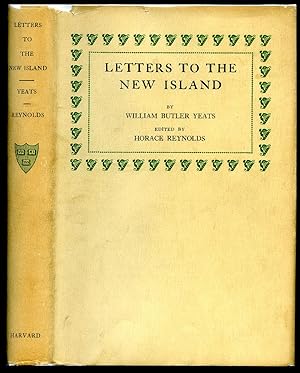
Letters to the New Island
Yeats, William Butler [Edited by Horace Reynolds] T. Sturge Moore and H. M. Paget. [William Butler Yeats (13 June 1865 - 28 January 1939) was an Irish poet and one of the foremost figures of 20th-century literature. A pillar of both the Irish and British literary establishments, he helped to found the Abbey Theatre, and in his later years served as a Senator of the Irish Free State for two terms. He was a driving force behind the Irish Literary Revival along with Lady Gregory, Edward Martyn and others].
Verlag: Published by Harvard University Press, 5 Randall Hall, Cambridge, Massachusetts First Edition . 1934., 1934
- Hardcover
- Erstausgabe
Anbieter: Little Stour Books PBFA Member, Canterbury, Vereinigtes KönigreichLittle Stour Books PBFA Member
Verkäufer/-in kontaktierenVerkäufer/-in mit 5 SternenVerbandsmitglied: PBFA
Zustand: Gebraucht - Gut
EUR 138,91
EUR 35,18 VersandVersand von Vereinigtes Königreich nach USAAnzahl: 1 verfügbar
Zustand: Very Good. First edition hard back binding in publisher's original illustrated green cloth designed by T. Sturge Moore, black title and author lettering to the spine and to the front cover. 8vo. 7½'' x 5¼''. Contains xiii, [3], 222 printed pages of text with tissue-guarded frontispiece portrait of Yeats at the age of 23…, from a portrait by H. M. Paget. Fine condition book in Very Good condition dust wrapper with slither of paper missing to the top front gutter, not price clipped, $2.50. Dust wrapper supplied in archive acetate film protection, it does not adhere to the book or to the dust wrapper. Member of the P.B.F.A. IRELAND (Éire).


