Gesamtpreis (1 Artikel Artikel):
Versandziel:

wanda tuchock (8 Ergebnisse)
Direkt zu den wichtigsten Suchergebnissen
Suchfilter
Produktart
- Alle Product Types
- Bücher (Keine weiteren Ergebnisse entsprechen dieser Verfeinerung)
- Magazine & Zeitschriften (Keine weiteren Ergebnisse entsprechen dieser Verfeinerung)
- Comics (Keine weiteren Ergebnisse entsprechen dieser Verfeinerung)
- Noten (Keine weiteren Ergebnisse entsprechen dieser Verfeinerung)
- Kunst, Grafik & Poster (Keine weiteren Ergebnisse entsprechen dieser Verfeinerung)
- Fotografien (6)
- Karten (Keine weiteren Ergebnisse entsprechen dieser Verfeinerung)
- Manuskripte & Papierantiquitäten (2)
Zustand Mehr dazu
- Neu (Keine weiteren Ergebnisse entsprechen dieser Verfeinerung)
- Wie Neu, Sehr Gut oder Gut Bis Sehr Gut (Keine weiteren Ergebnisse entsprechen dieser Verfeinerung)
- Gut oder Befriedigend (Keine weiteren Ergebnisse entsprechen dieser Verfeinerung)
- Ausreichend oder Schlecht (Keine weiteren Ergebnisse entsprechen dieser Verfeinerung)
- Wie beschrieben (8)
Einband
- alle Einbände
- Hardcover (Keine weiteren Ergebnisse entsprechen dieser Verfeinerung)
- Softcover (2)
Weitere Eigenschaften
- Erstausgabe (Keine weiteren Ergebnisse entsprechen dieser Verfeinerung)
- Signiert (Keine weiteren Ergebnisse entsprechen dieser Verfeinerung)
- Schutzumschlag (Keine weiteren Ergebnisse entsprechen dieser Verfeinerung)
- Angebotsfoto (8)
Sprache (1)
Preis
- Beliebiger Preis
- Weniger als EUR 20 (Keine weiteren Ergebnisse entsprechen dieser Verfeinerung)
- EUR 20 bis EUR 45
- Mehr als EUR 45
Gratisversand
- Kostenloser Versand nach USA (Keine weiteren Ergebnisse entsprechen dieser Verfeinerung)
Land des Verkäufers
Verkäuferbewertung
-

Fifteen-Day Postscript (Original screenplay for an unproduced play)
Verlag: N.p., N.p.
Anbieter: Royal Books, Inc., ABAA, Baltimore, MD, USA
Verkäuferbewertung 5 von 5 Sternen

Manuskript / Papierantiquität
Draft script for an unproduced play. Captain Farragut Cash is the owner of a multimillion dollar tugship line until his death, upon which, his will states his younger son will inherit control of the company if he graduates from the Merchant Marine Academy. However, Junior's illicit marriage and subsequent birth of his child will cast him out of the rite of graduation, and his other brother's wife is eager to get her hands on the riches that become theirs following Junior's lack of graduation and relinquishing of control of the company. Now Etta the maid, who can communicate with the late captain via an oil portrait is trying to balance all these efforts while maintaining the control and dignity the captain so greatly valued in his life. Set in Brooklyn. Gray titled wrappers, with credits for playwrights Wanda Tuchock, and Harry Ruskin. Title page present, with credits for playwrights Wanda Tuchock, and Harry Ruskin. 139 leaves, with last page of text numbered 40. Mechanical duplication. Pages Near Fine, wrapper Near Fine bound internally with three gold brads.
-
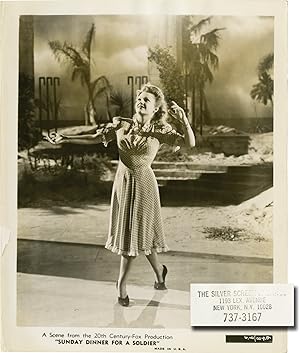
Sunday Dinner for a Soldier (Three original photographs from the 1944 film)
Verlag: Twentieth Century-Fox, los Altos, CA, 1944
Anbieter: Royal Books, Inc., ABAA, Baltimore, MD, USA
Verkäuferbewertung 5 von 5 Sternen
Fotografie
Three vintage studio still photographs from the 1944 film. Starring actress Baxter is featured in two stills. Two stills with "Silver Screen Archives" (New York) rubber-stamps on the verso. One image from the set is shown. Please inquire for others. Based on a story by Cheavens, source author of "Penny Serenade" (1941). Tessa (Baxter) leads an impoverished family holding a dinner for a soldier returning from war. They don't receive the soldier they expected, and the charming stranger Sgt. Eric (Hodiak) quickly involves himself. The film was reprised for radio by Lux Radio Theatre in 1945, with original starring actors performing. Shot on location in Florida. 8 x 10 inches, one slightly larger, two single-weight, glossy, and one double weight, matte. Very Good plus, faint discoloration to the matte still, small surface chips and brief creases to the glossy stills.
-
This Is The Life (Original photograph of actress Louis Allbritton from the 1944 film)
Verlag: Universal Pictures, Universal City, 1944
Anbieter: Royal Books, Inc., ABAA, Baltimore, MD, USA
Verkäuferbewertung 5 von 5 Sternen
Fotografie
Vintage publicity photograph from the 1944 film, showing actress Louise Allbritton behind a camera. Printed mimeo snipe affixed to the verso. A teenage orphan from New England receives an inheritance for education, but instead uses it to travel to New York to pursue the object of her obsession, an Army surgeon. From the archive of noted Hollywood still photographer Ray Jones. Born in Wisconsin on January 1, 1901, Jones worked for Paramount Pictures in the early 1930s, and went on to be the head of the still photography department at Universal Pictures in 1935, where he worked well into the 1950s. 8 x 10 inches. Near Fine.
-
Within These Walls [This is the Law] (Original screenplay for the 1945 film, producer Ben Silvey's copy)
Verlag: N.p., N.p., 1945
Anbieter: Royal Books, Inc., ABAA, Baltimore, MD, USA
Verkäuferbewertung 5 von 5 Sternen
Manuskript / Papierantiquität
Third Draft Continuity script for the 1945 film, here under the working title "This is the Law." Copy belonging to producer Ben Silvey, with his name on the front wrapper and manuscript pencil and ink annotations throughout. A stern judge moves with his family across state lines for a new job as a prison warden, unaware that his own son harbors criminal intentions. Blue titled wrappers with credits for screenwriter Eugene Ling on the front wrapper. Title page present, dated 1/23/45, noted as Third Draft Continuity, with credits for screenwriter Eugene Ling. 119 leaves, with last page of text numbered 118. Mimeograph duplication on onionskin stock, rectos only. Pages Near Fine, wrapper Very Good plus overall, bound internally with two gold brads.
-
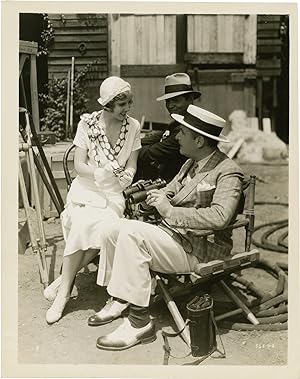
Clark Gable on the set of Sporting Blood (Original photograph from the set of the 1931 film)
Verlag: Metro-Goldwyn-Mayer [MGM], Beverly Hills, CA, 1931
Anbieter: Royal Books, Inc., ABAA, Baltimore, MD, USA
Verkäuferbewertung 5 von 5 Sternen
Fotografie
Vintage still photograph from the set of the 1931 film. Featuring Madge Evans and Lew Cody comparing binoculars while a very young and not yet famous Clark Gable smiles over their shoulders. Mimeograph snipe on the verso. Based on the short story "Horse Flesh" by Frederick Hazlitt Brennan, published in the "Saturday Evening Post" on September 13, 1930. An orphaned foal's journey through various owners, including that of nefarious gambler Ludeking (Hallam Cooley), before being returned to his loving breeder Jim (Ernest Torrence). Clark Gable's first starring role, as a card dealer with occasional moral failings, whose love story with Ruby (Madge Evans) makes for an entertaining side plot. Set in Kentucky, shot on location in Lexington, Kentucky and California. 8 x 10 inches. Just about Fine.
-
Susan Lenox (Her Fall and Rise) (Original publicity photograph from the 1931 film)
Verlag: Metro-Goldwyn-Mayer [MGM], Beverly Hills, CA, 1931
Anbieter: Royal Books, Inc., ABAA, Baltimore, MD, USA
Verkäuferbewertung 5 von 5 Sternen
Fotografie
Vintage publicity photograph from the 1931 pre-Code film, showing actress Greta Garbo in a belted, brocade two-piece ensemble with a fur-accented evening coat. Spanish mimeo snipe on the verso. Based on the notorious 1917 novel by David Graham Phillips, a Cinderella tale about a young woman's rise through social classes. The only on-screen pairing of Garbo and Clark Gable, who purportedly did not get along. 8 x 10 inches. Very Good plus, moderately faded.
-
Hallelujah (Original oversize double weight photograph of Daniel L. Haynes from the 1929 film)
Verlag: Metro-Goldwyn-Mayer [MGM], Beverly Hills, CA, 1929
Anbieter: Royal Books, Inc., ABAA, Baltimore, MD, USA
Verkäuferbewertung 5 von 5 Sternen
Fotografie
Vintage oversize borderless double weight portrait photograph of actor Daniel L. Haynes from the 1929 film. With the ink stamp and blind stamp of photographer Ruth Harriet Louise, a mimeo snipe, and a publication stamp on the verso. Rare, or possibly unique. Director King Vidor's first talkie and the first Black musical, as well as the second all-Black film by a major Hollywood studio, with arguably more depth than its predecessor, Paul Sloane's "Hearts in Dixie," released earlier the same year. Although Vidor had expressed his intent of an honest depiction of rural southern African-American life, the film still clearly advanced racial stereotypes of the era. "Hallelujah" had, however, authentically represented African-American spiritual music from the period, which no other film at that point had achieved. Nominated for an Academy Award for Best Director. Shot on location in Memphis, Tennessee, and Arkansas. 9.25 x 12.25 inches, trimmed unevenly. Very Good plus, with a small chip to the bottom right corner, and print preparation touch ups and cropping annotations on the recto. National Film Registry. Rosenbaum 1000.
-
Hallelujah (Two original photographs from the set of the 1929 film)
Verlag: Metro-Goldwyn-Mayer [MGM], Beverly Hills, CA, 1929
Anbieter: Royal Books, Inc., ABAA, Baltimore, MD, USA
Verkäuferbewertung 5 von 5 Sternen
Fotografie
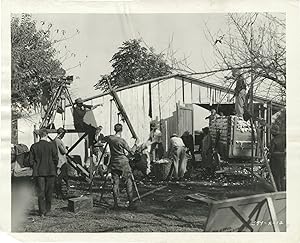
Two vintage reference photographs on the set of the 1929 film. Mimeo snipes on verso of both, one with annotations in manuscript pencil and Culver Picture stamp on verso, and one with "Menningen" and graphic stamps on verso. The first Black musical, and one of the first all-Black films by a major Hollywood studio, with arguably more depth than its predecessor, Paul Sloane's "Hearts in Dixie," the first all-black Hollywood film released earlier the same year. King Vidor's first talkie, written by screenwriter Wanda Tuchock, who started in the silent era and went on to become one of the first women to be credited as a director on a Hollywood film. Although King Vidor had expressed his intent of an honest depiction of rural southern African American life, the film still clearly advanced racial stereotypes of the era. "Hallelujah" had, however, authentically represented African American spiritual music from the period, which no other film achieved. Shot on location in Memphis, Tennessee and Arkansas. 8 x 10 inches. Very Good plus, with some creasing and waviness, one with a chip in the bottom left margin, one with faint tape shadows on recto and paper tape on verso. National Film Registry. Rosenbaum 1000.


![Bild des Verkäufers für Within These Walls [This is the Law] (Original screenplay for the 1945 film, producer Ben Silvey's copy) zum Verkauf von Royal Books, Inc., ABAA](https://pictures.abebooks.com/inventory/md/md30719017897.jpg)