Gesamtpreis (1 Artikel Artikel):
Versandziel:

walther stern (10 Ergebnisse)
Direkt zu den wichtigsten Suchergebnissen
Suchfilter
Produktart
- Alle Product Types
- Bücher (10)
- Magazine & Zeitschriften (Keine weiteren Ergebnisse entsprechen dieser Verfeinerung)
- Comics (Keine weiteren Ergebnisse entsprechen dieser Verfeinerung)
- Noten (Keine weiteren Ergebnisse entsprechen dieser Verfeinerung)
- Kunst, Grafik & Poster (Keine weiteren Ergebnisse entsprechen dieser Verfeinerung)
- Fotografien (Keine weiteren Ergebnisse entsprechen dieser Verfeinerung)
- Karten (Keine weiteren Ergebnisse entsprechen dieser Verfeinerung)
- Manuskripte & Papierantiquitäten (Keine weiteren Ergebnisse entsprechen dieser Verfeinerung)
Zustand Mehr dazu
- Neu (1)
- Wie Neu, Sehr Gut oder Gut Bis Sehr Gut (1)
- Gut oder Befriedigend (2)
- Ausreichend oder Schlecht (Keine weiteren Ergebnisse entsprechen dieser Verfeinerung)
- Wie beschrieben (6)
Einband
Weitere Eigenschaften
- Erstausgabe (5)
- Signiert (Keine weiteren Ergebnisse entsprechen dieser Verfeinerung)
- Schutzumschlag (Keine weiteren Ergebnisse entsprechen dieser Verfeinerung)
- Angebotsfoto (5)
Sprache (4)
Preis
- Beliebiger Preis
- Weniger als EUR 20 (Keine weiteren Ergebnisse entsprechen dieser Verfeinerung)
- EUR 20 bis EUR 45
- Mehr als EUR 45
Gratisversand
Land des Verkäufers
Verkäuferbewertung
-

Le tour de France des maisons écologiques
Anbieter: Gallix, Gif sur Yvette, Frankreich
Verkäuferbewertung 5 von 5 Sternen

Zustand: Neuf.
-

UNTERSUCHUNGEN ÜBER DIE INTELLIGENZ VON KINDERN UND JUGENDLICHEN. Hamburger Arbeiten zur Begabungsforschung Nr. 11.
Sprache: Deutsch
Verlag: Ambrosius Barth. Leipzig., 1919
Anbieter: avelibro OHG, Dinkelscherben, Deutschland
Verbandsmitglied: BOEV
Verkäuferbewertung 5 von 5 Sternen
Zustand: Gut. III, 167, 1 Seiten. Gut erhalten. Heft 19. BEIHEFTE ZUR ZEITSCHRIFT FÜR ANGEWANDTE PSYCHOLOGIE, herausgegeben von William Stern und Otto Lipmann. William Stern, geboren als Wilhelm Louis Stern, (* 29. April 1871 in Berlin ; ? 27. März 1938 in Durham (North_Carolina) war ein bedeutender deutscher Psychologe, Begründer der Differenziellen Psychologie und Erfinder des Intelligenzquotienten . Er war Mitbegründer der Universität Hamburg , der Deutschen Gesellschaft für Psychologie und der Zeitschrift für angewandte Psychologie Otto Lipmann 1880-1933, Psychologe . Lipmann studierte Psychologie in München, Breslau (bei W. Stern ) und Berlin. Mit Stern baute er dort 1906 das private Institut für angewandte Psychologie und Sammelforschung auf, das erste Institut dieser Art, gründete mit Stern 1908 die Zeitschrift für angewandte Psychologie und wirkte als Wegbereiter der Angewandten Psychologie , Psychotechnik und psychologischen Diagnostik . Bibliotheksexemplar mit Stempel. deu 1. Stock 47|4133AB Sprache: Deutsch Gewicht in Gramm: 444 23,5 x 16 cm. Bibliothekseinband.
-

Am Anfang war die Erde : Plädoyer zur Umwelt-Ethik = "Sand county almanac"
Anbieter: Dennis Wolter, Hardegsen OT Gladebeck, Deutschland
Verkäuferbewertung 4 von 5 Sternen

Zustand: Sehr gut. 190 S. : Ill. ; 25 cm, Orig.-Pappband mit Schutzumschlag. Kontaktdaten des Herstellers: von dem Knesebeck GmbH & Co. Verlag KG Holzstraße 26 80469 München Deutschland Telefonnummer: +49 (0) 89 / 242 1166-0 Fax: +49 (0) 89 / 242 1166-110 E-Mail: sekretariat(at)knesebeck-verlag(.)de Webseite: WeWeWe.knesebeck-verlag(.)de Kontaktdaten der verantwortlichen Person: Antonia Bürger (Geschäftsführerin) Holzstraße 26 80469 München Deutschland Telefon: +49 (0) 89 / 242 1166-0 E-Mail: sekretariat(at)knesebeck-verlag(.)de. Buch.
-
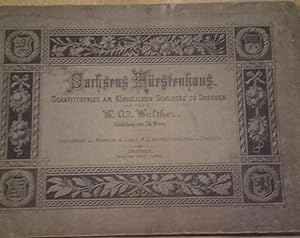
Sachsens Fürstenhaus. Sgraffitofries ( Sgraffiti ) am Königlichen Schloß zu Dresden. 1876
Verlag: Adolf Gutbier nach 1876, Dresden, 1876
Anbieter: Buecherstube Eilert, Versandantiquariat, Dresden, DD, Deutschland
Verkäuferbewertung 5 von 5 Sternen
Querfolio ( 33 x 49 cm ) , 3 S. / IX Tafeln, ( Lichtdrucke von Römmler & Jonas ), illustr. Hlwd. - Mappe, diese mit sehr starken Gebrauchsspuren ( fleckig, wasserrandig, eselsohrig, Kanten bestoßen, Kapitale ausgefranst, aber im ganzen intakt. ). Die Tafeln sind nur ganz vereinzelt an den Rändern stockfleckig, sonst aber in gutem Zustand. 25, n, Wg Sprache: de.
-

Untersuchungen über die Intelligenz von Kindern und Jugendlichen
Sprache: Deutsch
Verlag: Barth Leipzig, 1919
Anbieter: ralfs-buecherkiste, Herzfelde, MOL, Deutschland
Verkäuferbewertung 5 von 5 Sternen
Halbleder 16x24. Zustand: Gut. 167 Seiten altersbedingt guter Zustand, angestoßen, Bibliotheksexemplar, gebräunt 200526521 Sprache: Deutsch Gewicht in Gramm: 430.
-

Ein Weg zur experimentellen Prüfung der Richtungsquantelung im Magnetfeld. SS. 249-253. - Und: Dieselben. Der experimentelle Nachweis des magnetischen Moments des Silberatoms. SS. 110-111. - Und: Dieselben. Der experimentelle Nachweis der Richtungsquantelung im Magnetfeld. SS. 349-352. - Und: Dieselben. Das magnetische Moment des Silberatoms. SS. 353-355. In: Zeitschrift für Physik. Bände 7-9 in 3 Bänden.
Sprache: Deutsch
Verlag: Berlin Springer -22, 1921
Anbieter: Antiquariat Gerhard Gruber, Heilbronn, Deutschland
Verkäuferbewertung 4 von 5 Sternen
Erstausgabe
(22,5 x 15,5 cm). VI (richtig IV) 414 S./ IV, 419 S./ IV, 412 S. Mit zahlreichen Abbildungen. Halbleinwandbände der Zeit. Erste Ausgabe dieser bedeutenden Veröffentlichungen, ein Meilenstein auf dem Weg zur Etablierung der Quantenmechanik. - Die beiden Wissenschaftler beschreiben hier die erstmalige Beobachtung der Richtungsquantelung von Drehimpulsen. Das als Stern-Gerlach-Versuch bezeichnete Experiment ist deshalb so bedeutend, weil sich mit ihm quantenmechanische Erscheinungen beschreiben lassen, die im Rahmen der klassischen Physik nicht zu erklären sind. - Stern (1888-1969), Professor für Physik in Hamburg und Pittsburgh, wurde dafür 1943 mit dem Nobelpreis für Physik ausgezeichnet. - Titel gestempelt, sonst sauber, gut erhalten und uniform gebunden.
-
Ein Weg zur experimentellen Prüfung der Richtungsquantelung im Magnetfeld [in: Zeitschr. für Physik vol. 7, 1921:] (+) Der experimentelle Nachweis des magnetischen Moments des Silberatoms [in Zeitschr. für Physik vol. 8, 1922] - [DISCOVERY OF SPATIAL QUANTIZATION - THE STERN-GERLACH EXPERIMENT]
Anbieter: Herman H. J. Lynge & Søn ILAB-ABF, Copenhagen, Dänemark
Verkäuferbewertung 4 von 5 Sternen
Erstausgabe
Berlin, Julius Springer, 1921 & 1922. 8vo. Bound in two uniform contemporary. In "Zeitschrift für Physik", Vol. 7, 8 & 9, 1922. All three volumes offered. Both with library stamp to title page and light wear to extremities. A fine set. Pp. 249-53" 110-11 349-55. [Entire volumes: VI, 414 pp IV, 419 pp." IV, 412 pp.]. First printing of Stern and Gerlach's seminal papers in which the first spatial quantization, atomic magnetic moments, was first presented. With these papers, the first clear proof for the spin of the electron appeared, profoundly influencing the world of physics. The discovery of the deflection of particles is often used to illustrate basic principles of quantum mechanics and demonstrates that electrons and atoms have inherent quantum properties.Spatial quantization had been introduced merely as a theoretical concept by Sommerfeld in 1916, but no one before Stern had ever empirically demonstrated its existence, and some physicists even considered it to be nothing more than a mathematical tool. In his 1921-paper Stern proposed an empirical test:"The idea for the experiment proposed by Stern was simple enough. A beam of silver atoms is produced by letting silver evaporate in an oven with a small opening. The beam is collimated and travels in X direction until it falls on a glass plate. Between collimators and plate an inhomogeneous magnetic field is produced. It points in y direction and also changes its strength as a function of y. If the atoms possess a magnetic moment, the field pulls them away from the X axis. If the moments are oriented at random, there will be a broadening of the beam. But if spatial quantization exists with just two possible orientations, then the beam will be split in two. Half the atoms are pulled in the positive and half in the negative y direction. It should be treated as a spinning top with a magnetic needle in its axis." ( Brandt. The Harvest of a Century, p. 124).In November 1921, Stern and Gerlach observed a broadening of the beam, its size increased from 0.1 mm till 0.3 mm when the field was turned on. "This result proved that silver atoms possess a magnetic moment. With a still better collimated beam in February 1922 where the splitting of the beam into two was observed. Spatial quantization was established." ( Brandt. The Harvest of a Century, p. 124).Only after the birth of quantum mechanics it became clear that the atoms themselves are not turned, but that their quantum mechanical wave function assumes one of its possible values in the apparatus. The discovery penetrated all aspects of physics" it was documented that electrons are responsible for the hyperfine structure of the spectroscopic lines and more generally that the direct observation of the spin of the electron is the most clear evidence of quantization in quantum mechanics.The three volumes also contains the following papers of interest:1. Born, Max. Über elektrostatische Gitterpotentiale. Bd. 7. pp. 124-140.2. Born, Max. Zur Thermodynamik der Kristallgitter. Bd. 7. pp. 217-248.3. Geiger, H. Reichweitemessungen an alfa-Strahlen. Bd. 8. pp. 45-58.4. Brody, E. & Max Born. Bemerkungen zy unseren Abhandlungen "Über die Schwingungen eines mechanischen Systems mit endlicher Amplitude und ihre Quantelung" [.] . Bd. 8. Pp. 205-208.5. Heisenberg, Werner. Zur Quantentheorie der Linienstruktur und der anomalen Zeemaneffekte. Bd. 8. pp. 273-297.6. Bohr, Niels. Der Bau der Atome und die physikalischen und chemischen Eigenschaften der Elemente. Bd. 9. pp. 1-67.And many others.
-
Ein Weg zur experimentellen Prüfung der Richtungsquantelung im Magnetfeld [in: Zeitschr. für Physik vol. 7, 1921:] (+) Der experimentelle Nachweis des magnetischen Moments des Silberatoms [in Zeitschr. für Physik vol. 8, 1922] - [DISCOVERY OF SPATIAL QUANTIZATION - THE STERN-GERLACH EXPERIMENT]
Anbieter: Herman H. J. Lynge & Søn ILAB-ABF, Copenhagen, Dänemark
Verkäuferbewertung 4 von 5 Sternen
Erstausgabe
Berlin, Julius Springer, 1921 & 1922. 8vo. Entire volumes 7-8, 1921 and 1922, of "Zeitschrift für Physik" bound in two uniform contemporary half cloth bindings over marbled boards. Library-stamp to title-pages, otherwise, both volumes fine, clean, and tight. Pp. 249-53" Pp. 110-11. [Entire volumes: VI, 414 pp" IV, 419 pp.]. First printing of Stern and Gerlach's seminal papers in which the first spatial quantization, atomic magnetic moments, was first presented. With these papers, the first clear proof for the spin of the electron appeared, profoundly influencing the world of physics. The discovery of the deflection of particles is often used to illustrate basic principles of quantum mechanics and demonstrates that electrons and atoms have inherent quantum properties.Spatial quantization had been introduced merely as a theoretical concept by Sommerfeld in 1916, but no one before Stern had ever empirically demonstrated its existence, and some physicists even considered it to be nothing more than a mathematical tool. In his 1921-paper Stern proposed an empirical test:"The idea for the experiment proposed by Stern was simple enough. A beam of silver atoms is produced by letting silver evaporate in an oven with a small opening. The beam is collimated and travels in X direction until it falls on a glass plate. Between collimators and plate an inhomogeneous magnetic field is produced. It points in y direction and also changes its strength as a function of y. If the atoms possess a magnetic moment, the field pulls them away from the X axis. If the moments are oriented at random, there will be a broadening of the beam. But if spatial quantization exists with just two possible orientations, then the beam will be split in two. Half the atoms are pulled in the positive and half in the negative y direction. It should be treated as a spinning top with a magnetic needle in its axis." ( Brandt. The Harvest of a Century, p. 124).In November 1921, Stern and Gerlach observed a broadening of the beam, its size increased from 0.1 mm till 0.3 mm when the field was turned on. "This result proved that silver atoms possess a magnetic moment. With a still better collimated beam in February 1922 where the splitting of the beam into two was observed. Spatial quantization was established." ( Brandt. The Harvest of a Century, p. 124).Only after the birth of quantum mechanics it became clear that the atoms themselves are not turned, but that their quantum mechanical wave function assumes one of its possible values in the apparatus. The discovery penetrated all aspects of physics" it was documented that electrons are responsible for the hyperfine structure of the spectroscopic lines and more generally that the direct observation of the spin of the electron is the most clear evidence of quantization in quantum mechanics.The three volumes also contains the following papers of interest:1. Born, Max. Über elektrostatische Gitterpotentiale. Bd. 7. pp. 124-140.2. Born, Max. Zur Thermodynamik der Kristallgitter. Bd. 7. pp. 217-248.3. Geiger, H. Reichweitemessungen an alfa-Strahlen. Bd. 8. pp. 45-58.4. Brody, E. & Max Born. Bemerkungen zy unseren Abhandlungen "Über die Schwingungen eines mechanischen Systems mit endlicher Amplitude und ihre Quantelung" [.] . Bd. 8. Pp. 205-208.5. Heisenberg, Werner. Zur Quantentheorie der Linienstruktur und der anomalen Zeemaneffekte. Bd. 8. pp. 273-297.And many others.
-
Ein Weg zur experimentellen Prüfung der Richtungsquantelung im Magnetfeld [in: Zeitschr. für Physik vol. 7, 1921:] (+) Der experimentelle Nachweis des magnetischen Moments des Silberatoms [in Zeitschr. für Physik vol. 8, 1922] (+) Der experimentelle . - [DISCOVERY OF SPATIAL QUANTIZATION - THE STERN-GERLACH EXPERIMENT]
Anbieter: Herman H. J. Lynge & Søn ILAB-ABF, Copenhagen, Dänemark
Verkäuferbewertung 4 von 5 Sternen
Erstausgabe
Berlin, Julius Springer, 1921 & 1922. 8vo. Entire volumes 7-9, 1921 and 1922, of "Zeitschrift für Physik" bound in three contemporary half cloth bindings over marbled boards, volumes 7 and 8 in uniform bindings, volume 9 slightly differing, with more gilding to spine. Tiny marginal dampstain to the first leaves of vol. 9, and large library-stamp to front free end-papers of volumes 7-8, otherwise, all three volumes fine, clean, and tight. All three title-pages with library-stamp. Pp. 249-53" 110-11 349-55. [Entire volumes: VI, 414 pp IV, 419 pp." IV, 412 pp.]. First printing of Stern and Gerlach's seminal papers in which the first spatial quantization, atomic magnetic moments, was first presented. With these papers, the first clear proof for the spin of the electron appeared, profoundly influencing the world of physics. The discovery of the deflection of particles is often used to illustrate basic principles of quantum mechanics and demonstrates that electrons and atoms have inherent quantum properties.Spatial quantization had been introduced merely as a theoretical concept by Sommerfeld in 1916, but no one before Stern had ever empirically demonstrated its existence, and some physicists even considered it to be nothing more than a mathematical tool. In his 1921-paper Stern proposed an empirical test:"The idea for the experiment proposed by Stern was simple enough. A beam of silver atoms is produced by letting silver evaporate in an oven with a small opening. The beam is collimated and travels in X direction until it falls on a glass plate. Between collimators and plate an inhomogeneous magnetic field is produced. It points in y direction and also changes its strength as a function of y. If the atoms possess a magnetic moment, the field pulls them away from the X axis. If the moments are oriented at random, there will be a broadening of the beam. But if spatial quantization exists with just two possible orientations, then the beam will be split in two. Half the atoms are pulled in the positive and half in the negative y direction. It should be treated as a spinning top with a magnetic needle in its axis." ( Brandt. The Harvest of a Century, p. 124).In November 1921, Stern and Gerlach observed a broadening of the beam, its size increased from 0.1 mm till 0.3 mm when the field was turned on. "This result proved that silver atoms possess a magnetic moment. With a still better collimated beam in February 1922 where the splitting of the beam into two was observed. Spatial quantization was established." ( Brandt. The Harvest of a Century, p. 124).Only after the birth of quantum mechanics it became clear that the atoms themselves are not turned, but that their quantum mechanical wave function assumes one of its possible values in the apparatus. The discovery penetrated all aspects of physics" it was documented that electrons are responsible for the hyperfine structure of the spectroscopic lines and more generally that the direct observation of the spin of the electron is the most clear evidence of quantization in quantum mechanics.The three volumes also contains the following papers of interest:1. Born, Max. Über elektrostatische Gitterpotentiale. Bd. 7. pp. 124-140.2. Born, Max. Zur Thermodynamik der Kristallgitter. Bd. 7. pp. 217-248.3. Geiger, H. Reichweitemessungen an alfa-Strahlen. Bd. 8. pp. 45-58.4. Brody, E. & Max Born. Bemerkungen zy unseren Abhandlungen "Über die Schwingungen eines mechanischen Systems mit endlicher Amplitude und ihre Quantelung" [.] . Bd. 8. Pp. 205-208.5. Heisenberg, Werner. Zur Quantentheorie der Linienstruktur und der anomalen Zeemaneffekte. Bd. 8. pp. 273-297.6. Bohr, Niels. Der Bau der Atome und die physikalischen und chemischen Eigenschaften der Elemente. Bd. 9. pp. 1-67.And many others.
-
![Bild des Verkäufers für Ein Weg zur experimentellen Prufung der Richtungquantelung im Magnetfeld [and] Der experimentelle Nachweis. . zum Verkauf von Jeremy Norman's historyofscience](https://pictures.abebooks.com/inventory/md/md1299101709.jpg)
Ein Weg zur experimentellen Prufung der Richtungquantelung im Magnetfeld [and] Der experimentelle Nachweis. .
Erscheinungsdatum: 1921
Anbieter: Jeremy Norman's historyofscience, Novato, CA, USA
Verkäuferbewertung 2 von 5 Sternen

Erstausgabe
First edition. Stern, Otto (1888-1969). et al. (1) Ein Weg zur experimentellen Prüfung der Richtungsquantelung im Magnetfeld. In Zeitschrift fur Physik 7 (1921): 249-253. (2) (with Walter Gerlach [1889-1979]). Der experimentelle Nachweis des magnetischen Moments des Silberatoms. In ibid. 8 (1921): 110-111. Together 2 whole volumes. [iii]-vi, 414; iv, 419pp. Braunschweig: Fried. Vieweg & Sohn; Berlin: Julius Springer, 1921-22. 224 x 149 mm. Vol. 7 in half morocco, cloth boards, a little rubbed; Vol. 8 in half cloth, marbled boards. Library stamps on titles. First Editions. Stern, whom Emilio Segrè considered "one of the major physicists of the century" (p. 138), developed Dunoyer's molecular beam method and used it to devise what is now known as the Stern-Gerlach experiment, which demonstrates the reality of space-quantization of atoms. This experiment had an enormous impact on modern physics, and has become a paradigm of quantum measurement. Spatial quantization had been introduced as a theoretical concept by Sommerfeld in 1916, but no one before Stern had ever demonstrated its existence, and some quantum physicists even considered it to be nothing more than a mathematical tool. In his 1921 paper, Stern proposed an empirical test: "If an electron in an atom carried a magnetic moment of about 1 Bohr magneton (= eh/4 me), an atomic beam of silver atoms should split in passing through a magnetic field of strong inhomogeneity" (Twentieth Century Physics, p. 164). In the 1922 paper, written jointly with Walther Gerlach, Stern described the initial results of their experimental work. In three later papers (not included here) Stern and Gerlach continued their investigations, which provided direct experimental proof of directional [space-] quantization in a magnetic field. .