

Gesamtpreis (1 Artikel Artikel):
Versandziel:

valentich scott (4 Ergebnisse)
Direkt zu den wichtigsten Suchergebnissen
Suchfilter
Produktart
- Alle Product Types
- Bücher (4)
- Magazine & Zeitschriften (Keine weiteren Ergebnisse entsprechen dieser Verfeinerung)
- Comics (Keine weiteren Ergebnisse entsprechen dieser Verfeinerung)
- Noten (Keine weiteren Ergebnisse entsprechen dieser Verfeinerung)
- Kunst, Grafik & Poster (Keine weiteren Ergebnisse entsprechen dieser Verfeinerung)
- Fotografien (Keine weiteren Ergebnisse entsprechen dieser Verfeinerung)
- Karten (Keine weiteren Ergebnisse entsprechen dieser Verfeinerung)
- Manuskripte & Papierantiquitäten (Keine weiteren Ergebnisse entsprechen dieser Verfeinerung)
Zustand Mehr dazu
- Neu (Keine weiteren Ergebnisse entsprechen dieser Verfeinerung)
- Wie Neu, Sehr Gut oder Gut Bis Sehr Gut (Keine weiteren Ergebnisse entsprechen dieser Verfeinerung)
- Gut oder Befriedigend (Keine weiteren Ergebnisse entsprechen dieser Verfeinerung)
- Ausreichend oder Schlecht (Keine weiteren Ergebnisse entsprechen dieser Verfeinerung)
- Wie beschrieben (4)
Einband
- alle Einbände
- Hardcover (2)
- Softcover (Keine weiteren Ergebnisse entsprechen dieser Verfeinerung)
Weitere Eigenschaften
- Erstausgabe (Keine weiteren Ergebnisse entsprechen dieser Verfeinerung)
- Signiert (Keine weiteren Ergebnisse entsprechen dieser Verfeinerung)
- Schutzumschlag (Keine weiteren Ergebnisse entsprechen dieser Verfeinerung)
- Angebotsfoto (2)
Sprache (1)
Gratisversand
- Kostenloser Versand nach USA (Keine weiteren Ergebnisse entsprechen dieser Verfeinerung)
Land des Verkäufers
Verkäuferbewertung
-
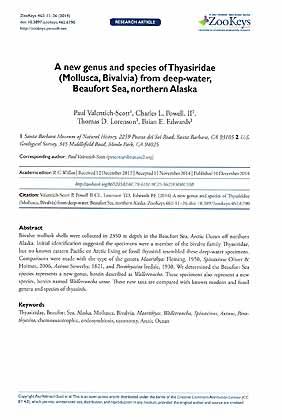
A new genus and species of Thyasiridae (Mollusca, Bivalvia) from deep-water, Beaufort Sea, northern Alaska
Erscheinungsdatum: 2014
Anbieter: ConchBooks, Harxheim, Deutschland
Verkäuferbewertung 4 von 5 Sternen

Bivalve mollusk shells were collected in 2350 m depth in the Beaufort Sea, Arctic Ocean off northern Alaska. Initial identification suggested the specimens were a member of the bivalve family Thyasiridae, but no known eastern Pacific or Arctic living or fossil thyasirid resembled these deep-water specimens. Comparisons were made with the type of the genera Maorithyas Fleming, 1950, Spinaxinus Oliver & Holmes, 2006, Axinus Sowerby, 1821, and Parathyasira Iredale, 1930. We determined the Beaufort Sea species represents a new genus, herein described as Wallerconcha. These specimens also represent a new species, herein named Wallerconcha sarae. These new taxa are compared with known modern and fossil genera and species of thyasirds. 16 pp., 4 pls, 2 figs, gr. 8.
-

A new species of Malletia (Bivalvia, Malletiidae) and new records of deep-water bivalves from Pacific Southern Colombia
Erscheinungsdatum: 2018
Anbieter: ConchBooks, Harxheim, Deutschland
Verkäuferbewertung 4 von 5 Sternen
In order to enhance the understanding of Pacific Colombia's deep-water marine fauna, a benthic research cruise (2012 TUM Offshore 6 and 7) was conducted off the coast of the Department of Nariño, in southern Colombia. Biological, oceanographic and sediment samples from the continental shelf and slope were collected at depths between 350 and 941 m. A new species of Malletia obtained on that cruise is described and compared with other species from the eastern Pacific. Sixteen species of bivalve mollusks (belonging to 12 families and 15 genera) were identified. Five of them were the first records for Pacific Colombia (Jupiteria lobula, Limatula saturna, Lucinoma heroica, Cuspidaria panamensis, and Dallicordia alaskana). Four of them had geographic distributions that now extend to Tumaco at the southern end of Nariño. New taxa: Malletia tumaquensis n. sp. 19 pp., 22 figs, gr. 8.
-

Bivalve Seashells of Western South America. Marine Bivalve Mollusks from Punta Aguja, Perú to Isla Chiloé, Chile
Erscheinungsdatum: 2020
Anbieter: ConchBooks, Harxheim, Deutschland
Verkäuferbewertung 4 von 5 Sternen
This book is a comprehensive guide to the identification of bivalve mollusks in the Perú-Chile Province. Nearly 240 species are detailed, and to facilitate its use, we have provided a series of to help the reader in making identifications. For the bivalve identification novice, we recommend beginning with an understanding of common bivalve morphological features found in the "Introduction". Bivalve vocabulary is further defined in the "Glossary". Once the basic morphological terms are understood, the "Key to the Superfamilies"will give the reader an opportunity to place a specimen in a general taxonomic group. It should be noted that this key, and all keys in this book, were written considering full size (adult) characteristics. Many superfamily sections begin with a short key to its contained families. A family containing more than one species have a "Species Characteristics Table" with images that will help readers separate a particular species of that family from others in the Perú-Chile Province. Readers can confirm their preliminary identification by considering the "Species Descriptions§ and "Illustrations" for every species. Within the species accounts are details about the known geographic and depth distributions. We have also included a maximum size for the species. New taxa: Gullerina n. gen., Kamenevus n. gen., Propeleda hickmanae n. sp., Semele iscovichorum n. sp. Santa Barbara, CA. Santa Barbara Museum. 593 pp., 135 plates, hardcover 4 [23 x 30.5 cm].
-
Bivalve Seashells of Tropical West America. Marine Bivalve Mollusks from Baja California to Northern Peru
Erscheinungsdatum: 2012
Anbieter: ConchBooks, Harxheim, Deutschland
Verkäuferbewertung 4 von 5 Sternen
This book is a comprehensive guide to the identification of bivalve mollusks in the Panamic Province. Nearly 900 species are detailed, and to facilitate its use, the authors have provided a series of tools to help the reader in making identifications. 1258 pp., 326 col. pls, 2 Vols hc 4 in slipcase.

