

Gesamtpreis (1 Artikel Artikel):
Versandziel:

usher burdick (12 Ergebnisse)
Direkt zu den wichtigsten Suchergebnissen
Suchfilter
Produktart
- Alle Product Types
- Bücher (12)
- Magazine & Zeitschriften (Keine weiteren Ergebnisse entsprechen dieser Verfeinerung)
- Comics (Keine weiteren Ergebnisse entsprechen dieser Verfeinerung)
- Noten (Keine weiteren Ergebnisse entsprechen dieser Verfeinerung)
- Kunst, Grafik & Poster (Keine weiteren Ergebnisse entsprechen dieser Verfeinerung)
- Fotografien (Keine weiteren Ergebnisse entsprechen dieser Verfeinerung)
- Karten (Keine weiteren Ergebnisse entsprechen dieser Verfeinerung)
- Manuskripte & Papierantiquitäten (Keine weiteren Ergebnisse entsprechen dieser Verfeinerung)
Zustand Mehr dazu
- Neu (3)
- Wie Neu, Sehr Gut oder Gut Bis Sehr Gut (Keine weiteren Ergebnisse entsprechen dieser Verfeinerung)
- Gut oder Befriedigend (5)
- Ausreichend oder Schlecht (1)
- Wie beschrieben (3)
Einband
Weitere Eigenschaften
- Erstausgabe (5)
- Signiert (2)
- Schutzumschlag (Keine weiteren Ergebnisse entsprechen dieser Verfeinerung)
- Angebotsfoto (7)
Sprache (3)
Gratisversand
Land des Verkäufers
Verkäuferbewertung
-

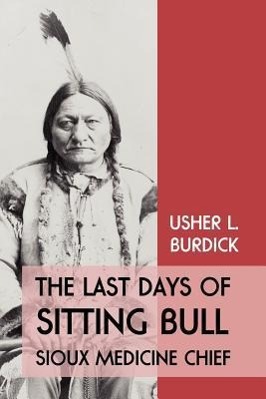
The Last Days of Sitting Bull: Sioux Medicine Chief
Anbieter: Revaluation Books, Exeter, Vereinigtes Königreich
Verkäuferbewertung 5 von 5 Sternen

EUR 24,38
EUR 11,56 Versand
Versand von Vereinigtes Königreich nach USAAnzahl: 2 verfügbar
In den WarenkorbPaperback. Zustand: Brand New. 188 pages. 8.90x5.90x0.60 inches. In Stock.
-

Das Schicksal der Sudetendeutschen : Die Sudetenfrage im US-Kongress. Übers. aus d. Kongressbericht. Carroll Reece / Mitteleuropäische Quellen und Dokumente ; Bd. 3
Sprache: Deutsch
Verlag: München : Wolf, 1960
Anbieter: Herr Klaus Dieter Boettcher, Karlsruhe, BW, Deutschland
Verkäuferbewertung 3 von 5 Sternen

kart. Zustand: Gut. 116 S. : mit Abb., 1 Bl. Ktn., 1 Titelbild ; 8 Alles sauber und gut erhalten. Sprache: Deutsch Gewicht in Gramm: 550.
-

My Friend the Indian; or Three Heretofore Unpublished Chapters of the Book Published Under the Title My Friend the Indian
Verlag: The Proof Press
Anbieter: Wonder Book, Frederick, MD, USA
Verkäuferbewertung 5 von 5 Sternen
Erstausgabe
Zustand: Good. Baltimore: The Proof Press, 1936. 1st edition. 8vo. 30pp. Plates. Near very good book. Spine ends mildly worn. Pages aged. Inquire if you need further information.
-

The Life of George Sperry Loftus: Militant Farm Leader of the Northwest
Verlag: Wirth Brothers, Baltimore, MD, 1939
Anbieter: Easy Chair Books, Lexington, MO, USA
Verkäuferbewertung 5 von 5 Sternen
Hardcover. Zustand: Fair. Zustand des Schutzumschlags: No Dust Jacket. 92 pages. Ex-university library marks, some wear and discoloring; cracked in the middle but still intact; a reading copy of a hard to find book. Quantity Available: 1. Category: Biography & Autobiography; Inventory No: 218637.
-
EUR 22,24
EUR 48,99 Versand
Versand von Deutschland nach USAAnzahl: Mehr als 20 verfügbar
In den WarenkorbZustand: New.
-
My Friend the Indian; or Three Heretofore Unpublished Chapters of the Book Published Under the Title My Friend the Indian
Verlag: The Proof Press, 1936
Anbieter: Books From California, Simi Valley, CA, USA
Verkäuferbewertung 4 von 5 Sternen

pamphlet. Zustand: Good.
-

The Last Days of Sitting Bull : Sioux Medicine Chief
Sprache: Englisch
Verlag: Coachwhip Publications Aug 2011, 2011
ISBN 10: 1616461004 ISBN 13: 9781616461003
Anbieter: AHA-BUCH GmbH, Einbeck, Deutschland
Verkäuferbewertung 5 von 5 Sternen
Taschenbuch. Zustand: Neu. Neuware - Sitting Bull was a fascinating, but controversial figure in the political history of relationships between the First Nations and the U.S. Government. Author Usher L. Burdick illuminates the human factor in the tragic events leading up to the death of Sitting Bull and the aftermath at Wounded Knee, building from the correspondence and papers of Indian Agent James McLaughlin. The late Congressman Usher L. Burdick (1879-1960) first published 'The Last Days of Sitting Bull' in 1941.
-
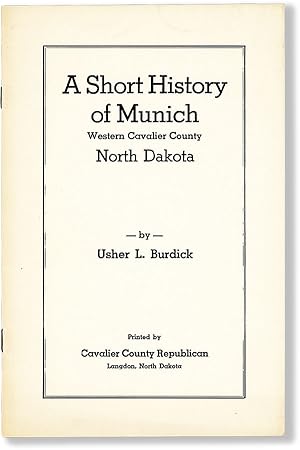
A Short History of Munich, Western Cavalier County, North Dakota
Verlag: Cavalier County Republican [1953], Langdon, ND, 1953
Anbieter: Lorne Bair Rare Books, ABAA, Winchester, VA, USA
Verbandsmitglied: ABAA ILAB IOBA
Verkäuferbewertung 5 von 5 Sternen
Erstausgabe
First Edition. First printing. Octavo (22.5cm). Stampled pamphlet in cream printed wrappers; [iv],19,[1]pp; a few in-text halftone photographs. Slight toning along edges, with mild rubbing, else Very Good. [62484].
-
THE LAST BATTLE OF THE SIOUX NATION
Verlag: Worzalla Oublishing Company, Stevens Point, Wisconsin, 1929
Anbieter: Glenn Books, ABAA, ILAB, Prairie Village, KS, USA
Verkäuferbewertung 5 von 5 Sternen
Erstausgabe
Brown Pebbled Cloth. Zustand: Minor Edge and Corner Wear. Zustand des Schutzumschlags: No Dust Jacket. First Edition. Front cover lettered on gilt. A total of 26 full-page illustrations and maps, 4 of which are in color. Chapters on Sitting Bull, Reno, Crazy Horse, Custer's last stand, Little Big Horn. A very clean and crisp copy.164pp. See Custer High Spots 115. Size: Thin Octavo.
-
THE LAST DAYS OF SITTING BULL:SIOUX MEDICINE CHIEF [Signed]
Verlag: Wirth Brothers, Baltimore, 1941
Anbieter: Second Story Books, ABAA, Rockville, MD, USA
Verkäuferbewertung 4 von 5 Sternen
Erstausgabe Signiert
Hardcover. First Edition. Octavo, 188 pages; VG-; Dark blue cloth spine with faded gilt lettering; Boards show light wear to head/tail of spine and minimal wear to corners; Textblock has moderate but even age-toning to deckled edges, and minimal soiling to top edge; An inscription in ink appears on ffep, which reads: "To Mary Bowman / from / Usher L. Burdick / 1956 - "; Illustrated; NOTE: Shelved in Netdesk office, Case #2. 1348669. FP New Rockville Stock.
-
The Last Days of Sitting Bull; Sioux Medicine Chief
Verlag: Wirth Brothers, Baltimore, 1941
Anbieter: Ground Zero Books, Ltd., Silver Spring, MD, USA
Verkäuferbewertung 4 von 5 Sternen
Erstausgabe
Hardcover. Zustand: Good. Format is approximately 5.5 inches by 8 inches. 188, [4] pages. Frontis illustration. Illustrations. Folding map. Appendix. Some lettering on the spine faded. Usher Lloyd Burdick (February 21, 1879 - August 19, 1960) was a member of the United States House of Representatives from North Dakota. Burdick moved with his parents to Dakota Territory in 1882. He graduated from the North Dakota State at Mayville in 1900. He was deputy superintendent of schools of Benson County from 1900 to 1902. He graduated from University of Minnesota Law School in 1904, was admitted to the state bar in 1904 and commenced practice in Munich, North Dakota. He served as a member of the North Dakota House of Representatives from 1907 to 1911, serving as speaker in 1909. He moved to Williston in 1907 and continued the practice of law. He was the eighth Lieutenant Governor of North Dakota from 1911 to 1913, state's attorney of Williams County from 1913 to 1915, and served as assistant United States district attorney for North Dakota from 1929 to 1932. Burdick also engaged in livestock breeding and farming and was an author. In 1932, Burdick was elected president of the Farmers' Holiday Association, an association which advocated strikes for farmers, and which took direct action against farm foreclosures. Burdick was elected as a Republican to the 74th Congress and to the four succeeding Congresses (January 3, 1935-January 3, 1945). He was supportive of Native American issues. Burdick was elected to the 81st Congress and to the four succeeding Congresses (January 3, 1949-January 3, 1959). Sitting Bull was a fascinating, but controversial figure in the political history of relationships between the First Nations and the U.S. Government. Author Usher L. Burdick illuminates the human factor in the tragic events leading up to the death of Sitting Bull and the aftermath at Wounded Knee, building from the correspondence and papers of Indian Agent James McLaughlin. Congressman Usher L. Burdick (1879-1960) first published "The Last Days of Sitting Bull" in 1941. The author stated "This narrative is intended to be as near to the actual facts of the matter, as it will ever be possible to record it. It remains for each reader to make his own estimate of Sitting Bull." Sitting Bull (1831 - December 15, 1890) was a Hunkpapa Lakota leader who led his people during years of resistance against United States government policies. He was killed by Indian agency police on the Standing Rock Indian Reservation during an attempt to arrest him, at a time when authorities feared that he would join the Ghost Dance movement. Before the Battle of the Little Bighorn, Sitting Bull had a vision in which he saw many soldiers, "as thick as grasshoppers," falling upside down into the Lakota camp, which his people took as a foreshadowing of a major victory in which many soldiers would be killed. About three weeks later, the confederated Lakota tribes with the Northern Cheyenne defeated the 7th Cavalry under Lt. Col. George Armstrong Custer on June 25, 1876, annihilating Custer's battalion and seeming to bear out Sitting Bull's prophetic vision. Sitting Bull's leadership inspired his people to a major victory. In response, the U.S. government sent thousands more soldiers to the area, forcing many of the Lakota to surrender over the next year. Sitting Bull refused to surrender, and in May 1877, he led his band north to Wood Mountain, North-Western Territory (now Saskatchewan). He remained there until 1881, at which time he and most of his band returned to U.S. territory and surrendered to U.S. forces. After working as a performer with Buffalo Bill's Wild West show, Sitting Bull returned to the Standing Rock Agency in South Dakota. Due to fears that he would use his influence to support the Ghost Dance movement, Indian Service agent James McLaughlin at Fort Yates ordered his arrest. During an ensuing struggle between Sitting Bull's followers and the agency police, Sitting Bull was shot in the side and head by Standing Rock policemen Lieutenant Bull Head and Red Tomahawk, after the police were fired upon by Sitting Bull's supporters. His body was taken to nearby Fort Yates for burial. In 1953, his Lakota family exhumed what were believed to be his remains, reburying them near Mobridge, South Dakota, near his birthplace. First Edition [stated] Limited Edition of 500--unnumbered.
-
The last battle of the Sioux nation
Verlag: Pub. for U.L. Burdick, Fargo, N., 1928
Anbieter: Books From California, Simi Valley, CA, USA
Verkäuferbewertung 4 von 5 Sternen
Signiert
unknown_binding. Zustand: Good. Signed. dedicated, inscribed, and signed by Usher L. Burdick on the ffep. shows minimal wear, no dj.


![Bild des Verkäufers für THE LAST DAYS OF SITTING BULL:SIOUX MEDICINE CHIEF [Signed] zum Verkauf von Second Story Books, ABAA](https://pictures.abebooks.com/inventory/md/md31052773535.jpg)