
Tranet (3 Ergebnisse)
Sprache: Französisch
- Softcover
Anbieter: Masalai Press, Oakland, CA, USAMasalai Press
Verkäufer/-in kontaktierenVerkäufer/-in mit 5 SternenZustand: Gebraucht - Gut
EUR 180,07
EUR 4,20 VersandVersand innerhalb von USAAnzahl: 1 verfügbar
Soft cover. Zustand: Very Good. 431 p. Includes: illustrations, diagrams, bibliography. In French.
 Weitere Bilder
Verlag: Transnational Network for Appropriate / Alternative Technologies, Rangeley, ME, 1988
Anbieter: Burnside Rare Books, ABAA, Portland, OR, USABurnside Rare Books, ABAA
Verkäufer/-in kontaktierenVerkäufer/-in mit 5 SternenZustand: Gebraucht - Gut
EUR 1.350,58
Versand nach gratisVersand innerhalb von USAAnzahl: 1 verfügbar
Zustand: Very Good+. Collection of 40 issues, spanning ten years, of the quarterly newsletter directory "of, by, and for those individuals and groups around the world who are actively developing Appropriate/Alternative Technologies." Each issue approx 8-16 pp, printed in black or red-brown. Quarto, unbound layered broadside shee…ts folded in half. Overall Very Good+ with toning, light wear, and mailing label to each issue. Subscription creases and/or staple marks or tape to most issues. Letter soliciting subscriptions, in original envelope, laid in. Includes issues nos. 7-11, 13-32, 40-50, and 52-55. William Ellis ended his career as a science policy consultant for UNESCO and the World Bank in order to promote economic and scientific innovations that would reduce global inequality. He was part of a growing movement that rejected the autocratic international development tactics of wealthy countries and pivoted toward community land trusts, peer lending, and green growth. Participants from around the world wanted a way to stay in touch that steered clear of UN-style centralized bureaucracy. Ellis later wrote: "So I agreed that if people would send me their information, I would abstract it in a newsletter-directory, just saying so-and-so had built a windmill with such-and-such characteristics. I would include the name and address and contact information so that anyone could get in touch directly with the person who developed the technology for details and assistance." The Transnational Network for Appropriate / Alternative Technologies ran from 1976 to 1999, by which time online message boards and emails had rendered the printed newsletter superfluous. The subscriber to these issues was Bill Hill on behalf of the Library for Social and Technological Alternatives, the materials collection of the Berkeley-based nonprofit Village Design. These forty newsletters are a fascinating compendium of ideas, experiments, and successes from thousands of organizations working for social and environment justice.

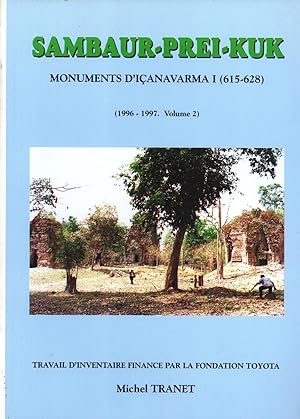
Sprache: Französisch
Anbieter: Librairie Le Trait d'Union sarl., TROYES, FrankreichLibrairie Le Trait d'Union sarl.
Verkäufer/-in kontaktierenVerkäufer/-in mit 5 SternenVerbandsmitglied: ILAB
Zustand: Gebraucht
EUR 135,00
EUR 42,75 VersandVersand von Frankreich nach USAAnzahl: 1 verfügbar
S.l., s.n., [2001]. 3 tomes en 3 vol. in-4 brochés, couv. ill. en coul., 430, 430 et 413 pp., très nb. fig. et ill. photogr. en n/b. in-t., bibliographie. Important travail d'inventaire réalisé sur ce site archéologique cambodgien. /S307-308 Très bon ex.

