

Gesamtpreis (1 Artikel Artikel):
Versandziel:

tompkins c b (8 Ergebnisse)
Direkt zu den wichtigsten Suchergebnissen
Suchfilter
Produktart
- Alle Product Types
- Bücher (8)
- Magazine & Zeitschriften (Keine weiteren Ergebnisse entsprechen dieser Verfeinerung)
- Comics (Keine weiteren Ergebnisse entsprechen dieser Verfeinerung)
- Noten (Keine weiteren Ergebnisse entsprechen dieser Verfeinerung)
- Kunst, Grafik & Poster (Keine weiteren Ergebnisse entsprechen dieser Verfeinerung)
- Fotografien (Keine weiteren Ergebnisse entsprechen dieser Verfeinerung)
- Karten (Keine weiteren Ergebnisse entsprechen dieser Verfeinerung)
- Manuskripte & Papierantiquitäten (Keine weiteren Ergebnisse entsprechen dieser Verfeinerung)
Zustand Mehr dazu
- Neu (1)
- Wie Neu, Sehr Gut oder Gut Bis Sehr Gut (1)
- Gut oder Befriedigend (4)
- Ausreichend oder Schlecht (Keine weiteren Ergebnisse entsprechen dieser Verfeinerung)
- Wie beschrieben (2)
Einband
Weitere Eigenschaften
- Erstausgabe (3)
- Signiert (Keine weiteren Ergebnisse entsprechen dieser Verfeinerung)
- Schutzumschlag (1)
- Angebotsfoto (5)
Sprache (2)
Preis
- Beliebiger Preis
- Weniger als EUR 20 (Keine weiteren Ergebnisse entsprechen dieser Verfeinerung)
- EUR 20 bis EUR 45
- Mehr als EUR 45
Gratisversand
Land des Verkäufers
Verkäuferbewertung
-

The Common Symptom Guide, 3/e
Anbieter: Romtrade Corp., STERLING HEIGHTS, MI, USA
Verkäuferbewertung 5 von 5 Sternen

Zustand: New. This is a Brand-new US Edition. This Item may be shipped from US or any other country as we have multiple locations worldwide.
-

Proceedings of Symposia in Applied Mathematics Volume XV. Experimental Arithmetic, High Speed Computing and Mathematics [American Mathematical Society, 1963]
Verlag: American Mathematical Society, Providence, RI, 1963
Anbieter: Powell's Bookstores Chicago, ABAA, Chicago, IL, USA
Verkäuferbewertung 4 von 5 Sternen

Hardcover. Zustand: Very good. Cloth, no dj. Tall octavo. Red cloth boards with gilt titles on front and spine. ix, 396 pp. Minor rubbing and edge wear to boards; slight fading to spine. Expected age-toning to text block; additional toning to paste downs and endpapers. Former owner's signature on ffep. Else clean.
-
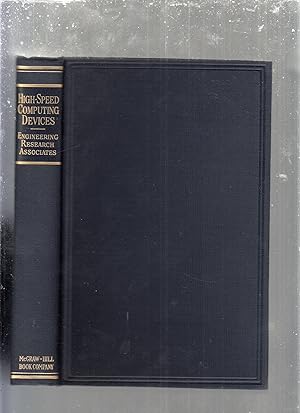
High-Speed Computing Devices
Verlag: McGraw-Hill, New York, 1950
Anbieter: Old Book Shop of Bordentown (ABAA, ILAB), Bordentown, NJ, USA
Verkäuferbewertung 4 von 5 Sternen
Hardcover. Zustand: Fine. Hardcover in black cloth with spine lettered in gilt. Sixth printing of the first edition, with "VI" on coyright page. A fine, bright, tight copy. No jacket. 451 pp. with index. Illustrated with diagrams. A cornerstone title in the early histroy of modern computing. From the preface: "This volume is primarily a discussion of the mechanical devices and electrical circuits which can be incorporated into computing machines.we have included descriptions of a few computers, to provide examples of the integration of thechniques and components into complete systems.
-

High-Speed Computing Devices
Verlag: McGraw-Hill, New York, 1950
Anbieter: Sekkes Consultants, North Dighton, MA, USA
Verkäuferbewertung 5 von 5 Sternen
Erstausgabe
Hardcover. Zustand: very good. First edition. This is the definitive modern sourcebook on the technologies from which the computer industry sprang. Widely read, it gave impetus to technical developments both in the United States and abroad. It presents a clear, organized picture of computing concepts, techniques, machinery, and components in use as of 1950, with emphasis on electronic high-speed computing. The material is elaborately referenced and contains a multitude of diagrams and tables. One particularly significant table lists all the computers of the era-including the famous EDVAC, UNIVAC, BINAC, and Mark III-with their specifications. This first compendium of United States computer technology was created by a research team that grew out of the U.S. Navy's wartime cryptologic establishment. Owner name with 1957 date on title page, shallow crease to first few pages, slight rubbing to the edges. First edition. 6¼" - 9½". book.
-
High-Speed Computing Devices
Verlag: McGraw-Hill
Anbieter: ThriftBooksVintage, Tukwila, WA, USA
Verkäuferbewertung 5 von 5 Sternen
Hardcover. Zustand: Good. No Jacket. Shelf and handling wear to cover and binding, with general signs of previous use. Boards show signs of wear. All pages intact, binding is sound. Clean and unmarked. Secure packaging for safe delivery.
-

Alphabet Kids
Verlag: Vermont Crossroads Press, Waitsfield, Vt
Anbieter: E. M. Maurice Books, ABAA, Torrington, CT, USA
Verkäuferbewertung 5 von 5 Sternen
Erstausgabe
Zustand: Very Good. Reppy Epstein (illustrator). First Edition. (1978). Pictorial card covers, light spine wear. An alphabet book with lift-the-flap elements on every other page. Brightly colored artwork on every page. Scarce title from this short-lived publisher. Size: Oblong 4to.
-
High-Speed Computing Devices.
Verlag: New York McGraw-Hill Company Inc, 1950
Anbieter: Shapero Rare Books, London, Vereinigtes Königreich
Verbandsmitglied: ABA ILAB PBFA
Verkäuferbewertung 5 von 5 Sternen
Erstausgabe
EUR 295,10
EUR 17,19 Versand
Versand von Vereinigtes Königreich nach USAAnzahl: 1 verfügbar
In den WarenkorbFirst edition; 8vo; diagrams throughout, contents fresh; original blue cloth, titles to spine in gilt, cloth a little rubbed with some tiny marks, an excellent copy; 451pp. First edition of 'the first treatise on how to build an electronic digital computer' (Hook & Norman, Origins of Cyberspace 584). An attractive copy. High-Speed Computing Devices was prepared under the supervision of Charles Brown Tompkins, vice president for research at Engineering Research Associates. Founded in 1946 by ex-Navy personnel, ERA manufactured both commercial computers and secret military equipment, and this book had its origins in a report to the Office of Naval Research. The text 'provided a "cookbook" describing the available ingredients and how they worked for both digital and analog computers. Because it explained the principles involved and gave examples, it was extremely useful'. Hook & Norman, Origins of Cyberspace 584.
-
High-Speed Computing Devices. - ["THE FIRST GENUINE TEXTBOOK ON COMPUTING TECHNIQUES AND COMPUTER HARDWARE"]
Anbieter: Herman H. J. Lynge & Søn ILAB-ABF, Copenhagen, Dänemark
Verkäuferbewertung 4 von 5 Sternen
New York, McGraw-Hill, 1950. 8vo. In the original full cloth with the original dust-jacket. Dust-jacket with light miscolouring to spine and and a tear to capitals. Small tear to upper part of the back to dust-jacket. A very fine and clean copy. XIII, (1), 451 pp. First edition in the rare original dust-jacket of the first textbook on digital computers. It constitutes "the first genuine textbook on computing techniques and computer hardware, was a pioneering book that influenced both American and foreign computer developments." (Tomash-Erwin E14). "The first treatise on how to build an electronic digital computer" (OOC)"High-Speed Computing Devices was written to satisfy a perceived need, following the end of World War II, for a compendium of technologies applicable to the emerging field of the electronic digital computer. Because published technical information was scarce in the US, there can be little question that the book was an important contribution to the computer literature of the 1950s. For today's student of computer history, whether a professional historian or a history buff, the book, with its state-of-the-art picture of the period 1947 through 1949, establishes a well-documented baseline for tracking and evaluating subsequent technological progress" (A.A. Cohen, "Introduction", Charles Babbage Institute Reprint Series Edition of the ERA Report, 1983)."It provides the best picture of the state of the industry in its infancy. Ostensibly written as a report to the Office of Naval Research, the work was really undertaken on behalf of the Naval cryptographic establishment. Engineering Research Associates, ERA, was a group formed primarily from demobilized World War II naval cryptographers. It presents a discussion of the mechanical and electrical (both analog and digital) devices that could be usefully incorporated into computing machines. Although it does not survey the computer projects then underway, it does occasionally discuss individual machines in the context of integrating devices into complete systems. Engineering Research Associates (ERA) later became a division of Remington Rand and then of Sperry Rand." (Tomash-Erwin E14)Tomash-Erwin E14.Origins of Cyberspace 584.


![Bild des Verkäufers für High-Speed Computing Devices. - ["THE FIRST GENUINE TEXTBOOK ON COMPUTING TECHNIQUES AND COMPUTER HARDWARE"] zum Verkauf von Herman H. J. Lynge & Søn ILAB-ABF](https://pictures.abebooks.com/inventory/md/md15723875143.jpg)