Gesamtpreis (1 Artikel Artikel):
Versandziel:

thermometer (6 Ergebnisse)
Direkt zu den wichtigsten Suchergebnissen
Suchfilter
Produktart
- Alle Product Types
- Bücher (5)
- Magazine & Zeitschriften (Keine weiteren Ergebnisse entsprechen dieser Verfeinerung)
- Comics (Keine weiteren Ergebnisse entsprechen dieser Verfeinerung)
- Noten (Keine weiteren Ergebnisse entsprechen dieser Verfeinerung)
- Kunst, Grafik & Poster (1)
- Fotografien (Keine weiteren Ergebnisse entsprechen dieser Verfeinerung)
- Karten (Keine weiteren Ergebnisse entsprechen dieser Verfeinerung)
- Manuskripte & Papierantiquitäten (Keine weiteren Ergebnisse entsprechen dieser Verfeinerung)
Zustand Mehr dazu
- Neu (Keine weiteren Ergebnisse entsprechen dieser Verfeinerung)
- Wie Neu, Sehr Gut oder Gut Bis Sehr Gut (Keine weiteren Ergebnisse entsprechen dieser Verfeinerung)
- Gut oder Befriedigend (Keine weiteren Ergebnisse entsprechen dieser Verfeinerung)
- Ausreichend oder Schlecht (Keine weiteren Ergebnisse entsprechen dieser Verfeinerung)
- Wie beschrieben (6)
Einband
Weitere Eigenschaften
- Erstausgabe (2)
- Signiert (Keine weiteren Ergebnisse entsprechen dieser Verfeinerung)
- Schutzumschlag (1)
- Angebotsfoto (3)
Sprache (1)
Gratisversand
Land des Verkäufers
Verkäuferbewertung
-

Spezial-Liste E: Pharmazeutische-chirurgische Glasartikel.
Verlag: Schmiedefeld, ca., 1920
Anbieter: Manfred Nosbuesch, Kuchenheim, Deutschland
Verkäuferbewertung 4 von 5 Sternen

4to. 10 S. Mit Abbildungen. Orig.-Broschur. Hs. Nummer auf Vorderumschlag. - Gutes Exemplar.
-
A History of the Thermometer and Its Use in Meteorology
Verlag: The Johns Hopkins Press, Baltimore, Md, 1966
Anbieter: The Old Mill Bookshop, HACKETTSTOWN, NJ, USA
Verkäuferbewertung 3 von 5 Sternen

Erstausgabe
Zustand des Schutzumschlags: dj. First edition. First edition. Illustrated. xiii, 249 pp. 1 vols. 8vo. Cloth. Fine in green dust jacket Illustrated. xiii, 249 pp. 1 vols. 8vo.
-

Anweisung zur Kenntniß, Prüfung, Anwendung und Verfertigung aller Arten Thermometer, Barometer, Hygrometer, Pyrometer, Aräometer, Hydrometer.Nebst Belehrung über die specifische Schwere und vergleichenden Tabellen der verschiedenen Skalen von Réaumur, Celsius, Fahrenheit, Baumé und Andern.
Verlag: Quedlinburg and Leipzig, Basse., 1833
Anbieter: Michael Steinbach Rare Books, Wien, Österreich
Verbandsmitglied: ILAB VDA VDAO
Verkäuferbewertung 5 von 5 Sternen

2. enlarged edition. 22,5 : 13,5 cm. 2 leaves, 188 pages With 106 lithographed illustrations on 6 manyfolded plates. Boards. Second, opposite the first, significaly enlarged edition. - A useful work for physicians, chemists and all the others how produce such instruments. The plates show different thermometers and the way to produce them. - Title-page and one leaf with stamp, lower part of the pages waterstained, also various pages and the plates. - See Engelmann 268 (EA).
-
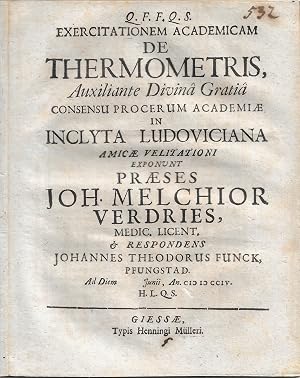
Exercitationem Academicam De Thermometris, Auxiliante Divina Gratia Consensu Procerum Academiae In Inclyta Ludoviciana Amicae Velitationi Exponunt Praeses Joh. Melchior Verdries, Medic. Licent. Respondens Johannes Theodorus Funck, Pfungstad. Ad Diem . Junii, An. MDCCIV.
Verlag: Gießen, Henning Müller, 1704., 1704
Anbieter: Antiquariat MEINDL & SULZMANN OG, Wien - Vienna, Österreich
Verkäuferbewertung 5 von 5 Sternen
Erstausgabe
Kl.-4°. Mit 1 Kupfertafel (linker Rand knapp beschnitten, dadurch minimaler Bildverlust). 40 (recte 38) SS. Zeitgenöss. Buntpapier-Broschur. Erste Ausgabe der seltenen Dissertation über Entwicklung, Bau und Funktion von Thermometern.- Johann Melchior Verdries (Gießen 1679 - 1735) war Arzt und Professor für Physik und Medizin in Gießen. Er studierte ab 1694 in Gießen, Jena und Halle Medizin, mit der Lizenz 1702 in Gießen. Darauf reiste er zu Studienzwecken in die Niederlande und wurde 1707 in Medizin promoviert. Im selben Jahr wurde er außerordentlicher und 1710 ordentlicher Professor für Physik in Gießen. 1714 wurde er außerordentlicher und 1720 ordentlicher Professor für Medizin in Gießen und 1727 Rat und Leibarzt des Landgrafen von Hessen-Darmstadt.- Papier leicht gebräunt und stellenweise etw. braunfleckig.
-
Discours sur quelques proprietez de l'air, & le moyen d'en connoître la temperature dans tous les climats de la terre.
Anbieter: Herman H. J. Lynge & Søn ILAB-ABF, Copenhagen, Dänemark
Verkäuferbewertung 4 von 5 Sternen
(Paris, Jean Boudot, 1704). 4to. Without wrappers. Extracted from "Mémoires de l'Academie des Sciences. Année 1702". Pp. 155-174 a. textillustrations. First appearance of this paper in which Amontons describes his invention, construction and function of his air thermomer. He thus improves on Gallileo's design by using air pressure instead of volume. The paper is the earliest study in this field, and Amontions concludes "that unequal masses of air under equal weights invcrease equally the force of their spring for equal degrees of heat" Fifteen years later Gay-lussac performed the same experiments with better technique and results - the Gay-Lussac laws.The paper "contains Amontons' account of the first thermometer with which temperature was measured by the pressure of air."(Magie "A Source book in Physics", pp. 128 ff.)."His first scientific production was a Hygrometer in 1687.The other was an air thermometer independent of the atmospheric pressure. Air occupied the top of one of the branches of a U-shaped tube, and by its dilation it pushed down one of the mercury columns so that the other end ofthe branch formed a barometric chamber."(DSB I, p. 138 a).Parkinson "Breakthroughs", 1702 M).
-

Sammelblatt mit 9 figürlichen Darstellungen. Kupferstich (anonym), 35 x 21,5 cm, 1816.
Anbieter: Antiquariat Michael Eschmann, Groß-Gerau, Deutschland
Verkäuferbewertung 5 von 5 Sternen
Kunst / Grafik / Poster
0. Sprache: Deutschu.