Gesamtpreis (1 Artikel Artikel):
Versandziel:

taborda saúl (8 Ergebnisse)
Direkt zu den wichtigsten Suchergebnissen
Suchfilter
Produktart
- Alle Product Types
- Bücher (6)
- Magazine & Zeitschriften (2)
- Comics (Keine weiteren Ergebnisse entsprechen dieser Verfeinerung)
- Noten (Keine weiteren Ergebnisse entsprechen dieser Verfeinerung)
- Kunst, Grafik & Poster (Keine weiteren Ergebnisse entsprechen dieser Verfeinerung)
- Fotografien (Keine weiteren Ergebnisse entsprechen dieser Verfeinerung)
- Karten (Keine weiteren Ergebnisse entsprechen dieser Verfeinerung)
- Manuskripte & Papierantiquitäten (Keine weiteren Ergebnisse entsprechen dieser Verfeinerung)
Zustand Mehr dazu
- Neu (2)
- Wie Neu, Sehr Gut oder Gut Bis Sehr Gut (5)
- Gut oder Befriedigend (Keine weiteren Ergebnisse entsprechen dieser Verfeinerung)
- Ausreichend oder Schlecht (Keine weiteren Ergebnisse entsprechen dieser Verfeinerung)
- Wie beschrieben (1)
Einband
Weitere Eigenschaften
- Erstausgabe (Keine weiteren Ergebnisse entsprechen dieser Verfeinerung)
- Signiert (Keine weiteren Ergebnisse entsprechen dieser Verfeinerung)
- Schutzumschlag (2)
- Angebotsfoto (5)
Sprache (2)
Gratisversand
- Kostenloser Versand nach USA (Keine weiteren Ergebnisse entsprechen dieser Verfeinerung)
Land des Verkäufers
Verkäuferbewertung
-

La representacion zoomorfa en la cultura Guangala : un analisis pre-iconografico en el periodo de desarrollo regional de la costa central ecuatoriana
Sprache: Spanisch
Verlag: Abya Yala, Quito, Ecuador, 2016
ISBN 10: 997810240X ISBN 13: 9789978102404
Anbieter: Carothers and Carothers, Albany, CA, USA
Verkäuferbewertung 5 von 5 Sternen

Soft cover. Zustand: Fine. 161 pages : illustrations (some color), color map . Pictorial paper wrappers fresh, corners sharp, spine uncreased; contents as new. 200 grams.
-

Escritos políticos 1934-1944 : escritos póstumos.
Sprache: Spanisch
Verlag: Universidad Nacional de Córdoba, 2011
ISBN 10: 950330878X ISBN 13: 9789503308783
Anbieter: SoferBooks, Barcelona, B, Spanien
Verkäuferbewertung 5 von 5 Sternen
blanda. Zustand: Excelente. Zustand des Schutzumschlags: Nuevo. Saúl Taborda ; Edición Y Prólogo De Matías Rodeiro. Includes Bibliographical References.
-

Saúl Taborda escritos políticos 1918-1934
Sprache: Spanisch
Verlag: Universidad Nacional de Córdoba, 2008
ISBN 10: 9503306930 ISBN 13: 9789503306932
Anbieter: SoferBooks, Barcelona, B, Spanien
Verkäuferbewertung 5 von 5 Sternen
blanda. Zustand: Excelente. Zustand des Schutzumschlags: Nuevo. Reflexiones Sobre El Ideal Político De América: Una Voz -- La Enseñanza De Positivismo -- El Estado -- La Escuela De Maquiavelo -- La Justicia -- La Política Agraria -- La Política Docente -- Las Instituciones Eclesiásticas -- La Moral -- Rectificar A Europa -- Los Síntomas Del Mal -- La Beligerancia Americana -- La Democracia Americana -- El Ideal Político De La Filosofía -- El Programa De La Democracia -- Las Ciudades -- Otros Escritos: Prólogo De Saúl Taborda A Naranjo En Flor De José De Maturana -- La Huelga Iglesia -- Arte Y Revolución -- ¿y Ahora? -- La Nueva Conciencia Histórica -- Significado, Trascendencia Y Evolución Del Sentido Reformista -- Frente De Afirmación Del Nuevo Orden Espiritual (f.a.n.o.e.) -- La Revolución Francesa Y La Crisis Espiritual De Occidente -- La Crisis Espiritual Y El Ideario Argentino: El Viento De Chebar -- El Problema Agrario -- El Reformismo Georgista -- Homenaje A Rivadavia -- La Sociedad De Las Naciones. Saúl Taborda ; Edición Y Prólogo De Matías Rodeiro. Biblioteca Nacional. Includes Bibliographical References.
-

Reflexiones sobre el ideal político de América
Verlag: Imp. La Elzeviriana, 1918
Anbieter: Librería Miguel Miranda, Lope de Vega n.º XIX, Madrid, M, Spanien
Verkäuferbewertung 5 von 5 Sternen
Zustand: Fair / Aceptable. Córdoba: Imp. La Elzeviriana, 1918.- 221 p.; 8º (18,4 cm); Rústica Ed.- MUY AGOTADO. Afectado de humedad en su margen externo, con hojas interiores ligeramente rizadas y cubiertas algo fatigadas. Libro en español HISTORIA, POLÍTICA Y DERECHO POLÍTICO-INTERNACIONAL AMERICANOS DESDE LA INDEPENDENCIA.
-

Córdoba : ciudad y comunidad / Saúl Taborda.
Verlag: Eduvim, Villa María, 2025
ISBN 10: 9876999257 ISBN 13: 9789876999250
Anbieter: Iberoamericana, Madrid, M, Spanien
Verkäuferbewertung 5 von 5 Sternen
Zustand: Nuevo. Publicado originalmente en 1947. 77 pages.
-

De los Discursos Patrimoniales a las Prácticas Regionales
Sprache: Spanisch
Verlag: Editorial Académica Española, 2012
ISBN 10: 3848452340 ISBN 13: 9783848452347
EUR 70,87
EUR 48,99 Versand
Versand von Deutschland nach USAAnzahl: Mehr als 20 verfügbar
In den WarenkorbZustand: New.
-
FACUNDO. Critica y polemica
Verlag: Unquillo (Córdoba), Argentina., 1935
Anbieter: Chaco 4ever Books, Montevideo, MO, Uruguay
Verkäuferbewertung 5 von 5 Sternen
Magazin / Zeitschrift
Encuadernación de tapa dura. Zustand: Muy bien. Folio. #1 May 1935 - #7 Dic 1939. (Complete set), Bound in half brown calf marbled boards. Collaborators: Carlos Arguello Lencinas, Santiago Montserrat, Tomas Fulgueira, Tomas Bordones, Among others. Facundo put the emphasis on the elucidation of essential aspects of our political and university news that in the literary problems of the time. The "Cordovan group" integrated, among others, by Deodoro Roca, Raúl A. Orgaz, Adelmo R. Montenegro, Tomás Fulgueira, Santaigo Monserrat, Saúl Taborda, Carlos A. Fernández Ordóñez, Carlos Argüello Lencinas, Tomas Bordones, Humberto Castello and Francisco Deffis, has made contributions of singular importance for the history of Argentine culture. In 1935, Saúl Taborda began in Córdoba the publication of Facundo (Criticism and controversy), a kind of author's magazine in which he tried to display his view of the Argentine moment and specify the guidelines of a comprehensive social proposal. Shaped by the utopian tradition and fed by contemporary models, the facundic invocation of that proposal came to underline its inscription in a long dilemma and its character as a native solution for a crisis that Taborda understood to be prolonged and on a Western scale. If the problem was not new, the circumstances were, and these were what inclined us to look for the antidote in the nation and history. For the rest, the alternatives drew from distant sources, which Taborda explored with marked liberality, as he usually did with respect to a very broad system of intellectual and political references.Given the national visibility offered by the Córdoba University Reform, of which it was a central reference, Taborda shared in the 1930s the local withdrawal of most of his peers. Previously identified with forces between progressive and radicalized, his position is now less clear within that same space, in which accusations of fascism, somewhat bucolic revalidations and quite elusive audiences are crossed. This is the moment of Facundo, a magazine crossed by the complexities of an era and a character of great relative strangeness. Provenzano p155. Washington Pereyra T3,p218.
-
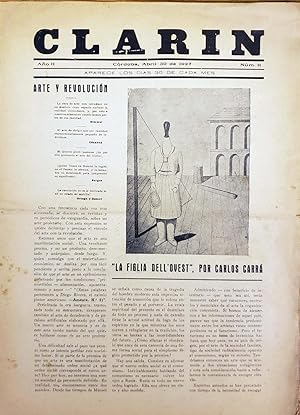
Clarin -Aparece los 15 y 30 de Cada Mes.
Verlag: Cordoba Establecimeinto grafico Pereyra Hnos., 1926
Anbieter: Chaco 4ever Books, Montevideo, MO, Uruguay
Verkäuferbewertung 5 von 5 Sternen
Magazin / Zeitschrift
Sin Encuadernar. Zustand: Muy bien. Folio. #1 August 1926 - #13 June 1927. (Complete set). Wrappers in a blue cloth folder. Collaborators : A. Navarro, Brandan Carafa, Alberto Hidalgo, Norah Lange, Ramon Gomez de la Serna, Macedonio fernandez, Pettoruti, Juan Filloy, Gerardo Diego, Among Others. Illustred bay Pettoruti, Barra , Lipchitz. It is so rare that Provenzano refers to this magazine saying ". in September 1926 the newspaper Clarín, a publication of" Literary Synthesis, "circulated in the city of Córdoba, some numbers appeared, we do not know how many, but in La Campana de Palo, May 1927, it is still mentioned and with these terms: "It is of a vanguardism too acute and crazy to be deeply sincere". Of brief but intense life, Clarín constitutes a privileged testimony of the modalities that assumed the aesthetic and literary avant-gardes in Córdoba in the decade of the '20. It expresses, in turn, a network of intellectual friendships fed by the reformist experience of '18 in opening, not necessarily peaceful, towards the territory of new art. Designed and directed by Carlos Astrada, with the accompaniment of Saúl Taborda and the usual collaboration of Emilio Petorutti -among several others- Clarín tried to connect the criticism and culture of the city with the deep, disordered and contradictory regeneration that affected the world of music. ideas and art in Europe. Forgetful, his initiative can be added to the chain of more or less failed attempts to remove the image of Cordoba from the one proposed by Sarmiento. Or it can illuminate with a different light a moment of local culture, marked by the tension assumed by the reformist legacy almost a decade after the event, and before the "call to order" of the 1930s. Washington Pereyra T2,p122.