Gesamtpreis (1 Artikel Artikel):
Versandziel:

sumner hon charles (6 Ergebnisse)
Direkt zu den wichtigsten Suchergebnissen
Suchfilter
Produktart
- Alle Product Types
- Bücher (6)
- Magazine & Zeitschriften (Keine weiteren Ergebnisse entsprechen dieser Verfeinerung)
- Comics (Keine weiteren Ergebnisse entsprechen dieser Verfeinerung)
- Noten (Keine weiteren Ergebnisse entsprechen dieser Verfeinerung)
- Kunst, Grafik & Poster (Keine weiteren Ergebnisse entsprechen dieser Verfeinerung)
- Fotografien (Keine weiteren Ergebnisse entsprechen dieser Verfeinerung)
- Karten (Keine weiteren Ergebnisse entsprechen dieser Verfeinerung)
- Manuskripte & Papierantiquitäten (Keine weiteren Ergebnisse entsprechen dieser Verfeinerung)
Zustand Mehr dazu
- Neu (Keine weiteren Ergebnisse entsprechen dieser Verfeinerung)
- Wie Neu, Sehr Gut oder Gut Bis Sehr Gut (Keine weiteren Ergebnisse entsprechen dieser Verfeinerung)
- Gut oder Befriedigend (5)
- Ausreichend oder Schlecht (Keine weiteren Ergebnisse entsprechen dieser Verfeinerung)
- Wie beschrieben (1)
Einband
Weitere Eigenschaften
- Erstausgabe (1)
- Signiert (1)
- Schutzumschlag (Keine weiteren Ergebnisse entsprechen dieser Verfeinerung)
- Angebotsfoto (2)
Sprache (1)
Preis
- Beliebiger Preis
- Weniger als EUR 20 (Keine weiteren Ergebnisse entsprechen dieser Verfeinerung)
- EUR 20 bis EUR 45
- Mehr als EUR 45
Gratisversand
Land des Verkäufers
Verkäuferbewertung
-

THE LANDMARK OF FREEDOM SPEECH IN THE SENATE, FEBRUARY 21, 1854 - AGAINST THE REPEAL OF THE MISSOURI PROHIBITION OF SLAVERY NORTH OF 36 30
Erscheinungsdatum: 1854
Anbieter: Xerxes Fine and Rare Books and Documents, Glen Head, NY, USA
Verkäuferbewertung 5 von 5 Sternen

Zustand: Good. 1854. Octavo, 16pp., later wraps. Good, paper label glued to top margin of first page.
-
SECURITY AND RECONCILIATION FOR THE FUTURE PROPOSITIONS AND ARGUMENTS ON THE REORGANIZATION OF THE REBEL STATES
Erscheinungsdatum: 1865
Anbieter: Xerxes Fine and Rare Books and Documents, Glen Head, NY, USA
Verkäuferbewertung 5 von 5 Sternen
Zustand: VG. Boston 1865 Geo. C. Rand & Avery. Octavo, 32pp., original printing in later wraps, VG.
-
THE SLAVE OLIGARCHY AND ITS USURPATIONS - SPEECH IN FANEUIL HALL, BOSTON 1855
Erscheinungsdatum: 1855
Anbieter: Xerxes Fine and Rare Books and Documents, Glen Head, NY, USA
Verkäuferbewertung 5 von 5 Sternen
Zustand: Good. 1855. Octavo, 16pp., later wraps. Good, light fraying of text edges, light soiling.
-
THE WAR SYSTEM OF THE COMMONWEALTH OF NATIONS - AN ADDRESS BEFORE THE AMERICAN PEACE SOCIETY
Erscheinungsdatum: 1854
Anbieter: Xerxes Fine and Rare Books and Documents, Glen Head, NY, USA
Verkäuferbewertung 5 von 5 Sternen
Zustand: VG. Boston 1854 American Peace Society. Octavo, 80pp., removed and rebound in later wraps. Contemporary signature of I. J. Porter. VG.
-

The Complete Works of Charles Sumner.
Verlag: Lee and Shepard, Boston, 1900
Anbieter: Raptis Rare Books, Palm Beach, FL, USA
Verkäuferbewertung 5 von 5 Sternen
Erstausgabe Signiert
The Statesman edition of the complete works of Charles Sumner, with a three-page autograph letter signed by Sumner tipped into Vol. I. Octavo, twenty volumes bound in three quarter crushed levant morocco over marbled boards with gilt titles and tooling to the spine in six compartments within raised gilt bands, marbled endpapers, top edge gilt, tissue-guarded frontispiece to each volume. One of one thousand numbered copies, this is number 391. With three-page autograph letter signed by Sumner to the Rev. R.C. Waterston tipped into Vol. I. which reads in full, "Yesterday I read the enclosed account, which will explain itself. It seems to me rather hard that I should be left in the lurch by our committee, & particularly by individuals on it who have never contributed their full quota, & who are themselves rich, too. I have so far neglected my worldly affairs during these latter years, & have been called upon so frequently for contributions, that I am less able than any member of the committee to pay this deficiency out of my own pocket. Nor do I think it just that Mr. Brigham, or Mr. Brooks, or Mr. Thayer, all of whom were originally responsible with me, and who have not contributed their full share, should let this be cast upon me. I have had the labor & responsibility of carrying the matter through--as far as it has gone, & secured contributions much beyond my portion. It seems to me, therefore, that I may properly devolve upon the members of the committee above named the duty of meeting this deficit. Upon you there is no claim; for you have already supplied more than your share but I submit the account to you, & ask your advice as to the course to be pursued. Ever sincerely yours,ÂCharlesÂSumner." Here, Sumner writes as Republican Senator to Reverend Robert C. Waterston, regarding a commitment made to raise money for the public school system in Massachusetts, a cause Sumner championed alongside famous education reformer Horace Mann (1796-1859). In fine condition. A stunning set. The only complete set of the Statesman Edition we can locate in the auction record since 1964. Charles Sumner was a prominent American statesman, lawyer, and abolitionist who played a critical role in the political struggle against slavery in the mid-19th century. As a leading member of the Radical Republicans in the U.S. Senate, Sumner championed civil rights and was an outspoken critic of the institution of slavery and its defenders. His most notable moment came in 1856 when he delivered a fiery anti-slavery speech titled "The Crime Against Kansas," which led to his brutal caning on the Senate floor by Representative Preston Brooksâ"a violent episode that symbolized the intensifying sectional conflict. Throughout the Civil War and Reconstruction, Sumner advocated for the emancipation of enslaved people and pushed for full legal and political equality for African Americans, including support for the Civil Rights Act and the Fourteenth Amendment. His commitment to moral principle and constitutional equality often put him at odds with more moderate figures, but it positioned him as a key figure in the transformation of American democracy during one of its most turbulent periods.
-
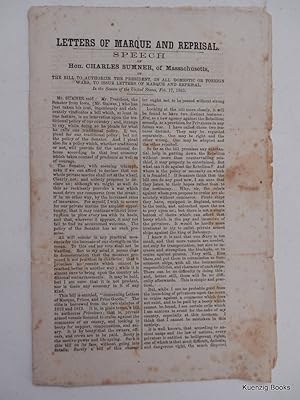
LETTERS OF MARQUE AND REPRISAL - Speech of Hon Charles Sumner, of Massachusetts, on the Bill to authorize the President, in all domestic or foreign wars, to issue letters of marque and reprisal. In the Senate of the United States, Feb,. 17, 1862 WITH Foreign intervention . Concurrent resolutions of Congress, concerning foreign intervention in the existing rebellion
Verlag: [ Washington, D.C. ? ], 1863
Anbieter: Kuenzig Books ( ABAA / ILAB ), Topsfield, MA, USA
Verbandsmitglied: ABAA ESA ILAB IOBA SNEAB
Verkäuferbewertung 5 von 5 Sternen
Pamphlet. Zustand: Good. 8 pages. 8vo. Self wrappers. The last two pages comprise "Foreign intervention . Concurrent resolutions of Congress, concerning foreign intervention in the existing rebellion". Folded as if for mailing, wear at the folds. Two folded sheets. Outer sheet fold nearly detached at spine. Foxing throughout. Pamphlet. Wikipedia notes the following: "In the days of fighting sail, a letter of marque and reprisal was a government license authorizing a person (known as a privateer) to attack and capture enemy vessels and bring them before admiralty courts for condemnation and sale. Cruising for prizes with a letter of marque was considered an honorable calling combining patriotism and profit, in contrast to unlicensed piracy, which was universally reviled. In addition to the term lettre de marque, the French sometimes used the term lettre de course for their letters of marque. "Letter of marque" was sometimes used to describe the vessel used: a "letter of marque" generally refers to a lumbering square-rigged cargo carrier that might pick up a prize if the opportunity arose. A "privateer" was a fast and weatherly fore-and-aft-rigged vessel heavily armed and heavily crewed, intended exclusively for fighting. A "letter of marque and reprisal" would include permission to cross an international border to effect a reprisal (take some action against an attack or injury) authorized by an issuing jurisdiction to conduct reprisal operations outside its borders." and later: "Article 1 of the United States Constitution lists issuing letters of marque and reprisal in Section 8 as one of the enumerated powers of Congress, alongside the power to tax and to declare War. However, since the American Civil War, the United States as a matter of policy has consistently followed the terms of the 1856 Paris Declaration forbidding the practice. The United States has not legally commissioned any privateers since 1815, although the status of submarine-hunting Goodyear airships in the early days of World War II created significant confusion. Various accounts refer to airships Resolute and Volunteer as operating under a "privateer status", but Congress never authorized a commission, nor did the President sign one.".