

Gesamtpreis (1 Artikel Artikel):
Versandziel:

strong benjamin (7 Ergebnisse)
Direkt zu den wichtigsten Suchergebnissen
Suchfilter
Produktart
- Alle Product Types
- Bücher (6)
- Magazine & Zeitschriften (Keine weiteren Ergebnisse entsprechen dieser Verfeinerung)
- Comics (Keine weiteren Ergebnisse entsprechen dieser Verfeinerung)
- Noten (Keine weiteren Ergebnisse entsprechen dieser Verfeinerung)
- Kunst, Grafik & Poster (Keine weiteren Ergebnisse entsprechen dieser Verfeinerung)
- Fotografien (Keine weiteren Ergebnisse entsprechen dieser Verfeinerung)
- Karten (Keine weiteren Ergebnisse entsprechen dieser Verfeinerung)
- Manuskripte & Papierantiquitäten (1)
Zustand Mehr dazu
- Neu (1)
- Wie Neu, Sehr Gut oder Gut Bis Sehr Gut (1)
- Gut oder Befriedigend (2)
- Ausreichend oder Schlecht (Keine weiteren Ergebnisse entsprechen dieser Verfeinerung)
- Wie beschrieben (3)
Einband
Weitere Eigenschaften
- Erstausgabe (2)
- Signiert (1)
- Schutzumschlag (Keine weiteren Ergebnisse entsprechen dieser Verfeinerung)
- Angebotsfoto (4)
Sprache (2)
Preis
- Beliebiger Preis
- Weniger als EUR 20 (Keine weiteren Ergebnisse entsprechen dieser Verfeinerung)
- EUR 20 bis EUR 45
- Mehr als EUR 45
Gratisversand
Land des Verkäufers
Verkäuferbewertung
-

INTRODUCTION TO THE STUDY OF THE HISTORY OF LANGUAGE
Erscheinungsdatum: 1891
Anbieter: Xerxes Fine and Rare Books and Documents, Glen Head, NY, USA
Verkäuferbewertung 5 von 5 Sternen

Zustand: VG. London 1891 Longmans Green. 435pp., index. Owner signed. VG. slight fraying of top spine end. Hinges not cracked; text lightly toned but unmarked. clean. Pictures available on request.
-
THE RESERVE BANKS AND THE MONEY MARKET
Verlag: Harper & Brothers, New York and London, 1927
Anbieter: Douglas Books, Tunbridge Wells, Vereinigtes Königreich
Verkäuferbewertung 4 von 5 Sternen

Erstausgabe
EUR 29,69
EUR 25,37 Versand
Versand von Vereinigtes Königreich nach USAAnzahl: 1 verfügbar
In den WarenkorbHardcover. Zustand: Very Good for Age. No Jacket. 1st Edition. Dark red cloth with gilt-lettering to fr. and spine, clean and virtually unworn but spine quite darkened. xxi + 328, 2 maps, 51 diagrams, 18 tables, all in text; light tanning to end-papers, otherwise clean, tight and unmarked. 14 cm x 20.5 cm.
-

Introduction To The Study Of The History Of Language (1891)
Sprache: Englisch
Verlag: Kessinger Publishing, LLC, 2009
ISBN 10: 1104134748 ISBN 13: 9781104134747
EUR 43,88
EUR 48,99 Versand
Versand von Deutschland nach USAAnzahl: Mehr als 20 verfügbar
In den WarenkorbZustand: New. KlappentextrnrnThis scarce antiquarian book is a facsimile reprint of the original. Due to its age, it may contain imperfections such as marks, notations, marginalia and flawed pages. Because we believe this work is culturally important, we have.
-

Zustand: Sehr gut. Zustand: Sehr gut | Sprache: Englisch | Produktart: Bücher | Keine Beschreibung verfügbar.
-
Introduction to the study of the history of language
Verlag: Longmans, Green, & Co, London, 1891
Anbieter: Rulon-Miller Books (ABAA / ILAB), St. Paul, MN, USA
Verbandsmitglied: ABAA ILAB RMABA
Verkäuferbewertung 5 von 5 Sternen
8vo, pp. x, [2], 435, [1], 24; original blue cloth, spine lettered in gilt, black glazed endpapers; extremities a bit worn, 3 small spots of dampstaining to cloth, else a very good, sound copy. 24 pp. of publisher's advertisements bound in rear.
-
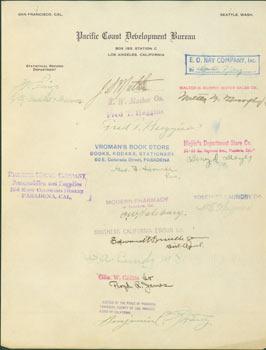
Autographs from noteworthy Californians on Pacific Coast Development Bureau letterhead. RE: Commercial Encyclopedia of the Pacific Southwest by Ellis A. Davis.
Verlag: Los Angeles, CA: Pacific Coast Development Bureau, [1914]., 1914
Anbieter: Wittenborn Art Books, San Francisco, CA, USA
Verkäuferbewertung 5 von 5 Sternen
Manuskript / Papierantiquität
Zustand: Good. Letter-Sized Page, Signatures & Stamps on Pacific Coast Development Bureau Letterhead, Good with perforations, some toning & creasing. Provenance: Letters and Autographs from a Who's Who in California 1914 - 1917, to the author Ellis A. Davis, regarding Davis' Commercial Encyclopedia of the Pacific Southwest, California, Nevada, Utah, Arizona. Sold by Cherokee Book Shop to Frederick Ruffner, Jr., the founder of Gale Research, Detroit.
-

Benjamin Strong Signed Second Liberty Loan of 1917.
Verlag: Liberty Loan Committee, New York, 1917
Anbieter: Raptis Rare Books, Palm Beach, FL, USA
Verkäuferbewertung 5 von 5 Sternen
Erstausgabe Signiert
Rare Second Liberty Loan of 1917 of the United States of America signed by Governor of the Federal Reserve Bank of New York, Benjamin Strong. Duodecimo, partially printed document on card stock made out to Miss Lena Gallup, dated December 21, 1917. Signed at the bottom right corner "Ben Strong" as Governor, Federal Reserve Bank of New York. Benjamin Strong Jr. (1872â"1928) was a pivotal figure in the early development of the United States Federal Reserve System and served as the first governor of the Federal Reserve Bank of New York from 1914 until his death. As one of the most influential central bankers of the early twentieth century, Strong played a central role in shaping Federal Reserve policy during and after the First World War, helping to stabilize financial markets and coordinate international monetary relations. He advocated the use of open market operations as a key tool of monetary policy and worked closely with leading European central bankers to support postwar economic recovery and the restoration of the gold standard. In near fine condition with light toning and creasing. The piece measures 5.75 inches by 8 inches. Accompanied by the original mailing envelope addressed to "Miss Lena Gallup Findley Lake NY" and in good condition. The Second Liberty Loan of 1917 was a major United States government bond campaign launched during the First World War to finance the nationâs expanding military operations following its entry into the conflict in April 1917. Issued by the U.S. Treasury in October 1917, the loan offered bonds bearing interest to encourage widespread public investment in the war effort. Like other Liberty Loan drives, the campaign relied heavily on patriotic appeals, mass advertising, and community-based sales efforts to mobilize financial support from American citizens.


