Gesamtpreis (1 Artikel Artikel):
Versandziel:

stokes e j (18 Ergebnisse)
Direkt zu den wichtigsten Suchergebnissen
Suchfilter
Produktart
- Alle Product Types
- Bücher (18)
- Magazine & Zeitschriften (Keine weiteren Ergebnisse entsprechen dieser Verfeinerung)
- Comics (Keine weiteren Ergebnisse entsprechen dieser Verfeinerung)
- Noten (Keine weiteren Ergebnisse entsprechen dieser Verfeinerung)
- Kunst, Grafik & Poster (Keine weiteren Ergebnisse entsprechen dieser Verfeinerung)
- Fotografien (Keine weiteren Ergebnisse entsprechen dieser Verfeinerung)
- Karten (Keine weiteren Ergebnisse entsprechen dieser Verfeinerung)
- Manuskripte & Papierantiquitäten (Keine weiteren Ergebnisse entsprechen dieser Verfeinerung)
Zustand Mehr dazu
Einband
Weitere Eigenschaften
Sprache (2)
Gratisversand
Land des Verkäufers
Verkäuferbewertung
-

Clinical Microbiology
Anbieter: Anybook.com, Lincoln, Vereinigtes Königreich
Verkäuferbewertung 5 von 5 Sternen

EUR 6,89
EUR 15,74 Versand
Versand von Vereinigtes Königreich nach USAAnzahl: 1 verfügbar
In den WarenkorbZustand: Fair. This is an ex-library book and may have the usual library/used-book markings inside.This book has soft covers. Book contains pencil markings. In fair condition, suitable as a study copy. Please note the Image in this listing is a stock photo and may not match the covers of the actual item,700grams, ISBN:9780713145328.
-

Just Rutland
Verlag: John Hawthorn, 1953
Anbieter: World of Rare Books, Goring-by-Sea, SXW, Vereinigtes Königreich
Verkäuferbewertung 5 von 5 Sternen
Erstausgabe
EUR 11,91
EUR 5,58 Versand
Versand von Vereinigtes Königreich nach USAAnzahl: 1 verfügbar
In den WarenkorbZustand: Good. 1953. First Edition. 128 pages. Illustrated dust jacket over blue cloth boards with lettering. Contains black and white illustrations. Pages and binding are presentable with no major defects. Minor issues present such as mild cracking, inscriptions, inserts, light foxing, tanning and thumb marking. Boards have mild shelf wear with light rubbing and corner bumping. Some light marking and sunning. Boards are bowed. Unclipped jacket has light edge wear with minor tears and chipping. Mild rubbing and marking. Tanning to jacket.
-
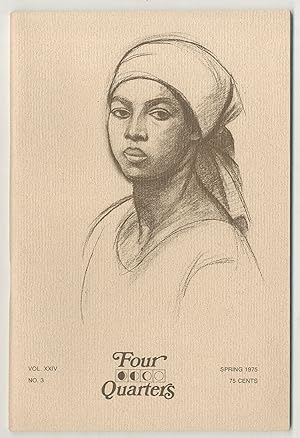
Four Quarters: Vol. XXIV, No. 3, Spring, 1975
Verlag: La Salle College, Philadelphia, Pennsylvania, 1975
Anbieter: Between the Covers-Rare Books, Inc. ABAA, Gloucester City, NJ, USA
Verbandsmitglied: ABAA ESA ILAB IOBA
Verkäuferbewertung 5 von 5 Sternen
Erstausgabe
Softcover. Zustand: Near Fine. Single Issue. Stapled wrappers. 48pp. Fine. Contributions by Mary A. Culliton, M.E. Grenander, Charles Edward Eaton, Dale Goodhue, P.W. Gray, Larry Bowman, Terry Stokes, Susan Bartels, Phyllis Brooks, Carl Schiffman, Gerald T. Gordon, and John Humma.
-

The Alone - Stokes short manual of the Amharic language (with vocabularies).
Verlag: Madras, Macmillan, ,, 1962
Anbieter: Antiquariat Gothow & Motzke, Berlin, Deutschland
Verkäuferbewertung 3 von 5 Sternen

5. Auflage. 204 S., Originalhalbleinenband (publisher's halfcloth binding), gutes Exemplar (fine), Sprache: englisch.
-

The Satan: How God's Executioner Became the Enemy
Anbieter: Revaluation Books, Exeter, Vereinigtes Königreich
Verkäuferbewertung 5 von 5 Sternen
EUR 40,83
EUR 11,58 Versand
Versand von Vereinigtes Königreich nach USAAnzahl: 2 verfügbar
In den WarenkorbPaperback. Zustand: Brand New. 275 pages. 8.75x5.75x0.75 inches. In Stock.
-

Pediatric Pulmonology, Asthma, and Sleep Medicine: A Quick Reference Guide
Sprache: Englisch
Verlag: American Academy Of Pediatrics, 2018
ISBN 10: 1610021428 ISBN 13: 9781610021425
Anbieter: Anybook.com, Lincoln, Vereinigtes Königreich
Verkäuferbewertung 5 von 5 Sternen
EUR 60,42
EUR 18,24 Versand
Versand von Vereinigtes Königreich nach USAAnzahl: 1 verfügbar
In den WarenkorbZustand: Fair. This is an ex-library book and may have the usual library/used-book markings inside.This book has soft covers. In fair condition, suitable as a study copy. Please note the Image in this listing is a stock photo and may not match the covers of the actual item,1750grams, ISBN:9781610021425.
-
Pediatric Pulmonology Asthma And Sleep Medicine (Pb 2018)
Sprache: Englisch
Verlag: American Academy of Pediatrics, 2018
ISBN 10: 1610021428 ISBN 13: 9781610021425
Anbieter: Majestic Books, Hounslow, Vereinigtes Königreich
Verkäuferbewertung 4 von 5 Sternen

EUR 73,33
EUR 7,52 Versand
Versand von Vereinigtes Königreich nach USAAnzahl: 4 verfügbar
In den WarenkorbZustand: New.
-
Short Manual (With Vocabulary) of the Amharic Language Prepared for the General Staff
Verlag: McCorquodale & Co. Ltd, Khartoum, 1940
Anbieter: Librairie Sheehy (Theologia Books), La Charite sur Loire, Frankreich
Verkäuferbewertung 4 von 5 Sternen
Hardcover. Zustand: Good. Good copy. 228pp, 2 foldout charts. First published in 1909 and revised in 1940. Book.
-
![Bild des Verkäufers für Christian Iconography - Or, The History Of Christian Art In The Middle Ages Volume I : Comprising The History Of The Nimbus, The Aureole, And The Glory, The History Of God The Father, The Son, And The Holy Ghost [with] Volume II : The Trinity, Angels, Devils, Death, The Soul, The Christian Scheme, Appendicies zum Verkauf von Eastleach Books](https://pictures.abebooks.com/inventory/md/md31755910703.jpg)
Christian Iconography - Or, The History Of Christian Art In The Middle Ages Volume I : Comprising The History Of The Nimbus, The Aureole, And The Glory, The History Of God The Father, The Son, And The Holy Ghost [with] Volume II : The Trinity, Angels, Devils, Death, The Soul, The Christian Scheme, Appendicies
Sprache: Englisch
Verlag: Kessinger Publishing, Montana, 2010
ISBN 10: 076614075X ISBN 13: 9780766140752
Anbieter: Eastleach Books, Newbury, BER, Vereinigtes Königreich
Verkäuferbewertung 5 von 5 Sternen
EUR 57,23
EUR 29,03 Versand
Versand von Vereinigtes Königreich nach USAAnzahl: 1 verfügbar
In den WarenkorbZustand: Fine. reprint. Paperback, F. 2 volumes, xii+508pp, viii+452pp, grand total of 232 b/w illustrations, a fine set. A facsimile reprint ( volume I from a 1851 Henry Bohn edition & volume II from a George Bell edition of 1907 ) of Didron's monumental study of Christian art & its meaning. Adolphe Napoléon Didron [ 1806 - 1867 ] French art historian and archaeologist. 2400 grams.
-
Pediatric Pulmonology, Asthma, and Sleep Medicine
Sprache: Englisch
Verlag: MP-AAP American Academy of Pediatrics, 2018
ISBN 10: 1610021428 ISBN 13: 9781610021425
Anbieter: PBShop.store UK, Fairford, GLOS, Vereinigtes Königreich
Verkäuferbewertung 5 von 5 Sternen
EUR 76,14
EUR 10,84 Versand
Versand von Vereinigtes Königreich nach USAAnzahl: 7 verfügbar
In den WarenkorbPAP. Zustand: New. New Book. Shipped from UK. Established seller since 2000.
-
Pediatric Pulmonology, Asthma, and Sleep Medicine: A Quick Reference Guide
Sprache: Englisch
Verlag: American Academy of Pediatrics, 2018
ISBN 10: 1610021428 ISBN 13: 9781610021425
Anbieter: Kennys Bookstore, Olney, MD, USA
Verkäuferbewertung 5 von 5 Sternen
Zustand: New. 2018. 1st Edition. Paperback. . . . . . Books ship from the US and Ireland.
-
Pediatric Pulmonology, Asthma, and Sleep Medicine: A Quick Reference Guide
Sprache: Englisch
Verlag: Amer Academy of Pediatrics, 2018
ISBN 10: 1610021428 ISBN 13: 9781610021425
Anbieter: Revaluation Books, Exeter, Vereinigtes Königreich
Verkäuferbewertung 5 von 5 Sternen
EUR 76,62
EUR 23,15 Versand
Versand von Vereinigtes Königreich nach USAAnzahl: 2 verfügbar
In den WarenkorbPaperback. Zustand: Brand New. 890 pages. 9.00x6.00x1.75 inches. In Stock.
-

Strategies for Integrated Communications: State of the Art Report 12:5
Sprache: Englisch
Verlag: Pergamon Infotech Ltd., Maidenhead, Berks., England, 1984
ISBN 10: 0080285902 ISBN 13: 9780080285900
Anbieter: PsychoBabel & Skoob Books, Didcot, Vereinigtes Königreich
Verkäuferbewertung 5 von 5 Sternen
Erstausgabe
EUR 113,87
EUR 14,47 Versand
Versand von Vereinigtes Königreich nach USAAnzahl: 1 verfügbar
In den WarenkorbHardcover. Zustand: Good. Zustand des Schutzumschlags: Acceptable. First Edition. Ex-library: label on spine; jacket taped to endpapers; torn FEP; bookplate on pastedown; ink stamps on endpapers, edges of page block, front matter. Contents otherwise clean, sound. Light wear to covers. Dust jacket tanned and notably worn at edges and corners. Nicked and chipped.
-
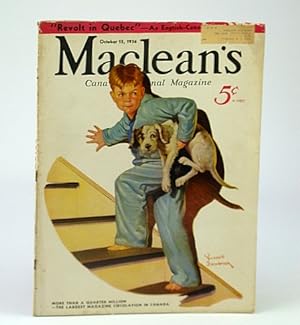
Maclean's, Canada's National Magazine, October (Oct.) 15, 1936 - Revolt in Quebec / Farming in King Ridges, Ontario
Verlag: Maclean Hunter / Key Publishers, Montreal, 1936
Anbieter: RareNonFiction, IOBA, Ladysmith, BC, Kanada
Verbandsmitglied: IOBA
Verkäuferbewertung 5 von 5 Sternen
Erstausgabe
Single Issue Magazine. Zustand: Good. Sambrook, Russell (Cover Art); Wilcox, C.R.; Hallam, J.S.; Keay, Jack; McCrea, H.W.; Eldridge, H. (illustrator). First Edition. 60 pages. Features: Russell Sambrook cover illustration of boy in pajamas sneaking his dog upstairs; Dominion Linoleum colour ad inside front cover features yellow and maroon interior design of a 'very lucky' young person's bedroom; AC spark plug ad features horse talking to man cleaning his shotgun; Premier Aberhart of Alberta ponders 'licensing' newspapers; Fantastic one-page photo-illustrated ad for Marconi radios includes photos of newscaster Christopher Ellis and Frances James, plus photos of the model 79 A.C., 81 A.C. and 85 A.C. radios; One-page ad for the Parker Vacumatic pen features marathon theme; The Red Boar (short story from Rajputana); Revolt in Quebec - The English-Canadian View - article with photos of C.E. Gault, Maurice Duplessis and Camillien Houde; A Matter of Business (short story); Forward-Pass Time - article explaining how the aerial attack has made a new game of Canadian football - with photo of Rosso of the Argos in 1935; Beverley Baxter shares interesting new from London, plus he explains how Hitler saw propaganda used against Germany in WWI and vowed to use that same weapon to avenge his nation; Finished Picture (short story about the marriage trap); J. Bull, Customer - article on Canadian exports to Britain; The Thin Woman (short story); Photo-illustrated article on the settlers of King Ridges, 25 miles north of Toronto, where 41 families formerly on relief are plowing, sowing and reaping to earn their own living from the land; The General Died at Dawn (short story); Vintage one-page colour-photo ad for Green Giant Fine Foods of Canada features their canned vegetables; Very nice one-page colour-photo Westinghouse Air-pilot radio ad; Charming one-page colour Kraft ad features their cheese products; Prestone anti-freeze one-page ad features illustrations of (now) classy vintage cars; Half-page Palmolive Soap ad features two photos of the Dionne Quints, plus Dr. Dafoe who helped birth them; Stanfield's ad features illustration of man proudly strutting in his long underwear; Ponds Cold Cream ad features photo of Mrs. William Jay Iselin; One-page ad for the Singer "Make-It-Yourself" Wardrobe Plan; Fantastic colour photo/colour comic ads inside back cover for Lifebuoy and Rinso soaps feature "True B.O. Experience No. 127"; Back cover colour ad by the federal Department of Fisheries encourages readers to eat fish often; and more. Average wear. Unmarked. A sound copy of this marvelous depression-era issue.
-
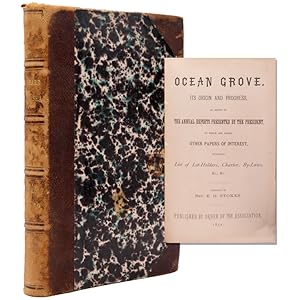
Ocean Grove, Its Origins and Progress as Shown In the Annual Reports Presented by the President, to which are added other papers of interest, including list of lot-holders, charter, by-laws, &c., &c
Verlag: Published by Order of the Association, 1879
Anbieter: James Cummins Bookseller, ABAA, New York, NY, USA
Verkäuferbewertung 5 von 5 Sternen
Erstausgabe
First Edition. First Edition. Illustrated throughout, folding map. 88; 24; 45, [2]; 40;40; 39, [1]; 50pp. 8vo. With 10 Annual Reports. The Fifth -Tenth with seperate title-pages and pagination. Half brown morocco, spine sunned Illustrated throughout, folding map. 88; 24; 45, [2]; 40;40; 39, [1]; 50pp. 8vo.
-
Two complete journal issues of Nature, Vol. 171, comprising: (1) No. 4356, 25 April 1953, containing the three papers under the common head-title 'Molecular Structure of Nucleic Acids': WATSON & CRICK, 'A Structure for Deoxyribose Nucleic Acid,' pp. 737-738; WILKINS, STOKES & WILSON, 'Molecular Structure of Deoxypentose Nucleic Acids,' pp. 738-740; and FRANKLIN & GOSLING, 'Molecular Configuration in Sodium Thymonucleate,' pp. 740-741.(2) No. 4361, 30 May 1953, containing WATSON & CRICK, 'Genetical Implications of the Structure of Deoxyribonucleic Acid,' pp. 964-967
Verlag: Macmillan, London, 1953
Anbieter: SOPHIA RARE BOOKS, Koebenhavn V, Dänemark
Verkäuferbewertung 4 von 5 Sternen
Erstausgabe
First edition. Discovery of the Double Helix and the Birth of Molecular Biology. First edition, rare, journal issues in the original printed wrappers, of the four papers by which the double-helix structure of deoxyribonucleic acid was announced to the world and its implications for heredity set out. The 25 April 1953 issue of Nature carries, under the common head-title 'Molecular Structure of Nucleic Acids,' three successive papers of a little over a page each: the Watson-Crick paper proposing the double helix with antiparallel sugar-phosphate backbones and complementary base-pairing; the Wilkins-Stokes-Wilson paper reporting the X-ray diffraction evidence that the B-form of DNA is helical; and the Franklin-Gosling paper giving the X-ray diffraction evidence that is in fact decisive for the helical structure, including the famous oxygen positions and fibre-diagram symmetry that Watson and Crick had used, in Franklin's absence and without her permission, to arrive at their model. Five weeks later, in the 30 May issue, the Watson-Crick paper 'Genetical Implications of the Structure of Deoxyribonucleic Acid' sets out what the two 1953 issues together amount to: that the sequence of bases along the double helix is the carrier of hereditary information; that the complementary structure of the molecule itself supplies the mechanism by which this information is copied from one generation to the next; and that mutation can be understood, for the first time, as a change at a single, localisable position in the molecule. For this body of work Watson, Crick, and Wilkins received the 1962 Nobel Prize in Physiology or Medicine; Franklin, who had died of ovarian cancer in 1958 at the age of thirty-seven, was not named. The two issues together are listed in One Hundred Books Famous in Medicine as item 99, in Dibner's Heralds of Science as item 200, in Norman as 534, and in Garrison-Morton as 256.3, 256.4, 256.8, 752.1, and 752.7, reflecting the five distinct discoveries it is possible to cite them for. The problem the papers solved had been on the agenda of biology for eighty-four years. In 1869 the Swiss physiological chemist Friedrich Miescher, working in Felix Hoppe-Seyler's laboratory at Tübingen, had extracted from the nuclei of pus-coated surgical bandages a substance of unprecedentedly high phosphorus content, resistant to the proteolytic enzymes of the day, which he had named 'nuclein.' Miescher and his successors had correctly predicted that a whole family of such phosphorus-rich substances would be found to exist, equivalent in rank to the proteins, but the physiological role of the nucleins had remained unknown for the rest of the century. In 1944 Oswald Avery, Colin MacLeod, and Maclyn McCarty, at the Rockefeller Institute, had established through the pneumococcal transformation experiment that the hereditary material of the cell-the 'transforming principle'-was not, as most biochemists had expected, a protein but was Miescher's nuclein, now understood chemically as deoxyribonucleic acid. Through the following decade the basic chemistry of DNA was worked out: Alexander Todd at Cambridge had established the phosphate-sugar backbone; Erwin Chargaff at Columbia had discovered, from 1950 onward, that in DNA preparations from any source the molar ratio of adenine to thymine and of guanine to cytosine is always one to one, though the A+T to G+C ratio varies between species. These were the data. But what arrangement of atoms produced them, and how the arrangement could act as the carrier of hereditary information through the generations, remained entirely obscure. Two groups in England were applying X-ray crystallographic methods to DNA by the start of 1951. At the Medical Research Council Biophysics Unit at King's College London, under Sir John Randall, Maurice Wilkins had initiated a programme of X-ray diffraction work on DNA fibres; he was joined in late 1950 by Raymond Gosling, then a graduate student, and in January 1951 by Rosalind Franklin, a p.
-
Molecular Structure of Nucleic Acids: A Structure for Deoxyribose Nucleic Acid; Molecular Structure of Deoxypentose Nucleic Acids; Molecular Configuration in Sodium Thymonucleate; Three papers from Nature, Vol. 171, No. 4356, April 25, 1953
Verlag: Fisher, Knight & Co, St. Albans, 1953
Anbieter: Biblioctopus, Los Angeles, CA, USA
Verbandsmitglied: ABAA ILAB IOBA
Verkäuferbewertung 4 von 5 Sternen
Erstausgabe Signiert
First Edition. Offprint, 8vo (210 x 140mm), pp. 14, with two diagrams (including the double helix) and two illustrations from photographs. The three-paper offprint issue, of the primary record of the co-discovery of the molecular structure of DNA, the most transformative moment in twentieth-century biology. Stapled in self-wrappers as issued. Signed by Maurice Wilkins on the first page. Very lightly toned and a coulpe soft creases, near fine. Grolier Club, One Hundred Books Famous in Medicine, 99; Dibner, Heralds of Science, 200. Garrison-Morton 256.3; Judson, Eighth Day of Creation, pp. 145-56. Ex-Dr. Myron Printzmetal. The discovery of DNA's double helix structure emerged from an intense period of competitive collaboration between research teams at Cambridge and King's College London. Watson and Crick's theoretical breakthrough synthesized crucial experimental evidence from multiple sources: Erwin Chargaff's base composition rules demonstrating the 1:1 ratio of adenine to thymine and guanine to cytosine, X-ray crystallographic data revealing DNA's helical structure, and most critically, the precise measurements of backbone positioning and molecular dimensions. Their elegant model proposed complementary base pairing (A-T and C-G) held together by hydrogen bonds, immediately suggesting a mechanism for genetic replication where each strand could serve as a template for its complement. The accompanying papers by Wilkins, Stokes, and Wilson, and by Franklin and Gosling, provided essential experimental validation through X-ray diffraction analysis, creating a unified presentation of both theoretical insight and empirical evidence that established the foundation of molecular biology. The contentious history surrounding this discovery has generated enduring scholarly debate, particularly regarding the systematic marginalization of Rosalind Franklin's contributions. Franklin's meticulous X-ray crystallographic work, conducted with her graduate student Raymond Gosling, had independently determined many key structural features including the antiparallel orientation of DNA strands, the external positioning of phosphate groups, and precise helical parameters. Her famous "Photograph 51" provided definitive evidence of DNA's helical structure, while her systematic analysis of A-form and B-form DNA revealed critical dimensions that enabled Watson and Crick's model construction. As Brenda Maddox documents in "Rosalind Franklin: The Dark Lady of DNA," Franklin's data was shown to Watson and Crick without her knowledge through Maurice Wilkins, creating an ethical controversy that persists in discussions of scientific collaboration and gender bias. Franklin's death from ovarian cancer in 1958, four years before the Nobel Prize was awarded to Watson, Crick, and Wilkins, has intensified debates about recognition and the complex dynamics of mid-twentieth century scientific discovery, with many scholars arguing that her rigorous experimental approach was as fundamental to the breakthrough as the theoretical modeling that received greater acclaim. This publication represents the founding document of modern molecular biology, establishing the conceptual framework for understanding heredity, genetic replication, and the molecular basis of life itself. The discovery immediately suggested mechanisms for protein synthesis and genetic information transfer, creating the theoretical foundation for subsequent developments in genetic engineering, biotechnology, and genomic medicine. As Francis Crick later observed, the structure's elegant simplicitywith its complementary base pairing and antiparallel strandsprovided not merely a static model but a dynamic mechanism explaining how genetic information could be accurately copied and transmitted across generations. The offprint's scientific significance extends far beyond its immediate discovery, representing the moment when biology transformed from a primarily descriptive science into a molecular discipline capable of manipulating the fundamental mechanisms of life, establishing the intellectual foundation for the biotechnology revolution that continues to reshape medicine, agriculture, and our understanding of evolutionary processes seventy years after its publication.
-
'Molecular Structure of Nucleic Acids: A Structure for Deoxyribose Nucleic Acid'; 'Molecular Structure of Deoxypentose Nucleic Acids'; 'Molecular Configuration in Sodium Thymonucleate'. Three papers in a single offprint from Nature, Vol. 171, No. 4356, April 25, 1953
Verlag: Fisher, Knight & Co, St. Albans, 1953
Anbieter: SOPHIA RARE BOOKS, Koebenhavn V, Dänemark
Verkäuferbewertung 4 von 5 Sternen
Erstausgabe
First edition. DISCOVERY OF THE STRUCTURE OF DNA. First edition, in the rare offprint form, of one of the most important scientific papers of the twentieth century, which "records the discovery of the molecular structure of deoxyribonucleic acid (DNA), the main component of chromosomes and the material that transfers genetic characteristics in all life forms. Publication of this paper initiated the science of molecular biology. Forty years after Watson and Crick's discovery, so much of the basic understanding of medicine and disease has advanced to the molecular level that their paper may be considered the most significant single contribution to biology and medicine in the twentieth century" (One Hundred Books Famous in Medicine, p. 362). "The discovery in 1953 of the double helix, the twisted-ladder structure of deoxyribonucleic acid (DNA), by James Watson and Francis Crick marked a milestone in the history of science and gave rise to modern molecular biology, which is largely concerned with understanding how genes control the chemical processes within cells. In short order, their discovery yielded ground-breaking insights into the genetic code and protein synthesis. During the 1970s and 1980s, it helped to produce new and powerful scientific techniques, specifically recombinant DNA research, genetic engineering, rapid gene sequencing, and monoclonal antibodies, techniques on which today's multi-billion dollar biotechnology industry is founded. Major current advances in science, namely genetic fingerprinting and modern forensics, the mapping of the human genome, and the promise, yet unfulfilled, of gene therapy, all have their origins in Watson and Crick's inspired work. The double helix has not only reshaped biology, it has become a cultural icon, represented in sculpture, visual art, jewelry, and toys" (Francis Crick Papers, National Library of Medicine, profiles./SC/Views/Exhibit/narrative/). In 1962, Watson, Crick, and Wilkins shared the Nobel Prize in Physiology or Medicine "for their discoveries concerning the molecular structure of nucleic acids and its significance for information transfer in living material." In 1869, the Swiss physiological chemist Friedrich Miescher (1844-95) first identified what he called 'nuclein' inside the nuclei of human white blood cells. (The term 'nuclein' was later changed to 'nucleic acid' and eventually to 'deoxyribonucleic acid,' or 'DNA.') Miescher's plan was to isolate and characterize not the nuclein (which nobody at that time realized existed) but instead the protein components of leukocytes (white blood cells). Miescher thus made arrangements for a local surgical clinic to send him used, pus-coated patient bandages; once he received the bandages, he planned to wash them, filter out the leukocytes, and extract and identify the various proteins within the white blood cells. But when he came across a substance from the cell nuclei that had chemical properties unlike any protein, including a much higher phosphorous content and resistance to proteolysis (protein digestion), Miescher realized that he had discovered a new substance. Sensing the importance of his findings, Miescher wrote, "It seems probable to me that a whole family of such slightly varying phosphorous-containing substances will appear, as a group of nucleins, equivalent to proteins". But Miescher's discovery of nucleic acids was not appreciated by the scientific community, and his name had fallen into obscurity by the 20th century. "Researchers working on DNA in the early 1950s used the term 'gene' to mean the smallest unit of genetic information, but they did not know what a gene actually looked like structurally and chemically, or how it was copied, with very few errors, generation after generation. In 1944, Oswald Avery had shown that DNA was the 'transforming principle,' the carrier of hereditary information, in pneumococcal bacteria. Nevertheless, many scientists continued to believe that DNA had a structure too uniform and simple to store genetic information for making complex living organisms. The genetic material, they reasoned, must consist of proteins, much more diverse and intricate molecules known to perform a multitude of biological functions in the cell. "Crick and Watson recognized, at an early stage in their careers, that gaining a detailed knowledge of the three-dimensional configuration of the gene was the central problem in molecular biology. Without such knowledge, heredity and reproduction could not be understood. They seized on this problem during their very first encounter, in the summer of 1951, and pursued it with single-minded focus over the course of the next eighteen months. This meant taking on the arduous intellectual task of immersing themselves in all the fields of science involved: genetics, biochemistry, chemistry, physical chemistry, and X-ray crystallography. Drawing on the experimental results of others (they conducted no DNA experiments of their own), taking advantage of their complementary scientific backgrounds in physics and X-ray crystallography (Crick) and viral and bacterial genetics (Watson), and relying on their brilliant intuition, persistence, and luck, the two showed that DNA had a structure sufficiently complex and yet elegantly simple enough to be the master molecule of life. "Other researchers had made important but seemingly unconnected findings about the composition of DNA; it fell to Watson and Crick to unify these disparate findings into a coherent theory of genetic transfer. The organic chemist Alexander Todd had determined that the backbone of the DNA molecule contained repeating phosphate and deoxyribose sugar groups. The biochemist Erwin Chargaff had found that while the amount of DNA and of its four types of bases - the purine bases adenine (A) and guanine (G), and the pyrimidine bases cytosine (C) and thymine (T) - varied widely from species to species, A and T always appeared in ratios of one-to-one, as did G and C. Maurice Wilkins an.