
Gosling watson (4 Ergebnisse)
 Weitere Bilder
Two complete journal issues of Nature, Vol. 171, comprising: (1) No. 4356, 25 April 1953, containing the three papers under the common head-title 'Molecular Structure of Nucleic Acids': WATSON & CRICK, 'A Structure for Deoxyribose Nucleic Acid,' pp. 737-738; WILKINS, STOKES & WILSON, 'Molecular Structure of Deoxypentose Nucleic Acids,' pp. 738-740; and FRANKLIN & GOSLING, 'Molecular Configuration in Sodium Thymonucleate,' pp. 740-741.(2) No. 4361, 30 May 1953, containing WATSON & CRICK, 'Genetical Implications of the Structure of Deoxyribonucleic Acid,' pp. 964-967
WATSON, J. D. & CRICK, F. H. C.; WILKINS, M. H. F., STOKES, A. R. & WILSON, H. R.; FRANKLIN, R. E. & GOSLING, R. G. [WITH:] WATSON, J. D. & CRICK, F. H. C.
Verlag: Macmillan, London, 1953
- Softcover
- Erstausgabe
Anbieter: SOPHIA RARE BOOKS, Koebenhavn V, DänemarkSOPHIA RARE BOOKS
Verkäufer/-in kontaktierenVerkäufer/-in mit 5 SternenZustand: Gebraucht
EUR 12.168,35
Versand nach gratisVersand von Dänemark nach USAAnzahl: 1 verfügbar
First edition. Discovery of the Double Helix and the Birth of Molecular Biology. First edition, rare, journal issues in the original printed wrappers, of the four papers by which the double-helix structure of deoxyribonucleic acid was announced to the world and its implications for heredity set out. The 25 April 1953 issue of Na…ture carries, under the common head-title 'Molecular Structure of Nucleic Acids,' three successive papers of a little over a page each: the Watson-Crick paper proposing the double helix with antiparallel sugar-phosphate backbones and complementary base-pairing; the Wilkins-Stokes-Wilson paper reporting the X-ray diffraction evidence that the B-form of DNA is helical; and the Franklin-Gosling paper giving the X-ray diffraction evidence that is in fact decisive for the helical structure, including the famous oxygen positions and fibre-diagram symmetry that Watson and Crick had used, in Franklin's absence and without her permission, to arrive at their model. Five weeks later, in the 30 May issue, the Watson-Crick paper 'Genetical Implications of the Structure of Deoxyribonucleic Acid' sets out what the two 1953 issues together amount to: that the sequence of bases along the double helix is the carrier of hereditary information; that the complementary structure of the molecule itself supplies the mechanism by which this information is copied from one generation to the next; and that mutation can be understood, for the first time, as a change at a single, localisable position in the molecule. For this body of work Watson, Crick, and Wilkins received the 1962 Nobel Prize in Physiology or Medicine; Franklin, who had died of ovarian cancer in 1958 at the age of thirty-seven, was not named. The two issues together are listed in One Hundred Books Famous in Medicine as item 99, in Dibner's Heralds of Science as item 200, in Norman as 534, and in Garrison-Morton as 256.3, 256.4, 256.8, 752.1, and 752.7, reflecting the five distinct discoveries it is possible to cite them for. The problem the papers solved had been on the agenda of biology for eighty-four years. In 1869 the Swiss physiological chemist Friedrich Miescher, working in Felix Hoppe-Seyler's laboratory at Tübingen, had extracted from the nuclei of pus-coated surgical bandages a substance of unprecedentedly high phosphorus content, resistant to the proteolytic enzymes of the day, which he had named 'nuclein.' Miescher and his successors had correctly predicted that a whole family of such phosphorus-rich substances would be found to exist, equivalent in rank to the proteins, but the physiological role of the nucleins had remained unknown for the rest of the century. In 1944 Oswald Avery, Colin MacLeod, and Maclyn McCarty, at the Rockefeller Institute, had established through the pneumococcal transformation experiment that the hereditary material of the cell-the 'transforming principle'-was not, as most biochemists had expected, a protein but was Miescher's nuclein, now understood chemically as deoxyribonucleic acid. Through the following decade the basic chemistry of DNA was worked out: Alexander Todd at Cambridge had established the phosphate-sugar backbone; Erwin Chargaff at Columbia had discovered, from 1950 onward, that in DNA preparations from any source the molar ratio of adenine to thymine and of guanine to cytosine is always one to one, though the A+T to G+C ratio varies between species. These were the data. But what arrangement of atoms produced them, and how the arrangement could act as the carrier of hereditary information through the generations, remained entirely obscure. Two groups in England were applying X-ray crystallographic methods to DNA by the start of 1951. At the Medical Research Council Biophysics Unit at King's College London, under Sir John Randall, Maurice Wilkins had initiated a programme of X-ray diffraction work on DNA fibres; he was joined in late 1950 by Raymond Gosling, then a graduate student, and in January 1951 by Rosalind Franklin, a physical chemist with substantial experience of X-ray crystallography obtained in Paris. The working relationship between Franklin and Wilkins broke down almost at once over a misunderstanding about responsibilities-Randall had verbally placed the DNA work in Franklin's hands without informing Wilkins, who continued to believe it his-and Franklin, with Gosling, worked largely independently through 1951 and 1952. In May 1952 Gosling took, from a well-hydrated fibre of the B-form of DNA that Franklin had prepared, the X-ray photograph that is item 51 in Franklin's laboratory notebook and that is now among the best-known images in the history of science; it shows, from the central cross of spots and the pattern of absences on the layer lines, that the B-form of DNA is an antiparallel double helix with ten residues per turn. By the winter of 1952-1953 Franklin had deduced the space group, the helical parameters, and the antiparallel disposition of the two chains. The one feature she had not yet determined was the base-pairing. At the Cavendish Laboratory in Cambridge, twenty-two-year-old Francis Crick had returned to graduate study in 1949 after the war and was applying the helical diffraction theory of Cochran, Crick, and Vand (1952) to a variety of structural problems; the twenty-three-year-old American James Watson arrived at the Cavendish in October 1951 from a postdoctoral position in Copenhagen with the explicit personal intention of solving the structure of DNA. The two met, agreed that the structure was the central problem of biology, and set out to solve it by the model-building method Linus Pauling had developed for protein ?-helices in 1951. Neither Watson nor Crick was formally assigned to DNA, which was King's territory under an informal British inter-laboratory convention; they nevertheless pursued the problem on and off through 1951 and 1952, producing in late 1951 a disastrously wrong three-stranded model with the phosphate backbones on the inside that Fr.
 Weitere Bilder
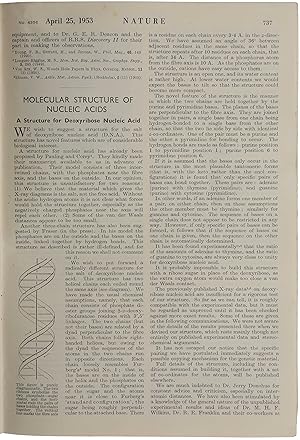
Molecular Structure of Nucleic Acids: A Structure for Deoxyribose Nucleic Acid; Molecular Structure of Deoxypentose Nucleic Acids; Molecular Configuration in Sodium Thymonucleate; Three papers from Nature, Vol. 171, No. 4356, April 25, 1953
Watson, J. D.; Crick, F. H. C.; Wilkins, M. H. F., Stokes, A. R. & Wilson, H. R.; Franklin, R. E. & Gosling, R. G.
Verlag: Fisher, Knight & Co, St. Albans, 1953
- Erstausgabe
- Signiert
Anbieter: Biblioctopus, Los Angeles, CA, USABiblioctopus
Verkäufer/-in kontaktierenVerkäufer/-in mit 2 SternenZustand: Gebraucht
EUR 31.547,57
Versand nach gratisVersand innerhalb von USAAnzahl: 1 verfügbar
First Edition. Offprint, 8vo (210 x 140mm), pp. 14, with two diagrams (including the double helix) and two illustrations from photographs. The three-paper offprint issue, of the primary record of the co-discovery of the molecular structure of DNA, the most transformative moment in twentieth-century biology. Stapled in self-wrapp…ers as issued. Signed by Maurice Wilkins on the first page. Very lightly toned and a coulpe soft creases, near fine. Grolier Club, One Hundred Books Famous in Medicine, 99; Dibner, Heralds of Science, 200. Garrison-Morton 256.3; Judson, Eighth Day of Creation, pp. 145-56. Ex-Dr. Myron Printzmetal. The discovery of DNA's double helix structure emerged from an intense period of competitive collaboration between research teams at Cambridge and King's College London. Watson and Crick's theoretical breakthrough synthesized crucial experimental evidence from multiple sources: Erwin Chargaff's base composition rules demonstrating the 1:1 ratio of adenine to thymine and guanine to cytosine, X-ray crystallographic data revealing DNA's helical structure, and most critically, the precise measurements of backbone positioning and molecular dimensions. Their elegant model proposed complementary base pairing (A-T and C-G) held together by hydrogen bonds, immediately suggesting a mechanism for genetic replication where each strand could serve as a template for its complement. The accompanying papers by Wilkins, Stokes, and Wilson, and by Franklin and Gosling, provided essential experimental validation through X-ray diffraction analysis, creating a unified presentation of both theoretical insight and empirical evidence that established the foundation of molecular biology. The contentious history surrounding this discovery has generated enduring scholarly debate, particularly regarding the systematic marginalization of Rosalind Franklin's contributions. Franklin's meticulous X-ray crystallographic work, conducted with her graduate student Raymond Gosling, had independently determined many key structural features including the antiparallel orientation of DNA strands, the external positioning of phosphate groups, and precise helical parameters. Her famous "Photograph 51" provided definitive evidence of DNA's helical structure, while her systematic analysis of A-form and B-form DNA revealed critical dimensions that enabled Watson and Crick's model construction. As Brenda Maddox documents in "Rosalind Franklin: The Dark Lady of DNA," Franklin's data was shown to Watson and Crick without her knowledge through Maurice Wilkins, creating an ethical controversy that persists in discussions of scientific collaboration and gender bias. Franklin's death from ovarian cancer in 1958, four years before the Nobel Prize was awarded to Watson, Crick, and Wilkins, has intensified debates about recognition and the complex dynamics of mid-twentieth century scientific discovery, with many scholars arguing that her rigorous experimental approach was as fundamental to the breakthrough as the theoretical modeling that received greater acclaim. This publication represents the founding document of modern molecular biology, establishing the conceptual framework for understanding heredity, genetic replication, and the molecular basis of life itself. The discovery immediately suggested mechanisms for protein synthesis and genetic information transfer, creating the theoretical foundation for subsequent developments in genetic engineering, biotechnology, and genomic medicine. As Francis Crick later observed, the structure's elegant simplicitywith its complementary base pairing and antiparallel strandsprovided not merely a static model but a dynamic mechanism explaining how genetic information could be accurately copied and transmitted across generations. The offprint's scientific significance extends far beyond its immediate discovery, representing the moment when biology transformed from a primarily descriptive science into a molecular discipline capable of manipu.
 Weitere Bilder
'Molecular Structure of Nucleic Acids: A Structure for Deoxyribose Nucleic Acid'; 'Molecular Structure of Deoxypentose Nucleic Acids'; 'Molecular Configuration in Sodium Thymonucleate'. Three papers in a single offprint from Nature, Vol. 171, No. 4356, April 25, 1953
WATSON, J. D. & CRICK, F. H. C.; WILKINS, M. H. F., STOKES, A. R. & WILSON, H. R.; FRANKLIN, R. E. & GOSLING, R. G.
Verlag: Fisher, Knight & Co, St. Albans, 1953
- Erstausgabe
Anbieter: SOPHIA RARE BOOKS, Koebenhavn V, DänemarkSOPHIA RARE BOOKS
Verkäufer/-in kontaktierenVerkäufer/-in mit 5 SternenZustand: Gebraucht
EUR 22.533,98
Versand nach gratisVersand von Dänemark nach USAAnzahl: 2 verfügbar
First edition. DISCOVERY OF THE STRUCTURE OF DNA. First edition, in the rare offprint form, of one of the most important scientific papers of the twentieth century, which "records the discovery of the molecular structure of deoxyribonucleic acid (DNA), the main component of chromosomes and the material that transfers genetic cha…racteristics in all life forms. Publication of this paper initiated the science of molecular biology. Forty years after Watson and Crick's discovery, so much of the basic understanding of medicine and disease has advanced to the molecular level that their paper may be considered the most significant single contribution to biology and medicine in the twentieth century" (One Hundred Books Famous in Medicine, p. 362). "The discovery in 1953 of the double helix, the twisted-ladder structure of deoxyribonucleic acid (DNA), by James Watson and Francis Crick marked a milestone in the history of science and gave rise to modern molecular biology, which is largely concerned with understanding how genes control the chemical processes within cells. In short order, their discovery yielded ground-breaking insights into the genetic code and protein synthesis. During the 1970s and 1980s, it helped to produce new and powerful scientific techniques, specifically recombinant DNA research, genetic engineering, rapid gene sequencing, and monoclonal antibodies, techniques on which today's multi-billion dollar biotechnology industry is founded. Major current advances in science, namely genetic fingerprinting and modern forensics, the mapping of the human genome, and the promise, yet unfulfilled, of gene therapy, all have their origins in Watson and Crick's inspired work. The double helix has not only reshaped biology, it has become a cultural icon, represented in sculpture, visual art, jewelry, and toys" (Francis Crick Papers, National Library of Medicine, profiles./SC/Views/Exhibit/narrative/). In 1962, Watson, Crick, and Wilkins shared the Nobel Prize in Physiology or Medicine "for their discoveries concerning the molecular structure of nucleic acids and its significance for information transfer in living material." In 1869, the Swiss physiological chemist Friedrich Miescher (1844-95) first identified what he called 'nuclein' inside the nuclei of human white blood cells. (The term 'nuclein' was later changed to 'nucleic acid' and eventually to 'deoxyribonucleic acid,' or 'DNA.') Miescher's plan was to isolate and characterize not the nuclein (which nobody at that time realized existed) but instead the protein components of leukocytes (white blood cells). Miescher thus made arrangements for a local surgical clinic to send him used, pus-coated patient bandages; once he received the bandages, he planned to wash them, filter out the leukocytes, and extract and identify the various proteins within the white blood cells. But when he came across a substance from the cell nuclei that had chemical properties unlike any protein, including a much higher phosphorous content and resistance to proteolysis (protein digestion), Miescher realized that he had discovered a new substance. Sensing the importance of his findings, Miescher wrote, "It seems probable to me that a whole family of such slightly varying phosphorous-containing substances will appear, as a group of nucleins, equivalent to proteins". But Miescher's discovery of nucleic acids was not appreciated by the scientific community, and his name had fallen into obscurity by the 20th century. "Researchers working on DNA in the early 1950s used the term 'gene' to mean the smallest unit of genetic information, but they did not know what a gene actually looked like structurally and chemically, or how it was copied, with very few errors, generation after generation. In 1944, Oswald Avery had shown that DNA was the 'transforming principle,' the carrier of hereditary information, in pneumococcal bacteria. Nevertheless, many scientists continued to believe that DNA had a structure too uniform and simple to store genetic information for making complex living organisms. The genetic material, they reasoned, must consist of proteins, much more diverse and intricate molecules known to perform a multitude of biological functions in the cell. "Crick and Watson recognized, at an early stage in their careers, that gaining a detailed knowledge of the three-dimensional configuration of the gene was the central problem in molecular biology. Without such knowledge, heredity and reproduction could not be understood. They seized on this problem during their very first encounter, in the summer of 1951, and pursued it with single-minded focus over the course of the next eighteen months. This meant taking on the arduous intellectual task of immersing themselves in all the fields of science involved: genetics, biochemistry, chemistry, physical chemistry, and X-ray crystallography. Drawing on the experimental results of others (they conducted no DNA experiments of their own), taking advantage of their complementary scientific backgrounds in physics and X-ray crystallography (Crick) and viral and bacterial genetics (Watson), and relying on their brilliant intuition, persistence, and luck, the two showed that DNA had a structure sufficiently complex and yet elegantly simple enough to be the master molecule of life. "Other researchers had made important but seemingly unconnected findings about the composition of DNA; it fell to Watson and Crick to unify these disparate findings into a coherent theory of genetic transfer. The organic chemist Alexander Todd had determined that the backbone of the DNA molecule contained repeating phosphate and deoxyribose sugar groups. The biochemist Erwin Chargaff had found that while the amount of DNA and of its four types of bases - the purine bases adenine (A) and guanine (G), and the pyrimidine bases cytosine (C) and thymine (T) - varied widely from species to species, A and T always appeared in ratios of one-to-one, as did G and C. Maurice Wilkins an.
 Weitere Bilder
[The six milestone papers on the structure of DNA in original wrappers:] 1. WATSON, J. D. & CRICK, F. H. C. Molecular Structure of Nucleic Acids: A Structure for Deoxyribose Nucleic Acid; 2. WILKINS, M. H. F., STOKES, A. R. & WILSON, H. R. Molecular Structure of Deoxypentose Nucleic Acids; 3. FRANKLIN, R. E. & GOSLING, R. G. Molecular Configuration in Sodium Thymonucleate, pp. 737-41 in Nature, Vol. 171, No. 4356, April 25, 1953. 4. WATSON, J. D. & CRICK, F. H. C. Genetical Implications of the Structure of Deoxyribonucleic Acid, pp. 964-7 in Nature, Vol. 171, No. 4361, May 30, 1953. 5. FRANKLIN, R. E. & GOSLING, R. G. Evidence for 2-Chain Helix in Crystalline Structure of Sodium Deoxyribonucleate, pp. 156-7 in Nature, Vol. 172, No. 4369, July 25, 1953. 6. WILKINS, M. H. F., SEEDS, W. E. STOKES, A. R. & WILSON, H. R. Helical Structure of Crystalline Deoxypentose Nucleic Acid, pp. 759-62 in Nature, Vol. 172, No. 4382, October 24, 1953
WATSON; CRICK; WILKINS; STOKES; WILSON; FRANKLIN; GOSLING; SEEDS
Verlag: Macmillan, London, 1953
Anbieter: SOPHIA RARE BOOKS, Koebenhavn V, DänemarkSOPHIA RARE BOOKS
Verkäufer/-in kontaktierenVerkäufer/-in mit 5 SternenZustand: Gebraucht
EUR 13.520,39
Versand nach gratisVersand von Dänemark nach USAAnzahl: 1 verfügbar
A VERY FINE SET OF THE DNA PAPERS. First edition, in the form in which they first appeared, of six crucial papers documenting the discovery of the structure of DNA and the mechanism of the genetic code. The first is Watson & Crick's paper 'Molecular Structure of Nucleic Acids: A Structure for Deoxyribose Nucleic Acid', which "re…cords the discovery of the molecular structure of deoxyribonucleic acid (DNA), the main component of chromosomes and the material that transfers genetic characteristics in all life forms. Publication of this paper initiated the science of molecular biology. Forty years after Watson and Crick's discovery, so much of the basic understanding of medicine and disease has advanced to the molecular level that their paper may be considered the most significant single contribution to biology and medicine in the twentieth century" (One Hundred Books Famous in Medicine, p. 362). Watson & Crick's paper is here accompanied by their paper published one month later, 'Genetical Implications of the Structure of Deoxyribonucleic Acid,' "in which they elaborated on their proposed DNA replication mechanism" (ibid.), together with one of the papers which provided the experimental data confirming their proposed structure, a follow up to 'Molecular Structure of Deoxypentose Nucleic Acids' by Wilkins et al. Also included is the 1961 paper 'General Nature of the Genetic Code for Proteins,' documenting Crick's team's efforts to crack the genetic code, amassing evidence suggesting that "the amino-acid sequence along the polypeptide chain of a protein is determined by the sequence of the bases along some particular part of the nucleic acid of the genetic material" (p. 1227), and that each acid was most likely coded by a group of three bases. In 1962, Watson, Crick, and Wilkins shared the Nobel Prize in Physiology or Medicine "for their discoveries concerning the molecular structure of nucleic acids and its significance for information transfer in living material." The first three papers were issued together in offprint from, but the journal issue offered here preceded the offprint and is actually rarer on the market. DNA was first isolated by the Swiss physician Friedrich Miescher in 1869, and over the succeeding years many researchers investigated its structure and function, with some arguing that it may be involved in genetic inheritance. By the early 1950s this had become one of the most important questions in biology. Maurice Wilkins of King's College London and his colleague Rosalind Franklin were both working on DNA, with Franklin producing X-ray diffraction images of its structure. Wilkins also introduced his friend Francis Crick to the subject, and Crick and his partner James Watson began their own investigation at the Cavendish Laboratory in Cambridge, focusing on building molecular models. After one failed attempt in which they postulated a triple-helix structure, they were banned by the Cavendish from spending any additional time on the subject. But a year later, after seeing new X-ray diffraction images taken by Franklin (notably the famous 'Photo 51', which is reproduced in the third offered paper), they resumed their work and soon announced that not only had they discovered the double-helix structure of DNA, but even more importantly, that "the specific pairing we have postulated immediately suggests a possible copying mechanism for the genetic material." When Watson and Crick's paper was submitted for publication in Nature, Sir Lawrence Bragg, the director of the Cavendish Laboratory at Cambridge, and Sir John Randall of King's College agreed that the paper should be published simultaneously with those of two other groups of researches who had also prepared important papers on DNA: Maurice Wilkins, A.R. Stokes, and H.R. Wilson, authors of 'Molecular Structure of Deoxypentose Nucleic Acids,' and Rosalind Franklin and Raymond Gosling, who submitted the paper 'Molecular Configuration in Sodium Thymonucleate.' The three papers were published in Nature under the general title 'The Molecular Structure of Nucleic Acids.' "Five weeks after Watson's and Crick's first paper in Nature, their second appeared, in which, after explaining the structure and the evidence all over again, they pursued some of the genetical implications. These flowed from the most novel, most fundamental fact of the model: "Any sequence of the pairs of the bases can fit into the structure. It follows that in a long molecule many different permutations are possible, and it therefore seems likely that the precise sequence of the bases is the code which carries the genetical information. If the actual order of the bases on one of the pair of chains were given, one could write down the exact order of the bases on the other one, because of the specific pairing." This immediately suggested, they said, how DNA duplicated itself. "Previous discussions of self-duplication have usually involved the concept of a template, or mould. Either the template was supposed to copy itself directly or it was to produce a "negative", which in its turn was to act as a template and produce the original "positive" once again. In no case has it been explained in detail how it would do this in terms of atoms and molecules." The elucidation of the structure of DNA called for a new kind of functional explanation. "Now our model for deoxyribonucleic acid is, in effect, a pair of templates, each of which is complementary to the other. We imagine that prior to duplication the hydrogen bonds [connecting the bases in pairs] are broken, and the two chains unwind and separate. Each chain then acts as a template for the formation on to itself of a new companion chain, so that eventually we shall have two pairs of chains, where we only had one before. Moreover, the sequence of the pairs of bases will have been duplicated exactly." Yet perhaps not always exactly: the model, or rather the mistake whose correction by Donohue had cleared the way for the m.


