

Gesamtpreis (1 Artikel Artikel):
Versandziel:

steven a oliver (13 Ergebnisse)
Direkt zu den wichtigsten Suchergebnissen
Suchfilter
Produktart
- Alle Product Types
- Bücher (13)
- Magazine & Zeitschriften (Keine weiteren Ergebnisse entsprechen dieser Verfeinerung)
- Comics (Keine weiteren Ergebnisse entsprechen dieser Verfeinerung)
- Noten (Keine weiteren Ergebnisse entsprechen dieser Verfeinerung)
- Kunst, Grafik & Poster (Keine weiteren Ergebnisse entsprechen dieser Verfeinerung)
- Fotografien (Keine weiteren Ergebnisse entsprechen dieser Verfeinerung)
- Karten (Keine weiteren Ergebnisse entsprechen dieser Verfeinerung)
- Manuskripte & Papierantiquitäten (Keine weiteren Ergebnisse entsprechen dieser Verfeinerung)
Zustand Mehr dazu
- Neu (10)
- Wie Neu, Sehr Gut oder Gut Bis Sehr Gut (Keine weiteren Ergebnisse entsprechen dieser Verfeinerung)
- Gut oder Befriedigend (2)
- Ausreichend oder Schlecht (Keine weiteren Ergebnisse entsprechen dieser Verfeinerung)
- Wie beschrieben (1)
Einband
Weitere Eigenschaften
- Erstausgabe (Keine weiteren Ergebnisse entsprechen dieser Verfeinerung)
- Signiert (Keine weiteren Ergebnisse entsprechen dieser Verfeinerung)
- Schutzumschlag (Keine weiteren Ergebnisse entsprechen dieser Verfeinerung)
- Angebotsfoto (6)
Sprache (3)
Gratisversand
Land des Verkäufers
Verkäuferbewertung
-

Sexuality, Gender, and the Church
Anbieter: ThriftBooks-Atlanta, AUSTELL, GA, USA
Verkäuferbewertung 5 von 5 Sternen

Hardcover. Zustand: Very Good. No Jacket. May have limited writing in cover pages. Pages are unmarked. ~ ThriftBooks: Read More, Spend Less.
-
Techniques of Venous Imaging (Techniques of Vascular Sonography)
Anbieter: ThriftBooks-Atlanta, AUSTELL, GA, USA
Verkäuferbewertung 5 von 5 Sternen
Hardcover. Zustand: Very Good. No Jacket. Beebe, Stephen (illustrator). May have limited writing in cover pages. Pages are unmarked. ~ ThriftBooks: Read More, Spend Less.
-

Forecasting Readines
Sprache: Englisch
Verlag: Creative Media Partners, LLC, 2025
ISBN 10: 1025098099 ISBN 13: 9781025098098
Anbieter: PBShop.store UK, Fairford, GLOS, Vereinigtes Königreich
Verkäuferbewertung 5 von 5 Sternen
EUR 22,90
EUR 4,88 Versand
Versand von Vereinigtes Königreich nach USAAnzahl: Mehr als 20 verfügbar
In den WarenkorbPAP. Zustand: New. New Book. Shipped from UK. Established seller since 2000.
-

An Evaluation of Telemaintenance Capability and Its Impact Within the United States Air Force
Anbieter: Ria Christie Collections, Uxbridge, Vereinigtes Königreich
Verkäuferbewertung 5 von 5 Sternen
EUR 15,81
EUR 14,05 Versand
Versand von Vereinigtes Königreich nach USAAnzahl: Mehr als 20 verfügbar
In den WarenkorbZustand: New. In.
-

Forecasting Readines
Sprache: Englisch
Verlag: Creative Media Partners, LLC, 2025
ISBN 10: 1025094239 ISBN 13: 9781025094236
Anbieter: PBShop.store UK, Fairford, GLOS, Vereinigtes Königreich
Verkäuferbewertung 5 von 5 Sternen
EUR 33,94
EUR 5,89 Versand
Versand von Vereinigtes Königreich nach USAAnzahl: Mehr als 20 verfügbar
In den WarenkorbHRD. Zustand: New. New Book. Shipped from UK. Established seller since 2000.
-
Sexuality, Gender, and the Church
Anbieter: Revaluation Books, Exeter, Vereinigtes Königreich
Verkäuferbewertung 5 von 5 Sternen
EUR 36,40
EUR 11,73 Versand
Versand von Vereinigtes Königreich nach USAAnzahl: 1 verfügbar
In den WarenkorbHardcover. Zustand: Brand New. 256 pages. 8.60x5.80x0.90 inches. In Stock.
-

EUR 22,14
EUR 48,99 Versand
Versand von Deutschland nach USAAnzahl: Mehr als 20 verfügbar
In den WarenkorbZustand: New. KlappentextrnrnOver the years technology has advanced as it relates to aircraft maintenance. Telemaintenance--an item specifically identified in JV2010 s Focused Logistics Joint Logistics Roadmap--is a new maintenance capability that could compl.
-

An Evaluation of Telemaintenance Capability and Its Impact Within the United States Air Force
Sprache: Englisch
Verlag: Creative Media Partners, LLC Okt 2012, 2012
ISBN 10: 1249591090 ISBN 13: 9781249591092
Anbieter: AHA-BUCH GmbH, Einbeck, Deutschland
Verkäuferbewertung 5 von 5 Sternen
Taschenbuch. Zustand: Neu. Neuware - Over the years technology has advanced as it relates to aircraft maintenance. Telemaintenance--an item specifically identified in JV2010's Focused Logistics Joint Logistics Roadmap--is a new maintenance capability that could completely transform the Air Force's maintenance doctrine and organizational structures. Telemaintenance, the capability to repair components and/or project technical expertise through a virtual environment among geographically separated maintenance units, is poised to revolutionize Air Force aircraft maintenance in the very near future. Currently, the Air Force, through its eLog21 logistics transformation program, is attempting to take advantage of these new capabilities by integrating them into its logistics operations to improve both their overall efficiency and operational effectiveness. However, before it can fully realize the benefits telemaintenance has to offer, the Air Force must ensure its combat support doctrine outlines the overarching principles on how best the Air Force can employ this facet of its combat support power.
-

Forecasting Readines
Sprache: Englisch
Verlag: Creative Media Partners, LLC Mai 2025, 2025
ISBN 10: 1025098099 ISBN 13: 9781025098098
Anbieter: AHA-BUCH GmbH, Einbeck, Deutschland
Verkäuferbewertung 5 von 5 Sternen
Taschenbuch. Zustand: Neu. Neuware - According to many experts, the readiness of America's armed forces has deteriorated throughout the 1990s. In the Air Force, the combat readiness of its fighter aircraft has declined in varying degrees. One of the Air Force's indicators of combat readiness for its aircraft, the mission capable rate, is a rate primarily used to identify the percentage of aircraft that are able to perform their primary missions. From FY94 through FY98, the aggregate Air Force aircraft total not mission capable rate for maintenance (TNMCM) for all aircraft has steadily increased from 14 percent to 18.2 percent while total not mission capable rate for supply (TNMCS) increased from 5.5 percent in FY86 to 17.5 percent in FY00. The Air Force currently uses the Funding/Availability Multi-Method Allocator for Spares (FAMMAS) forecasting model to predict overall mission capable rates for each type of aircraft it has in its inventory. While the FAMMAS model does an excellent job of predicting mission capable rates based on funding data and other associated planning factors, it is does not explain the key drivers that influence mission capable rates, which limits its effectiveness as a management and decision- making tool.This work has been selected by scholars as being culturally important, and is part of the knowledge base of civilization as we know it. This work was reproduced from the original artifact, and remains as true to the original work as possible. Therefore, you will see the original copyright references, library stamps (as most of these works have been housed in our most important libraries around the world), and other notations in the work.This work is in the public domain in the United States of America, and possibly other nations. Within the United States, you may freely copy and distribute this work, as no entity (individual or corporate) has a copyright on the body of the work.As a reproduction of a historical artifact, this work may contain missing or blurred pages, poor pictures, errant marks, etc. Scholars believe, and we concur, that this work is important enough to be preserved, reproduced, and made generally available to the public. We appreciate your support of the preservation process, and thank you for being an important part of keeping this knowledge alive and relevant.
-

Forecasting Readines
Sprache: Englisch
Verlag: Creative Media Partners, LLC Mai 2025, 2025
ISBN 10: 1025094239 ISBN 13: 9781025094236
Anbieter: AHA-BUCH GmbH, Einbeck, Deutschland
Verkäuferbewertung 5 von 5 Sternen
Buch. Zustand: Neu. Neuware - According to many experts, the readiness of America's armed forces has deteriorated throughout the 1990s. In the Air Force, the combat readiness of its fighter aircraft has declined in varying degrees. One of the Air Force's indicators of combat readiness for its aircraft, the mission capable rate, is a rate primarily used to identify the percentage of aircraft that are able to perform their primary missions. From FY94 through FY98, the aggregate Air Force aircraft total not mission capable rate for maintenance (TNMCM) for all aircraft has steadily increased from 14 percent to 18.2 percent while total not mission capable rate for supply (TNMCS) increased from 5.5 percent in FY86 to 17.5 percent in FY00. The Air Force currently uses the Funding/Availability Multi-Method Allocator for Spares (FAMMAS) forecasting model to predict overall mission capable rates for each type of aircraft it has in its inventory. While the FAMMAS model does an excellent job of predicting mission capable rates based on funding data and other associated planning factors, it is does not explain the key drivers that influence mission capable rates, which limits its effectiveness as a management and decision- making tool.This work has been selected by scholars as being culturally important, and is part of the knowledge base of civilization as we know it. This work was reproduced from the original artifact, and remains as true to the original work as possible. Therefore, you will see the original copyright references, library stamps (as most of these works have been housed in our most important libraries around the world), and other notations in the work.This work is in the public domain in the United States of America, and possibly other nations. Within the United States, you may freely copy and distribute this work, as no entity (individual or corporate) has a copyright on the body of the work.As a reproduction of a historical artifact, this work may contain missing or blurred pages, poor pictures, errant marks, etc. Scholars believe, and we concur, that this work is important enough to be preserved, reproduced, and made generally available to the public. We appreciate your support of the preservation process, and thank you for being an important part of keeping this knowledge alive and relevant.
-
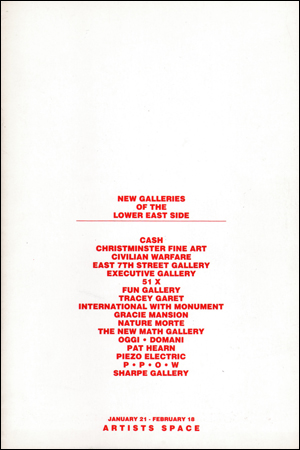
New Galleries of the Lower East Side
Verlag: Artists Space New York, NY, 1984
Anbieter: Specific Object / David Platzker, New York, NY, USA
Verkäuferbewertung 5 von 5 Sternen
[8] pp.; 22.8 x 15.3 cm.; accordion; black-and-white & color; edition size unknown; unsigned and unnumbered; offset-printed; Exhibition brochure / catalogue published in conjunction with show held January 21 - February 18, 1984. Foreword by Linda Shearer. Curated and with a text by Helene Winer. Galleries include Cash, Christminster Fine Art, Civilian Warfare, East 7th Street Gallery, Executive Gallery, 51 X, Fun Gallery, Tracey Garet, International With Monument, Gracie Mansion, Nature Morte, The New Math Gallery, Oggi - Domani, Pat Hearn, Piezo Electric, PPOW, and Sharpe Gallery. Artists include Stephen Aljian, Alan Belcher, Paul Benney, Zeke Berman, Ellen Berkenblit, Keiko Bonk, Tom Brazelton, Barry Bridgwood, Nancy Brooks Brody, Chris Chevins, Craig Coleman, Rich Colicchio, Michael Collins, George Condo, Gregory A. Crane, Mark Dean, Jimmy de Sana, Futura, Robert Garratt, Dana Garrett, Judith Glantzman, Arthur Gonzalez, Rodney Alan Greenblat, Kathleen Grove, Richard Hambleton, Kiely Jenkins, Sermin Kardestuncer, Elizabeth Koury, Stephen Lack, Leora Laor, Robert Loughlin, Paul Marcus, Frank Moore, Peter Nagy, Michael Ottersen, Steven Parrino, Rick Prol, Hope Sandrow, Michael Sangaris, Bruno Schmidt, Peter Schuyff, Huck Snyder, Ahbe Sulit, Frederick Sutherland, Meyer Vaisman, Oliver Wasow, Dondi White, David Wojnarowicz, Robert Yarber, Zephyr, and Rhonda Zwillinger. "The exhibition includes work from seventeen galleries located in the East Village or the area east of Second Avenue, just below Houston Street: CASH, Christminster, Civilian Warfare, East 7th Street Gallery. Executive Gallery, 51 X, Fun Gallery, Garet/ Kohn Gallery, Gracie Mansion. International with Monument, Nature Morte, New Math, Oggi-Domani, Pat Hearn. Piezo Electric, P.P.O.W. and Sharpe Gallery. Work by artists associated with the galleries have been selected by the individual gallery directors, and Helene Winer, organizer of the exhibition. Helene Winer is a past Director of Artists Space and currently co-owner of Metro Pictures a commercial gallery in SoHo. As part of Artists Space''''s celebration of its 10th anniversary season, she has organized this exhibition to examine a growing number of artist organized commercial exhibition spaces. Ms. Winer''''s past experience with the non-profit art community and her present position in the commercial art world offer a unique outlook on this new trend. In keeping with Artists Space''''s support of new art through both its Exhibition Program and Grants Program, NEW GALLERIES OF THE LOWER EAST SIDE is a look at a new outlet for emerging art: an outlet which straddles the lines between the artists cooperative, the non-profit alternative space, the artist organized independent exhibition and the commercial gallery. NEW GALLERIES OF THE LOWER EAST SIDE acknowledges the recent appearance and rapid proliferation of more than twenty commercial art galleries that are introducing new artists and art. This phenomenon has created overnight, it seems, active new exhibition outlets for artists, an on-going vehicle for massive social opening events, a Sunday activity for the art audience, a new map in the Gallery Guide and a new focus of excitement and energy in the art community. The galleries are now numerous and offer more than the aesthetic that was first presented by the pioneers (Gracie Mansion, Fun Gallery and 51 X) and which has come to be associated with the East Village. They are very professional enterprises that intend to provide serious support and attention to the artists they show. Many of the galleries are artist owned. The artist/owners who converted storefronts to studios have now converted these studios to galleries. Most of these owners work at jobs separate from the gallery to support the activity and many live ''''behind the shop." The East Village Eye and New York Beat play the role that the SoHo News and the Village Voice did for SoHo and Tribeca. The East Village and the Lower East Side of New York has been an area many artists moved to, since SoHo and then Tribeca have been increasingly gentrified, a fate that may now befall the East Village itself. Over the years the art community has found ''''alternative'''' means of creating needed opportunities for artists to exhibit their work to at least their peers, and occasionally to a broader audience. In the fifties. New York artists opened cooperative galleries on Tenth Street. Later, alternative spaces opened with government funding: commercial galleries moved from Uptown to Downtown for both space and accessibility to the artists. community artists organized their own temporary exhibitions such as the Times Square Show, and now, in a period of two years, some 25 commercial galleries have opened on the Lower East Side, the majority in 1983."--from exhibition press release Very Good / Fine. Light yellowing of cover edges, otherwise Fine. Contents clean and unmarked.
-

Risikomanagement in Supply Chains
Sprache: Deutsch
Verlag: Erich Schmidt Verlag GmbH & Co. KG, 2025
ISBN 10: 3503240683 ISBN 13: 9783503240685
Zustand: New.
-

Regional, innovativ und gesund: Nachhaltige Ernahrung als Teil der Grossen Transformation
Anbieter: Kennys Bookstore, Olney, MD, USA
Verkäuferbewertung 5 von 5 Sternen
Zustand: New. 2016. Hardcover. . . . . . Books ship from the US and Ireland.
