

Gesamtpreis (1 Artikel Artikel):
Versandziel:

spellman barbara (11 Ergebnisse)
Direkt zu den wichtigsten Suchergebnissen
Suchfilter
Produktart
- Alle Product Types
- Bücher (11)
- Magazine & Zeitschriften (Keine weiteren Ergebnisse entsprechen dieser Verfeinerung)
- Comics (Keine weiteren Ergebnisse entsprechen dieser Verfeinerung)
- Noten (Keine weiteren Ergebnisse entsprechen dieser Verfeinerung)
- Kunst, Grafik & Poster (Keine weiteren Ergebnisse entsprechen dieser Verfeinerung)
- Fotografien (Keine weiteren Ergebnisse entsprechen dieser Verfeinerung)
- Karten (Keine weiteren Ergebnisse entsprechen dieser Verfeinerung)
- Manuskripte & Papierantiquitäten (Keine weiteren Ergebnisse entsprechen dieser Verfeinerung)
Zustand Mehr dazu
- Neu (8)
- Wie Neu, Sehr Gut oder Gut Bis Sehr Gut (Keine weiteren Ergebnisse entsprechen dieser Verfeinerung)
- Gut oder Befriedigend (3)
- Ausreichend oder Schlecht (Keine weiteren Ergebnisse entsprechen dieser Verfeinerung)
- Wie beschrieben (Keine weiteren Ergebnisse entsprechen dieser Verfeinerung)
Einband
Weitere Eigenschaften
- Erstausgabe (Keine weiteren Ergebnisse entsprechen dieser Verfeinerung)
- Signiert (Keine weiteren Ergebnisse entsprechen dieser Verfeinerung)
- Schutzumschlag (Keine weiteren Ergebnisse entsprechen dieser Verfeinerung)
- Angebotsfoto (3)
Sprache (1)
Gratisversand
Land des Verkäufers
Verkäuferbewertung
-
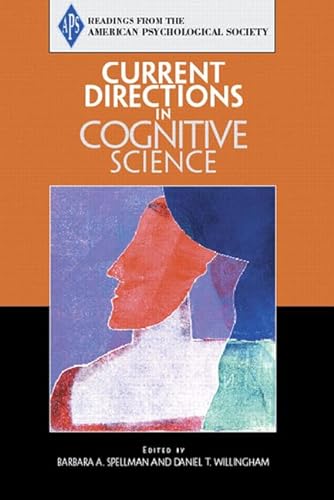
Current Directions In Cognitive Science
Anbieter: World of Books (was SecondSale), Montgomery, IL, USA
Verkäuferbewertung 5 von 5 Sternen

Zustand: Good. Item in good condition. Textbooks may not include supplemental items i.e. CDs, access codes etc.
-
Current Directions In Cognitive Science
Anbieter: ThriftBooks-Dallas, Dallas, TX, USA
Verkäuferbewertung 5 von 5 Sternen
Paperback. Zustand: Very Good. No Jacket. May have limited writing in cover pages. Pages are unmarked. ~ ThriftBooks: Read More, Spend Less.
-

Current Directions in Cognitive Science
Sprache: Englisch
Verlag: Prentice Hall/Pearson, Upper Saddle River, NJ, 2005
ISBN 10: 0131919911 ISBN 13: 9780131919914
Anbieter: PsychoBabel & Skoob Books, Didcot, Vereinigtes Königreich
Verkäuferbewertung 5 von 5 Sternen
EUR 11,43
EUR 14,59 Versand
Versand von Vereinigtes Königreich nach USAAnzahl: 1 verfügbar
In den WarenkorbPaperback. Zustand: Very Good. Paperback, very good condition. Minor wear to the covers with light surface marks and minor creasing at the edges. Internally excellent throughout. DP. Used.
-

The Psychological Foundations of Evidence Law (Psychology and the Law)
Buch 2 von 5: Psychology and the LawSprache: Englisch
Verlag: New York University Press, 2016
ISBN 10: 0814783872 ISBN 13: 9780814783870
Anbieter: Majestic Books, Hounslow, Vereinigtes Königreich
Verkäuferbewertung 4 von 5 Sternen

EUR 54,09
EUR 7,59 Versand
Versand von Vereinigtes Königreich nach USAAnzahl: 3 verfügbar
In den WarenkorbZustand: New. pp. 320.
-
The Psychological Foundations of Evidence Law (Psychology and the Law, 1)
Buch 2 von 5: Psychology and the LawAnbieter: Ria Christie Collections, Uxbridge, Vereinigtes Königreich
Verkäuferbewertung 5 von 5 Sternen
EUR 55,54
EUR 13,98 Versand
Versand von Vereinigtes Königreich nach USAAnzahl: Mehr als 20 verfügbar
In den WarenkorbZustand: New. In.
-
The Psychological Foundations of Evidence Law
Buch 2 von 5: Psychology and the LawAnbieter: Revaluation Books, Exeter, Vereinigtes Königreich
Verkäuferbewertung 5 von 5 Sternen
EUR 75,51
EUR 11,67 Versand
Versand von Vereinigtes Königreich nach USAAnzahl: 2 verfügbar
In den WarenkorbPaperback. Zustand: Brand New. 325 pages. 8.75x5.75x0.75 inches. In Stock.
-
EUR 62,92
EUR 48,99 Versand
Versand von Deutschland nach USAAnzahl: Mehr als 20 verfügbar
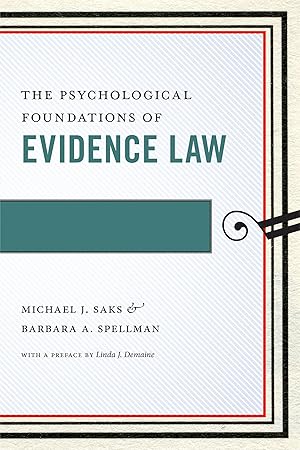
In den WarenkorbKartoniert / Broschiert. Zustand: New. Über den AutorMichael J. Saks is Regents Professor at the Arizona State University where he is on the faculties of the Sandra Day O Connor College of Law and the Department of Psychology. He is the past co-editor of Modern Sc.
-
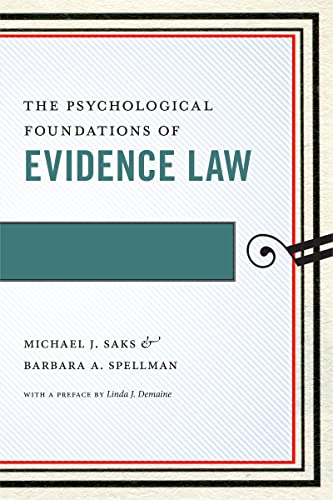
The Psychological Foundations of Evidence Law (Psychology and the Law, 1)
Buch 2 von 5: Psychology and the LawAnbieter: Ria Christie Collections, Uxbridge, Vereinigtes Königreich
Verkäuferbewertung 5 von 5 Sternen
EUR 128,94
EUR 13,98 Versand
Versand von Vereinigtes Königreich nach USAAnzahl: Mehr als 20 verfügbar
In den WarenkorbZustand: New. In.
-

The Psychological Foundations of Evidence Law
Buch 2 von 5: Psychology and the LawAnbieter: AHA-BUCH GmbH, Einbeck, Deutschland
Verkäuferbewertung 5 von 5 Sternen
Taschenbuch. Zustand: Neu. Neuware - Identifies and evaluates the psychological choices implicit in the rules of evidence Evidence law is meant to facilitate trials that are fair, accurate, and efficient, and that encourage and protect important societal values and relationships. In pursuit of these often-conflicting goals, common law judges and modern drafting committees have had to perform as amateur applied psychologists. Their task has required them to employ what they think they know about the ability and motivations of witnesses to perceive, store, and retrieve information; about the effects of the litigation process on testimony and other evidence; and about our capacity to comprehend and evaluate evidence. These are the same phenomena that cognitive and social psychologists systematically study. The rules of evidence have evolved to restrain lawyers from using the most robust weapons of influence, and to direct judges to exclude certain categories of information, limit it, or instruct juries on how to think about it. Evidence law regulates the form of questions lawyers may ask, filters expert testimony, requires witnesses to take oaths, and aims to give lawyers and factfinders the tools they need to assess witnesses' reliability. But without a thorough grounding in psychology, is the 'common sense' of the rulemakers as they create these rules always, or even usually, correct And when it is not, how can the rules be fixed Addressed to those in both law and psychology, The Psychological Foundations of Evidence Law draws on the best current psychological research-based knowledge to identify and evaluate the choices implicit in the rules of evidence, and to suggest alternatives that psychology reveals as better for accomplishing the law's goals.
-
EUR 132,41
EUR 48,99 Versand
Versand von Deutschland nach USAAnzahl: Mehr als 20 verfügbar
In den WarenkorbZustand: New.
-
The Psychological Foundations of Evidence Law
Buch 2 von 5: Psychology and the LawAnbieter: Revaluation Books, Exeter, Vereinigtes Königreich
Verkäuferbewertung 5 von 5 Sternen
EUR 173,31
EUR 14,59 Versand
Versand von Vereinigtes Königreich nach USAAnzahl: 2 verfügbar
In den WarenkorbHardcover. Zustand: Brand New. 320 pages. 9.25x6.25x1.25 inches. In Stock.

