

Gesamtpreis (1 Artikel Artikel):
Versandziel:

rosenstein carl (6 Ergebnisse)
Direkt zu den wichtigsten Suchergebnissen
Suchfilter
Produktart
- Alle Product Types
- Bücher (6)
- Magazine & Zeitschriften (Keine weiteren Ergebnisse entsprechen dieser Verfeinerung)
- Comics (Keine weiteren Ergebnisse entsprechen dieser Verfeinerung)
- Noten (Keine weiteren Ergebnisse entsprechen dieser Verfeinerung)
- Kunst, Grafik & Poster (Keine weiteren Ergebnisse entsprechen dieser Verfeinerung)
- Fotografien (Keine weiteren Ergebnisse entsprechen dieser Verfeinerung)
- Karten (Keine weiteren Ergebnisse entsprechen dieser Verfeinerung)
- Manuskripte & Papierantiquitäten (Keine weiteren Ergebnisse entsprechen dieser Verfeinerung)
Zustand Mehr dazu
- Neu (Keine weiteren Ergebnisse entsprechen dieser Verfeinerung)
- Wie Neu, Sehr Gut oder Gut Bis Sehr Gut (Keine weiteren Ergebnisse entsprechen dieser Verfeinerung)
- Gut oder Befriedigend (2)
- Ausreichend oder Schlecht (Keine weiteren Ergebnisse entsprechen dieser Verfeinerung)
- Wie beschrieben (4)
Einband
- alle Einbände
- Hardcover (1)
- Softcover (Keine weiteren Ergebnisse entsprechen dieser Verfeinerung)
Weitere Eigenschaften
- Erstausgabe (1)
- Signiert (Keine weiteren Ergebnisse entsprechen dieser Verfeinerung)
- Schutzumschlag (1)
- Angebotsfoto (3)
Sprache (2)
Gratisversand
- Kostenloser Versand nach USA (Keine weiteren Ergebnisse entsprechen dieser Verfeinerung)
Land des Verkäufers
Verkäuferbewertung
-
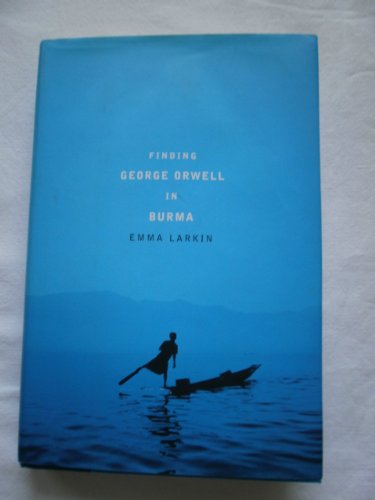
Finding George Orwell In Burma
Sprache: Englisch
Verlag: The Penguin Press, New York, 2005
ISBN 10: 1594200521 ISBN 13: 9781594200526
Anbieter: Ground Zero Books, Ltd., Silver Spring, MD, USA
Verkäuferbewertung 5 von 5 Sternen

Erstausgabe
Hardcover. Zustand: Very good. Zustand des Schutzumschlags: Very good. Carl Rosenstein (Jacket photograph) (illustrator). The format is approximately 5.75 inches by 8.5 inches. [8], 294, [2] pages. A profile of the police state in Burma and its effect on the writings of George Orwell discusses the author's mother's origins in Burma at the height of the British raj, Orwell's work with the British Imperial Police, and local reverence for his literary works. Her book, which has elements of biography, travelogue, and investigative reporting, argues that Orwell did not only write one book about his time in Burma, but that Animal Farm and Nineteen Eighty-Four were based on his experiences as a police officer in colonial Burma. In addition, these two dystopian novels uniquely prophecised what life under the Burmese military dictatorship would be like: from the naming of government departments, to the idea that the government can control the past when the sharing and recording of individual recollections is forbidden. Her identity has been the subject of speculation. Larkin has stated that, despite wishing to publish under her real name, she used a pseudonym to protect the identities of her sources. Because she was obliged to sign forms using her real name when boarding buses and trains and staying in hotels, the regime would have been able to piece together where she had been and who she had spoken to. This strategy which had been successful as of 2010. She spoke of the paranoia that affects foreign writers in Myanmar due to the surveillance and possibility of being searched at any time. This paranoia led her to destroy written notes or pass them to others who are leaving the country. In 2021, her photograph was published in her novel. Emma Larkin is the pseudonym of an American journalist and author. Born in The Philippines to an American mother, her family moved to Thailand when she was one year old, where she lived for the next nine years. At least part of this time was spent in Bangkok, where she now lives. Larkin was educated in the UK from the age of ten, going on to study the Burmese language at the School of Oriental and African Studies in London. Larkin has given conflicting accounts of her early years: in 2010, she told New Statesman that she has lived in Thailand her whole life. She has been visiting Burma since around the year 2000. Here she covers the military dictatorship that rules the country. She is known for her coverage of Myanmar and George Orwell's experience within it in her debut book, Finding George Orwell in Burma. Speaking to the Democratic Voice of Burma, Larkin stated that she began that book in 2002 and travelled back and forth between Bangkok and Myanmar over the next two or three years. The only way this could be accomplished at the time was by fraudulently using business visas that entitled her to stay in Myanmar for months at a time. As a cover story to hide her journalistic work in the country, she received business visas under the pretext of studying the Burmese language. Despite engaging a tutor and taking great pains to appear legitimate, she reported being followed by undercover police. Derived from a Kirkus review: A courageous, important examination of the bleak totalitarian state of Myanmar. It was known as Burma in the 1920s, when Orwell worked there as an officer of the British Imperial Police. The British were in the process of perfecting their reign of oppression in Burma, and much of Larkin's portrait traces the development of Orwell's social conscience through what he learned and witnessed. Though Burmese Days, Animal Farm and 1984 were all written by the time Burma became independent in 1948, these three novels "effectively tell the story of Burma's recent history," she argues. Following in his footsteps three-quarters of a century later, Larkin traveled to Myanmar, nestled idyllically between India and Thailand, and uncovered uncanny parallels between its abysmal social and political conditions and Orwell's fictional depictions. Despite the façade it presents to the world of smiling natives and pretty pagodas, the country's military dictatorship has one of the worst human-rights records anywhere. "We are a country of 50 million hostages," noted one man, talking with Larkin at one of the ubiquitous teashops where people congregate, despite the peril of being watched and recorded. Since the ill-fated democratic uprising of May 1988, history is being eerily rewritten in Myanmar. Dissidents are whisked away to prison, their names vaporizedâ"much like the dystopia portrayed in 1984. Larkin traveled the route along which Orwell was variously posted and uses the colonial names he knew. She went from Mandalay, where he attended Police Training School, to the mosquito-rich Delta. She visited the grandly constructed city of Rangoon and the nearby town of Insein, site of a jail built by the British that is now a notoriously brutal lock-up for the regime's political prisoners. Dogged by military intelligence wherever she went, Larkin sought out teachers, psychologists and writers who longed to tell the truth. A crucial exposé of a scandalous regime. First American Edition [stated], First printing [stated].
-

Predikan, hållen wid Riksdagens början i Stockholm, den 9 Maj 1809, och enligt det högwördiga prest-ståndets begäran af trycket utgifwen, af Carl von Rosenstein, Biskop i Linköping.
Anbieter: Antiquaria Bok & Bildantikvariat AB, Göteborg, Schweden
Verkäuferbewertung 5 von 5 Sternen
Andra upplagan. Stockholm, Tryckt hos Carl Delén, 1809. 12 s. Tagen ur band. Fuktfläckad. 18,5 x 11,5 cm.[#\135461].
-

Wid högstsalig hans Majestäts Konung Carl XIII:s begrafning i Kongl. Riddarholms-Kyrkan, den 20 Mars 1818, Predikan af Carl von Rosenstein, Biskop i Linköping.
Anbieter: Antiquaria Bok & Bildantikvariat AB, Göteborg, Schweden
Verkäuferbewertung 5 von 5 Sternen
Stockholm, Tryckt hos Carl Deleen, 1818. 14 s. Tagen ur band. Fläckad. Titelbladet förstärkt längs kanterna på baksidan. Sista bladet med ett par små pappersförluster i ytterkant. 18,5 x 11,5 cm.[#\135460].
-

Tal wid prosten och kyrkoherden uti Widsköfle och Degeberga församlingar, fullmägtigen för Lunds stift wid 1823 års riksdag, magister Olof Gottfried Horsters jordfästning uri Nicolai kyrka i Stockholm, den 22 april 1823, af Carl von Rosenstein, erke-biskop.
Anbieter: Centralantikvariatet, Stockholm, Schweden
Verkäuferbewertung 5 von 5 Sternen
Zustand: Very Good. Stockholm, Elméns och Granbergs Tryckeri, 1823. 8:o. 13 s. Brun fläck i övre hörnet de första fyra s. Tagen ur band. Olof Gottried Horster (1770-1823). Carl von Rosenstein (1766-1836). Softcover / Paperback.
-
Historiske Efterretninger om Hans Kongelige Højhed Høistsalig Carl August Sveriges Kronprins tilligemed den af Biskop Carl von Rosenstein over ham holdte Ligprædiken. Oversatte fra Svensk ved Jens Krag Høst. Anden Udgave.
Anbieter: Herman H. J. Lynge & Søn ILAB-ABF, Copenhagen, Dänemark
Verkäuferbewertung 4 von 5 Sternen

Kbh., 1810. Samt. blankt blåt kardusomsl. Lille hul i sidste blad samt bagomsl. 40 pp. Bibl.Dan. II:496.
-

Berättelse om några försök att leda vatten från sank mark efter Elkingtons sätt, på Örebro Läns Kongl. Hushållnings-Sällskaps föranstaltande företagne år 1806.
Anbieter: Antiquaria Bok & Bildantikvariat AB, Göteborg, Schweden
Verkäuferbewertung 5 von 5 Sternen
Med åtta chartor. Örebro, Tryckt hos Nils Magnus Lindh, 1807. (8),44 s. + 8 graverade planscher, varav 3 utvikbara. Modernt grönt halvklotband. En liten fläck i texten på sid 3/4. 22,5 x 17,5 cm.[#\128302].


