Gesamtpreis (1 Artikel Artikel):
Versandziel:

quetelet lambert adolphe (30 Ergebnisse)
Direkt zu den wichtigsten Suchergebnissen
Suchfilter
Produktart
- Alle Product Types
- Bücher (30)
- Magazine & Zeitschriften (Keine weiteren Ergebnisse entsprechen dieser Verfeinerung)
- Comics (Keine weiteren Ergebnisse entsprechen dieser Verfeinerung)
- Noten (Keine weiteren Ergebnisse entsprechen dieser Verfeinerung)
- Kunst, Grafik & Poster (Keine weiteren Ergebnisse entsprechen dieser Verfeinerung)
- Fotografien (Keine weiteren Ergebnisse entsprechen dieser Verfeinerung)
- Karten (Keine weiteren Ergebnisse entsprechen dieser Verfeinerung)
- Manuskripte & Papierantiquitäten (Keine weiteren Ergebnisse entsprechen dieser Verfeinerung)
Zustand Mehr dazu
- Neu (18)
- Wie Neu, Sehr Gut oder Gut Bis Sehr Gut (3)
- Gut oder Befriedigend (2)
- Ausreichend oder Schlecht (Keine weiteren Ergebnisse entsprechen dieser Verfeinerung)
- Wie beschrieben (7)
Weitere Eigenschaften
- Erstausgabe (8)
- Signiert (1)
- Schutzumschlag (Keine weiteren Ergebnisse entsprechen dieser Verfeinerung)
- Angebotsfoto (20)
Sprache (4)
Gratisversand
Land des Verkäufers
Verkäuferbewertung
-
![Beispielbild für A Treatise On Man and the Development of His Faculties, Tr. (Under the Superintendence of R. Knox). [Ed. by T. Smibert]. People's Ed zum Verkauf von Ria Christie Collections](https://pictures.abebooks.com/isbn/9781021191823-de-300.jpg)
A Treatise On Man and the Development of His Faculties, Tr. (Under the Superintendence of R. Knox). [Ed. by T. Smibert]. People's Ed
Anbieter: Ria Christie Collections, Uxbridge, Vereinigtes Königreich
Verkäuferbewertung 5 von 5 Sternen

EUR 18,70
EUR 13,87 Versand
Versand von Vereinigtes Königreich nach USAAnzahl: Mehr als 20 verfügbar
In den WarenkorbZustand: New. In.
-

A Treatise on Man and the Development of His Faculties
Sprache: Englisch
Verlag: Cambridge University Press, 2013
ISBN 10: 1108064426 ISBN 13: 9781108064422
Anbieter: Majestic Books, Hounslow, Vereinigtes Königreich
Verkäuferbewertung 4 von 5 Sternen

EUR 29,64
EUR 7,53 Versand
Versand von Vereinigtes Königreich nach USAAnzahl: 1 verfügbar
In den WarenkorbZustand: New. pp. 144 7 Illus.
-
A Treatise on Man and the Development of his Faculties (Cambridge Library Collection - Philosophy)
Sprache: Englisch
Verlag: Cambridge University Press, 2013
ISBN 10: 1108064426 ISBN 13: 9781108064422
Anbieter: Ria Christie Collections, Uxbridge, Vereinigtes Königreich
Verkäuferbewertung 5 von 5 Sternen
EUR 31,08
EUR 13,87 Versand
Versand von Vereinigtes Königreich nach USAAnzahl: Mehr als 20 verfügbar
In den WarenkorbZustand: New. In English.
-
![Beispielbild für A Treatise On Man and the Development of His Faculties, Tr. (Under the Superintendence of R. Knox). [Ed. by T. Smibert]. People's Ed zum Verkauf von Ria Christie Collections](https://pictures.abebooks.com/isbn/9781019407684-de-300.jpg)
A Treatise On Man and the Development of His Faculties, Tr. (Under the Superintendence of R. Knox). [Ed. by T. Smibert]. People's Ed
Anbieter: Ria Christie Collections, Uxbridge, Vereinigtes Königreich
Verkäuferbewertung 5 von 5 Sternen
EUR 32,10
EUR 13,87 Versand
Versand von Vereinigtes Königreich nach USAAnzahl: Mehr als 20 verfügbar
In den WarenkorbZustand: New. In.
-

Popular Instructions on the Calculation of Probabilities: To Which Are Appended Notes by Richard Beamish (Cambridge Library Collection - Mathematics)
Sprache: Englisch
Verlag: Cambridge University Press, 2013
ISBN 10: 1108064434 ISBN 13: 9781108064439
Anbieter: Ria Christie Collections, Uxbridge, Vereinigtes Königreich
Verkäuferbewertung 5 von 5 Sternen
EUR 34,70
EUR 13,87 Versand
Versand von Vereinigtes Königreich nach USAAnzahl: Mehr als 20 verfügbar
In den WarenkorbZustand: New. In English.
-

Sur L'homme Et Le Développement De Ses Facultés Ou Essai De Physique Sociale
Anbieter: Ria Christie Collections, Uxbridge, Vereinigtes Königreich
Verkäuferbewertung 5 von 5 Sternen
EUR 35,27
EUR 13,87 Versand
Versand von Vereinigtes Königreich nach USAAnzahl: Mehr als 20 verfügbar
In den WarenkorbZustand: New. In.
-

Popular Instructions on the Calculation of Probabilities
Verlag: UMI Books on Demand, 2004
Anbieter: Washburn Books, Pateley Bridge, Vereinigtes Königreich
Verkäuferbewertung 5 von 5 Sternen
EUR 8,95
EUR 23,97 Versand
Versand von Vereinigtes Königreich nach USAAnzahl: 1 verfügbar
In den WarenkorbSoft cover. Zustand: Near Fine. No Jacket. Reprint. Facsimile edition of a work first issued in the English translation in 1839 with notes by Richard Beamish. 157pp. Title label glued to front cover. Minor fading to edges and very slight creasing to corners, otherwise near fine copy with no inscriptions. Size: 4to - over 9¾" - 12" tall. Book.
-
Treatise on Man and the Development of His Faculties
Sprache: Englisch
Verlag: Cambridge Library Collection, 2013
ISBN 10: 1108064426 ISBN 13: 9781108064422
Anbieter: Kennys Bookstore, Olney, MD, USA
Verkäuferbewertung 5 von 5 Sternen
Zustand: New. The 1842 English translation of a seminal work of social statistics by the Belgian polymath Adolphe Quetelet (1796-1874). Editor(s): Smibert, T. Translator(s): Knox, R. Series: Cambridge Library Collection -Philosophy. Num Pages: 144 pages, 7 b/w illus. BIC Classification: HPM. Category: (P) Professional & Vocational. Dimension: 243 x 171 x 8. Weight in Grams: 268. . 2013. Paperback. . . . . Books ship from the US and Ireland.
-
Popular Instructions on the Calculation of Probabilities: To Which Are Appended Notes By Richard Beamish (Cambridge Library Collection - Mathematics)
Sprache: Englisch
Verlag: Cambridge University Press, 2013
ISBN 10: 1108064434 ISBN 13: 9781108064439
Anbieter: Kennys Bookstore, Olney, MD, USA
Verkäuferbewertung 5 von 5 Sternen
Zustand: New. The 1839 English translation of an 1828 work on probability by Adolphe Quetelet (1796-1874), pioneer of social statistics. Series: Cambridge Library Collection - Mathematics. Num Pages: 180 pages, 1 table. BIC Classification: PBX. Category: (P) Professional & Vocational. Dimension: 215 x 163 x 12. Weight in Grams: 244. . 2013. 1st Edition. paperback. . . . . Books ship from the US and Ireland.
-

EUR 29,63
EUR 48,99 Versand
Versand von Deutschland nach USAAnzahl: Mehr als 20 verfügbar
In den WarenkorbZustand: New.
-

EUR 42,12
EUR 48,99 Versand
Versand von Deutschland nach USAAnzahl: Mehr als 20 verfügbar
In den WarenkorbGebunden. Zustand: New.
-
![Bild des Verkäufers für A Treatise On Man and the Development of His Faculties, Tr. (Under the Superintendence of R. Knox). [Ed. by T. Smibert]. People's Ed zum Verkauf von AHA-BUCH GmbH](https://pictures.abebooks.com/inventory/md/md31915559526.jpg)
A Treatise On Man and the Development of His Faculties, Tr. (Under the Superintendence of R. Knox). [Ed. by T. Smibert]. People's Ed
Sprache: Englisch
Verlag: Creative Media Partners, LLC Jul 2023, 2023
ISBN 10: 1021191825 ISBN 13: 9781021191823
Anbieter: AHA-BUCH GmbH, Einbeck, Deutschland
Verkäuferbewertung 5 von 5 Sternen
Taschenbuch. Zustand: Neu. Neuware.
-

A Treatise on Man and the Development of His Faculties
Sprache: Englisch
Verlag: Cambridge University Press, 2013
ISBN 10: 1108064426 ISBN 13: 9781108064422
Anbieter: AHA-BUCH GmbH, Einbeck, Deutschland
Verkäuferbewertung 5 von 5 Sternen
Taschenbuch. Zustand: Neu. Druck auf Anfrage Neuware - Printed after ordering - The Belgian polymath Lambert Adolphe Jacques Quetelet (1796-1874) pioneered social statistics. Applying his training in mathematics to the physical and psychological dimensions of individuals, he identified the 'average man' as characterised by the mean values of measured variables that follow a normal distribution. He believed that comparing the features of individuals against this average would allow scientists to better explore the processes that determine normal and abnormal qualities. Quetelet's methods influenced many, among them Florence Nightingale, and his simple measure for classifying a person's weight, dividing it by the square of their height, is widely known as the body mass index. First published in French in 1835 and reissued here in the 1842 English translation, this is his most influential work and includes a new preface that succinctly states his aim to be 'the analysis of normal man through his actions and of intellectual man through his productions'.
-

Sur L'homme Et Le Développement De Ses Facultés Ou Essai De Physique Sociale
Sprache: Englisch
Verlag: Creative Media Partners, LLC Okt 2022, 2022
ISBN 10: 1018473599 ISBN 13: 9781018473598
Anbieter: AHA-BUCH GmbH, Einbeck, Deutschland
Verkäuferbewertung 5 von 5 Sternen
Taschenbuch. Zustand: Neu. Neuware.
-

Popular Instructions on the Calculation of Probabilities : To Which Are Appended Notes by Richard Beamish
Sprache: Englisch
Verlag: Cambridge University Press, 2013
ISBN 10: 1108064434 ISBN 13: 9781108064439
Anbieter: AHA-BUCH GmbH, Einbeck, Deutschland
Verkäuferbewertung 5 von 5 Sternen
Taschenbuch. Zustand: Neu. Druck auf Anfrage Neuware - Printed after ordering - The Belgian polymath Lambert Adolphe Jacques Quetelet (1796-1874) was regarded by John Maynard Keynes as a 'parent of modern statistical method'. Applying his training in mathematics to the physical and psychological dimensions of individuals, his Treatise on Man (also reissued in this series) identified the 'average man' in statistical terms. Reissued here is the 1839 English translation of his 1828 work, which appeared at a time when the application of probability was moving away from gaming tables towards more useful areas of life. Quetelet believed that probability had more influence on human affairs than had been accepted, and this work marked his move from a focus on mathematics and the natural sciences to the study of statistics and, eventually, the investigation of social phenomena. Written as a summary of lectures given in Brussels, the work was translated from French by the engineer Richard Beamish (1798-1873).
-
![Bild des Verkäufers für A Treatise On Man and the Development of His Faculties, Tr. (Under the Superintendence of R. Knox). [Ed. by T. Smibert]. People's Ed zum Verkauf von AHA-BUCH GmbH](https://pictures.abebooks.com/inventory/md/md31913504285.jpg)
A Treatise On Man and the Development of His Faculties, Tr. (Under the Superintendence of R. Knox). [Ed. by T. Smibert]. People's Ed
Sprache: Englisch
Verlag: Creative Media Partners, LLC Jul 2023, 2023
ISBN 10: 1019407689 ISBN 13: 9781019407684
Anbieter: AHA-BUCH GmbH, Einbeck, Deutschland
Verkäuferbewertung 5 von 5 Sternen
Buch. Zustand: Neu. Neuware.
-

Sur L'homme Et Le Développement De Ses Facultés Ou Essai De Physique Sociale
Sprache: Englisch
Verlag: Creative Media Partners, LLC Okt 2022, 2022
ISBN 10: 101846798X ISBN 13: 9781018467986
Anbieter: AHA-BUCH GmbH, Einbeck, Deutschland
Verkäuferbewertung 5 von 5 Sternen
Buch. Zustand: Neu. Neuware.
-

EUR 31,54
EUR 48,99 Versand
Versand von Deutschland nach USAAnzahl: Mehr als 20 verfügbar
In den WarenkorbZustand: New.
-

Du système social et des lois que le régissent
Sprache: Französisch
Verlag: Creative Media Partners, LLC Aug 2018, 2018
ISBN 10: 0274674297 ISBN 13: 9780274674299
Anbieter: AHA-BUCH GmbH, Einbeck, Deutschland
Verkäuferbewertung 5 von 5 Sternen
Taschenbuch. Zustand: Neu. Neuware - This work has been selected by scholars as being culturally important, and is part of the knowledge base of civilization as we know it. This work was reproduced from the original artifact, and remains as true to the original work as possible. Therefore, you will see the original copyright references, library stamps (as most of these works have been housed in our most important libraries around the world), and other notations in the work.
-

Anthropometrie ou Mesure des differentes facultes de l'homme.
Verlag: Leipzig und Gent (Gand), C. Muquardt, Brüssel (Bruxelle), 1871
Anbieter: AixLibris Antiquariat Klaus Schymiczek, Aachen, Deutschland
Verbandsmitglied: BOEV
Verkäuferbewertung 5 von 5 Sternen
Gr.8°, 2. Druck bzw. Titelauflage der EA. von 1870., 3 Bll., S. 5-479. weiss grauer Leinenband (wohl etwas später) mit Rückenschild. Sprache: Französisch, Mit 1 Falttafel (statt 2), einigen Textabbildungen und zahlr. Tabellen im Text - 1 Falttafel fehlt. Einband leicht berieben, bestoßen und gebräunt; Rückenschild etwas beschabt; Vorsätze und Schmutztitel etwas gebräunt; Titel mit kleiner Rasur (leichter Textverlust bei der Aufzählung der Akademiemitgliedschaften des Verfassers); etwas unfrisch (Geruch); eine der beiden Falttafeln fehlt. Mit gedruckter Widmung an Sir J. F. W. (John Frederick William) Herschel. Eines der Hauptwerke des Verfassers. Lambert Adolphe Jacques Quetelet (1796-1874); bedeutender belgischer Astronom, Mathematiker und Statistiker; er gilt als Begründer der modernen Sozialstatistik. Addison/Morton (5. ed.) 171: "In his classification of various populations, Quetelet adopted the plan of determining the standard or typical `mean man' as a basis, using stature, weight, or complexion, etc., as a measure in each particular race or population" / vgl. Poggendorff III, 1080.
-
Ueber den Menschen und die Entwicklung seiner Fähigkeiten, oder Versuch einer Physik der Gesellschaft. Deutsche Ausgabe, im Einverständniss mit dem Herrn Verfasser besorgt und mit Anmerkungen versehen von Dr. V. A. Riecke. Nebst einem Anhang, enthaltend die Zusätze des Herrn Verfassers zu dieser Ausgabe.
Verlag: Schweizerbart's Verlagsbuchhandlung, Stuttgart, 1838. Erste deutsche Ausgabe., 1838
Anbieter: Antiquariat Carl Wegner, Berlin, B, Deutschland
Verbandsmitglied: GIAQ
Verkäuferbewertung 5 von 5 Sternen
Erstausgabe
Hardcover. 21,4 : 13,2 cm. Brauner Halblederband der Zeit mit marmorierten Bezugspapieren und goldgeprägtem Rückentitel. Einband etwas berieben, Ecken bestoßen. 2x4,5 cm Ausschnitt am rechten Titelblattrand ohne Textverlust. XXIV, 656 Seiten mit 7 Tafeln und zahlreichen Statistiken. Gutes Exemplar. Aus dem Nachlass des Berliner Mathematikers und Philosophen Ulrich von Beckerath (Kürzel `Bth`), mit seinem Namensstempel auf Vorsatz und Titel sowie zwei rot markierten Passagen mit einer beigelegten, getippten Anmerkung zu einem Irrtum Quetelets Seiten 583 und 587. -- Bitte Portokosten außerhalb EU erfragen! / Please ask for postage costs outside EU! / S ' il vous plait demander des frais de port en dehors de l ' UE! // Bitte beachten Sie auch unsere Fotos! / Please also note our photos! / Veuillez noter nos photos -- Lesen Sie etwas Schönes auf einer Bank in der Frühlingssonne! Wir haben die passende Lektüre. -- Wir kaufen Ihre werthaltigen Bücher! MusiVit2.
-

soziale physik. 2 bände (komplett)
Verlag: verlag gustav fischer, jena, 1914
Anbieter: alt-saarbrücker antiquariat g.w.melling, Saarbrücken, Deutschland
Verkäuferbewertung 4 von 5 Sternen
Erstausgabe
Hardcover. Zustand: Sehr gut. 1. auflage. oktav hardcover. gute bis sehr gute exemplare. ungelesen, blaues, weißgeprägtes original-halbleinen, 520, 503 seiten, band 2 mit 31 abbildungen im text und 3 karten; nach der ausgabe letzter hand ( 1869) übersetzt von valentin dorn u. eingeleitet von heinrich waentig; reihe: sammlung sozialwissenschaftlicher meister, hrsg. von h. waentig, band XIX, XX; ecken, kanten u. einbanddecken minimal berieben, schnitte minimal stockfleckig, innen tadellos.
-
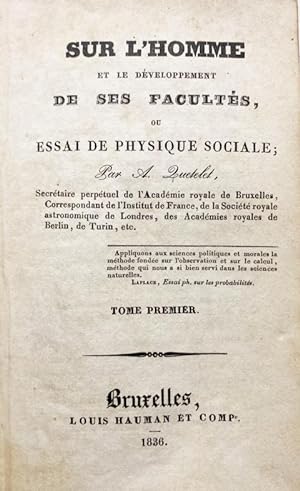
Sur l'Homme et le Développement de ses Facultés, ou Essai de Physique Sociale. 2 Bde. in 1 Bd. Mit 6 gefalteten Tafeln.
Verlag: Brüssel, Hauman, 1836
Anbieter: Treptower Buecherkabinett Inh. Schultz Volha, Berlin, Deutschland
Verkäuferbewertung 5 von 5 Sternen
Erstausgabe
XVI, 339, XII, 343 Seiten. Kl.-8°. Halbleder d. Zt. (beschabt und mit kleinen Läsuren). Seltene 2. Ausgabe (1 Jahr nach der Erstausgabe) von Quetelets bedeutendstem Werk, das Begründungswerk der soziologischen Statistik, in dem er seine Theorie der Wahrscheinlichkeit auf Moral und Politik anwendet. - Palgrave III, 247 - Garr.-M. 1698, 1 - DSB XI, S. 237: " "With Quetelet's work of 1835 a new era in statistics began. It presented a new technique of statistics or, rather, the first technique at all. The material was thoughtfully elaborated, arranged according to certain preestablished principles, and made comparable . Quetelet's average man became a slogan in ninetheenth-century discussions on social science . Quetelet's impact on nineteenth century thinking can in a certain sense be compared with Descartes's in the seventeenth century". - Teils leicht gebräunt bzw. gelegentlich etwas braunfleckig, Exlibris und wenige Notizen auf Vorsätzen, insgesamt gutes Exemplar. oLb Sprache: Deutsch Gewicht in Gramm: 2000.
-
Lettres a S.A.R. le Duc Regnant de Saxe-Cobourg et Gotha: sur la Theorie des probabilites, appliquee aux Sciences Morales et Politiques.
Verlag: M. Hayez, 1846., Bruxelles:, 1846
Anbieter: Jeff Weber Rare Books, Neuchatel, NEUCH, Schweiz
Verkäuferbewertung 3 von 5 Sternen

Erstausgabe Signiert
Large 8vo. [vi], iv, 450 pp. Half-title, numerous tables. Later full brown gilt-stamped cloth; endleaves with offsetting. With ownership signatures of A.L. Bowley, 1896, and F.N. David, 1957. Very good copy. FIRST EDITION of a landmark in social statistics. "This book is really an original, if elementary, treatise on probability and social statistics, written in the form of a series of letters to the Belgian king's two nephews, Ernest (the duke to whom the book was dedicated) and Albert (who by 1846 was husband to Queen Victoria of Great Britain). Quetelet had tutored the two in the 1830's, and in writing his book as a series of letters he was adopting a form that had been used with great success by Euler in 1768, with Letters to a German Princess, a popular exposition of physical science." :: Stigler, History of Statistics, p. 206. / In his 1846 Lettres, Quetelet used [Laplace's curve of 'possible error'] to interpret anthropomorphic data, thus giving it a new methodological significance, as has been pointed out by Stigler. Quetelet used Laplace's theorem to determine whether a series of real objects (and not mere measures) could be considered homogeneous. Laplace's theorem implied that a group of measures affected by the same major causes, and varying only in terms of many minor, accidental causes, should be distributed according to Gauss' law. Quetelet's innovation was to use the Gaussian distribution as a way of detecting groups of homogeneous objects. He thus made explicit what had previously been merely implicit in Laplace's work: a Gaussian (or 'normal' distribution) is a necessary and sufficient condition of homogeneity. The Laplace-Gauss law thus left the arcane realm of the estimation of error (in the measurement of a given object) to become a tool for detecting homogeneity in groups of real objects. In particular, it became a method for identifying 'populations' as objective entities. If, for example, the chest size or stature of soldiers was approximately distributed according to Gauss' law, this would indicate that it was a real population, within which variation was merely accidental. For Quetelet, a Gaussian distribution revealed both order in apparent chaos, and also an underlying ideal type that nature tries to attain, implying that variation has no real significance. This would also explain why Darwin, if he did read Quetelet, would hardly have been attracted by his concept of a 'population.'" :: (Jean Gayon, Darwinism's Struggle for Survival: Heredity and the Hypothesis of Natural Selection, tr. by Matthew Cobb, 1998, pp. 117-8). / "Quetelet is credited with the first published visual images of normal and skewed probability distributions" (Judy L. Klein, Statistical Visions in Time: A History of Time Series Analysis, 1662-1938, 1997, p. 164). / PROVENANCE: Sir Arthur Lyon Bowley (1869-1957), was an English statistician and economist who worked on economic statistics and pioneered the use of sampling techniques in social surveys. He is called the father of economic statistics. Bowley took his degree from Trinity College, Cambridge and graduated as Tenth Wrangler in the mathematics department. From 1893 to 1899 (the time he signed this book), Bowley taught mathematics at St. John's. From 1895 he took a part-time position at the new London School of Economics. He also taught at University College, Reading. In 1919 he was appointed the first chair of statistics at University College, London, apparently the first such position in Britain. The Royal Statistical Society awarded him its Guy Medal in Gold in 1935, becoming the Society's president 1938â"40. :: See: "Bowley, Arthur Lyon (BWLY887AL)". A Cambridge Alumni Database. / F.N.D. Florence Nightingale David (1909-1993), also known as F. N. David was an English statistician, born in Ivington, Herefordshire, England. She was named after Florence Nightingale, who was a friend of her parents. David did not like her forenames and thus always referred to herself as "F. N. David". She attended Bedford College for Women in London, earning her degree in mathematics in 1931. She then joined University College, London to work with Karl Pearson who obtained a scholarship for her, working as his research assistant, resulting in a doctorate received in 1938 (Pearson died in 1934). In 1938 her first book was published, Tables of the Correlation Coefficient. During that period she was working with Jerzy Neyman. "During World War II she served as Experimental Officer in the Ordnance Board for the Ministry of Supply, Senior Statistician for the Research and Experiments Department for the Ministry of Home Security, Member of the Land Mines Committee of the Scientific Advisory Council, and as Scientific Advisor on Mines to the Military Experimental Establishment. Her work during this time ranged from the study of bombing patterns and damage to the problem of discovering the placement of enemy land mines and a methodology for randomly placing land mines so as to avoid the semblance of any pattern in their placement." [Garber et.al.] After WWII she came back to University College, London, and was appointed professor in 1962. Five or six years later she took a position at the University of California, Riverside, becoming head of the Department of Statistics in 1970. Retiring in 1977 she came to Berkeley and continued her research. This copy of Simpson bears her initials on the Francis Galton Laboratory bookplate; she gave her books to Margaret Stein of Stanford University. See: M. J. Garber D. V. Gokhale J. M. Utts R. J. Beaver, Chair, "Florence Nightingale David, Statistics: Riverside." [Obituary]; "A conversation with F.N. David," Statistical Science, Vol. 4, No. 3,235-246 by Nan Laird; J. Utts, "Florence Nightingale David 1909-1993: Obituary," / Biometrics, (1993) 49, 1289-1291; Norman L. Johnson & Samuel Kotz (eds.), Leading Personalities in Statistical Sciences from the Seventeenth Century to the Present, Wiley, 1997 (pp. 91-92); F.N. Davi.
-
Letters Addressed to H. R. H. the Grand Duke of Saxe Coburg and Gotha on the Theory of Probabilities.
Verlag: Charles & Edwin Layton, 1849., London:, 1849
Anbieter: Jeff Weber Rare Books, Neuchatel, NEUCH, Schweiz
Verkäuferbewertung 3 von 5 Sternen
Erstausgabe
8vo. xvi, 309 pp. Tables. Original blind-stamped brown cloth, by Lewis (binder's ticket at rear); rebacked, new spine label. Fine. Inscribed by the translator Olinthus Gregory Downes, "To J.J. Sylvester Esq, F.R.S., with the translator's best respects." Bookplate of Percy Alexander MacMahon (engraved by C.M. Patt, R.E. 1904). Bookplate of the Francis Galton Laboratory; initials of Florence Nightingale David, 1945. REMARKABLE PROVENANCE. First edition in English, originally issued in Brussels, 1846. This is a translation of Lettres a S.A.R. le duc regnant de Saxe-Cobourg et Gotha sur la theorie des probabilites, appliquee aux sciences morales et politiques. "This book is really an original, if elementary, treatise on probability and social statistics, written in the form of a series of letters to the Belgian king's two nephews, Ernest (the duke to whom the book was dedicated) and Albert (who by 1846 was husband to Queen Victoria of Great Britain). Quetelet had tutored the two in the 1830's, and in writing his book as a series of letters he was adopting a form that had been used with great success by Euler in 1768, with Letters to a German Princess, a popular exposition of physical science." :: Stigler, History of Statistics, p. 206. / PROVENANCE: James Joseph Sylvester (1814-1897), British mathematician, Fellow of the Royal Society, made fundamental contributions to matrix theory, invariant theory, number theory, partition theory and combinatorics. He came to Johns Hopkins University and was founder of the American Journal of Mathematics. / Percy Alexander MacMahon (1854-1929), was a British mathematician, especially noted in connection with the partitions of numbers and enumerative combinatorics. / Florence Nightingale David, whose initials are found on the Francis Galton Laboratory bookplate, bears the date 1945, right at the time when she came back to University College London (the location of the lab). See: F.N. David, Games, Gods and Gambling: The Origins and History of Probability and Statistical Ideas From the Earliest Times in the Newtonian Era, (1962). / The Galton Laboratory researched eugenics and then human genetics, was based at University College London. REFERENCES: Stigler, Stephen M., Statistics on the Table; the History of Statistical Concepts and Methods, (1999), pp. 206, 161-220. See: Theodore M. Porter, Karl Pearson: The Scientific Life in a Statistical Age, (2010), page 237, 254, 259. FULL TITLE: Letters Addressed to H. R. H. the Grand Duke of Saxe Coburg and Gotha on the Theory of Probabilities, as Applied to the Moral and Political Sciences. Translated from the French by Olinthus Gregory Downes. [PLEASE CONTACT DIRECT FOR FURTHER INFORMATION].
-

Ueber den Menschen und die Entwicklung seiner Fähigkeiten. Deutsche Ausgabe, im Einverständniss mit dem Herrn Verfasser besorgt und mit Anmerkungen versehen von Dr. V. A. Riecke.
Sprache: Deutsch
Verlag: Schweizerbart's Verlagsbuchhandlung, Stuttgart, 1838
Anbieter: Tinakori Books, Lower Hutt, Neuseeland
Verkäuferbewertung 5 von 5 Sternen
Erstausgabe
Hardcover. Zustand: Good. 1st Edition. Nearly Very Good. xxiv, 656 pages, 7 plates, many statistics. Attractive quarter leather binding, gilt decorations on spine, old book dealer ticket and stamp on half-title page, top corner of half-title page torn out, otherwise a nice copy. First German edition of "Sur l'homme et le developpement des ses facultes, essai d'une physique sociale" (1835). Adolphe Quetelet's major work in which he presented his conception of the average man as the central value about which measurements of a human trait are grouped according to the normal curve. Quetelet laid the foundation for modern-day statistics. Quetelets Hauptwerk, in dem er Hilfe der Wahrscheinlichkeitstheorie naturgesetzliche Abläufe in der Gesellschaft nachzuweisen versucht.
-
Ueber den Menschen und die Entwicklung seiner Fähigkeiten, oder Versuch einer Physik der Gesellschaft. Deutsche Ausgabe, im Einverständniss mit dem Herrn Verfasser besorgt und mit Anmerkungen versehen von Dr. V. A. Riecke. Nebst einem Anhang, enthalte.
Anbieter: Herman H. J. Lynge & Søn ILAB-ABF, Copenhagen, Dänemark
Verkäuferbewertung 4 von 5 Sternen
Erstausgabe
Stuttgart, 1838. 8vo. Contemporary black bardborard binding with gilt lines and gilt title to spine. Corner of front board bent, and extremities worn. Light brownspotting to first and last leaves. Half title woth owner's stamp and old owner's inscription. XXIV, 656 pp + 7 plates. Numerous tables in the text. First edition of the first German translation of Quetelet's main work (Sur L'Homme et le Développement de ses Facultés, 1835), which founded a new statistical science. "With Quetelet's work of 1835 a new era in statistics began. It presented a new technique of statistics or, rather the first technique at all.There were not very many statistical figures in the book, but each figure reported made sense. For every number, Quetelet tried to find the determining influences, its natural Causes, and the pertubations caused by man. The work gave a description of the average man as both a static and a dynamic phenomenon.Quetelet's impact on 19th century thinking can in a certain sense be compared with Descarte's in the 17th-century. He certainly gave science new aims and tools.(DSB XI:p. 237).
-
Physique sociale ou Essai sur le développement des facultés de l'Homme
Erscheinungsdatum: 1869
Anbieter: Librairie Alain Brieux, Paris, Frankreich
Verbandsmitglied: ILAB
Verkäuferbewertung 4 von 5 Sternen
Couverture rigide. Zustand: Bon. 2 vol. in-8 : V-503 pp. + 485 Paris, J.-B. Baillière et fils, 1869, , 2 vol. in-8 : V-503 pp. + 485 pp. 2 pl, demi-basane verte, dos long orné de filets dorés, tranches mouchetées, Nouvelle édition dont l'originale a paru en 1835. Elle est illustrée de deux cartes de la France en tête du second volume. Adolphe Quetelet (1796-1874), secrétaire perpétuel de l'Académie Royale de Belgique à partir de 1834, s'est intéressé à l'astronomie et à la météorologie dès les années 1820 : il est à l'origine de la fondation de l'Observatoire de Bruxelles, dont il présenta le projet de construction au gouvernement belge en 1823. Savant polymorphe, Quetelet est également reconnu pour pour ses travaux de statistique sociale et démographique ; il participa à la création en 1841 du premier bureau statistique gouvernemental au monde. "With Quetelet's work of 1835 a new era in statistics began. It presented a new technique of statistics or, rather, the first techique at all" (DSB). Rousseurs, petits frottements et épidermures. Tampon ex-libris J. Falret.
-
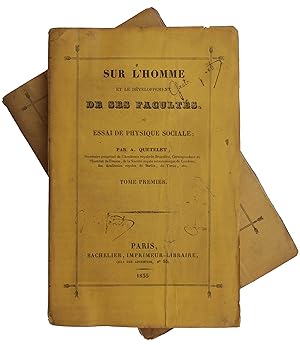
Sur l?Homme et le D?veloppement de ses Facult?s, ou Essai de Physique Sociale
Verlag: Bachelier, Paris, 1835
Anbieter: SOPHIA RARE BOOKS, Koebenhavn V, Dänemark
Verkäuferbewertung 5 von 5 Sternen
Erstausgabe
First edition. a new ERA of statistics. First edition of Quetelet's principal work in which he presented his conception of the homme moyen (?average man?) as the central value about which measurements of a human trait are grouped according to the normal distribution. ?With Quetelet's work of 1835 a new era in statistics began. It presented a new technique of statistics, or, rather, the first technique at all. The material was thoughtfully elaborated, arranged according to certain pre-established principles, and made comparable. There were not very many statistical figures in the book, but each figure reported made sense. For every number, Quetelet tried to find the determining influences, its natural causes, and the perturbations caused by man. The work gave a description of the average man as both a static and dynamic phenomenon. This work was a tremendous achievement, but Quetelet had aimed at a much higher goal: social physics, as the subtitle of the work said; the same title under which, since 1825, Comte had taught what he later called sociology. Terms and analogies borrowed from mechanics played a great part in Quetelet?s theoretical explanation. To find the laws that govern the social body, one has to do what one does in physics: to observe a large number of cases and then take averages. Quetelet?s average man became a slogan in nineteenth-century discussions on social science? (DSB). ?A rare, three-part review in the Athenaeum concluded by remarking: ?We consider the appearance of these volumes as forming an epoch in the literary history of civilization?? (Stigler, p. 170). This work occasionally appears on the market, but we have not been able to locate any copy in original printed wrappers sold at auction. ?It was in writings published in the 1830s that Quetelet (1796-1874) established the theoretical foundations of his work in moral statistics or, to use the modern term, sociology. First there was the idea that social phenomena in general are extremely regular and that the empirical regularities can be discovered through the application of statistical techniques. Furthermore, these regularities have causes: Quetelet considered his averages to be ?of the order of physical facts,? thus establishing the link between physical laws and social laws. But rather than attach a theological interpretation to these regularities?as Sussmilch and others had done a century earlier, finding in them evidence of a divine order?Quetelet attributed them to social conditions at different times and in different places. This conclusion had two consequences: It gave rise to a large number of ethical problems, casting doubt on man?s free will and thus, for example, on individual responsibility for crime; and in practical terms it provided a basis for arguing that meliorative legislation can alter social conditions so as to lower crime rates or rates of suicide. ?On the methodological side, two key principles were set forth very early in Quetelet?s work. The first states that ?Causes are proportional to the effects produced by them? This is easy to accept when it comes to man?s physical characteristics; it is the assumption that allows us to conclude, for example, that one man is ?twice as strong? as another (the cause) simply because we observe that he can lift an object that is twice as heavy (the effect). Quetelet proposed that a scientific study of man?s moral and intellectual qualities is possible only if this principle can be applied to them as well. The second key principle advanced by Quetelet is that large numbers are necessary in order to reach any reliable conclusions?an idea that can be traced to the influence of Laplace, Fourier, and Poisson ? ?Quetelet was greatly concerned that the methods he adopted for studying man in all his aspects be as ?scientific? as those used in any of the physical sciences. His solution to this problem was to develop a methodology that would allow full application of the theory of probabilities. For in striking contrast to his contemporary Auguste Comte, Quetelet believed that the use of mathematics is not only the sine qua non of any exact science but the measure of its worth ? ?The two memoirs which form the basis for all of Quetelet?s subsequent investigations of social phenomena appeared in 1831. By then he had decided that he wanted to isolate, from the general pool of statistical data, a special set dealing with human beings. He first published a memoir entitled Recherches sur la loi de la croissance de I?homme, which utilized a large number of measurements of people?s physical dimensions. A few months later he published statistics on crime, under the title Recherches sur le penchant au crime aux differens ages. While the emphasis in these publications is on what we would call the life cycle, both of them also include many multivariate tabulations, such as differences in the age-specific crime rates for men and women separately, for various countries, and for different social groups ? In 1833 Quetelet published a third memoir giving developmental data on weight, Recherches sur le poids de l?homme aux differens ages? (DSB). ??Quetelet made two important advances toward the statistical analysis of social data: the first of these was formulating the concept of the average man, the second the fitting of distributions. Quetelet?s first awakening to the variety of relationships latent in society may have come with his investigation of population data, but his interests soon spread. From 1827 to 1835 he examined scores of potentially meaningful relationships through the compilation of tables and the preparation of graphical displays? He examined birth and death rates by month and city, by temperature, and by time of day. He calculated the month of conception from the birth month and tried to relate it to marriage statistics. He investigated mortality by age, by profession, by locality, by season, in prisons, and in hospitals. He considered other human attributes: height, weigh.
-

Autograph letter signed to Charles Vincent Walker
Erscheinungsdatum: 1850
Anbieter: Jeremy Norman's historyofscience, Novato, CA, USA
Verkäuferbewertung 4 von 5 Sternen
Zustand: Very Good. Quetelet, Lambert Adolphe Jacques (1796-1874). A.L.s. to Charles Vincent Walker (1812-82). Brussels, July 14, 1850. 2pp. 207 x 132 mm. Pin-holes in upper margin, small inkstain in lower corner. Provenance: Latimer Clark. Discusses the construction of telegraph lines in Belgium, and some packages of books on electricity and other subjects that Quetelet was sending to Wheatstone and Faraday. Quetelet, an astronomer at the Brussels Royal Observatory, published several memoirs on atmospheric electricity, terrestrial magnetism, meteorology, and related subjects; however, he is best known as one of the founders of social science. His correspondent, Charles V. Walker, had been involved in telegraphy since the 1840s; in 1848 he sent the first submarine telegraph message from a ship connected by two miles of cable to London Bridge, and in 1876 he served as president of the Society of Telegraph Engineers and Electricians. Origins of Cyberspace 182. .