Gesamtpreis (1 Artikel Artikel):
Versandziel:

privateering (7 Ergebnisse)
Direkt zu den wichtigsten Suchergebnissen
Suchfilter
Produktart
- Alle Product Types
- Bücher (6)
- Magazine & Zeitschriften (Keine weiteren Ergebnisse entsprechen dieser Verfeinerung)
- Comics (Keine weiteren Ergebnisse entsprechen dieser Verfeinerung)
- Noten (Keine weiteren Ergebnisse entsprechen dieser Verfeinerung)
- Kunst, Grafik & Poster (Keine weiteren Ergebnisse entsprechen dieser Verfeinerung)
- Fotografien (Keine weiteren Ergebnisse entsprechen dieser Verfeinerung)
- Karten (Keine weiteren Ergebnisse entsprechen dieser Verfeinerung)
- Manuskripte & Papierantiquitäten (1)
Zustand Mehr dazu
- Neu (Keine weiteren Ergebnisse entsprechen dieser Verfeinerung)
- Wie Neu, Sehr Gut oder Gut Bis Sehr Gut (Keine weiteren Ergebnisse entsprechen dieser Verfeinerung)
- Gut oder Befriedigend (Keine weiteren Ergebnisse entsprechen dieser Verfeinerung)
- Ausreichend oder Schlecht (Keine weiteren Ergebnisse entsprechen dieser Verfeinerung)
- Wie beschrieben (7)
Einband
- alle Einbände
- Hardcover (Keine weiteren Ergebnisse entsprechen dieser Verfeinerung)
- Softcover (1)
Weitere Eigenschaften
- Erstausgabe (1)
- Signiert (Keine weiteren Ergebnisse entsprechen dieser Verfeinerung)
- Schutzumschlag (Keine weiteren Ergebnisse entsprechen dieser Verfeinerung)
- Angebotsfoto (5)
Sprache (1)
Preis
- Beliebiger Preis
- Weniger als EUR 20 (Keine weiteren Ergebnisse entsprechen dieser Verfeinerung)
- EUR 20 bis EUR 45 (Keine weiteren Ergebnisse entsprechen dieser Verfeinerung)
- Mehr als EUR 45
Gratisversand
- Kostenloser Versand nach USA (Keine weiteren Ergebnisse entsprechen dieser Verfeinerung)
Land des Verkäufers
Verkäuferbewertung
-

Memorial of Sundry Inhabitants of the State of Massachusetts, on the Subject of Privateering. January 26, 1821. Referred to the Committee on Commerce
Verlag: Foot & Brown, Washington, D.C., 1821
Anbieter: The Old Mill Bookshop, HACKETTSTOWN, NJ, USA
Verkäuferbewertung 3 von 5 Sternen

Erstausgabe
32 pp. 1 vols. 8vo. First edition. First edition. 32 pp. 1 vols. 8vo. Self wrappers, stitched. Some soiling, closely trimmed at bottom affecting some lines.
-

[ Valens Comyn, English parliamentarian. ] Autograph Signature on Exchequer receipt.
Verlag: His Majesty's Receipt of Exchequer. 15 November, 1769
Anbieter: Richard M. Ford Ltd, London, Vereinigtes Königreich
Verkäuferbewertung 5 von 5 Sternen

Manuskript / Papierantiquität
EUR 95,27
EUR 5,20 Versand
Versand von Vereinigtes Königreich nach USAAnzahl: 1 verfügbar
In den Warenkorb1p., 8vo. On leaf extracted from an Exchequer receipt book. Good firm signature, undamaged, on document with creasing and heavy wear elsewhere. Laid out in customary style, with printed text completed in manuscript. Recording receipt by Comyn, as assignee of 'Hale' of fifty pounds on an annuity. Witnessed at the foot by 'Jas: Comyn'.
-
A MEMORIAL OF SUNDRY MERCHANTS OF THE CITY OF PHILADELPHIA.FEBRUARY 5, 1802
Verlag: Printed by order of the Senate of the United States, Washington, 1802
Anbieter: James Cummins Bookseller, ABAA, New York, NY, USA
Verkäuferbewertung 4 von 5 Sternen

8pp. Dbd. 8pp. Dbd. Senate printing of a petition to both houses of Congress from Philadelphia merchants, asking that Congress pressure France to make reparations for the depredations inflicted by its privateers during the recent war. Five copies located between Shaw & Shoemaker and OCLC. Shaw & Shoermaker 3335 Contemporary manuscript pagination in upper outer corner. Early stains in outer corners throughout, affecting a few characters of text. Scattered foxing. A good copy.
-
Collection of 35 documents relating to Captain John McIver and the privateer Swallow.
Verlag: c.1796-97, 1796
Anbieter: Peter Harrington. ABA/ ILAB., London, Vereinigtes Königreich
Verbandsmitglied: ABA ILAB PBFA
Verkäuferbewertung 5 von 5 Sternen
EUR 29.770,52
EUR 25,44 Versand
Versand von Vereinigtes Königreich nach USAAnzahl: 1 verfügbar
In den WarenkorbAn outstanding and unusually comprehensive archive documenting the British-built armed brig Swallow, a Liverpool privateer operating in the Caribbean under the experienced prize-master John McIver. The papers trace in exceptional detail the purchase, fitting out, commissioning, and deployment of a late 18th-century privateering vessel, anchored by impressive original Letters of Marque. Privateering was, in essence, a form of licensed warfare. As the Oxford Companion to Ships and the Sea defines it, a privateer was "a privately owned vessel armed with guns commissioned by letters of marque, which licensed them to take prizes in time of war" (1979, p. 670). This archive shows the process in action. The owners' letters to McIver convey both urgency and anxiety as they navigate the risks of long-distance operations during wartime, revealing the network of merchants, agents, and seamen supporting the Swallow. Early letters make clear that McIver was the driving force: his kinsmen purchased the vessel "solely with the View to make a profitt by a Resale" yet were "well pleased you have taken the Command." The brig was refitted with 10 new iron cannon and furnished with Letters of Marque against French, Dutch, and later Spanish vessels. In late 1796 the Liverpool partners press McIver to sail immediately for Caribbean waters "in search of Spanish Prizes," while repeatedly stressing the need for constant intelligence. Their concerns deepen over slow remittances from their agent in Jamaica and uncertainty over whether to continue privateering or sell the ship. Built at East Cowes and bought on the stocks by the Royal Navy in 1781, the Swallow was sold in 1795 to a Liverpool consortium including Samuel McDowall, the Twemlow family, and the McIvers, with McIver himself later taking a one-third share. At his urging the vessel was strengthened, rearmed, and commissioned. Her first Letter of Marque (12 July 1796) authorized cruising against the French and Dutch; a second (January 1797) targeted Spanish shipping, prompting an increase to 20 guns and a crew of 80. As Gomer Williams notes, the Swallow "was not an ordinary privateer but an armed vessel, specially hired by Government." McIver enjoyed some success: off Léogâne he sent into Port-au-Prince a large brig and schooner with French property aboard, took other vessels, and saved the Fame of Liverpool from capture. The letters also record his ancillary government work transporting governors and army officers. By 1797, however, the quasi-peace following Leoben and Campo Formio curtailed her privateering activities. The archive also preserves McIver's account of capturing a small American merchantman in 1793 - a case serious enough to draw the attention of Thomas Jefferson and the British envoy George Hammond. The later history of the McIver/MacIver family forms a notable coda: their descendants became central figures in the creation of the Cunard Line, partnering with Samuel Cunard and Robert Napier in the 1830s and 1840s to establish what became the British and North American Royal Steam Packet Company. This archive offers a superlative and unusually granular record of British privateering at a moment when European conflict fuelled an upsurge of activity in the Caribbean - a milieu in which, as N. A. M. Rodger observes, "the letter of marque was often a slender cover for piracy." A full listing with commentary is available on request. N. A. M. Rodgers, The Wooden World, 1986; Gomer Williams, History of the Liverpool Privateers and Letters of Marque with an Account of the Liverpool Slave Trade, 1897; Rif Winfield, British Warships in the Age of Sail 1714-1792: Design, Construction, Careers and Fates, 2007, p. 314. Overall in remarkably good condition.
-
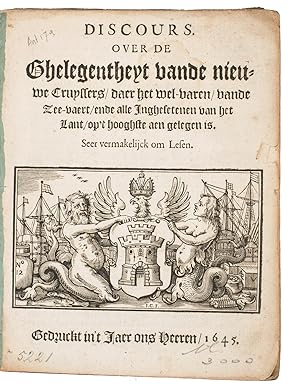
Discours over de ghelegentheyt vande nieuwe cruyssers, daer het wel-varen, vande zee-vaert, ende alle inghesetenen van het lant, op't hooghste aen gelegen is.
Verlag: [Middelburg?],, 1645
Anbieter: ASHER Rare Books, T Goy Houten, Niederlande
Verkäuferbewertung 5 von 5 Sternen
EUR 2.500,00
EUR 25,00 Versand
Versand von Niederlande nach USAAnzahl: 1 verfügbar
In den WarenkorbTwo dialogues discussing Dutch warships capturing Dunkirk privateers and merchant ships. Dunkirkers, serving the Spanish Navy, were a major threat to Dutch trade and shipping, taking hundreds of ships during the Dutch revolt. The present pamphlet discusses several commanders of warships, including the Zeeland captains Jacob Pense, Gerrit Verhagen, Jan Evertsen de Jonge and Jacob Verhelle, who captured no fewer than 30 Dunkirk ships in just one year. Jan Evertsen de Jonge was the son of the famous admiral Jan Evertsen, who had captured the infamous Duinkerk privateer Jacques Colaert in 1636 and later fought several battles in the first and second Anglo-Dutch war. The pamphlet concludes with a list of captured ships mentioned in the text. It seems to have been written to advocate the fitting out of more warships to protect Dutch (or more particularly Zeeland) trade.Spine damaged, otherwise in very good condition.l Den Zeusen Beesem 1062; Knuttel 5221; Thysius 4812; Tiele, Pamfletten, 3000. 19th-century sprinkled paper wrappers. With a large woodcut illustration on the title-page showing the Middelburg coat of arms, supported by a merman and a mermaid with ships in the background (signed "I.C.I."). Set in textura. Pages: [36] pp.
-

Copy van een brief, geschreeven aan boord van het kaaper-fregat De Dolphyn, capitein Van der Linden, aan . Matthys Ooster, te Amsterdam.
Anbieter: Gert Jan Bestebreurtje Rare Books (ILAB), Vianen, Niederlande
Verkäuferbewertung 5 von 5 Sternen
Amsterdam, Mattheus Schooneveld, 1781. Folio. (4) pp. Congratulations to Matthys Ooster on the save return of the privateers of De Dolphyn, Triton and Spion after hijacking two English ships with a load of coal, The Mary, captain Josias Gibson and The Providence, captain Thomas Wright, off the coast of England. On the return voyage there was a short (12 minutes) confrontation with 4 other English ships off the coast of Texel. Finally the fleet came home safe. Written by Dion. Werner on board of the ship the Dolphyn on the road of Texel, September 16, 1781. - (Stained). - Rare. STCN only 1 copy.
-

1797 (28 Mar) EL from Barbados to London detailing prizes captured on the Demerara Station.
Anbieter: Pennymead Books PBFA, Knaresborough, Vereinigtes Königreich
Verbandsmitglied: PBFA
Verkäuferbewertung 5 von 5 Sternen
EUR 475,85
EUR 17,34 Versand
Versand von Vereinigtes Königreich nach USAAnzahl: 1 verfügbar
In den Warenkorb3pp. With light two line BARBADOES (Type A2) late use and London cds, finally rated 3/- (?) Letter from Lieut. Bartleman concerning the prize money due to him from the capture of vessels by HMS Scorpio, La Babet and La Prompte including three American vessels.