

Gesamtpreis (1 Artikel Artikel):
Versandziel:

phillip fyman (7 Ergebnisse)
Direkt zu den wichtigsten Suchergebnissen
Suchfilter
Produktart
- Alle Product Types
- Bücher (7)
- Magazine & Zeitschriften (Keine weiteren Ergebnisse entsprechen dieser Verfeinerung)
- Comics (Keine weiteren Ergebnisse entsprechen dieser Verfeinerung)
- Noten (Keine weiteren Ergebnisse entsprechen dieser Verfeinerung)
- Kunst, Grafik & Poster (Keine weiteren Ergebnisse entsprechen dieser Verfeinerung)
- Fotografien (Keine weiteren Ergebnisse entsprechen dieser Verfeinerung)
- Karten (Keine weiteren Ergebnisse entsprechen dieser Verfeinerung)
- Manuskripte & Papierantiquitäten (Keine weiteren Ergebnisse entsprechen dieser Verfeinerung)
Zustand Mehr dazu
- Neu (7)
- Wie Neu, Sehr Gut oder Gut Bis Sehr Gut (Keine weiteren Ergebnisse entsprechen dieser Verfeinerung)
- Gut oder Befriedigend (Keine weiteren Ergebnisse entsprechen dieser Verfeinerung)
- Ausreichend oder Schlecht (Keine weiteren Ergebnisse entsprechen dieser Verfeinerung)
- Wie beschrieben (Keine weiteren Ergebnisse entsprechen dieser Verfeinerung)
Einband
Weitere Eigenschaften
- Erstausgabe (Keine weiteren Ergebnisse entsprechen dieser Verfeinerung)
- Signiert (Keine weiteren Ergebnisse entsprechen dieser Verfeinerung)
- Schutzumschlag (Keine weiteren Ergebnisse entsprechen dieser Verfeinerung)
- Angebotsfoto (4)
Sprache (1)
Preis
- Beliebiger Preis
- Weniger als EUR 20 (Keine weiteren Ergebnisse entsprechen dieser Verfeinerung)
- EUR 20 bis EUR 45 (Keine weiteren Ergebnisse entsprechen dieser Verfeinerung)
- Mehr als EUR 45
Gratisversand
- Kostenloser Versand nach USA (Keine weiteren Ergebnisse entsprechen dieser Verfeinerung)
Land des Verkäufers
Verkäuferbewertung
-

Controversies in Cardiovascular Anesthesia
Anbieter: Ria Christie Collections, Uxbridge, Vereinigtes Königreich
Verkäuferbewertung 5 von 5 Sternen

EUR 115,75
EUR 13,90 Versand
Versand von Vereinigtes Königreich nach USAAnzahl: Mehr als 20 verfügbar
In den WarenkorbZustand: New. In.
-

Controversies in Cardiovascular Anesthesia
Anbieter: Ria Christie Collections, Uxbridge, Vereinigtes Königreich
Verkäuferbewertung 5 von 5 Sternen
EUR 115,75
EUR 13,90 Versand
Versand von Vereinigtes Königreich nach USAAnzahl: Mehr als 20 verfügbar
In den WarenkorbZustand: New. In.
-
Taschenbuch. Zustand: Neu. Controversies in Cardiovascular Anesthesia | Phillip Fyman (u. a.) | Taschenbuch | Einband - flex.(Paperback) | Englisch | 2011 | Springer Us | EAN 9781461289937 | Verantwortliche Person für die EU: Springer Heidelberg, Tiergartenstr. 17, 69121 Heidelberg, buchhandel-buch[at]springer[dot]com | Anbieter: preigu.
-
Controversies in Cardiovascular Anesthesia
Sprache: Englisch
Verlag: Kluwer Academic Publishers, 1988
ISBN 10: 0898389852 ISBN 13: 9780898389852
Anbieter: Kennys Bookstore, Olney, MD, USA
Verkäuferbewertung 5 von 5 Sternen
Zustand: New. Editor(s): Fyman, Philip; Gotta, Alexander W. Num Pages: 192 pages, biography. BIC Classification: MJD; MMB. Category: (P) Professional & Vocational; (UP) Postgraduate, Research & Scholarly. Dimension: 234 x 156 x 12. Weight in Grams: 1050. . 1988. Hardback. . . . . Books ship from the US and Ireland.
-

Controversies in Cardiovascular Anesthesia
Anbieter: AHA-BUCH GmbH, Einbeck, Deutschland
Verkäuferbewertung 5 von 5 Sternen
Taschenbuch. Zustand: Neu. Druck auf Anfrage Neuware - Printed after ordering - On 16 October 1846, an itinerant New England dentist named William T. G. Morton proved the anesthetic effect of diethyl ether in a public demonstration in the 'ether dome' of the Bulfinch Building of the Massachusetts General Hospital in Boston. The patient, Gilbert Abbott, suffered no pain, and the surgeon, Dr. John C. Warren, was able to complete a suture ligature of a vas cular tumor of the jaw without the hurry that until then was so necessary. The operation proved a failure, since the tumor recurred; but the demonstration of ether's anesthetic effect was a great success. Operative pain was conquered, and surgery could advance from a crude and unscientific practice where speed was paramount, and the major body cavities could not be entered, into the unique blend of science and art that it is now. 'Gentlemen, this is no hum bug,' supposedly muttered Warren, perhaps the last noncontroversial assess ment of anesthesiology to be made by a surgeon. The screams of resisting patients in pain were stilled, and quiet entered the operating room for the first time. But the new science of pain relief was quickly wrapped in controversy. An argument immediately arose as to who could legitimately claim primacy for the discovery. Morton's attempt to hide the true nature of his anesthetic agent, coupled with an effort to patent the discovery, clouded his reputation and stimulated other claimants to push themselves forward.
-
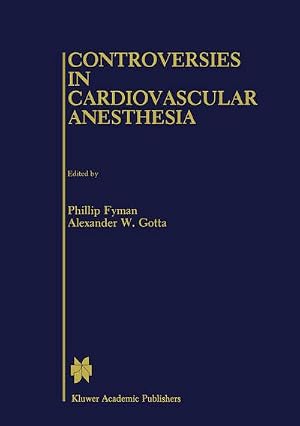
Controversies in Cardiovascular Anesthesia
Sprache: Englisch
Verlag: Springer US, Springer New York, 1988
ISBN 10: 0898389852 ISBN 13: 9780898389852
Anbieter: AHA-BUCH GmbH, Einbeck, Deutschland
Verkäuferbewertung 5 von 5 Sternen
Buch. Zustand: Neu. Druck auf Anfrage Neuware - Printed after ordering - On 16 October 1846, an itinerant New England dentist named William T. G. Morton proved the anesthetic effect of diethyl ether in a public demonstration in the 'ether dome' of the Bulfinch Building of the Massachusetts General Hospital in Boston. The patient, Gilbert Abbott, suffered no pain, and the surgeon, Dr. John C. Warren, was able to complete a suture ligature of a vas cular tumor of the jaw without the hurry that until then was so necessary. The operation proved a failure, since the tumor recurred; but the demonstration of ether's anesthetic effect was a great success. Operative pain was conquered, and surgery could advance from a crude and unscientific practice where speed was paramount, and the major body cavities could not be entered, into the unique blend of science and art that it is now. 'Gentlemen, this is no hum bug,' supposedly muttered Warren, perhaps the last noncontroversial assess ment of anesthesiology to be made by a surgeon. The screams of resisting patients in pain were stilled, and quiet entered the operating room for the first time. But the new science of pain relief was quickly wrapped in controversy. An argument immediately arose as to who could legitimately claim primacy for the discovery. Morton's attempt to hide the true nature of his anesthetic agent, coupled with an effort to patent the discovery, clouded his reputation and stimulated other claimants to push themselves forward.
-

EUR 127,59
EUR 48,99 Versand
Versand von Deutschland nach USAAnzahl: Mehr als 20 verfügbar
In den WarenkorbZustand: New. On 16 October 1846, an itinerant New England dentist named William T. G. Morton proved the anesthetic effect of diethyl ether in a public demonstration in the ether dome of the Bulfinch Building of the Massachusetts General Hospital in Boston. The patient.

