Gesamtpreis (1 Artikel Artikel):
Versandziel:

palingenius (18 Ergebnisse)
Direkt zu den wichtigsten Suchergebnissen
Suchfilter
Produktart
- Alle Product Types
- Bücher (18)
- Magazine & Zeitschriften (Keine weiteren Ergebnisse entsprechen dieser Verfeinerung)
- Comics (Keine weiteren Ergebnisse entsprechen dieser Verfeinerung)
- Noten (Keine weiteren Ergebnisse entsprechen dieser Verfeinerung)
- Kunst, Grafik & Poster (Keine weiteren Ergebnisse entsprechen dieser Verfeinerung)
- Fotografien (Keine weiteren Ergebnisse entsprechen dieser Verfeinerung)
- Karten (Keine weiteren Ergebnisse entsprechen dieser Verfeinerung)
- Manuskripte & Papierantiquitäten (Keine weiteren Ergebnisse entsprechen dieser Verfeinerung)
Zustand Mehr dazu
- Neu (7)
- Wie Neu, Sehr Gut oder Gut Bis Sehr Gut (1)
- Gut oder Befriedigend (1)
- Ausreichend oder Schlecht (Keine weiteren Ergebnisse entsprechen dieser Verfeinerung)
- Wie beschrieben (9)
Einband
Weitere Eigenschaften
- Erstausgabe (Keine weiteren Ergebnisse entsprechen dieser Verfeinerung)
- Signiert (Keine weiteren Ergebnisse entsprechen dieser Verfeinerung)
- Schutzumschlag (Keine weiteren Ergebnisse entsprechen dieser Verfeinerung)
- Angebotsfoto (11)
Sprache (4)
Gratisversand
- Kostenloser Versand nach USA (Keine weiteren Ergebnisse entsprechen dieser Verfeinerung)
Land des Verkäufers
Verkäuferbewertung
-

Marcelli Palingenii Stellati Zodiacus Vitae Sive De Hominis Vita Libri XII. Ad Optimarum Editionum
Anbieter: Ria Christie Collections, Uxbridge, Vereinigtes Königreich
Verkäuferbewertung 5 von 5 Sternen

EUR 25,88
EUR 13,86 Versand
Versand von Vereinigtes Königreich nach USAAnzahl: Mehr als 20 verfügbar
In den WarenkorbZustand: New. In.
-

Marcelli Palingenii Stellati Zodiacus Vitae Sive De Hominis Vita Libri XII. Ad Optimarum Editionum
Anbieter: Ria Christie Collections, Uxbridge, Vereinigtes Königreich
Verkäuferbewertung 5 von 5 Sternen
EUR 34,41
EUR 13,86 Versand
Versand von Vereinigtes Königreich nach USAAnzahl: Mehr als 20 verfügbar
In den WarenkorbZustand: New. In.
-

Marcelli Palingenii Stellati Zodiacus Vitae Sive De Hominis Vita Libri XII. Ad Optimarum Editionum
Sprache: Englisch
Verlag: Creative Media Partners, LLC Jul 2023, 2023
ISBN 10: 1021242950 ISBN 13: 9781021242952
Anbieter: AHA-BUCH GmbH, Einbeck, Deutschland
Verkäuferbewertung 5 von 5 Sternen
Taschenbuch. Zustand: Neu. Neuware.
-

The Zodiake of Life (1976)
Sprache: Englisch
Verlag: Scholars Facsimilies & Reprint, 1976
ISBN 10: 0820112143 ISBN 13: 9780820112145
Anbieter: MB Books, Derbyshire, Vereinigtes Königreich
Verkäuferbewertung 5 von 5 Sternen
EUR 88,17
EUR 23,14 Versand
Versand von Vereinigtes Königreich nach USAAnzahl: 1 verfügbar
In den WarenkorbHardcover. Zustand: Good. No Jacket. Condition : Good. Former university library copy with associated markings. Hard cover, no jacket. 242pp + appendix of title page and variants editions. A clean copy with no underlining or highlighting. Photo on request.
-

Marcelli Palingenii Stellati Zodiacus Vitae Sive De Hominis Vita Libri XII. Ad Optimarum Editionum
Sprache: Englisch
Verlag: Creative Media Partners, LLC Jul 2023, 2023
ISBN 10: 1019473959 ISBN 13: 9781019473955
Anbieter: AHA-BUCH GmbH, Einbeck, Deutschland
Verkäuferbewertung 5 von 5 Sternen
Buch. Zustand: Neu. Neuware - Originally published in 1531, Marcelli Palingenii Stellati Zodiacus Vitae is a complex exploration of human existence and the role of astrology in shaping our lives. This Latin text is a must-read for anyone interested in the history of philosophy and science, and will leave readers with a deeper appreciation for the vast mysteries of life.
-

Marcelli Palingenii Stellati Zodiacus Vitae Sive de Hominis Vita Libri XII. Ad Optimarum Editionum F
Anbieter: AHA-BUCH GmbH, Einbeck, Deutschland
Verkäuferbewertung 5 von 5 Sternen
Buch. Zustand: Neu. Neuware.
-

Le Zodiaque De La Vie Ou PrÃ(c)ceptes Pour Diriger La Conduite & Les Moeurs Des Hommes.
Sprache: Französisch
Verlag: Creative Media Partners, LLC Mai 2025, 2025
ISBN 10: 1024738647 ISBN 13: 9781024738643
Anbieter: AHA-BUCH GmbH, Einbeck, Deutschland
Verkäuferbewertung 5 von 5 Sternen
Taschenbuch. Zustand: Neu. Neuware - Le Zodiaque De La Vie Ou Préceptes Pour Diriger la Conduite & Les Moeurs Des Hommes. is a timeless treatise by Marcellus Palingenius Stellatus, offering profound insights into human behavior and moral guidance. Written in French, this work delves into philosophical principles, providing precepts designed to shape the conduct and morals of individuals.
-

Le Zodiaque De La Vie Ou PrÃ(c)ceptes Pour Diriger La Conduite & Les Moeurs Des Hommes.
Sprache: Französisch
Verlag: Creative Media Partners, LLC Mai 2025, 2025
ISBN 10: 1024736512 ISBN 13: 9781024736519
Anbieter: AHA-BUCH GmbH, Einbeck, Deutschland
Verkäuferbewertung 5 von 5 Sternen
Buch. Zustand: Neu. Neuware - Le Zodiaque De La Vie Ou Préceptes Pour Diriger la Conduite & Les Moeurs Des Hommes. is a timeless treatise by Marcellus Palingenius Stellatus, offering profound insights into human behavior and moral guidance. Written in French, this work delves into philosophical principles, providing precepts designed to shape the conduct and morals of individuals.This book explores enduring questions of ethics and self-improvement, presenting readers with a framework for navigating the complexities of life. Through its detailed examination, Le Zodiaque De La Vie serves as a valuable resource for those seeking wisdom and direction in their personal and moral development. Its historical significance and philosophical depth make it a compelling read for anyone interested in classical thought and the pursuit of a virtuous life.This work has been selected by scholars as being culturally important, and is part of the knowledge base of civilization as we know it. This work was reproduced from the original artifact, and remains as true to the original work as possible. Therefore, you will see the original copyright references, library stamps (as most of these works have been housed in our most important libraries around the world), and other notations in the work.This work is in the public domain in the United States of America, and possibly other nations. Within the United States, you may freely copy and distribute this work, as no entity (individual or corporate) has a copyright on the body of the work.As a reproduction of a historical artifact, this work may contain missing or blurred pages, poor pictures, errant marks, etc. Scholars believe, and we concur, that this work is important enough to be preserved, reproduced, and made generally available to the public. We appreciate your support of the preservation process, and thank you for being an important part of keeping this knowledge alive and relevant.
-
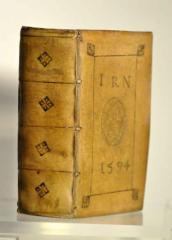
Marcelli Palingenii Stellati Poëta doctissimi Zodiacus vita : hoc est, De hominis vita, studio, ac moribus optime instituendis. Libri XII. Suivi de : Homerici Centones a Veteribus Vocati Homerokentra: Virgiliani Centones Utrique in Quaedam Historiae Sacrae Capita Scripti. Suivi de : Nonni Poetae Panopolitani Paraphrasis Santi Secundum Ioannem Evangelii.
Verlag: - Lugduni, 1581, 1581
Anbieter: L'Oeil de Mercure, Paris, Frankreich
Verkäuferbewertung 2 von 5 Sternen

Couverture rigide. Zustand: Très bon. (7 bl), 366 p., (40 ff. table) ; (4), 73 p., (2bl) ; 247 p., (7bl). Petit in-8, en plein-vélin à recouvrement estampé d'un super libros "IRN" sur le plat supérieur et daté 1594 placés dans un filet d'encadrement. Sur le premier contre-plat, estampe rehaussée représentant Atlas entouré des quatre empires (Asirria - Persia - Roma - Graeci) et de leurs attributs respectifs. Dans un cartouche : "In argentina. Stephanus Pater aet. 61 foelicite sculpsit Ihoani filio inve. 1580". Exemplaire de choix dont la page de titre a été minutieusement rehaussé à l'époque. Le premier texte est un poème satirique sur les mauvaises moeurs, contenant de vives attaques contre le Pape et le clergé. Un texte corrosif qui explique sans doute le double cryptage du nom de l'auteur : sous forme de palindrome, dont les premières lettres nous donnent Mercellus Palingenius Stellatus, anagramme du véritable nom de l'auteur, Pierangelo Manzolli, né à Stellata près de Florence. Réunion de trois textes dans une reliure de choix datée, monogrammée et ornée d'une gravures datée et signée ; condition remarquable. Livre ancien.
-
Zodiaci vitae, hoc est, de hominis vita, studio ac moribus optime instituendo, libri XII
Verlag: apud Ioannem TornaesiumGul. Gazeium, 1559
Anbieter: Librairie Le Feu Follet, Paris, Frankreich
Verbandsmitglied: ILAB
Verkäuferbewertung 5 von 5 Sternen
Couverture rigide. apud Ioannem Tornaesium Gul. Gazeium | Lugduni (Lyon) 1559 | 12 x 8 cm | relié | Nouvelle édition après l'originale de 1531. Brunet IV, 317. Caillet, 7096. Page de titre dans un encadrement gravé. Reliure en plein vélin souple d'époque à rabats. Titre (auteur) à la plume noire. Quelques annotation à la plume rouge sur la page de garde en regard du titre concernant l'histoire du livre. Exemplaire rogné court sur certaines pages, notamment de l'index. Recueil composé de 12 poèmes latins sur les arts libéraux, l'existence humaine, et le bonheur, chacun correspondant à un signe du zodiaque. En raison des critiques que le livre contient sur l'église et le pape, l'édition de 1531 fut interdite et l'inquisition conserva un oeil vigilant sur les activités de Palingenius, jusqu'à ce que ce dernier soit condamné au bucher. Le 11e livre a pour objet l'astronomie, et le 12e énonce une théorie de la lumière qui sera en partie suivie par Giordano Bruno. Marcellus Palingenius est l'anagramme de Pietro Angelo Manzolli. Ex libris Mathieu Varille Lyonnois. | [ENGLISH DESCRIPTION FOLLOWS] New edition after the original of 1531. Brunet IV, 317. Caillet, 7096. Title page within an engraved border. Contemporary limp vellum binding with overlapping edges. Title (author) in black ink. Some red ink annotations on the endpaper facing the title concerning the book's history. Copy trimmed short on certain pages, notably of the index. Collection composed of 12 Latin poems on the liberal arts, human existence, and happiness, each corresponding to a sign of the zodiac. Due to the criticisms the book contains about the church and the pope, the 1531 edition was banned and the Inquisition kept a watchful eye on Palingenius's activities, until he was condemned to the stake. The 11th book deals with astronomy, and the 12th sets forth a theory of light that would be partly followed by Giordano Bruno. Marcellus Palingenius is the anagram of Pietro Angelo Manzolli. Ex libris Mathieu Varille Lyonnois. * 366pp. -83.
-

L'Archeometra.
Anbieter: Antiquariat Bernard Richter, Baden-Baden, Deutschland
Verkäuferbewertung 2 von 5 Sternen
Translated by Luigi Manusco. 8vo. Paperback. 109 p, numerous illustrations. Roma, Atanòr, 1986.
-
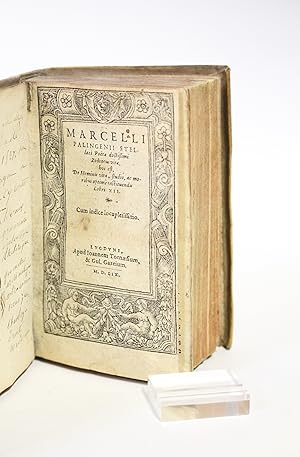
Poeta doctißimi Zodiacus vita: hoc est, de hominis vita, studio, ac moribus optime instituendis, libri XII. Cum indice iocupletissimo.
Sprache: Latein
Verlag: Lyon, Joannes Tornaesius (Jean de Tournes), 1581., 1581
Anbieter: Versandantiquariat Wolfgang Friebes, Graz, Österreich
Verkäuferbewertung 5 von 5 Sternen
Zustand: 0. Das satirische Lehrgedicht des neulateinischen Dichters P. A. Manzoli, über dessen Leben so gut wie nichts bekannt ist, erschien erstmals in Venedig um 1531 und wurde seitdem vielfach aufgelegt. Eine deutsche Übertragung erschien noch 1788 unter dem Titel Thierkreis des Lebens. Wegen seiner lebhaften Attacken gegen den Papst und die ganze Geistlichkeit wurde es 1559 auf den Index gesetzt, was seine Popularität, besonders unter den Protestanten, noch steigerte. - Wie bei Bruno gipfeln Manzoli's Bestrebungen einer religiösen u. sittlichen Reformation in der Satire auf Geistliche und Mönche, in der Verhöhnung des Pedanten, in der Polemik gegen den Papst u. seine kirchliche Politik (Olschki, Galilei u. seine Zeit, S. 4ff.). - Einband etw. berieben. Vorsatzbl. m. Eckabriß u. (wie auch der Titel) alten Besitzvermerken. Vereinzelte alte Unterstreichungen u. Marginalien. Kopfsteg knapp beschnitten (Kapitalüberschriften tlw. etw. angeschnitten). Etw. gebräunt. - Diese Ausgabe nicht bei bei Adams u. im BM STC, French Books. la Gewicht in Gramm: 500 16°. Mit Holzschn.-Titelbordüre u. Holzschn.-Druckermarke am Ende. 366 S., 41 nn. Bll., Etw. späterer Ldr.-Bd. m. reicher Rückenverg. u. goldgepr. Rückentitel.
-
Zodiacus vitae, id est de hominis vita, studio ac moribus optime instituendis. Libri XII.
Verlag: Rotterdam. Hofhout., 1722
Anbieter: Antiquariat C. Dorothea Müller, München, Deutschland
Verkäuferbewertung 4 von 5 Sternen

8°. - 15,8:10,3 cm. 16 Seiten einschl. Kupfertitel v. J. Goeree, 407 Seiten, 23 Blätter Index. Pergamenteinband der Zeit Achtung Zustand: Recht frisch, jedoch durchgehend mit zahlreichen Spuren von Unterstreichungen mit rotem Farbstift (siehe Photo). Einband gering fleckig. - Bitte lesen Sie die Zustandsbeschreibung vor einem evtl. Kauf sorgfältig durch. - 4348 "Belle édition" (Brunet, IV, 316). - Hübscher Druck.
-
Marcelli Palingenii Stellati Poetae Zodiacus vitae, id est de hominis vita, studio, ac moribus optime instituendis libri XII. Nunc demum ad exemplaria primaria sedulo castigati, centenis aliquot mendis expurgati, aliisque accessionibus aucti.
Verlag: Rotterdam (Rotterodami), Apud Joannem Hofhout, 1722., 1722
Anbieter: Antiquariaat Fragmenta Selecta, AMSTERDAM, Niederlande
Verkäuferbewertung 5 von 5 Sternen
8vo. XVI (including frontispiece),407;(47 index),(2 blank) p. Calf 15.5 cm (Details:.Back gilt and with 5 raised bands. The frontispiece, designed and executed by Jan Goeree, depicts an allegorical scene, which may refer to passages in the second and sixth book of the 'Zodiacus Vitae', called Taurus and Virgo. It shows a laureated woman, Poetry, who shakes hands with death, and at the same time clings with her left arm to a bust of the virtuous goddess of wisdom Athena. Her feet rest on a bag of gold and a scepter. Next to her stands a winged putto, scourge at hand, who reveals gold and other treasures of the church that lay hidden below a piece of cloth. Above them, on a monument, the wellknown scene of Hercules on the crossroads, where he meets two women, personifications of Virtue and Vice. They both advice Hercules to follow the road they show him. Virtue, depicted here as Athena, points at a narrow rocky and steep path at the end of which he will find a reward. Vice, who is stripped to the waist, offers Hercules pleasure, crowns and wealth; she points at the easy road. The message is clear, the highest good can not be found in wealth and profane goods but in virtue combined with wisdom. At the end of the sixth book, Virgo, the poet concludes, having considered the endless miseries of humankind, that we should not fear death, but that we must embrace her/him as a safe haven. The woodcut printer's mark shows the intertwined initials of the publisher Johannes Hofhout. The title is printed in red and black. Each of the 12 songs is preceded by a useful synopsis) (Condition: Binding scuffed. Tip at the head of the spine worn away. Gilt on the back fading. Front joint cracked, still strong, but showing some small damage. Bookplate on the front pastedown. Endpapers worn and yellowing. Some old ink underlinings) (Note: The real name of the Italian neolatin poet Marcello Palingenio Stellato, or in Latin Marcellus Palingenius Stellatus, was in 1725 revealed by I. Facciolati in a letter to the German bibliographer J.A. Fabricius. Marcello Palingenio is an anagram for the name of the Italian courtier Pier Angelo Manzol(l)i, born to a humble family in La Stellata, near Ferrara, between 1500 and 1503. He died before 1558. Recent research (Bacchelli 1985) points in a completely different direction. On the basis of indications in the privilege for the printing of the Zodiacus, granted in Venice in 1535 to one Marcellus Stellato Neapolitanus, it is thought that Marcellus may have been born in Campania, and that his real name was Marcello Stellato (or Stellati), a family name attested in area of Campania, thus denying the attribution of the poem to Pier Angelo Manzoli. A weak point is that the appellation 'Palingenio' is here hard to explain. Anyway, of the author's life little is known. It is assumed that he was a medical doctor. He was at one point suspected of heterodoxy, perhaps because he was a member of the Calvinist circle of Renata d'Este. After his death his bones were dug up, following a process of heresy under pope Paulus III, and burned at the stake. A Vatican codex, which includes documents of the Congregation of the Index of the years 1571-90, informs us that the unearthing of Marcello,'nihil credens neque divinitatem Christi', took place in Cesena, without, however, indicating the date, while in November 1558 the Bolognese Jesuit Francesco Palmio informed his general G. Lainez that his body was publicly exhumed and burned, because of certain heretic books Palingenius had composed. The cause of this exhumation may well have been his 'Zodiacus Vitae', a poem in 12 songs (9939 hexameters), each song taking its name from one the twelve signs of the Zodiac. It was written between 1520 and 1534, and was dedicated to Ercole II d'Este. These songs do not form a coherent unity, and contain a variety of didactic, moralistic, metaphysical, astronomical and frequently satirical passages. The work was placed on the Index in 1558; and perhaps because of this, in addition to its intrinsic qualities and its attacks upon the Catholic clergy, it was widely read and admired in Protestant countries. In England it was even used as a school text, both in Latin and English. It was imitated in, and translated into several languages. The main theme is the 'highest good', and around this are woven other secondary themes. There are contradictions, repetitions, and none of the questions dealt with is original. Yet the Zodiacus is a characteristic and interesting work, for its dealing with important philosophical questions and the author's noble intent to offer the reader a poetic code of rule how to live wisely. Its literary value lies in its ornate style and the freedom with which it treats the Latin language. Most importantly, the poem shows traits of true and heartfelt poetry, as found in some particularly sharp satiric attacks upon the clergy, in certain similes and in outpourings of real pessimism. (Source: Dizionario Biografico degli Italiani - Volume 69 (2007), and Enciclopedia Italiana (1934)) (Provenance: On the front pastedown the armorial bookplate of 'The Right Honorable Sir John Trollope, Bar-t. M.P.' Probably Sir John Trollope, 1800-1874, 7th Baronet of Casewick in the county of Lincoln, and created Baron Kesteven in 1868. He was a conservative politician, and M.P. for Lincolnshire South. (See Wikipedia 'John Trollope, 1st Baron Kesteven', and 'Trollope Baronets')) (Collation: pi1 (frontispiece), *8 (minus leaf *1); A-2C8, 2D-2G4, 2H4 (leaf 2H4 is a blank, and located between the leaves 2H1 and 2H2 because of a binder's error)) (Photographs on request) 1000 gr.
-
Zodiacus vitae. hoc est: de hominis vita libri XII.addita Palingenii vita.
Verlag: Genf (Ortsname schwarz eingestempelt)Tornaesius, 1608
Anbieter: Antiquariat Stefan Krüger, Essen, NRW, Deutschland
Verkäuferbewertung 3 von 5 Sternen

366 S., 33 Bl. Pgmt. d. Zt. kl.-8°. gegen Ende kaum störend schwach wasserrrandig - gutes Exemplar, Für diesen Druck wird auch Lyon als Druckort angegeben, Jean de Tournes druckte aber nach seiner Flucht aus Frankreich 1585 in Genf. ( 'GENEVA' hier evtl. später über dem Verlegernamen eingestempelt). Hübsche Taschenausgabe des seit 1559 auf dem Index lib. proh. stehenden Werkes. (Zum Verfasser vgl., Korye.
-
Verlag: Lyon
Anbieter: Antiquariat Ulrich Engel, Stuttgart, Deutschland
Verkäuferbewertung 2 von 5 Sternen
Lyon 1570. 3 Bl. 333 S. 22 Bl. Kl.8°. Späterer Hldr.-Bd. Berieben u. bestoßen, etwas lädiert. Vordergelenk gebrochen. Rückentitel u. Vors. gestempelt. Sehr frühe Ausgabe des satirischen Lehrgedichtes über die Tierkreiszeichen, erstmals 1531 veröffentlicht und mehrfach neu aufgelegt. Wegen seiner scharfen Kritik am Klerus und insbesondere dem Papst wurde das Werk 1559 auf den Index gesetzt. "Aufgrund der EPR-Regelung kann in folgende Länder KEIN Versand mehr erfolgen: Bulgarien, Finnland, Frankreich, Griechenland, Luxemburg, Österreich, Polen, Rumänien, Schweden, Slowakei, Spanien.".
-
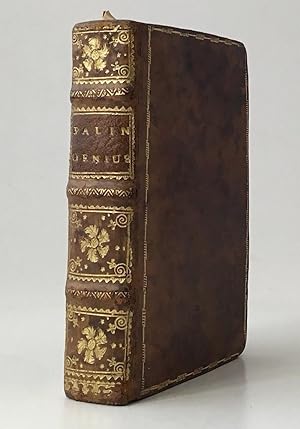
Marcellus Palingenii Stellati Poëtadoctissimi Zodiai vita: hoc est De hominus vita studio, ac moribus optime instituendis, Libri XII.
Anbieter: Vangsgaards Antikvariat Aps, Copenhagen, Dänemark
Verkäuferbewertung 5 von 5 Sternen
Apud Ioannem Tornasium, Lyon 1566. 12mo. Woodcut titlepage. 366+(82) pages. Bound with: Marci Manilii poëtae clariss. astronomicon ad Caesarem Augustum. Ioan Tornæsium, Lyon 1551. 165+(1)+(4) pages. Fine contemporary marbled calf binding with richly gilt spine and line ornaments on boards. Old name (overwritten) on titlepage. * Very early edition of Italian humanist Stellato's [c.1500-1550] main work: A philosophical journey after the zodiacs, meant to neoplatonically lift the spirit of man away from the darkness of the world into the light and thus God. Not muchis known about the author, but apparently his body was dug up and burned posthumously because of alledged heresy.
-
Le Zodiaque de la vie humaine ou Préceptes pour diriger la conduite & les moeurs des hommes. Divisé en XII. livres, sous les douze signes. Traduit du poeme latin de Marcel Palinene, célébre Poete, de la Stellada. Nouvelle edition, revue, corrigée, & augmentée de notes . par Mr. J. B. C. de la Monnierie. 2 Teile in 1 Band.
Anbieter: Antiquariat Fatzer ILAB, Zug, Schweiz
Verkäuferbewertung 5 von 5 Sternen
Londres, Le Prevost 1733. 19 x 11 cm. (20) S., 213 S., (3) S.; (2) S., 248 S., (4) S. Mit 2 Titelblättern in rot/schwarz und 2 gefaltete Tabellen. Pgmt.d.Zt. mit goldgepr. Rückenschildchen. Durchgehend etwas stockfleckig. Gutes Exemplar.