Gesamtpreis (1 Artikel Artikel):
Versandziel:

murray johan anders (3 Ergebnisse)
Direkt zu den wichtigsten Suchergebnissen
Suchfilter
Produktart
- Alle Product Types
- Bücher (3)
- Magazine & Zeitschriften (Keine weiteren Ergebnisse entsprechen dieser Verfeinerung)
- Comics (Keine weiteren Ergebnisse entsprechen dieser Verfeinerung)
- Noten (Keine weiteren Ergebnisse entsprechen dieser Verfeinerung)
- Kunst, Grafik & Poster (Keine weiteren Ergebnisse entsprechen dieser Verfeinerung)
- Fotografien (Keine weiteren Ergebnisse entsprechen dieser Verfeinerung)
- Karten (Keine weiteren Ergebnisse entsprechen dieser Verfeinerung)
- Manuskripte & Papierantiquitäten (Keine weiteren Ergebnisse entsprechen dieser Verfeinerung)
Zustand Mehr dazu
- Neu (Keine weiteren Ergebnisse entsprechen dieser Verfeinerung)
- Wie Neu, Sehr Gut oder Gut Bis Sehr Gut (Keine weiteren Ergebnisse entsprechen dieser Verfeinerung)
- Gut oder Befriedigend (1)
- Ausreichend oder Schlecht (Keine weiteren Ergebnisse entsprechen dieser Verfeinerung)
- Wie beschrieben (2)
Einband
- alle Einbände
- Hardcover (2)
- Softcover (Keine weiteren Ergebnisse entsprechen dieser Verfeinerung)
Weitere Eigenschaften
- Erstausgabe (1)
- Signiert (Keine weiteren Ergebnisse entsprechen dieser Verfeinerung)
- Schutzumschlag (Keine weiteren Ergebnisse entsprechen dieser Verfeinerung)
- Angebotsfoto (3)
Sprache (1)
Preis
- Beliebiger Preis
- Weniger als EUR 20 (Keine weiteren Ergebnisse entsprechen dieser Verfeinerung)
- EUR 20 bis EUR 45 (Keine weiteren Ergebnisse entsprechen dieser Verfeinerung)
- Mehr als EUR 45
Gratisversand
Land des Verkäufers
Verkäuferbewertung
-
"In Stirpes Aliquot Novas et Minus Cognitas Horti R. Academici. Praelectae D. II. Martii, A. MCCCLXXXII." In Commentationes Societatis Regia Scientiarum Gottingensis, vol. V.
Verlag: Ioan. Christ Dieterich, 1783., Gottingen:, 1783
Anbieter: Jeff Weber Rare Books, Neuchatel, NEUCH, Schweiz
Verkäuferbewertung 4 von 5 Sternen

4to. xii, [xvi], 102, 64, 136, 54 pp. Title page vignette, 1 chapter head vignette, tailpieces, 5 engraved folding botanical plates, 3 engraved mathematical plates (1 folding); moderate foxing, early ex-library rubber stamps on plates. Later quarter tan calf, boards, gilt spine, brown leather spine label, new endleaves. A fine copy. Murray's work is an attempt at Linnean classification of rare and unusual plants in the genera lysimachus, veronica, scabiosa, and celosia. Murray, a Swede, was one of Linnaeus' favorite students. He took his medical degree at the University of Gottingen and was appointed professor of medicine there and inspector of the university's botanical garden. He translated many of Linnaeus' works and his teaching powerfully influenced the succeeding generation of botanists. See: Blake, NLM, 317; BM (Nat. Hist.), III, p. 1382. This volume also contains contributions on botany, physics, mathematics and ancient inscriptions by: Johann Friedrich Gmelin (1748-1804), Joh. Beckman, Heinrich August Wrisbert, Abraham Gotthelf Kaestner (1719-1800), Alb. L. Fr. Maister, Christian Gottlob Heyne, Christian Wilhelm Franz Walch, Christoph Meiners, and more. CONTAINS: Abraham Gotthelf Kaestner (1719-1800), De Dentibus Rotarum qui Iunguntur Paxillis Rotundis. [On wheel teeth joined by pins]. / [Egypt] Aegyptiaca Complexum. Interponitur Indicium de omni historia Aegyptiacam eius fontibus et vaussis et de modo ac ratione eam interpretandl. / Christian Gottlob Heyne (1729-1812), De Fontibus et Auctoribus Historiarum Diodori et de eius auctoritate . . . [on Diodorus Siculus, the Greek historian, fl. first century BC] / [Herodotus] Johann Christoph Gatterer (1727-1799), De Herodoti ac Thucydidis Thracia. . . . Commentatio Geographica. Pars altera: De Thracia Australi, er eius quidem Orientali parte, seu Thracia posterioris aeui proprie dicta. / Christian Wilhelm Franz Walch (1726-1784), De Michaelis Glycae Aetate commentatio. / [Greek weaponry] Christian Gottlob Heyne (1729-1812), Nova Armorum Inventa in Vetere Graecia quid ad rerum summam profecerint. Commentatio recitata . . . / Jo. Matthia Gesnero, Inscriptiones Aliquot Pocockianae illustratae . . . Commentatio I.
-
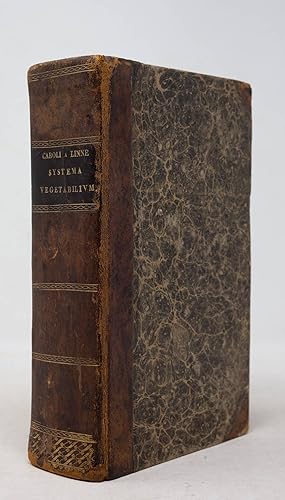
Caroli a Linné Equitis Systema Vegetabilium secundum classes ordines genera species cum characteribus et differentiis. Edition decima quinta quae ipsa est recognitionis a b. Io. Andrea Murray institutate tertia procurata a C. H. Persoon plurium societatum socio
Verlag: Johann Christian Dieterich, Göttingen, 1797
Erstausgabe
Hardcover. Zustand: Very good. First. Third edition, first Persoon edition (see below). Göttingen: Johann Christian Dieterich, 1797. Octavo (8" x 4 7/8", 204mm x 123mm). [Full collation available.] Bound in half mottled sheep over marbled paper boards. On the spine, six transverse gilt rolls with gilt fillets top-and-bottom. Author and title gilt to dark sheep in the second panel. Printed scrollwork head- and tail-bands. All edges of the text-block glazed aqua. Rubbed at the extremities, with some wear and loss at the fore-corners and tail. Mildly foxed throughout. A completely unsophisticated copy. Carl von Linné (Carolus Linnæus, 1707-1778) was the ultimate taxonomist, the father of modern natural science, princeps botanicorum (prince of botanists). The system of binomial nomenclature that he perfected is the cornerstone of an international community of scientists, newly able to refer to a species using a standard language. His Systema Naturæ (1735) was the first to lay out his scientific Weltanschauung, and went through 12 editions under his supervision, reflecting new discoveries. After his death, the Systema diverged; Johan Anders Murray excerpted the part relating only to plants (vegetabilia) into a "thirteenth" edition -- confusingly, there is also a thirteenth edition of the whole Systema -- that then ran to two further; thus, this "fifteenth" edition is in fact the third edition of the Systema Vegetabilium. The present item is the first edited by Christiaan Hendrik Persoon, himself an eminent mycologist. Pritzel 5430.
-
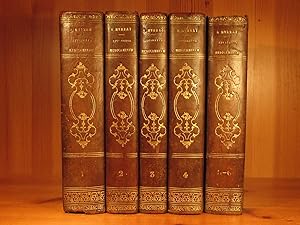
Apparatus medicaminum tam simplicium quam praeparatorum et compositorum in praxeos adiumentum consideratus, 6 Bände, Prachtausgabe.
Verlag: Göttingen, Christ. Dieterich, 1784 - 1794., 1794
Anbieter: Das Konversations-Lexikon, Garding, Deutschland
Verkäuferbewertung 5 von 5 Sternen

XXXVIII, 964 S., 3 Bl.; 628 S., 3 Bl.; 572; 665; X, 604, 243 S., 12 Bl. Vollständiges Werk in 6 Bänden (gebunden in 5 Bänden). Braune Original-Halblederbände mit goldgeprägten Rückentiteln sowie reicher goldgeprägter Ornamentik; Buchschnitt in braun-beiger Marmorierung; Vorsätze in ebensolchem Marmor-Design; Buchdeckel mit schwarz-grünen Marmorbezügen. Hauptwerk des schwedischen, väterlicherseits preußischstämmigen Botanikers und Mediziners Johan Andreas Murray (1740 - 1791) sowie frühes und wegweisendes Grundlagenwerk der modernen Pharmakognosie. 3 Bände mit Titelkupfer; die Bände 2 und 3 jeweils mit Bandregister; Bd. 6 mit Gesamtregister des Werkes.Murray studierte von 1756 an der Universität Uppsala Pharmazie, Medizin und Botanik, unter anderem bei Carl von Linné, dessen Hauptwerk "Systema vegetabilium" er später in 13. und 14. Auflage herausgeben sollte. 1760 ging Murray nach Göttingen, um an der dortigen Universität eine Professur der Medizin und Botanik anzutreten; von 1769 an war er außerdem als Kustos für den Botanischen Gartens Göttingen verantwortlich. "Sein Verdienst ist es, daß der von Albrecht v. Haller angelegte Garten durch die Errichtung verschiedener Gewächshäuser (Frigidarium, Caldarium, Tepidarium), durch die Erwerbung zahlreicher seltener und exotischer Pflanzen (besonders aus Nordamerika und Sibirien) und durch die wissenschaftliche Anordnung nach dem Linnéschen System zu internationalem Ruhm gelangte." Den brieflichen Kontakt zu Linné hielt er stets aufrecht. Wie sehr Linné seinen ehemaligen Schüler schätzte, ist auch daran abzulesen, daß er einen ostindischen Baum sowie einen von ihm entdeckten Käfer nach Murray benannte. Die Kapitale der Bände 2 und 5/6 etwas berieben, Bd. 1 etwas standspurig. Ansonsten befinden sich die Bände in sehr gutem Zustand; Seiten überwiegend sauber, kaum gebräunt, allenfalls vereinzelt mit leichter Fleckigkeit (diese lediglich bei Bd. 4 etwas stärker ausgeprägt).In toto sehr gutes Exemplar dieser hübsch gestalteten Halbleder-Ausgabe des einschlägigen Werkes. Weitere Fotos auf der Homepage des Antiquariats (bitte Art.-Nr. auf der Angebotsseite in das Suchfeld eingeben).