Gesamtpreis (1 Artikel Artikel):
Versandziel:

montmort (27 Ergebnisse)
Direkt zu den wichtigsten Suchergebnissen
Suchfilter
Produktart
- Alle Product Types
- Bücher (27)
- Magazine & Zeitschriften (Keine weiteren Ergebnisse entsprechen dieser Verfeinerung)
- Comics (Keine weiteren Ergebnisse entsprechen dieser Verfeinerung)
- Noten (Keine weiteren Ergebnisse entsprechen dieser Verfeinerung)
- Kunst, Grafik & Poster (Keine weiteren Ergebnisse entsprechen dieser Verfeinerung)
- Fotografien (Keine weiteren Ergebnisse entsprechen dieser Verfeinerung)
- Karten (Keine weiteren Ergebnisse entsprechen dieser Verfeinerung)
- Manuskripte & Papierantiquitäten (Keine weiteren Ergebnisse entsprechen dieser Verfeinerung)
Zustand Mehr dazu
- Neu (6)
- Wie Neu, Sehr Gut oder Gut Bis Sehr Gut (12)
- Gut oder Befriedigend (5)
- Ausreichend oder Schlecht (Keine weiteren Ergebnisse entsprechen dieser Verfeinerung)
- Wie beschrieben (4)
Einband
Weitere Eigenschaften
- Erstausgabe (2)
- Signiert (Keine weiteren Ergebnisse entsprechen dieser Verfeinerung)
- Schutzumschlag (3)
- Angebotsfoto (13)
Sprache (4)
Gratisversand
Land des Verkäufers
Verkäuferbewertung
-

Zustand: good. Befriedigend/Good: Durchschnittlich erhaltenes Buch bzw. Schutzumschlag mit Gebrauchsspuren, aber vollständigen Seiten. / Describes the average WORN book or dust jacket that has all the pages present.
-

Softcover. Zustand: Très bon. Ammareal reverse jusqu'à 15% du prix net de cet article à des organisations caritatives. ENGLISH DESCRIPTION Book Condition: Used, Very good. Ammareal gives back up to 15% of this item's net price to charity organizations.
-

blanda. Zustand: Buen estado. Zustand des Schutzumschlags: Buen estado.
-

Blanda. Zustand: Buen Estado. Zustand des Schutzumschlags: Buen Estado.
-
Vivre pour apprendre (French Edition)
Anbieter: Gallix, Gif sur Yvette, Frankreich
Verkäuferbewertung 5 von 5 Sternen

Zustand: Neuf.
-

Ex-libris.
Sprache: Französisch
Anbieter: Librairie Trois Plumes, Angers, Frankreich
Verkäuferbewertung 4 von 5 Sternen

Couverture rigide. Zustand: Bon. Ex-libris armorié (37*32mm) avec la devise « Ny amy ny ennemy à demy ». Ex-libris XVIIIe regravé ici au début du XXe.
-

Ex-libris.
Sprache: Französisch
Anbieter: Librairie Trois Plumes, Angers, Frankreich
Verkäuferbewertung 4 von 5 Sternen
Couverture rigide. Zustand: Bon. Ex-libris armorié (83*62mm) avec la devise « Ny amy ny ennemy à demy ». Ex-libris XVIIIe regravé ici au début du XXe.
-

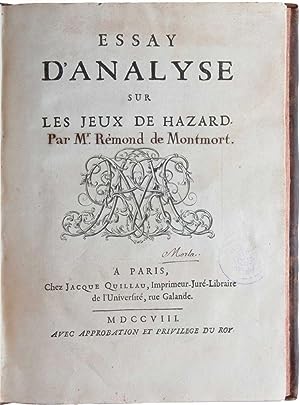
Essay d'Analyse Sur Les Jeux de Hazard (2e Éd) (Éd.1713) (Sciences) (French Edition)
Anbieter: Ria Christie Collections, Uxbridge, Vereinigtes Königreich
Verkäuferbewertung 5 von 5 Sternen
EUR 30,11
EUR 13,89 Versand
Versand von Vereinigtes Königreich nach USAAnzahl: Mehr als 20 verfügbar
In den WarenkorbZustand: New. In.
-

Un Compagnon de Rochambeau. Antoire-Charles Du Houx, baron de Viomevil, Lieutenant général des armées du Roi (1728-1792)
Verlag: J. de Grandpré, Blois, 1935
Anbieter: Librairie Farfouille, Paris, Frankreich
Verkäuferbewertung 4 von 5 Sternen
In-8 - br. 11 pp.
-

Un autre Maupassant. Dictionnaire, suivi de Le canular de Le Corbeau et souvenir de Madame X
Anbieter: Librairie de l'Avenue - Henri Veyrier, Saint-Ouen, FR, Frankreich
Verkäuferbewertung 4 von 5 Sternen
Couverture souple. Zustand: Bon état. In-8 broché 24,0 cm sur 15,0. 461 pages. Bordures des pages poussiéreuses. Bon état d'occasion.
-

LE DEUXIEME VOYAGE.
Couverture souple. Zustand: bon. R150150664: 1995. In-8. Broché. Etat d'usage, Couv. légèrement pliée, Dos plié, Intérieur frais. 238 pages. . . . Classification Dewey : 840-Littératures des langues romanes. Littérature française.
-

EUR 18,50
EUR 48,99 Versand
Versand von Deutschland nach USAAnzahl: Mehr als 20 verfügbar
In den WarenkorbZustand: New.
-
Vivre pour apprendre
Anbieter: LiLi - La Liberté des Livres, CANEJAN, Frankreich
Verkäuferbewertung 5 von 5 Sternen
Zustand: fine. l'article peut presenter de tres legers signes d'usure. vendeur professionnel; envoi soigne en 24/48h.
-
Zustand: Bon. Merci, votre achat aide à financer des programmes de lutte contre l'illettrisme.
-
Zustand: Assez bon. Merci, votre achat aide à financer des programmes de lutte contre l'illettrisme.
-
Zustand: Comme neuf. Merci, votre achat aide à financer des programmes de lutte contre l'illettrisme.
-
VIVRE POUR APPRENDRE
Anbieter: LiLi - La Liberté des Livres, CANEJAN, Frankreich
Verkäuferbewertung 5 von 5 Sternen
Zustand: new. vendeur professionnel. Expedition en 24/48h.
-

EUR 35,74
EUR 48,99 Versand
Versand von Deutschland nach USAAnzahl: Mehr als 20 verfügbar
In den WarenkorbZustand: New. KlappentextrnrnWORK IS IN FRENCH This book is a reproduction of a work published before 1920 and is part of a collection of books reprinted and edited by Hachette Livre, in the framework of a partnership with the National Library of France, prov.
-

Rústica. Zustand: Muy bueno. Zustand des Schutzumschlags: Usado.
-

Essay d'Analyse Sur Les Jeux de Hazard (2e Éd) (Éd.1713)
Sprache: Französisch
Verlag: Hachette Livre - BNF Mai 2012, 2012
ISBN 10: 2012543456 ISBN 13: 9782012543454
Anbieter: AHA-BUCH GmbH, Einbeck, Deutschland
Verkäuferbewertung 5 von 5 Sternen
Taschenbuch. Zustand: Neu. Neuware - WORK IS IN FRENCH This book is a reproduction of a work published before 1920 and is part of a collection of books reprinted and edited by Hachette Livre, in the framework of a partnership with the National Library of France, providing the opportunity to access old and often rare books from the BnF's heritage funds.
-

Der Schlüssel zum Erfolg: Ein unentbehrliches Handbuch zum Stricken und Häkeln. Grundmuster, neue Techniken und Anregungen für den Anfang, Fortschritt und Erfolg
Sprache: Deutsch
Verlag: Hambung, IPV [Mon Tricot], 1980
Anbieter: Antiquariat Biebusch, Lilienthal, Deutschland
Verbandsmitglied: GIAQ
Verkäuferbewertung 5 von 5 Sternen
Heft. Zustand: Gut. 130 S., 28cm Zustand: berieben, Ecken bestoßen, sonst gut --- Inhalt: detaillierte Anleitungen umfangreich mit Fotografien und Sizzen erläutert. Grundlage, Formen und Fertigstellung, Zubehör, Ratschläge. KS066 Sprache: Deutsch Gewicht in Gramm: 200.
-

Zustand: Bon. Merci, votre achat aide à financer des programmes de lutte contre l'illettrisme.
-
Les arrêts du Grand Conseil portant dispens du Marc d?or de noblesse.
Verlag: Paris, S.G.A.F., 1951,, 1951
Anbieter: Harteveld Rare Books Ltd., Marly, Schweiz
Verkäuferbewertung 4 von 5 Sternen
gr. in-8vo, XIX + 533 p., brochure originale. Please notify before visiting to see a book. Prices are excl. VAT/TVA (only Switzerland) & postage.
-
Les chevau-légers de la garde du roy, 1592-1787
Verlag: S.G.A.F., Paris, 1953
Anbieter: Christophe Hüe - Livres anciens, Paris, Frankreich
Verkäuferbewertung 5 von 5 Sternen
Erstausgabe
Broché. Zustand: Bon. Edition originale. In-8 broché, xii-251 pp., [1] f. Illustré d'un frontispice en couleurs. Ouvrage tiré à 289 exemplaires numérotés. Préface du général Weygand. ''Le principal ouvrage sur le sujet'', Saffroy, 13177. Rare. . (Catégories : ). 380.
-
Essay d'analyse sur les jeux de hazard. Seconde Edition. Revise & augmentée de plusieurs Lettres.
Verlag: Paris: Jacques Quillau, 1713, 1713
Anbieter: Peter Harrington. ABA/ ILAB., London, Vereinigtes Königreich
Verbandsmitglied: ABA ILAB PBFA
Verkäuferbewertung 5 von 5 Sternen
EUR 12.835,52
EUR 25,50 Versand
Versand von Vereinigtes Königreich nach USAAnzahl: 1 verfügbar
In den WarenkorbSecond, revised edition of the pioneering study of games of chance, among the first comprehensive studies of probability theory. This edition is the first to publish seven extensive letters from Nicholas and Johann Bernoulli on probability, covering 69 pages in total. Pierre Rémont de Montmort (1678-1719) devoted his life to resolving the problems of probability raised by Huygens and Pascal and made pressing by Louis XIV's love of gambling. An Anglophile, he visited England several times (where he gained Newton's friendship), and the Essay has been interpreted as blending an English emphasis on state-orientated statistics with the French interest in algorithmic analysis. Shortly after the publication of the first edition in 1709, Montmort began an extended correspondence with Johann and Nicholas Bernoulli (1687-1759). The correspondence, itself a series of friendly games, typically consists of Montmort illustrating the solution to a problem without disclosing a proof, which is then supplied by Bernoulli along with a generalization. The Essay itself is cited as a key influence on both Nicholas Bernoulli (in particular his decision to publish his uncle's Ars Conjectandi in 1713), and on De Moivre's series of works on probability. Aside from including the Bernoulli correspondence, the second edition greatly expands Montmort's analysis of combinatorics and adds many general proofs to his earlier work. Brunet III, 1870; Tomash & Williams M121 (first edition). Quarto (250 x 185 mm), pp. xlii, 414, [2]. Engraved monogram to title page, 6 folding plates, 6 engraved headpieces, 2 engraved diagrams, wood-engraved tailpieces, extensive tables and formulae in the text. Contemporary red morocco, spine ruled and decorated in gilt and with brown morocco label, covers with triple-fillet panel and cornerpieces in gilt, marbled endpapers, edges gilt, green silk bookmarker. Light rubbing, minor foxing, slight browning to several gatherings: a very good copy in a handsome contemporary binding.
-
Essay d'analyse sur les jeux de hazard
Erscheinungsdatum: 1708
Anbieter: Librairie Alain Brieux, Paris, Frankreich
Verbandsmitglied: ILAB
Verkäuferbewertung 4 von 5 Sternen
Couverture rigide. Zustand: Bon. XXIV-189-[3] pp., 3 pl. Paris, Jacques Quillau, 1708, in-4, XXIV-189-[3] pp, 3 pl. repliées, Veau havane de l'époque, dos à nerfs fleuronné, pièce de titre rouge, tranches rouges (reliure restaurée), Première édition, second tirage, de ce bel ouvrage de Pierre Rémond de Montmort (1678-1719). L'édition a connu un premier tirage, en prépublication, qui contient plus de fautes et qui ne contient pas les tables. L'ouvrage comporte trois tables, gravées sur cuivre - une pour la bassette et deux pour le pharaon; il est illustré de quatre jolies vignettes par le graveur-mathématicien Sébastien Leclerc, en tête de la préface et des trois parties, figurant des joueurs aux tables de jeux, et de deux figures représentant un plateau de trictrac. Il s'agit du premier livre entièrement dévolu à la théorie de la probabilité, dont seul un nombre très restreint de savants s'étaient occupés jusqu'alors. Montmort utilise le jeu comme support et illustration de ses analyses mathématiques, en prenant l'exemple de jeux en vogue à son époque : des jeux cartes de hasard pur (pharaon, lansquenet, jeu du treize, bassette, etc.), de dés (quinquenove, tric trac, etc.) et même un "jeu des sauvages, appelé jeu des noyaux", mentionné par Lahontan dans ses Voyages dans l'Amérique septentrionale (1702-1703). L'ouvrage influença fortement Abraham de Moivre, que Montmort accusa de plagiat; il répliqua en 1713 en donnant une seconde édition de son Essai, enrichie de la longue correspondance qu'il avait entretenue avec Jacques Bernoulli sur le sujet des jeux et des probabilités. Pierre Rémond étudia le droit avant de partir en voyage, en Angleterre et en Allemagne. Il fit lecture de Malebranche, s'initia à la philosophie cartésienne et appris les mathématiques nouvelles. De retour en Angleterre, où il se rendit pour rencontrer des savants, il se présenta à Newton. Devenu chanoine de Notre Dame, il acheta un domaine à Montmort, puis renonça à la carrière ecclésiastique en épousant la nièce de la duchesse d'Angoulême. Ex-libris manuscrit ancien sur la page de titre (Doyen) et annotation ancienne en regard DSB IX, pp. 499-500. Sotheran 3059.
-
Essay d'Analyse sur les Jeux de Hazard
Verlag: Jacque Quillau, Paris, 1708
Anbieter: SOPHIA RARE BOOKS, Koebenhavn V, Dänemark
Verkäuferbewertung 4 von 5 Sternen
Erstausgabe
First edition. THE FIRST BOOK ON PROBABILITY: PREPUBLICATION ISSUE. First edition, first issue, very rare, of the first separately published textbook of probability. This issue has significant textual differences from what is usually referred to as the first edition. "In 1708 [Montmort] published his work on Chances, where with the courage of Columbus he revealed a new world to mathematicians" (Todhunter, p. 78). "The Essay (1708) is the first published comprehensive text on probability theory, and it represents a considerable advance compared with the treatises of Huygens (1657) and Pascal (1665). Montmort continues in a masterly way the work of Pascal on combinatorics and its application to the solution of problems on games of chance. He also makes effective use of the methods of recursion and analysis to solve much more difficult problems than those discussed by Huygens. Finally, he uses the method of infinite series, as indicated by Bernoulli (1690)" (Hald, p. 290). "Montmort's book on probability, Essay d'analyse sur les jeux de hazard, which came out in 1708, made his reputation among scientists" (DSB). Based on the problems set forth by Huygens in his De Ratiociniis in Ludo Aleae (1657) (published as an appendix to Frans van Schooten's Exercitationum mathematicarum), the Essay spawned Abraham de Moivre's two important works De Mensura Sortis (1711) and Doctrine of Chances (1718). ABPC/RBH record the sale of just three other copies of the first edition (Christie's 1981, Hartung 1987 and the Tomash copy). As Sotheby's correctly noted in the Tomash library sale catalogue (18 September 2018, lot 434), "This book was first issued in 1708 without illustrations and an uncorrected text," and indeed the three large folding tables found in the regular issue are not present in this first issue, which also has a shorter list of errata than the regular issue. The existence of two textually different issues of this work, both published in 1708, has not, as far as we are aware, been noted in the academic literature. The modern theory of probability is generally agreed to have begun with the correspondence between Pierre de Fermat and Blaise Pascal in 1654 on the solution of the 'Problem of points'; this was published in Fermat's Varia Opera (1679). Pascal included his solution as the third section of the second part of his 36-page Traité du triangle arithmétique (1665), which was essentially a treatise on pure mathematics. "Huygens heard about Pascal's and Fermat's ideas [on games of chance] but had to work out the details for himself. His treatise De ratiociniis in ludo aleae . essentially followed Pascal's method of expectation. . At the end of his treatise, Huygens listed five problems about fair odds in games of chance, some of which had already been solved by Pascal and Fermat. These problems, together with similar questions inspired by other card and dice games popular at the time, set an agenda for research that continued for nearly a century. The most important landmarks of this work are Bernoulli's Ars conjectandi (1713), Montmort's Essay d'analyse sur les jeux de hazard (editions in 1708 and 1711 [i.e., 1713]) and De Moivre's Doctrine of Chances (editions in 1718, 1738, and 1756). These authors investigated many of the problems still studied under the heading of discrete probability, including gamblers ruin, duration of play, handicaps, coincidences and runs. In order to solve these problems, they improved Pascal and Fermat's combinatorial reasoning, summed infinite series, developed the method of inclusion and exclusion, and developed methods for solving the linear difference equations that arise in using Pascal's method of expectations." (Glenn Schafer in Companion Encyclopedia of the History and Philosophy of the Mathematical Sciences (1994), Grattan-Guiness (ed.), p. 1296). "It is not clear why Montmort undertook a systematic exposition of the theory of games of chance. Gaming was a common pastime among the lesser nobility whom he frequented, but it had not been treated mathematically since Christiaan Huygens' monograph of 1657. Although there had been isolated publications about individual games, and occasional attempts to come to grips with annuities, Jakob I Bernoulli's major work on probability, the Ars conjectandi, had not yet been published. Bernoulli's work was nearly complete at his death in 1705; two obituary notices give brief accounts of it. Montmort set out to follow what he took to be Bernoulli's plan . [Montmort] continued along the lines laid down by Huygens and made analyses of fashionable games of chance in order to solve problems in combinations and the summation of series" (DSB). "In this first edition of the Essai d'Analyse Montmort begins by finding the chances involved in various games of cards. He discusses such simple games as Pharaoh, Bassette, Lansquenet and Treize, and then, not so fully or successfully, Ombre and Picquet. The work is easy to read in that he prefaces each section with the rules of the game discussed, so that what he is trying to do can be explicitly understood. Possibly he found it necessary to do this because different versions of the games were in vogue, but this does not always occur to other writers. Having set down the rules, he solves simple cases in a method somewhat reminiscent of Huygens, and then takes a plunge into a general solution which appears to be correct but is not always demonstrably so. The Problèmes divers sur le jeu du treize are interesting indeed in that he gives the matching distribution and its exponential limit. Treize has survived today as the children's game of Snap. 'The players draw first of all as to who shall be the Bank. Let us suppose that this is Pierre, and the number of players whatever one likes. Pierre having a complete pack of 52 shuffled cards, turns them up one after the other. Naming and pronouncing one when he turns the first card, two when he turns the second, three when he turns the third, and so on until t.