

Gesamtpreis (1 Artikel Artikel):
Versandziel:

lee t d yang (10 Ergebnisse)
Direkt zu den wichtigsten Suchergebnissen
Suchfilter
Produktart
- Alle Product Types
- Bücher (10)
- Magazine & Zeitschriften (Keine weiteren Ergebnisse entsprechen dieser Verfeinerung)
- Comics (Keine weiteren Ergebnisse entsprechen dieser Verfeinerung)
- Noten (Keine weiteren Ergebnisse entsprechen dieser Verfeinerung)
- Kunst, Grafik & Poster (Keine weiteren Ergebnisse entsprechen dieser Verfeinerung)
- Fotografien (Keine weiteren Ergebnisse entsprechen dieser Verfeinerung)
- Karten (Keine weiteren Ergebnisse entsprechen dieser Verfeinerung)
- Manuskripte & Papierantiquitäten (Keine weiteren Ergebnisse entsprechen dieser Verfeinerung)
Zustand Mehr dazu
- Neu (Keine weiteren Ergebnisse entsprechen dieser Verfeinerung)
- Wie Neu, Sehr Gut oder Gut Bis Sehr Gut (Keine weiteren Ergebnisse entsprechen dieser Verfeinerung)
- Gut oder Befriedigend (5)
- Ausreichend oder Schlecht (Keine weiteren Ergebnisse entsprechen dieser Verfeinerung)
- Wie beschrieben (5)
Einband
- alle Einbände
- Hardcover (Keine weiteren Ergebnisse entsprechen dieser Verfeinerung)
- Softcover (6)
Weitere Eigenschaften
- Erstausgabe (8)
- Signiert (Keine weiteren Ergebnisse entsprechen dieser Verfeinerung)
- Schutzumschlag (Keine weiteren Ergebnisse entsprechen dieser Verfeinerung)
- Angebotsfoto (6)
Sprache (2)
Preis
- Beliebiger Preis
- Weniger als EUR 20 (Keine weiteren Ergebnisse entsprechen dieser Verfeinerung)
- EUR 20 bis EUR 45 (Keine weiteren Ergebnisse entsprechen dieser Verfeinerung)
- Mehr als EUR 45
Gratisversand
Land des Verkäufers
Verkäuferbewertung
-
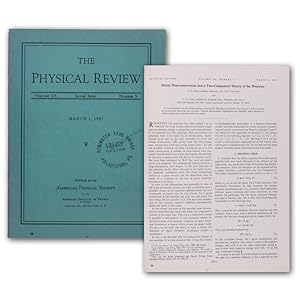
Parity Nonconservation and a Two-Component Theory of the Neutrino. SS. 1671-1675. In: The Physical Review. Vol. 105, No. 5.
Sprache: Englisch
Verlag: Lancaster American Physical Society, 1957
Anbieter: Antiquariat Gerhard Gruber, Heilbronn, Deutschland
Verkäuferbewertung 4 von 5 Sternen

Erstausgabe
(26,5 x 20 cm). SS. 1421-1682. Mit zahlreichen Abbildungen. Original-Broschur. Erste Ausgabe dieser bedeutenden Arbeit. - Lee und Yang sagen die Möglichkeit der Paritätsverletzung bei schwacher Wechselwirkung vorher, die später von Wu experimentell bestätigt wird. "Für ihre Forschungen über die Gesetze der Parität, die zu wichtigen Entdeckungen über die Elementarteilchen führt" werden die beiden Forscher 1957 mit dem Nobelpreis für Physik ausgezeichnet. - Stempel auf Einband, sonst sauber und gut erhalten.
-

Some Considerations on Global Symmetry. SS. 1954-1961. In: The Physical Review. Vol. 122, No. 4-6.
Sprache: Englisch
Verlag: Lancaster American Physical Society, 1961
Anbieter: Antiquariat Gerhard Gruber, Heilbronn, Deutschland
Verkäuferbewertung 4 von 5 Sternen
Erstausgabe
(26,5 x 19,5 cm). SS. 1007-1982. Mit Abbildungen. Halbleinwandband der Zeit. Erste Ausgabe. - "Für ihre Forschungen über die Gesetze der Parität, die zu wichtigen Entdeckungen über die Elementarteilchen führt" werden Lee und Yang 1957 mit dem Nobelpreis für Physik ausgezeichnet. - Stempel auf Vorsatz, sonst sauber und gut erhalten.
-

Question of Parity Conservation in Weak Interactions. SS. 254-258. In: The Physical Review. Vol. 104.
Sprache: Englisch
Verlag: Lancaster, 1956
Anbieter: Antiquariat Gerhard Gruber, Heilbronn, Deutschland
Verkäuferbewertung 4 von 5 Sternen
Erstausgabe
(26 x 20 cm). (2) 856 S. Mit Abbildungen. Halbleinwandband der Zeit. Erste Ausgabe dieser hochbedeutenden Arbeit über die Möglichkeit der Paritätsverletzung bei schwachen Wechselwirkungen. Die beiden Wissenschaftler bekamen dafür 1957 den Nobelpreis für Physik. - Die physikalischen Gesetze beruhen auf den Symmetrieeigenschaften von Raum und Zeit. In der Quantenmechanik führt die Spiegelsymmetrie zum Paritätserhaltungssatz. Im Jahr 1956 standen die Elementarteilchenphysiker vor dem sogenannten Theta-Tau-Puzzle, bei dem zwei Mesonen mit gleicher Masse und Lebenszeit auf verschiedene Weise zerfallen. Diese Beobachtung widersprach dem Paritätserhaltungssatz. Lee und Yang gelang die Lösung durch die Postulierung, dass bei schwachen Wechselwirkungen die Paritätserhaltung nicht gelte. - Stempel auf Vorsatz. Erstes und letztes Blatt leicht gebräunt. Einband leicht restauriert, sonst sauber und gut erhalten.
-
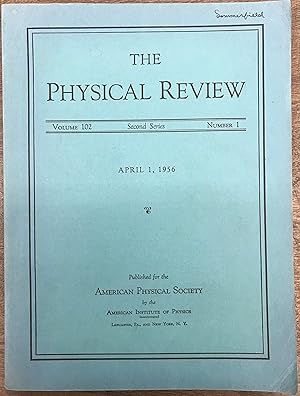
The Physical Review. Second Series. Volume 102, Number 1. April 1, 1956 (Includes "Mass Degeneracy of the Heavy Mesons")
Verlag: The American Physical Society / American Institute of Physics, 1956
Anbieter: Zubal-Books, Since 1961, Cleveland, OH, USA
Verkäuferbewertung 5 von 5 Sternen

Zustand: Very Good. 298 pp., softcover, previous owner's name to upper corner of front cover, faint wear to spine edges else text clean & binding tight. - If you are reading this, this item is actually (physically) in our stock and ready for shipment once ordered. We are not bookjackers. Buyer is responsible for any additional duties, taxes, or fees required by recipient's country.
-
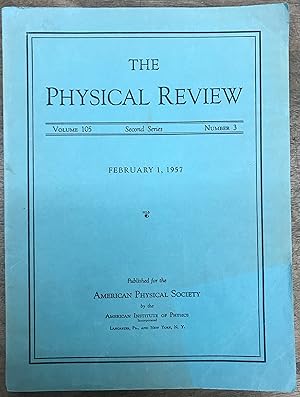
The Physical Review. Second Series. Volume 105, Number 3. February 1, 1957 (Includes "Many-Body Problem in Quantum Mechanics and Quantum Statistical Mechanics")
Verlag: The American Physical Society / American Institute of Physics, 1957
Anbieter: Zubal-Books, Since 1961, Cleveland, OH, USA
Verkäuferbewertung 5 von 5 Sternen
Zustand: Very Good. 364 pp., softcover, faint wear to spine and cover edges else text clean & binding tight. - If you are reading this, this item is actually (physically) in our stock and ready for shipment once ordered. We are not bookjackers. Buyer is responsible for any additional duties, taxes, or fees required by recipient's country. Photos available upon request.
-
CONSERVATION OF HEAVY PARTICLES AND GENERALIZED GAUGE TRANSFORMATIONS - article in one complete issue of THE PHYSICAL REVIEW, June 1, 1955
Erscheinungsdatum: 1955
Anbieter: Xerxes Fine and Rare Books and Documents, Glen Head, NY, USA
Verkäuferbewertung 5 von 5 Sternen
Erstausgabe
Zustand: VG. Lancaster, PA 1955 first edition. American Physical Society. Original green printed 4to wraps. Lee and Yang article p. 1501. Issue paginated 1213-1569. VG , almost no wear at all; owner name stamp (A. Oppenheim) on front cover; text clean and binding secure. Lee and Yang were awarded the Nobel prize in 1957 for their work on parity.
-
MANY-BODY PROBLEM IN QUANTUM STATISTICAL MECHANICS. I - GENERAL FORMULATION - article in one complete issue of THE PHYSICAL REVIEW, March 1, 1959
Erscheinungsdatum: 1959
Anbieter: Xerxes Fine and Rare Books and Documents, Glen Head, NY, USA
Verkäuferbewertung 5 von 5 Sternen
Erstausgabe
Zustand: VG. Lancaster, PA 1959 first edition. original bluegreen 4to wraps. volume 113, second series, number 5. The first presentation of the Lee Yang "Many Body Problem" appears on pp. 1165-77. Complete issue paginated 1163-1378. VG, just slight wear; no owner marks; text clean and binding secure. Pictures available on request.
-
PARITY NONCONSERVATION AND A TWO-COMPONENT THEORY OF THE NEUTRINO - article in one complete issue of THE PHYSICAL REVIEW, MARCH 1 1957
Erscheinungsdatum: 1957
Anbieter: Xerxes Fine and Rare Books and Documents, Glen Head, NY, USA
Verkäuferbewertung 5 von 5 Sternen
Erstausgabe
Zustand: VG. Lancaster, PA 1957 first edition. American Physical Society. Original green printed 4to wraps. Lee and Yang article on pp. 1671-1675. Issue paginated 1421 to 1682. VG faint owner name stamp (A. Oppenheim) on front cover. Text clean; binding secure; no cover wear. Lee and Yang were awarded the Nobel prize in 1957 for their work on parity.
-
![Bild des Verkäufers für Question of Parity Conservation in Weak Interactions. - [FOUNDATIONAL THEORY OF THE UNIVERSAL FORCES OF NATURE] zum Verkauf von Herman H. J. Lynge & Søn ILAB-ABF](https://pictures.abebooks.com/inventory/md/md4577053080.jpg)
Question of Parity Conservation in Weak Interactions. - [FOUNDATIONAL THEORY OF THE UNIVERSAL FORCES OF NATURE]
Anbieter: Herman H. J. Lynge & Søn ILAB-ABF, Copenhagen, Dänemark
Verkäuferbewertung 4 von 5 Sternen
Erstausgabe
Lancaster, American Institute of Physics, 1956. Lex8vo. Volume 104, October 1, No. 1, 1956 of "The Physical Review", Second Series. Entire volume offered. In the original printed blue wrappers. Minor bumpings to extremities and two small tears to bottom and right side of front wrapper. Otherwise a fine and clean copy. Pp. 254-58. [Entire issue: (2), 272 pp.]. First printing of Yang and Lee's seminal and topic-creating paper which proved that parity is not conserved in weak interactions. "The discovery of parity nonconservation contributed to a general change in the intellectual climate of fundamental physics, leading to a tendency to question the absolute validity of other conservation laws as well." (Kragh, Quantum Generations, pp. 318-9). Before 1956, the general belief was that parity conservation is never violated in nature, a firm paradigm that was not challenged until the publication of the present paper. Chen Ning Yang and Tsung-Dao Lee were awarded the 1957 Nobel Prize in Physics "for their penetrating investigation of the so-called parity laws which has led to important discoveries regarding the elementary particles". Lee is the youngest Nobel laureate after WWII. It had earlier been suggested that parity might not be conserved but noone had been able to put forth compelling evidence. A careful review by Lee and Yang went further, showing that while parity conservation had been verified in decays by the strong or electromagnetic interactions, it was untested in the weak interaction. They proposed several possible direct experimental tests.When Lee and Yang's paper appeared in 1956, physicists were not immediately swept away by their ground breaking conclusions. The physicist Freeman Dyson wrote of his reaction to the paper: "A copy of it was sent to me and I read it. I read it twice. I said, `This is very interesting,' or words to that effect. But I had not the imagination to say, `By golly, if this is true it opens up a whole new branch of physics.' And I think other physicists, with very few exceptions, at that time were as unimaginative as I." Wolfgang Pauli wrote to Weisskopf after reading the paper: "Now after the first shock is over, I begin to collect myself. Yes, it was very dramatic. I am shocked not so much by the fact that the Lord prefers the left hand as by the fact that He still appears to be left-right symmetric when he expresses Himself strongly." (Kragh, Quantum Generations, pp. 319).The presented theory paved the way for a reconsideration of physical theories and led to new, far-reaching discoveries regarding the nature of matter and the universe. The removal of the restrictions imposed by parity law brought order to the theoretical chaos that existed with regard to subatomic particles elementary particles seen in cosmic rays and particle accelerator experiments were understood to be manifestations of the strong and weak nuclear interactions. Eventually the better understanding of their characteristics has led to a more unified theory of the fundamental universal forces of nature.
-
Question of Parity Conservation in Weak Interactions. - [FOUNDATIONAL THEORY OF THE UNIVERSAL FORCES OF NATURE]
Anbieter: Herman H. J. Lynge & Søn ILAB-ABF, Copenhagen, Dänemark
Verkäuferbewertung 4 von 5 Sternen
Erstausgabe
Lancaster, American Institute of Physics, 1956. Lex8vo. Volume 104, October 1, No. 1, 1956 of "The Physical Review", Second Series. Entire volume offered. In the original printed blue wrappers. Minor bumping and sunning to extremities, otherwise a fine and clean copy. Pp. 254-58. [Entire issue: Pp. (2), 272 pp.]. First printing of Yang and Lee's seminal and topic-creating paper which proved that parity is not conserved in weak interactions. "The discovery of parity nonconservation contributed to a general change in the intellectual climate of fundamental physics, leading to a tendency to question the absolute validity of other conservation laws as well." (Kragh, Quantum Generations, pp. 318-9). Before 1956, the general belief was that parity conservation is never violated in nature, a firm paradigm that was not challenged until the publication of the present paper. Chen Ning Yang and Tsung-Dao Lee were awarded the 1957 Nobel Prize in Physics "for their penetrating investigation of the so-called parity laws which has led to important discoveries regarding the elementary particles". Lee is the youngest Nobel laureate after WWII. It had earlier been suggested that parity might not be conserved but noone had been able to put forth compelling evidence. A careful review by Lee and Yang went further, showing that while parity conservation had been verified in decays by the strong or electromagnetic interactions, it was untested in the weak interaction. They proposed several possible direct experimental tests.When Lee and Yang's paper appeared in 1956, physicists were not immediately swept away by their ground breaking conclusions. The physicist Freeman Dyson wrote of his reaction to the paper: "A copy of it was sent to me and I read it. I read it twice. I said, `This is very interesting,' or words to that effect. But I had not the imagination to say, `By golly, if this is true it opens up a whole new branch of physics.' And I think other physicists, with very few exceptions, at that time were as unimaginative as I." Wolfgang Pauli wrote to Weisskopf after reading the paper: "Now after the first shock is over, I begin to collect myself. Yes, it was very dramatic. I am shocked not so much by the fact that the Lord prefers the left hand as by the fact that He still appears to be left-right symmetric when he expresses Himself strongly." (Kragh, Quantum Generations, pp. 319).The presented theory paved the way for a reconsideration of physical theories and led to new, far-reaching discoveries regarding the nature of matter and the universe. The removal of the restrictions imposed by parity law brought order to the theoretical chaos that existed with regard to subatomic particles elementary particles seen in cosmic rays and particle accelerator experiments were understood to be manifestations of the strong and weak nuclear interactions. Eventually the better understanding of their characteristics has led to a more unified theory of the fundamental universal forces of nature.


![Bild des Verkäufers für Question of Parity Conservation in Weak Interactions. - [FOUNDATIONAL THEORY OF THE UNIVERSAL FORCES OF NATURE] zum Verkauf von Herman H. J. Lynge & Søn ILAB-ABF](https://pictures.abebooks.com/inventory/md/md4225279210.jpg)