

Gesamtpreis (1 Artikel Artikel):
Versandziel:

leclerc a g (7 Ergebnisse)
Direkt zu den wichtigsten Suchergebnissen
Suchfilter
Produktart
- Alle Product Types
- Bücher (7)
- Magazine & Zeitschriften (Keine weiteren Ergebnisse entsprechen dieser Verfeinerung)
- Comics (Keine weiteren Ergebnisse entsprechen dieser Verfeinerung)
- Noten (Keine weiteren Ergebnisse entsprechen dieser Verfeinerung)
- Kunst, Grafik & Poster (Keine weiteren Ergebnisse entsprechen dieser Verfeinerung)
- Fotografien (Keine weiteren Ergebnisse entsprechen dieser Verfeinerung)
- Karten (Keine weiteren Ergebnisse entsprechen dieser Verfeinerung)
- Manuskripte & Papierantiquitäten (Keine weiteren Ergebnisse entsprechen dieser Verfeinerung)
Zustand Mehr dazu
- Neu (Keine weiteren Ergebnisse entsprechen dieser Verfeinerung)
- Wie Neu, Sehr Gut oder Gut Bis Sehr Gut (2)
- Gut oder Befriedigend (2)
- Ausreichend oder Schlecht (Keine weiteren Ergebnisse entsprechen dieser Verfeinerung)
- Wie beschrieben (3)
Einband
Weitere Eigenschaften
- Erstausgabe (Keine weiteren Ergebnisse entsprechen dieser Verfeinerung)
- Signiert (Keine weiteren Ergebnisse entsprechen dieser Verfeinerung)
- Schutzumschlag (Keine weiteren Ergebnisse entsprechen dieser Verfeinerung)
- Angebotsfoto (3)
Sprache (4)
Gratisversand
Land des Verkäufers
Verkäuferbewertung
-

Paperback. Zustand: Very Good. It's a well-cared-for item that has seen limited use. The item may show minor signs of wear. All the text is legible, with all pages included. It may have slight markings and/or highlighting.
-
![Beispielbild für Portrait de Monsieur Guitton. Une vi dans le sià cle [Paperback] Leclerc, Gà rard zum Verkauf von Hubert Colau](https://pictures.abebooks.com/isbn/9782841001774-de-300.jpg)
Portrait de Monsieur Guitton. Une vi dans le sià cle [Paperback] Leclerc, Gà rard
Anbieter: Hubert Colau, LA BAZOCHE GOUET, Frankreich
Verkäuferbewertung 3 von 5 Sternen

Zustand: 1. broche.
-
Portrait de Monsieur Guitton. Une vi dans le sià cle [Paperback] Leclerc, Gà rard
Anbieter: Hubert Colau, LA BAZOCHE GOUET, Frankreich
Verkäuferbewertung 3 von 5 Sternen
Zustand: 2. Couverture là gà rement cornà e, nom inscrit sur la premià re page.
-
Portrait de Monsieur Guitton. Une vi dans le sià cle [Paperback] Leclerc, Gà rard
Anbieter: Hubert Colau, LA BAZOCHE GOUET, Frankreich
Verkäuferbewertung 3 von 5 Sternen
Zustand: 2.
-
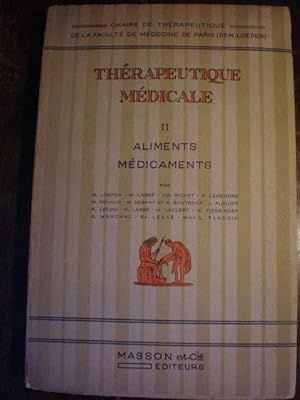
Thérapeutique Médicale II. Aliments Médicaments
Sprache: Spanisch
Verlag: Masson et Cie Editeurs, Paris, 1930
Anbieter: Librería Antonio Azorín, San Lorenzo de El Escorial, M, Spanien
Verkäuferbewertung 5 von 5 Sternen

Encuadernación de tapa blanda. Zustand: Muy bien. Idioma francés. Ejemplar en muy buen estado. 330 pp.
-

RICHARD ou LE DEVELOPPEMENT A LA FAMILLE DES STUARTS
Verlag: PORNIN R. ET CIE, 1846
Couverture rigide. Zustand: bon. R320108930: 1846. In-16. Cartonné. Etat d'usage, Couv. défraîchie, Dos abîmé, Intérieur frais. 284 pages 2 Tampons sur la page de titre - Traces legeres de mouillure en toute fin de volume, sans conséquence réelle sur la lecture. Coins et dos frottés. . . . Classification Dewey : 840.08-XIX ème siècle.
-
Histoire Naturelle de Buffon, classée par ordres, genres et espèces, d'après le systême de Linné; Avec les Caractères Génériques et la nomenclature Linnéenne; Par René-Richard Castel, auteur du poëme des Plantes (80 volumes)
Verlag: De L'Imprimerie de Crapelet, Paris, 1803
Anbieter: Ken Sanders Rare Books, ABAA, Salt Lake City, UT, USA
Verbandsmitglied: ABAA ILAB IOBA RMABA
Verkäuferbewertung 5 von 5 Sternen
Leather Bound. Zustand: Very Good. Nouvelle Édition. Twenty-fourmo [13.5 cm] Contemporary 3/4 brown leather with speckled paper over boards. Pale red and green gilt stamped leather spine labels. Six gilt ruled compartments on the spines. Illustrated plates, the majority with tissue-guards. This specific set has a frontispiece portrait of Buffon, 781 illustrated plates, and 5 folding tables (the exact number of plates found in each volume is available upon request). Text in French. Extremities very lightly rubbed and soiled. A couple of boards with small red stains. Spines sporadically mottled. Occasional minor chipping to spine ends, and a handful of spine labels with loss. Underlying boards peeking through at corners. Endpapers have a previous owner's red ink stamp(s), a small, faint ink stamp in black, and minute contemporary numerical notations. Stitching visible in gutters here and there. Pp. 125-130 (volume 12) are partially detached. Pp. 29-32 (volume 44) and pp. 93-96 (volume 77) are completely detached, but present. Skillful repair to fore-edge margin of p. 169 (volume 59). Pages bound out of sequence in volume 59 (between p. 136 and p. 185). Periodic printing errors occur in the set's pagination. In a handful of plates, the sky in the background appears stained, and there is a bit of red staining to plate at p. 258 in volume 70. Two reptile illustrations in volume 42 are a trifle trimmed at the head. Additional Collation Notes: Curiously, volumes 56-65 are the only volumes in which the plates are numbered. In volume 58, I believe plate 15 is mislabeled as 13, and it is found between plates 23 and 24. The books are very structurally sound, and the pages are strikingly clean and bright. Contents: Théorie de la Terre. Époques de la Nature; Discours Généraux; Quadrupèdes; Oiseaux; Histoire Naturelle des Minéraux; Histoire Naturelle des Poissons; Histoire Naturelle des Reptiles; Histoire Naturelle des Insectes; Histoire Naturelle des Coquilles; Histoire Naturelle des Vers; Histoire Naturelle des Crustacés; Histoire Naturelle des Végétaux. An edition, published posthumously, of Buffon's most famous work. Buffon's Histoire Naturelle was continued in part by others after his death. It was translated into various languages and read throughout Europe. French naturalist George-Louis Leclerc de Buffon (1707-1788), Comte de Buffon, is viewed as the most influential biologist of the 18th century, epitomizing the revolutionary changes the Enlightenment brought to the study of nature. The title of Count was bestowed on him by Louis XV in recognition of his accomplishments, rather than by birth. He is most famous for Histoire Naturelle, a comprehensive work on natural history first begun in 1749. De Buffon began his studies at the College of Godrans in Dijon, where he was only an average student. Originally, his father wanted him to have a legal career, however, in 1728, he went to Angers, where he studied medicine, botany, and mathematics. In 1739, he was appointed keeper of the Jardin du Roi (the royal botanical garden, now the Jardin des Plantes) and of the accompanying museum. There, he was tasked with creating a catalog of the royal collections in natural history, which he transformed into an undertaking to produce a record of the whole of nature. This became his monumental work, Histoire Naturelle, Générale et Particulière, which was the first modern effort to methodically present all existing knowledge in the subjects of natural history, geology, and anthropology in one publication. Buffon's ideas challenged traditional biological classification and introduced theories of evolutionary thought roughly one hundred years before Darwin. Comte de Buffon is also remembered for his argument that the world had a lengthy history, rather than being only a few thousand years old, as the naturalists of the 1600s believed. In addition, he felt that scientific writing should be energetic and graceful in style, thereby allowing his work to be accessible to a wide audience in Europe and beyond. Buffon's work articulated that species were different throughout the world, that the planet was much older than the Bible suggested, and that plant and animal species were related in intricate ways. Buffon's bold way of looking at the world laid the groundwork for later revolutionary thinkers who are responsible for much of what we know about the natural world. An attractive set of a pivotal work of the Enlightenment, richly illustrated with numerous hand-colored plates.


