Gesamtpreis (1 Artikel Artikel):
Versandziel:

leaf philip (10 Ergebnisse)
Direkt zu den wichtigsten Suchergebnissen
Suchfilter
Produktart
- Alle Product Types
- Bücher (10)
- Magazine & Zeitschriften (Keine weiteren Ergebnisse entsprechen dieser Verfeinerung)
- Comics (Keine weiteren Ergebnisse entsprechen dieser Verfeinerung)
- Noten (Keine weiteren Ergebnisse entsprechen dieser Verfeinerung)
- Kunst, Grafik & Poster (Keine weiteren Ergebnisse entsprechen dieser Verfeinerung)
- Fotografien (Keine weiteren Ergebnisse entsprechen dieser Verfeinerung)
- Karten (Keine weiteren Ergebnisse entsprechen dieser Verfeinerung)
- Manuskripte & Papierantiquitäten (Keine weiteren Ergebnisse entsprechen dieser Verfeinerung)
Zustand Mehr dazu
- Neu (2)
- Wie Neu, Sehr Gut oder Gut Bis Sehr Gut (Keine weiteren Ergebnisse entsprechen dieser Verfeinerung)
- Gut oder Befriedigend (Keine weiteren Ergebnisse entsprechen dieser Verfeinerung)
- Ausreichend oder Schlecht (Keine weiteren Ergebnisse entsprechen dieser Verfeinerung)
- Wie beschrieben (8)
Einband
- alle Einbände
- Hardcover (2)
- Softcover (Keine weiteren Ergebnisse entsprechen dieser Verfeinerung)
Weitere Eigenschaften
- Erstausgabe (Keine weiteren Ergebnisse entsprechen dieser Verfeinerung)
- Signiert (Keine weiteren Ergebnisse entsprechen dieser Verfeinerung)
- Schutzumschlag (Keine weiteren Ergebnisse entsprechen dieser Verfeinerung)
- Angebotsfoto (8)
Sprache (2)
Preis
- Beliebiger Preis
- Weniger als EUR 20 (Keine weiteren Ergebnisse entsprechen dieser Verfeinerung)
- EUR 20 bis EUR 45 (Keine weiteren Ergebnisse entsprechen dieser Verfeinerung)
- Mehr als EUR 45
Gratisversand
- Kostenloser Versand nach USA (Keine weiteren Ergebnisse entsprechen dieser Verfeinerung)
Land des Verkäufers
Verkäuferbewertung
-

Research in Community and Mental Health: Theoretical Positions Vol 4 (Advances in the Study of Entrepreneurship, Innovation and Economic Growth)
Sprache: Englisch
Verlag: Emerald Publishing Limited, 1995
ISBN 10: 1559381914 ISBN 13: 9781559381918
Anbieter: Ria Christie Collections, Uxbridge, Vereinigtes Königreich
Verkäuferbewertung 5 von 5 Sternen

EUR 123,91
EUR 13,89 Versand
Versand von Vereinigtes Königreich nach USAAnzahl: Mehr als 20 verfügbar
In den WarenkorbZustand: New. In.
-
Research in Community and Mental Health: Theoretical Positions Vol 4 (Advances in the Study of Entrepreneurship, Innovation and Economic Growth)
Sprache: Englisch
Verlag: Emerald Group Publishing Limited, 1991
ISBN 10: 1559381914 ISBN 13: 9781559381918
Anbieter: Revaluation Books, Exeter, Vereinigtes Königreich
Verkäuferbewertung 5 von 5 Sternen
EUR 194,53
EUR 11,59 Versand
Versand von Vereinigtes Königreich nach USAAnzahl: 2 verfügbar
In den WarenkorbHardcover. Zustand: Brand New. 260 pages. 9.75x6.75x1.00 inches. In Stock.
-

LETTERS FROM THE 15TH CENTURY: ON THE ORIGINS OF THE KELMSCOTT CHAUCER TYPEFACE. A STUDY, WITH SPECIMEN LEAVES, OF THE INFLUENCE OF THE EARLY GERMAN PRINTERS ON WILLIAM MORRIS' MASTERPIECE
Verlag: Phillip J. Pirages, McMinnville, Oregon, 2019
Anbieter: Phillip J. Pirages Rare Books (ABAA), McMinnville, OR, USA
Verkäuferbewertung 3 von 5 Sternen

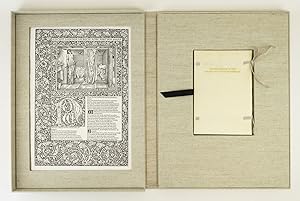
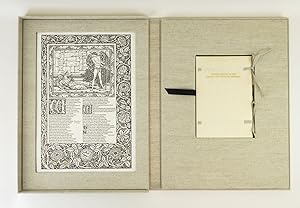
Text: 244 x 154 mm. (9 1/8 x 6 1/8"); Case: 502 x 372 mm. (19 3/4 x 14 5/8"). ii, 75 pp. Bound in flexible vellum with ties (inspired by Kelmscott Press bindings) by Amy Borezo, who also constructed the case holding the volume and leaves. The book printed letterpress on Zerkall Book Laid Vellum paper by Arthur Larson at Horton Tank Graphics. Book layout by Jill Mann. EACH COPY WITH FIVE LEAVES: ONE FROM THE KELMSCOTT CHAUCER WITH woodcut borders, woodcut beginning word, and A WOODCUT SCENE DESIGNED BY EDWARD BURNE-JONES, AND ONE EACH FROM THE PRESSES OF FOUR GERMAN PRINTERS FROM THE 1470s--PETER SCHOEFFER, JOHANN MENTELIN, G?NTHER ZAINER, AND ANTON KOBERGER, the Zainer leaf featuring at least one woodcut initial. The incunabular leaves consistently excellent, with only minor defects, and the Kelmscott leaves (which were never part of a bound volume) in entirely fine condition. This is a unique leaf book in the way that it combines three elements: a significant private press production involving people at the top of their craft, a scholarly commentary that contributes to a further understanding of the history of printing, and--most important--five leaves: one from the Kelmscott Press "Works" of Geoffrey Chaucer and four from books issued by German printers at work in the 1470s. The book has been printed and bound by hand by gifted professionals; the essay addresses a topic of significance to typophiles in a considerably more thoroughgoing way than has been done before; and the assemblage of leaves represents a powerful visual reinforcement of the text, as well as an opportunity to share in the ownership of four important incunabula, along with the extraordinary Kelmscott Chaucer. The story of the production is heavy on serendipity: in the winter of 2012, after purchasing a very incomplete copy of the Kelmscott Chaucer at auction, we considered the possibility of producing a leaf book, but because the Chaucer--universally considered to be one of the most beautiful books ever printed--had been written about by so many different people in so many different ways, we didn't know what aspect was left for us to explore. The one topic we fastened on as thus far inadequately examined is the origin of the work's typeface. We soon learned that Morris, who is known to have owned more than 500 incunables, most admired--and was, consequently, most likely to have been influenced in his typographic design by--Peter Schoeffer of Mainz, Johann Mentelin of Strassburg, G?nther Zainer of Augsburg, and Anton Koberger of Nuremberg. Over the course of the years succeeding the purchase of the defective Chaucer, we were fortunate beyond all expectation to acquire incomplete books from each of these four eminent printers. As a result, the present leaf book will allow the reader not only to read in the accompanying essay about the influence on Morris of his typographic forebears, but also to compare with his or her own eyes the resemblances between the Kelmscott leaf and the leaves from four centuries earlier. The essay comes in one of three bindings (which reflect the degree of decorative elaboration on the accompanying Kelmscott leaf): linen-backed paper boards in imitation of the small format Kelmscott publications (with a leaf containing text and small initials); floral patterned cloth after a Morris design (with a leaf containing multiple six-line initials); or, in the most deluxe version, as here, in flexible vellum with ties (with a leaf featuring a full woodcut frame, one or more prominent woodcut initials, and a very large and striking Edward Burne-Jones woodcut scene). No. VII OF 47 COPIES (numbered I-XLVII) bound in flexible vellum from a total edition of 165 COPIES. Text: 244 x 154 mm. (9 1/8 x 6 1/8"); Case: 502 x 372 mm. (19 3/4 x 14 5/8").
-
LETTERS FROM THE 15TH CENTURY: ON THE ORIGINS OF THE KELMSCOTT CHAUCER TYPEFACE. A STUDY, WITH SPECIMEN LEAVES, OF THE INFLUENCE OF THE EARLY GERMAN PRINTERS ON WILLIAM MORRIS' MASTERPIECE
Verlag: Phillip J. Pirages, McMinnville, Oregon, 2019
Anbieter: Phillip J. Pirages Rare Books (ABAA), McMinnville, OR, USA
Verkäuferbewertung 3 von 5 Sternen
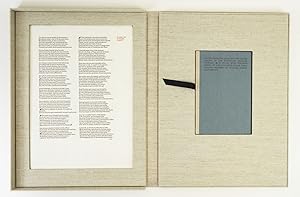
Text: 244 x 154 mm. (9 1/8 x 6 1/8"); Case: 502 x 372 mm. (19 3/4 x 14 5/8"). ii, 75 pp. Bound in linen-backed blue paper boards (inspired by Kelmscott Press bindings) by Amy Borezo, who also constructed the case holding the volume and leaves. The book printed letterpress on Zerkall Book Laid Vellum paper by Arthur Larson at Horton Tank Graphics. Book layout by Jill Mann. EACH COPY WITH FIVE LEAVES: ONE FROM THE KELMSCOTT CHAUCER with multiple 3-line initials AND ONE EACH FROM THE PRESSES OF FOUR GERMAN PRINTERS FROM THE 1470s--PETER SCHOEFFER, JOHANN MENTELIN, GÜNTHER ZAINER, AND ANTON KOBERGER. The incunabular leaves consistently excellent, with only minor defects, and the Kelmscott leaves (which were never part of a bound volume) in entirely fine condition. This is a unique leaf book in the way that it combines three elements: a significant private press production involving people at the top of their craft, a scholarly commentary that contributes to a further understanding of the history of printing, and--most important--five leaves: one from the Kelmscott Press "Works" of Geoffrey Chaucer and four from books issued by German printers at work in the 1470s. The book has been printed and bound by hand by gifted professionals; the essay addresses a topic of significance to typophiles in a considerably more thoroughgoing way than has been done before; and the assemblage of leaves represents a powerful visual reinforcement of the text, as well as an opportunity to share in the ownership of four important incunabula, along with the extraordinary Kelmscott Chaucer. The story of the production is heavy on serendipity: in the winter of 2012, after purchasing a very incomplete copy of the Kelmscott Chaucer at auction, we considered the possibility of producing a leaf book, but because the Chaucer--universally considered to be one of the most beautiful books ever printed--had been written about by so many different people in so many different ways, we didn't know what aspect was left for us to explore. The one topic we fastened on as thus far inadequately examined is the origin of the work's typeface. We soon learned that Morris, who is known to have owned more than 500 incunables, most admired--and was, consequently, most likely to have been influenced in his typographic design by--Peter Schoeffer of Mainz, Johann Mentelin of Strassburg, Günther Zainer of Augsburg, and Anton Koberger of Nuremberg. Over the course of the years succeeding the purchase of the defective Chaucer, we were fortunate beyond all expectation to acquire incomplete books from each of these four eminent printers. As a result, the present leaf book will allow the reader not only to read in the accompanying essay about the influence on Morris of his typographic forebears, but also to compare with his or her own eyes the resemblances between the Kelmscott leaf and the leaves from four centuries earlier. ONE OF 32 COPIES in linen-backed blue paper boards from a total edition of 165 COPIES.
-
LETTERS FROM THE 15TH CENTURY: ON THE ORIGINS OF THE KELMSCOTT CHAUCER TYPEFACE. A STUDY, WITH SPECIMEN LEAVES, OF THE INFLUENCE OF THE EARLY GERMAN PRINTERS ON WILLIAM MORRIS' MASTERPIECE
Verlag: Phillip J. Pirages, McMinnville, Oregon, 2019
Anbieter: Phillip J. Pirages Rare Books (ABAA), McMinnville, OR, USA
Verkäuferbewertung 3 von 5 Sternen
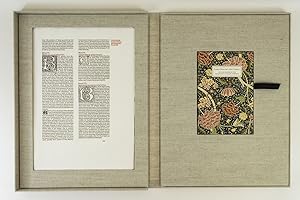
Text: 244 x 154 mm. (9 1/8 x 6 1/8"); Case: 502 x 372 mm. (19 3/4 x 14 5/8"). ii, 75 pp. Bound in floral-patterned cloth after a Morris design by Amy Borezo, who also constructed the case holding the volume and leaves. The book printed letterpress on Zerkall Book Laid Vellum paper by Arthur Larson at Horton Tank Graphics. Book layout by Jill Mann. EACH COPY WITH FIVE LEAVES: ONE FROM THE KELMSCOTT CHAUCER with six- and three-line initials AND ONE EACH FROM THE PRESSES OF FOUR GERMAN PRINTERS FROM THE 1470s--PETER SCHOEFFER, JOHANN MENTELIN, GÜNTHER ZAINER, AND ANTON KOBERGER. The incunabular leaves consistently excellent, with only minor defects, and the Kelmscott leaves (which were never part of a bound volume) in entirely fine condition. This is a unique leaf book in the way that it combines three elements: a significant private press production involving people at the top of their craft, a scholarly commentary that contributes to a further understanding of the history of printing, and--most important--five leaves: one from the Kelmscott Press "Works" of Geoffrey Chaucer and four from books issued by German printers at work in the 1470s. The book has been printed and bound by hand by gifted professionals; the essay addresses a topic of significance to typophiles in a considerably more thoroughgoing way than has been done before; and the assemblage of leaves represents a powerful visual reinforcement of the text, as well as an opportunity to share in the ownership of four important incunabula, along with the extraordinary Kelmscott Chaucer. The story of the production is heavy on serendipity: in the winter of 2012, after purchasing a very incomplete copy of the Kelmscott Chaucer at auction, we considered the possibility of producing a leaf book, but because the Chaucer--universally considered to be one of the most beautiful books ever printed--had been written about by so many different people in so many different ways, we didn't know what aspect was left for us to explore. The one topic we fastened on as thus far inadequately examined is the origin of the work's typeface. We soon learned that Morris, who is known to have owned more than 500 incunables, most admired--and was, consequently, most likely to have been influenced in his typographic design by--Peter Schoeffer of Mainz, Johann Mentelin of Strassburg, Günther Zainer of Augsburg, and Anton Koberger of Nuremberg. Over the course of the years succeeding the purchase of the defective Chaucer, we were fortunate beyond all expectation to acquire incomplete books from each of these four eminent printers. As a result, the present leaf book will allow the reader not only to read in the accompanying essay about the influence on Morris of his typographic forebears, but also to compare with his or her own eyes the resemblances between the Kelmscott leaf and the leaves from four centuries earlier. ONE OF 84 COPIES in floral-patterned cloth from a total edition of 165 COPIES.
-
LETTERS FROM THE 15TH CENTURY: ON THE ORIGINS OF THE KELMSCOTT CHAUCER TYPEFACE. A STUDY, WITH SPECIMEN LEAVES, OF THE INFLUENCE OF THE EARLY GERMAN PRINTERS ON WILLIAM MORRIS' MASTERPIECE
Verlag: Phillip J. Pirages, McMinnville, Oregon, 2019
Anbieter: Phillip J. Pirages Rare Books (ABAA), McMinnville, OR, USA
Verkäuferbewertung 3 von 5 Sternen
Text: 244 x 154 mm. (9 1/8 x 6 1/8"); Case: 502 x 372 mm. (19 3/4 x 14 5/8"). ii, 75 pp. Bound in floral-patterned cloth after a Morris design by Amy Borezo, who also constructed the case holding the volume and leaves. The book printed letterpress on Zerkall Book Laid Vellum paper by Arthur Larson at Horton Tank Graphics. Book layout by Jill Mann. EACH COPY WITH FIVE LEAVES: ONE FROM THE KELMSCOTT CHAUCER with multiple six-line initials AND ONE EACH FROM THE PRESSES OF FOUR GERMAN PRINTERS FROM THE 1470s--PETER SCHOEFFER, JOHANN MENTELIN, GÜNTHER ZAINER, AND ANTON KOBERGER. ?The incunabular leaves consistently excellent, with only minor defects, and the Kelmscott leaves (which were never part of a bound volume) in entirely fine condition. This is a unique leaf book in the way that it combines three elements: a significant private press production involving people at the top of their craft, a scholarly commentary that contributes to a further understanding of the history of printing, and--most important--five leaves: one from the Kelmscott Press "Works" of Geoffrey Chaucer and four from books issued by German printers at work in the 1470s. The book has been printed and bound by hand by gifted professionals; the essay addresses a topic of significance to typophiles in a considerably more thoroughgoing way than has been done before; and the assemblage of leaves represents a powerful visual reinforcement of the text, as well as an opportunity to share in the ownership of four important incunabula, along with the extraordinary Kelmscott Chaucer. The story of the production is heavy on serendipity: in the winter of 2012, after purchasing a very incomplete copy of the Kelmscott Chaucer at auction, we considered the possibility of producing a leaf book, but because the Chaucer--universally considered to be one of the most beautiful books ever printed--had been written about by so many different people in so many different ways, we didn't know what aspect was left for us to explore. The one topic we fastened on as thus far inadequately examined is the origin of the work's typeface. We soon learned that Morris, who is known to have owned more than 500 incunables, most admired--and was, consequently, most likely to have been influenced in his typographic design by--Peter Schoeffer of Mainz, Johann Mentelin of Strassburg, Günther Zainer of Augsburg, and Anton Koberger of Nuremberg. Over the course of the years succeeding the purchase of the defective Chaucer, we were fortunate beyond all expectation to acquire incomplete books from each of these four eminent printers. As a result, the present leaf book will allow the reader not only to read in the accompanying essay about the influence on Morris of his typographic forebears, but also to compare with his or her own eyes the resemblances between the Kelmscott leaf and the leaves from four centuries earlier. ONE OF 84 COPIES in floral-patterned cloth from a total edition of 165 COPIES.
-
LETTERS FROM THE 15TH CENTURY: ON THE ORIGINS OF THE KELMSCOTT CHAUCER TYPEFACE. A STUDY, WITH SPECIMEN LEAVES, OF THE INFLUENCE OF THE EARLY GERMAN PRINTERS ON WILLIAM MORRIS' MASTERPIECE
Verlag: Phillip J. Pirages, McMinnville, Oregon, 2019
Anbieter: Phillip J. Pirages Rare Books (ABAA), McMinnville, OR, USA
Verkäuferbewertung 3 von 5 Sternen
Text: 244 x 154 mm. (9 1/8 x 6 1/8"); Case: 502 x 372 mm. (19 3/4 x 14 5/8"). ii, 75 pp. Bound in flexible vellum with ties (inspired by Kelmscott Press bindings) by Amy Borezo, who also constructed the case holding the volume and leaves. The book printed letterpress on Zerkall Book Laid Vellum paper by Arthur Larson at Horton Tank Graphics. Book layout by Jill Mann. EACH COPY WITH FIVE LEAVES: ONE FROM THE KELMSCOTT CHAUCER WITH woodcut borders, woodcut beginning word, and A WOODCUT SCENE DESIGNED BY EDWARD BURNE-JONES, AND ONE EACH FROM THE PRESSES OF FOUR GERMAN PRINTERS FROM THE 1470s--PETER SCHOEFFER, JOHANN MENTELIN, GÜNTHER ZAINER, AND ANTON KOBERGER, the Zainer leaf featuring at least one woodcut initial. âThe incunabular leaves consistently excellent, with only minor defects, and the Kelmscott leaves (which were never part of a bound volume) in entirely fine condition. This is a unique leaf book in the way that it combines three elements: a significant private press production involving people at the top of their craft, a scholarly commentary that contributes to a further understanding of the history of printing, and--most important--five leaves: one from the Kelmscott Press "Works" of Geoffrey Chaucer and four from books issued by German printers at work in the 1470s. The book has been printed and bound by hand by gifted professionals; the essay addresses a topic of significance to typophiles in a considerably more thoroughgoing way than has been done before; and the assemblage of leaves represents a powerful visual reinforcement of the text, as well as an opportunity to share in the ownership of four important incunabula, along with the extraordinary Kelmscott Chaucer. The story of the production is heavy on serendipity: in the winter of 2012, after purchasing a very incomplete copy of the Kelmscott Chaucer at auction, we considered the possibility of producing a leaf book, but because the Chaucer--universally considered to be one of the most beautiful books ever printed--had been written about by so many different people in so many different ways, we didn't know what aspect was left for us to explore. The one topic we fastened on as thus far inadequately examined is the origin of the work's typeface. We soon learned that Morris, who is known to have owned more than 500 incunables, most admired--and was, consequently, most likely to have been influenced in his typographic design by--Peter Schoeffer of Mainz, Johann Mentelin of Strassburg, Günther Zainer of Augsburg, and Anton Koberger of Nuremberg. Over the course of the years succeeding the purchase of the defective Chaucer, we were fortunate beyond all expectation to acquire incomplete books from each of these four eminent printers. As a result, the present leaf book will allow the reader not only to read in the accompanying essay about the influence on Morris of his typographic forebears, but also to compare with his or her own eyes the resemblances between the Kelmscott leaf and the leaves from four centuries earlier. ONE OF 47 COPIES (numbered I-XLVII) bound in flexible vellum from a total edition of 165 COPIES.
-
LETTERS FROM THE 15TH CENTURY: ON THE ORIGINS OF THE KELMSCOTT CHAUCER TYPEFACE. A STUDY, WITH SPECIMEN LEAVES, OF THE INFLUENCE OF THE EARLY GERMAN PRINTERS ON WILLIAM MORRIS' MASTERPIECE
Verlag: Phillip J. Pirages, McMinnville, Oregon, 2019
Anbieter: Phillip J. Pirages Rare Books (ABAA), McMinnville, OR, USA
Verkäuferbewertung 3 von 5 Sternen
Text: 244 x 154 mm. (9 1/8 x 6 1/8"); Case: 502 x 372 mm. (19 3/4 x 14 5/8"). ii, 75 pp. Bound in flexible vellum with ties (inspired by Kelmscott Press bindings) by Amy Borezo, who also constructed the case holding the volume and leaves. The book printed letterpress on Zerkall Book Laid Vellum paper by Arthur Larson at Horton Tank Graphics. Book layout by Jill Mann. EACH COPY WITH FIVE LEAVES: ONE FROM THE KELMSCOTT CHAUCER WITH woodcut borders and initials and A WOODCUT SCENE DESIGNED BY EDWARD BURNE-JONES AND ONE EACH FROM THE PRESSES OF FOUR GERMAN PRINTERS FROM THE 1470s--PETER SCHOEFFER, JOHANN MENTELIN, GÜNTHER ZAINER, AND ANTON KOBERGER. âThe incunabular leaves consistently excellent, with only minor defects, and the Kelmscott leaves (which were never part of a bound volume) in entirely fine condition. This is a unique leaf book in the way that it combines three elements: a significant private press production involving people at the top of their craft, a scholarly commentary that contributes to a further understanding of the history of printing, and--most important--five leaves: one from the Kelmscott Press "Works" of Geoffrey Chaucer and four from books issued by German printers at work in the 1470s. The book has been printed and bound by hand by gifted professionals; the essay addresses a topic of significance to typophiles in a considerably more thoroughgoing way than has been done before; and the assemblage of leaves represents a powerful visual reinforcement of the text, as well as an opportunity to share in the ownership of four important incunabula, along with the extraordinary Kelmscott Chaucer. The story of the production is heavy on serendipity: in the winter of 2012, after purchasing a very incomplete copy of the Kelmscott Chaucer at auction, we considered the possibility of producing a leaf book, but because the Chaucer--universally considered to be one of the most beautiful books ever printed--had been written about by so many different people in so many different ways, we didn't know what aspect was left for us to explore. The one topic we fastened on as thus far inadequately examined is the origin of the work's typeface. We soon learned that Morris, who is known to have owned more than 500 incunables, most admired--and was, consequently, most likely to have been influenced in his typographic design by--Peter Schoeffer of Mainz, Johann Mentelin of Strassburg, Günther Zainer of Augsburg, and Anton Koberger of Nuremberg. Over the course of the years succeeding the purchase of the defective Chaucer, we were fortunate beyond all expectation to acquire incomplete books from each of these four eminent printers. As a result, the present leaf book will allow the reader not only to read in the accompanying essay about the influence on Morris of his typographic forebears, but also to compare with his or her own eyes the resemblances between the Kelmscott leaf and the leaves from four centuries earlier. We have additional copies of this binding available at different price points. Please contact us directly for more details. ONE OF 47 COPIES (numbered I-XLVII) bound in flexible vellum from a total edition of 165 COPIES.
-
LETTERS FROM THE 15TH CENTURY: ON THE ORIGINS OF THE KELMSCOTT CHAUCER TYPEFACE. A STUDY, WITH SPECIMEN LEAVES, OF THE INFLUENCE OF THE EARLY GERMAN PRINTERS ON WILLIAM MORRIS' MASTERPIECE
Verlag: Phillip J. Pirages, McMinnville, Oregon, 2019
Anbieter: Phillip J. Pirages Rare Books (ABAA), McMinnville, OR, USA
Verkäuferbewertung 3 von 5 Sternen
EUR 2.307,94
EUR 8,62 Versand
Versand innerhalb von USAAnzahl: Mehr als 20 verfügbar
In den WarenkorbText: 244 x 154 mm. (9 1/8 x 6 1/8"); Case: 502 x 372 mm. (19 3/4 x 14 5/8"). ii, 75 pp. Bound in floral-patterned cloth after a Morris design by Amy Borezo, who also constructed the case holding the volume and leaves. The book printed letterpress on Zerkall Book Laid Vellum paper by Arthur Larson at Horton Tank Graphics. Book layout by Jill Mann. EACH COPY WITH FIVE LEAVES: ONE FROM THE KELMSCOTT CHAUCER with one or more 10-line initials, multiple six- and/or three-line initials, AND ONE EACH FROM THE PRESSES OF FOUR GERMAN PRINTERS FROM THE 1470s--PETER SCHOEFFER, JOHANN MENTELIN, GÜNTHER ZAINER, AND ANTON KOBERGER. âThe incunabular leaves consistently excellent, with only minor defects, and the Kelmscott leaves (which were never part of a bound volume) in entirely fine condition. This is a unique leaf book in the way that it combines three elements: a significant private press production involving people at the top of their craft, a scholarly commentary that contributes to a further understanding of the history of printing, and--most important--five leaves: one from the Kelmscott Press "Works" of Geoffrey Chaucer and four from books issued by German printers at work in the 1470s. The book has been printed and bound by hand by gifted professionals; the essay addresses a topic of significance to typophiles in a considerably more thoroughgoing way than has been done before; and the assemblage of leaves represents a powerful visual reinforcement of the text, as well as an opportunity to share in the ownership of four important incunabula, along with the extraordinary Kelmscott Chaucer. The story of the production is heavy on serendipity: in the winter of 2012, after purchasing a very incomplete copy of the Kelmscott Chaucer at auction, we considered the possibility of producing a leaf book, but because the Chaucer--universally considered to be one of the most beautiful books ever printed--had been written about by so many different people in so many different ways, we didn't know what aspect was left for us to explore. The one topic we fastened on as thus far inadequately examined is the origin of the work's typeface. We soon learned that Morris, who is known to have owned more than 500 incunables, most admired--and was, consequently, most likely to have been influenced in his typographic design by--Peter Schoeffer of Mainz, Johann Mentelin of Strassburg, Günther Zainer of Augsburg, and Anton Koberger of Nuremberg. Over the course of the years succeeding the purchase of the defective Chaucer, we were fortunate beyond all expectation to acquire incomplete books from each of these four eminent printers. As a result, the present leaf book will allow the reader not only to read in the accompanying essay about the influence on Morris of his typographic forebears, but also to compare with his or her own eyes the resemblances between the Kelmscott leaf and the leaves from four centuries earlier. We have additional copies of this binding available at different price points. Please contact us directly for more details. ONE OF 84 COPIES in floral-patterned cloth from a total edition of 165 COPIES.
-
LETTERS FROM THE 15TH CENTURY: ON THE ORIGINS OF THE KELMSCOTT CHAUCER TYPEFACE. A STUDY, WITH SPECIMEN LEAVES, OF THE INFLUENCE OF THE EARLY GERMAN PRINTERS ON WILLIAM MORRIS' MASTERPIECE
Verlag: Phillip J. Pirages, McMinnville, Oregon, 2019
Anbieter: Phillip J. Pirages Rare Books (ABAA), McMinnville, OR, USA
Verkäuferbewertung 3 von 5 Sternen
Text: 244 x 154 mm. (9 1/8 x 6 1/8"); Case: 502 x 372 mm. (19 3/4 x 14 5/8"). ii, 75 pp. Bound in linen-backed blue paper boards (inspired by Kelmscott Press bindings) by Amy Borezo, who also constructed the case holding the volume and leaves. The book printed letterpress on Zerkall Book Laid Vellum paper by Arthur Larson at Horton Tank Graphics. Book layout by Jill Mann. EACH COPY WITH FIVE LEAVES: ONE FROM THE KELMSCOTT CHAUCER with text only AND ONE EACH FROM THE PRESSES OF FOUR GERMAN PRINTERS FROM THE 1470s--PETER SCHOEFFER, JOHANN MENTELIN, GÜNTHER ZAINER, AND ANTON KOBERGER. âThe incunabular leaves consistently excellent, with only minor defects, and the Kelmscott leaves (which were never part of a bound volume) in entirely fine condition. This is a unique leaf book in the way that it combines three elements: a significant private press production involving people at the top of their craft, a scholarly commentary that contributes to a further understanding of the history of printing, and--most important--five leaves: one from the Kelmscott Press "Works" of Geoffrey Chaucer and four from books issued by German printers at work in the 1470s. The book has been printed and bound by hand by gifted professionals; the essay addresses a topic of significance to typophiles in a considerably more thoroughgoing way than has been done before; and the assemblage of leaves represents a powerful visual reinforcement of the text, as well as an opportunity to share in the ownership of four important incunabula, along with the extraordinary Kelmscott Chaucer. The story of the production is heavy on serendipity: in the winter of 2012, after purchasing a very incomplete copy of the Kelmscott Chaucer at auction, we considered the possibility of producing a leaf book, but because the Chaucer--universally considered to be one of the most beautiful books ever printed--had been written about by so many different people in so many different ways, we didn't know what aspect was left for us to explore. The one topic we fastened on as thus far inadequately examined is the origin of the work's typeface. We soon learned that Morris, who is known to have owned more than 500 incunables, most admired--and was, consequently, most likely to have been influenced in his typographic design by--Peter Schoeffer of Mainz, Johann Mentelin of Strassburg, Günther Zainer of Augsburg, and Anton Koberger of Nuremberg. Over the course of the years succeeding the purchase of the defective Chaucer, we were fortunate beyond all expectation to acquire incomplete books from each of these four eminent printers. As a result, the present leaf book will allow the reader not only to read in the accompanying essay about the influence on Morris of his typographic forebears, but also to compare with his or her own eyes the resemblances between the Kelmscott leaf and the leaves from four centuries earlier. We have additional copies of this binding available at different price points. Please contact us directly for more details. ONE OF 32 COPIES in linen-backed blue paper boards from a total edition of 165 COPIES.