

Gesamtpreis (1 Artikel Artikel):
Versandziel:

julian wilmer wright (13 Ergebnisse)
Direkt zu den wichtigsten Suchergebnissen
Suchfilter
Produktart
- Alle Product Types
- Bücher (13)
- Magazine & Zeitschriften (Keine weiteren Ergebnisse entsprechen dieser Verfeinerung)
- Comics (Keine weiteren Ergebnisse entsprechen dieser Verfeinerung)
- Noten (Keine weiteren Ergebnisse entsprechen dieser Verfeinerung)
- Kunst, Grafik & Poster (Keine weiteren Ergebnisse entsprechen dieser Verfeinerung)
- Fotografien (Keine weiteren Ergebnisse entsprechen dieser Verfeinerung)
- Karten (Keine weiteren Ergebnisse entsprechen dieser Verfeinerung)
- Manuskripte & Papierantiquitäten (Keine weiteren Ergebnisse entsprechen dieser Verfeinerung)
Zustand Mehr dazu
- Neu (11)
- Wie Neu, Sehr Gut oder Gut Bis Sehr Gut (Keine weiteren Ergebnisse entsprechen dieser Verfeinerung)
- Gut oder Befriedigend (2)
- Ausreichend oder Schlecht (Keine weiteren Ergebnisse entsprechen dieser Verfeinerung)
- Wie beschrieben (Keine weiteren Ergebnisse entsprechen dieser Verfeinerung)
Einband
Weitere Eigenschaften
- Erstausgabe (Keine weiteren Ergebnisse entsprechen dieser Verfeinerung)
- Signiert (Keine weiteren Ergebnisse entsprechen dieser Verfeinerung)
- Schutzumschlag (1)
- Angebotsfoto (3)
Sprache (1)
Preis
- Beliebiger Preis
- Weniger als EUR 20 (Keine weiteren Ergebnisse entsprechen dieser Verfeinerung)
- EUR 20 bis EUR 45
- Mehr als EUR 45 (Keine weiteren Ergebnisse entsprechen dieser Verfeinerung)
Gratisversand
- Kostenloser Versand nach USA (Keine weiteren Ergebnisse entsprechen dieser Verfeinerung)
Land des Verkäufers
Verkäuferbewertung
-
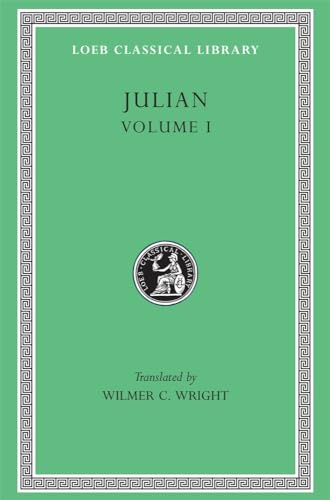
THE WORKS OF THE EMPEROR JULIAN; Volume I
Buch 2 von 3: Loeb Classical Library: JulianSprache: Englisch
Verlag: Harvard University Press & William Heinemann, 1913
ISBN 10: 0674990145 ISBN 13: 9780674990142
Anbieter: Ancient World Books, Toronto, ON, Kanada
Verkäuferbewertung 5 von 5 Sternen

Hardcover. Zustand: Good+. Zustand des Schutzumschlags: No Dust Jacket. Scholar's name to ffep (A. R. Littlewood). Faint dampstain to lower corner of book. Small tear to base of spine (repaired with cellotape). Spine darkened. Endpapers browned.; Loeb Classical Library No. 29; 1; 511 pages; Julian (Flavius Claudius Iulianus) "the Apostate", Roman Emperor, lived 331 or 332 to 363 CE. Born and educated in Constantinople as a Christian, after a precarious childhood he devoted himself to literature and philosophy and became a pagan, studying in various Greek cities. In 355 his cousin Emperor Constantius called him from Athens to the court at Milan, entitled him "Caesar", and made him governor of Gaul. Julian restored Gaul to prosperity and good government after the ravages of the Alamanni (he overthrew them at the battle of Strassburg in 357) and other Germans. Between 357 and 361 Julian's own soldiers, refusing to serve in the East at Constantius's orders, nearly involved Julian in war with Constantiusâ"who however died in 361 so that Julian became sole Emperor of the Roman world. He began many reforms and proclaimed universal toleration in religion but pressed for the restoration of the older pagan worships. In 362â"363 he prepared at Constantinople and then at Antioch for his expedition against Persia ruled by Shapur II. He died of a wound received in desperate battle. Julian's surviving works (lost are his Commentaries on his western campaigns) , all in Greek, are given in the Loeb Classical Library in three volumes. The eight Orations (1-5 in Volume I, 6-8 in Volume II) include two in praise of Constantius, one praising Constantius's wife Eusebia, and two theosophical hymns (in prose) or declamations, of interest for studies in neo-Platonism, Mithraism, and the cult of the Magna Mater in the Roman world. The satirical Caesars and Misopogon, Beard-hater, are also in Volume II. The Letters (more than eighty, Volume III) include edicts or rescripts, mostly about Christians, encyclical or pastoral letters to priests, and private letters.
-

THE WORKS OF THE EMPEROR JULIAN; Volume II
Buch 1 von 3: Loeb Classical Library: JulianAnbieter: Ancient World Books, Toronto, ON, Kanada
Verkäuferbewertung 5 von 5 Sternen
Hardcover. Zustand: Very Good. Zustand des Schutzumschlags: Poor. Scholar's name to ffep (A. R. Littlewood). DJ is tattered and torn and in 2 pieces with chipping and foxing; Loeb Classical Library No. 29; 2; 519 pages; Julian (Flavius Claudius Iulianus) "the Apostate", Roman Emperor, lived 331 or 332 to 363 CE. Born and educated in Constantinople as a Christian, after a precarious childhood he devoted himself to literature and philosophy and became a pagan, studying in various Greek cities. In 355 his cousin Emperor Constantius called him from Athens to the court at Milan, entitled him "Caesar", and made him governor of Gaul. Julian restored Gaul to prosperity and good government after the ravages of the Alamanni (he overthrew them at the battle of Strassburg in 357) and other Germans. Between 357 and 361 Julian's own soldiers, refusing to serve in the East at Constantius's orders, nearly involved Julian in war with Constantiusâ"who however died in 361 so that Julian became sole Emperor of the Roman world. He began many reforms and proclaimed universal toleration in religion but pressed for the restoration of the older pagan worships. In 362â"363 he prepared at Constantinople and then at Antioch for his expedition against Persia ruled by Shapur II. He died of a wound received in desperate battle. Julian's surviving works (lost are his Commentaries on his western campaigns) , all in Greek, are given in the Loeb Classical Library in three volumes. The eight Orations (1-5 in Volume I, 6-8 in Volume II) include two in praise of Constantius, one praising Constantius's wife Eusebia, and two theosophical hymns (in prose) or declamations, of interest for studies in neo-Platonism, Mithraism, and the cult of the Magna Mater in the Roman world. The satirical Caesars and Misopogon, Beard-hater, are also in Volume II. The Letters (more than eighty, Volume III) include edicts or rescripts, mostly about Christians, encyclical or pastoral letters to priests, and private letters.
-

The Works of the Emperor Julian
Anbieter: Ria Christie Collections, Uxbridge, Vereinigtes Königreich
Verkäuferbewertung 5 von 5 Sternen
EUR 22,75
EUR 13,90 Versand
Versand von Vereinigtes Königreich nach USAAnzahl: Mehr als 20 verfügbar
In den WarenkorbZustand: New. In.
-

The Works of the Emperor Julian
Anbieter: Ria Christie Collections, Uxbridge, Vereinigtes Königreich
Verkäuferbewertung 5 von 5 Sternen
EUR 22,75
EUR 13,90 Versand
Versand von Vereinigtes Königreich nach USAAnzahl: Mehr als 20 verfügbar
In den WarenkorbZustand: New. In.
-
Works of the Emperor Julian: Loeb 29; Orations Vi-Viii, Letters to Themistius, to the Senate and People of Athens to a Priest-The Caesars-Misopogon: Vol 002
Buch 1 von 3: Loeb Classical Library: JulianAnbieter: Revaluation Books, Exeter, Vereinigtes Königreich
Verkäuferbewertung 5 von 5 Sternen
EUR 29,83
EUR 11,61 Versand
Versand von Vereinigtes Königreich nach USAAnzahl: 1 verfügbar
In den WarenkorbHardcover. Zustand: Brand New. 528 pages. 6.75x4.75x1.00 inches. In Stock.
-

Letters. Epigrams. Against the Galilaeans. Fragments
Buch 3 von 3: Loeb Classical Library: JulianAnbieter: Majestic Books, Hounslow, Vereinigtes Königreich
Verkäuferbewertung 4 von 5 Sternen

EUR 35,12
EUR 7,54 Versand
Versand von Vereinigtes Königreich nach USAAnzahl: 3 verfügbar
In den WarenkorbZustand: New. pp. 520.
-
Works of the Emperor Julian: Loeb 13: Vol 001
Buch 2 von 3: Loeb Classical Library: JulianAnbieter: Revaluation Books, Exeter, Vereinigtes Königreich
Verkäuferbewertung 5 von 5 Sternen
EUR 35,33
EUR 11,61 Versand
Versand von Vereinigtes Königreich nach USAAnzahl: 2 verfügbar
In den WarenkorbHardcover. Zustand: Brand New. 528 pages. 6.75x4.50x1.00 inches. In Stock.
-

The Works of the Emperor Julian
Anbieter: Ria Christie Collections, Uxbridge, Vereinigtes Königreich
Verkäuferbewertung 5 von 5 Sternen
EUR 33,46
EUR 13,90 Versand
Versand von Vereinigtes Königreich nach USAAnzahl: Mehr als 20 verfügbar
In den WarenkorbZustand: New. In.
-
Julian, Volume I: Orations 1-5
Buch 2 von 3: Loeb Classical Library: JulianAnbieter: Ria Christie Collections, Uxbridge, Vereinigtes Königreich
Verkäuferbewertung 5 von 5 Sternen
EUR 34,28
EUR 13,90 Versand
Versand von Vereinigtes Königreich nach USAAnzahl: 2 verfügbar
In den WarenkorbZustand: New. In English.
-
Julian, Volume II: Orations 6-8. Letters to Themistius; to the Senate and People of Athens; to a Priest. The Caesars. Misopogon
Buch 1 von 3: Loeb Classical Library: JulianAnbieter: Ria Christie Collections, Uxbridge, Vereinigtes Königreich
Verkäuferbewertung 5 von 5 Sternen
EUR 34,28
EUR 13,90 Versand
Versand von Vereinigtes Königreich nach USAAnzahl: 2 verfügbar
In den WarenkorbZustand: New. In English.
-

Zustand: New. The surviving works of the Roman Emperor Julian the Apostate (331 or 332-363 CE) include eight Orations Misopogon (Beard-hater), assailing the morals of the people of Antioch more than eighty Letters and fragments of Against the Galileans, written main.
-

Gebunden. Zustand: New. The surviving works of the Roman Emperor Julian the Apostate (331 or 332-363 CE) include eight Orations Misopogon (Beard-hater), assailing the morals of the people of Antioch more than eighty Letters and fragments of Against the Galileans, written main.
-

Zustand: New. The surviving works of the Roman Emperor Julian the Apostate (331 or 332-363 CE) include eight Orations Misopogon (Beard-hater), assailing the morals of the people of Antioch more than eighty Letters and fragments of Against the Galileans, written main.

