Gesamtpreis (1 Artikel Artikel):
Versandziel:

john leech mark lemon (4 Ergebnisse)
Direkt zu den wichtigsten Suchergebnissen
Suchfilter
Produktart
- Alle Product Types
- Bücher (3)
- Magazine & Zeitschriften (Keine weiteren Ergebnisse entsprechen dieser Verfeinerung)
- Comics (Keine weiteren Ergebnisse entsprechen dieser Verfeinerung)
- Noten (Keine weiteren Ergebnisse entsprechen dieser Verfeinerung)
- Kunst, Grafik & Poster (Keine weiteren Ergebnisse entsprechen dieser Verfeinerung)
- Fotografien (Keine weiteren Ergebnisse entsprechen dieser Verfeinerung)
- Karten (Keine weiteren Ergebnisse entsprechen dieser Verfeinerung)
- Manuskripte & Papierantiquitäten (1)
Zustand Mehr dazu
- Neu (2)
- Wie Neu, Sehr Gut oder Gut Bis Sehr Gut (Keine weiteren Ergebnisse entsprechen dieser Verfeinerung)
- Gut oder Befriedigend (Keine weiteren Ergebnisse entsprechen dieser Verfeinerung)
- Ausreichend oder Schlecht (1)
- Wie beschrieben (1)
Einband
Weitere Eigenschaften
- Erstausgabe (1)
- Signiert (Keine weiteren Ergebnisse entsprechen dieser Verfeinerung)
- Schutzumschlag (Keine weiteren Ergebnisse entsprechen dieser Verfeinerung)
- Angebotsfoto (2)
Sprache (2)
Preis
- Beliebiger Preis
- Weniger als EUR 20 (Keine weiteren Ergebnisse entsprechen dieser Verfeinerung)
- EUR 20 bis EUR 40
- Mehr als EUR 40
Gratisversand
- Kostenloser Versand nach USA (Keine weiteren Ergebnisse entsprechen dieser Verfeinerung)
Land des Verkäufers
Verkäuferbewertung
-

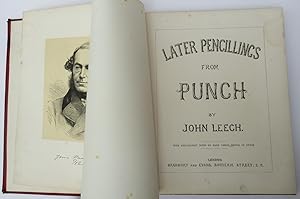
Later Pencillings From Punch /by John Leech, With Explanatory Notes by Mark Lemon.
Anbieter: Ria Christie Collections, Uxbridge, Vereinigtes Königreich
Verkäuferbewertung 5 von 5 Sternen

EUR 24,60
EUR 13,84 Versand
Versand von Vereinigtes Königreich nach USAAnzahl: Mehr als 20 verfügbar
In den WarenkorbZustand: New. In.
-
Later Pencillings from Punch. With explanatory notes by Mark Lemon, Editor of Punch
Sprache: Englisch
Verlag: Bradbury and Evans, London, no date, 1863
Anbieter: The Bookmonger, Nottingham, Vereinigtes Königreich
Verkäuferbewertung 5 von 5 Sternen
Erstausgabe
EUR 35,69
EUR 16,17 Versand
Versand von Vereinigtes Königreich nach USAAnzahl: 1 verfügbar
In den WarenkorbHardcover. Zustand: Fair. John Leech (illustrator). 1st Edition. Apparently scarce, especially in first edition form as this appears to be. 252 full page drawings from Punch by John Leech, in chronological order dating from 1851-1861, with short notes from Lemon in the bottom margin. Half title, portrait frontispiece of Leech with a facsimile signature, contents list. Publisher's red blindstamped and gilt lettered cloth, rather stained. Unfortunately there is a water stain which goes almost right through the book, affecting the top corner of all the plates, some hardly at all, most slightly, a few badly (please see images for best and worst). Possibly this stain is what has saved the book from being broken up for plates.
-

EUR 29,91
EUR 48,99 Versand
Versand von Deutschland nach USAAnzahl: Mehr als 20 verfügbar
In den WarenkorbZustand: New.
-

[Punch] Letter, headed 'Copy', in contemporary hand, from 'X.' to 'Mr. Editor' [of Punch].
Verlag: 1 May, 1859
Anbieter: Richard M. Ford Ltd, London, Vereinigtes Königreich
Verkäuferbewertung 5 von 5 Sternen
Manuskript / Papierantiquität
EUR 66,62
EUR 5,20 Versand
Versand von Vereinigtes Königreich nach USAAnzahl: 1 verfügbar
In den Warenkorb12mo, 4 pp. Bifolium. Watermarked 'TOWGOOD'S | SUPER FINE | 1859'. Eighty-seven lines of text. Text clear and complete on aged and grubby paper. With little hope of influencing the editor of Punch, the author feels compelled to 'write and tell you what I and many others think about your Publication and the malignant spite you display towards individuals who happen to incur your wrath'. This 'malignity', he feels, 'must be derived from that murderous old ruffian from whom your publication takes its name, and which alone prevents it being an influential publication. Men laugh at the jokes in it, and admire the skill of Mr. Leech and his assistants, but II have yet to find the Man whose opinions were ever changed by anything he saw in "Punch".' He gives two examples of 'many instances of individuals who have been persecuted' by the magazine: the actor Charles Kean and 'Mr Williams of Lambeth'. What had Kean 'done to incur the wrath of "Punch"? Simply offended one of its staff'. As for Williams, he had stated, 'in a Speech to the Electors of Lambeth [.] that he had been offered a Title which he rejected - now that was nothing but the truth, for you know very well that a Baronetcy really was offered to Mr Williams and rejected'. The author accuses 'Punch' of being 'ready enough to make yourself a mere tool of corruption [.] trying to do that by ridicule which those in power could not do by flattery'. Quotes 'the advice given this day by the "Weekly Dispatch" to the "Saturday Review", before concluding 'You need not make any funny (?) remarks about any grammatical errors that may appear in this letter. If there are any I admit them, for I do not profess to be a Scholar'.