
James clark maxwell (22 Ergebnisse)

Lonely Planet Cruise Ports Mediterranean Europe 1 (Travel Guide)
Maxwell, Virginia; Armstrong, Kate; Atkinson, Brett; Averbuck, Alexis; Bainbridge, James; Bonetto, Cristian; Clark, Gregor; Garwood, Duncan; Hardy, Paula; Kaminski, Anna; Le Nevez, Catherine; McNaughtan, Hugh; Morgan, Kate; Raub, Kevin; Richmond, Simon; Sainsbury, Brendan; St Louis, Regis; Ward, Greg; Williams, Nicola
- Softcover
Anbieter: Dream Books Co., Denver, CO, USADream Books Co.
Verkäufer/-in kontaktierenVerkäufer/-in mit 5 SternenZustand: Gebraucht - Ausreichend
EUR 5,90
Versand nach gratisVersand innerhalb von USAAnzahl: 1 verfügbar
Zustand: acceptable. This copy has clearly been enjoyedâ"expect noticeable shelf wear and some minor creases to the cover. Binding is strong, and all pages are legible. May contain previous library markings or stamps.

- Softcover
Anbieter: AwesomeBooks, Wallingford, Vereinigtes KönigreichAwesomeBooks
Verkäufer/-in kontaktierenVerkäufer/-in mit 5 SternenZustand: Gebraucht - Gut
EUR 3,95
EUR 4,85 VersandVersand von Vereinigtes Königreich nach USAAnzahl: 2 verfügbar
Paperback. Zustand: Very Good. Lonely Planet Europe (Travel Guide) This book is in very good condition and will be shipped within 24 hours of ordering. The cover may have some limited signs of wear but the pages are clean, intact and the spine remains undamaged. This book has clearly been well maintained and looked after thus fa…r. Money back guarantee if you are not satisfied. See all our books here, order more than 1 book and get discounted shipping. .

- Softcover
Anbieter: PBShop.store US, Wood Dale, IL, USAPBShop.store US
Verkäufer/-in kontaktierenVerkäufer/-in mit 5 SternenZustand: Neu
EUR 18,91
Versand nach gratisVersand innerhalb von USAAnzahl: 15 verfügbar
PAP. Zustand: New. New Book. Shipped from UK. Established seller since 2000.
- Softcover
Anbieter: Bahamut Media, Reading, Vereinigtes KönigreichBahamut Media
Verkäufer/-in kontaktierenVerkäufer/-in mit 5 SternenZustand: Gebraucht - Gut
EUR 12,09
EUR 8,21 VersandVersand von Vereinigtes Königreich nach USAAnzahl: 2 verfügbar
Zustand: Very Good. Shipped within 24 hours from our UK warehouse. Clean, undamaged book with no damage to pages and minimal wear to the cover. Spine still tight, in very good condition. Remember if you are not happy, you are covered by our 100% money back guarantee.
- Softcover
Anbieter: PBShop.store UK, Fairford, GLOS, Vereinigtes KönigreichPBShop.store UK
Verkäufer/-in kontaktierenVerkäufer/-in mit 5 SternenZustand: Neu
EUR 17,80
EUR 4,89 VersandVersand von Vereinigtes Königreich nach USAAnzahl: 15 verfügbar
PAP. Zustand: New. New Book. Shipped from UK. Established seller since 2000.

- Softcover
Anbieter: PBShop.store UK, Fairford, GLOS, Vereinigtes KönigreichPBShop.store UK
Verkäufer/-in kontaktierenVerkäufer/-in mit 5 SternenZustand: Neu
EUR 19,66
EUR 3,87 VersandVersand von Vereinigtes Königreich nach USAAnzahl: Mehr als 20 verfügbar
PAP. Zustand: New. New Book. Shipped from UK. Established seller since 2000.

- Softcover
Anbieter: PBShop.store UK, Fairford, GLOS, Vereinigtes KönigreichPBShop.store UK
Verkäufer/-in kontaktierenVerkäufer/-in mit 5 SternenZustand: Neu
EUR 19,66
EUR 3,87 VersandVersand von Vereinigtes Königreich nach USAAnzahl: Mehr als 20 verfügbar
PAP. Zustand: New. New Book. Shipped from UK. Established seller since 2000.

- Hardcover
Anbieter: PBShop.store UK, Fairford, GLOS, Vereinigtes KönigreichPBShop.store UK
Verkäufer/-in kontaktierenVerkäufer/-in mit 5 SternenZustand: Neu
EUR 31,84
EUR 4,89 VersandVersand von Vereinigtes Königreich nach USAAnzahl: Mehr als 20 verfügbar
HRD. Zustand: New. New Book. Shipped from UK. Established seller since 2000.

- Hardcover
Anbieter: PBShop.store UK, Fairford, GLOS, Vereinigtes KönigreichPBShop.store UK
Verkäufer/-in kontaktierenVerkäufer/-in mit 5 SternenZustand: Neu
EUR 31,84
EUR 4,89 VersandVersand von Vereinigtes Königreich nach USAAnzahl: Mehr als 20 verfügbar
HRD. Zustand: New. New Book. Shipped from UK. Established seller since 2000.

National Theatre Connections 2011: Plays for Young People: Frank & Ferdinand; Gap; Cloud Busting; Those Legs; Shooting Truth; Bassett; Gargantua; ... Beauty Manifesto; Too Fast (Play Anthologies)
Samuel Adamson; Alia Bano; Helen Blakeman; Noel Clark; Molly Davies; James Graham; Carl Grose; Katori Hall; Nell Leyson; Douglas Maxwell
- Softcover
Anbieter: Ria Christie Collections, Uxbridge, Vereinigtes KönigreichRia Christie Collections
Verkäufer/-in kontaktierenVerkäufer/-in mit 5 SternenZustand: Neu
EUR 36,74
EUR 14,10 VersandVersand von Vereinigtes Königreich nach USAAnzahl: Mehr als 20 verfügbar
Zustand: New. In.

- Softcover
Anbieter: moluna, Greven, Deutschlandmoluna
Verkäufer/-in kontaktierenVerkäufer/-in mit 5 SternenZustand: Neu
EUR 21,80
EUR 48,99 VersandVersand von Deutschland nach USAAnzahl: Mehr als 20 verfügbar
Zustand: New. KlappentextrnrnUnlike some other reproductions of classic texts (1) We have not used OCR(Optical Character Recognition), as this leads to bad quality books with introduced typos. (2) In books where there are images such as portraits, maps, sketc.
 Weitere Bilder
Drawing Autism [ Nurturing the ways in which we see the world -- As seen through the autism spectrum -- Interaction, individual and societal -- Repetition, repetition, repetition -- Getting from here to there -- Bird's eye view -- Another world -- It's all history -- Art for art's sake -- Artists' bios]
Jill Mullin; Temple Grandin ; Kay Aitch, Milda Bandzaite, David Barth, Shawn Belanger, Gregory Blockstock, JW Beidges, Esther Brokow, Susan Brown, Pam Button, Justin Canha, Cesarenko, Felix, Vrinda Chaswal, Eric Chen, Bailey Clark, Marilyn Cosho, Marcy Deutsch, Wout Devolder, Noah Erenberg, Trisha Ferguson, Emile Fey-Legault, Zach Hamm, Alexandra Hill, Kevin Hosseini, James Kenneally, Wil Kerner, Amanda Lamunyon, Jonathan Lerman, Stephen Mallon, Rachel Marks, Robert Maxwell, Eleni Michael, Ted Mauris, Daniel Muller, Jesica Park, Josh Peddle, Daniel Pout, Vedhas Rangan, Orko Roy, Glen Russ, Caryn Schlosser, Rohan Sonalker, Philip Stoeppelwerth, DJ Svaboda, Klaas Telkampo, Charles Topping, Alexandra Vallinga, Sonna Williams, Ping Lian Yeak
Sprache: Englisch
Verlag: Mark Batty Publisher ; Thames & Hudson [distributor], New York City, London, 2009, 2009
- Hardcover
- Erstausgabe
Anbieter: Joseph Valles - Books, Stockbridge, GA, USAJoseph Valles - Books
Verkäufer/-in kontaktierenVerkäufer/-in mit 5 SternenZustand: Gebraucht - Sehr gut
EUR 70,31
EUR 14,83 VersandVersand innerhalb von USAAnzahl: 1 verfügbar
Hardcover. Zustand: Fine. 1st Edition. 159 pages : illustrations (chiefly color) ; 29 cm ISBN 9780981960005, 0981960006 OCLC 317463470 color pictorial boards, no dustjacket ; "Using artwork created by individuals diagnosed with ASD, Drawing Autism celebrates their artistry and self-expression while also serving as an accessible…point of entry into understanding how ASD manifests in individuals. Autism is known as a 'spectrum disorder' because no two diagnoses are exactly the same; however, there are characteristic traits of ASD. Through their art, the contributors exhibit unique perspectives on how they see the world and their places in it. The book's seven chapters . speak directly to the core characteristics of ASD"--Provided by publisher ; "Drawing autism celebrates the artistry and self-expression found in the drawings, paintings and collages created by people diagnosed with autism. The work of over 50 contributors exhibits an array of unique perspectives on how these individuals see the world and their places in it"--Publisher description ; Contents: Nurturing the ways in which we see the world -- As seen through the autism spectrum -- Interaction, individual and societal -- Repetition, repetition, repetition -- Getting from here to there -- Bird's eye view -- Another world -- It's all history -- Art for art's sake -- Artists' bios ; Artists include: Kay Aitch, Milda Bandzaite, David Barth, Shawn Belanger, Gregory Blockstock, JW Beidges, Esther Brokow, Susan Brown, Pam Button, Justin Canha, Cesarenko, Felix, Vrinda Chaswal, Eric Chen, Bailey Clark, Marilyn Cosho, Marcy Deutsch, Wout Devolder, Noah Erenberg, Trisha Ferguson, Emile Fey-Legault, Zach Hamm, Alexandra Hill, Kevin Hosseini, James Kenneally, Wil Kerner, Amanda Lamunyon, Jonathan Lerman, Stephen Mallon, Rachel Marks, Robert Maxwell, Eleni Michael, Ted Mauris, Daniel Muller, Jesica Park, Josh Peddle, Daniel Pout, Vedhas Rangan, Orko Roy, Glen Russ, Caryn Schlosser, Rohan Sonalker, Philip Stoeppelwerth, DJ Svaboda, Klaas Telkampo, Charles Topping, Alexandra Vallinga, Sonna Williams, Ping Lian Yeak ; two dots on edge olf title page, else FINE. Book.

- Softcover
Anbieter: AHA-BUCH GmbH, Einbeck, DeutschlandAHA-BUCH GmbH
Verkäufer/-in kontaktierenVerkäufer/-in mit 5 SternenZustand: Neu
EUR 25,97
EUR 61,09 VersandVersand von Deutschland nach USAAnzahl: 2 verfügbar
Taschenbuch. Zustand: Neu. Neuware - 'Colonial Days' offers a glimpse into the daily lives and customs of early American settlers. Through vivid descriptions and historical details, James Maxwell Clark brings to life the challenges and triumphs of those who shaped the foundations of the United States. Explore the social structur…es, traditions, and significant events that defined the colonial period. From farming and trade to education and religion, this book provides a comprehensive overview of life in 17th- and 18th-century America. Discover the stories of the men, women, and children who built a new world, and gain a deeper appreciation for the rich history of the United States. A valuable resource for students and history enthusiasts alike, 'Colonial Days' captures the spirit and resilience of the colonial era.

- Softcover
Anbieter: AHA-BUCH GmbH, Einbeck, DeutschlandAHA-BUCH GmbH
Verkäufer/-in kontaktierenVerkäufer/-in mit 5 SternenZustand: Neu
EUR 26,00
EUR 61,11 VersandVersand von Deutschland nach USAAnzahl: 2 verfügbar
Taschenbuch. Zustand: Neu. Neuware - Explore the world of early America in 'Colonial Days,' a vivid account of life in the American colonies. Journey back in time to witness the daily routines, social customs, and pivotal events that shaped a nation. From the bustling town squares to the quiet countryside, this book captures the… essence of colonial existence. Discover the challenges and triumphs of the settlers as they forged a new society in a new land.

- Hardcover
Anbieter: AHA-BUCH GmbH, Einbeck, DeutschlandAHA-BUCH GmbH
Verkäufer/-in kontaktierenVerkäufer/-in mit 5 SternenZustand: Neu
EUR 43,52
EUR 61,95 VersandVersand von Deutschland nach USAAnzahl: 2 verfügbar
Buch. Zustand: Neu. Neuware - Explore the world of early America in 'Colonial Days,' a vivid account of life in the American colonies. Journey back in time to witness the daily routines, social customs, and pivotal events that shaped a nation. From the bustling town squares to the quiet countryside, this book captures the essenc…e of colonial existence. Discover the challenges and triumphs of the settlers as they forged a new society in a new land.Delve into the lives of farmers, artisans, merchants, and community leaders who built the foundations of the United States. Gain insight into the political, economic, and cultural forces at play during this formative period. 'Colonial Days' offers a compelling narrative for anyone interested in understanding the roots of American identity and the legacy of its colonial past.This work has been selected by scholars as being culturally important, and is part of the knowledge base of civilization as we know it. This work was reproduced from the original artifact, and remains as true to the original work as possible. Therefore, you will see the original copyright references, library stamps (as most of these works have been housed in our most important libraries around the world), and other notations in the work.This work is in the public domain in the United States of America, and possibly other nations. Within the United States, you may freely copy and distribute this work, as no entity (individual or corporate) has a copyright on the body of the work.As a reproduction of a historical artifact, this work may contain missing or blurred pages, poor pictures, errant marks, etc. Scholars believe, and we concur, that this work is important enough to be preserved, reproduced, and made generally available to the public. We appreciate your support of the preservation process, and thank you for being an important part of keeping this knowledge alive and relevant.

- Hardcover
Anbieter: AHA-BUCH GmbH, Einbeck, DeutschlandAHA-BUCH GmbH
Verkäufer/-in kontaktierenVerkäufer/-in mit 5 SternenZustand: Neu
EUR 43,52
EUR 61,95 VersandVersand von Deutschland nach USAAnzahl: 2 verfügbar
Buch. Zustand: Neu. Neuware - 'Colonial Days' offers a glimpse into the daily lives and customs of early American settlers. Through vivid descriptions and historical details, James Maxwell Clark brings to life the challenges and triumphs of those who shaped the foundations of the United States. Explore the social structures, tra…ditions, and significant events that defined the colonial period. From farming and trade to education and religion, this book provides a comprehensive overview of life in 17th- and 18th-century America. Discover the stories of the men, women, and children who built a new world, and gain a deeper appreciation for the rich history of the United States. A valuable resource for students and history enthusiasts alike, 'Colonial Days' captures the spirit and resilience of the colonial era.This work has been selected by scholars as being culturally important, and is part of the knowledge base of civilization as we know it. This work was reproduced from the original artifact, and remains as true to the original work as possible. Therefore, you will see the original copyright references, library stamps (as most of these works have been housed in our most important libraries around the world), and other notations in the work.This work is in the public domain in the United States of America, and possibly other nations. Within the United States, you may freely copy and distribute this work, as no entity (individual or corporate) has a copyright on the body of the work.As a reproduction of a historical artifact, this work may contain missing or blurred pages, poor pictures, errant marks, etc. Scholars believe, and we concur, that this work is important enough to be preserved, reproduced, and made generally available to the public. We appreciate your support of the preservation process, and thank you for being an important part of keeping this knowledge alive and relevant.
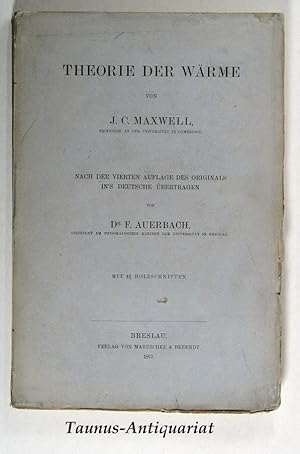
Verlag: Breslau, Verlag Maruschke und Berendt, 1877
- Softcover
Anbieter: Taunus-Antiquariat Karl-Heinz Eisenbach, Niedernhausen, DeutschlandTaunus-Antiquariat Karl-Heinz Eisenbach
Verkäufer/-in kontaktierenVerkäufer/-in mit 5 SternenZustand: Gebraucht
EUR 110,00
EUR 9,95 VersandVersand von Deutschland nach USAAnzahl: 1 verfügbar
In den WarenkorbDt. Erstauflage. VIII, 324 Seiten, mit 41 Holzschnitten. Hier die Erstausgabe der wichtigen physikalischen Arbeit Maxwells in der Übersetzung von F. Auerbach. Aus dem Inhalt der Arbeit: Messung und Wirkung der inneren Kräfte. Die Isothermen. Adiabatische Linien. Wärmemaschinen. Thermodynamische Beziehungen. Latente Wärme. Thermo…dynamik der Gase. Über die wesentliche Energie eines Systems. Freie Ausdehnung. Exkurs über Wellenbeweagung. Stralung (Strahlung). Strömungserscheinungen durch Wärmewirkung. Wärmeleitung. Diffusion. Capillarität. Elasticität und Zähigkeit. Moleculartheorie. Sprache: Deutsch [Physik, Wissenschaftsgeschichte, Forschung, Forscher, Physiker] Gr.-8°, 16 x 23,5 cm, kart., unbeschnitten, keine Vorbesitzereinträge, bis auf die geringe Randbräunung des Papiers und kleinere zeittypische Mängel, von guter sammelwürdiger Erhaltung.
 Weitere Bilder
A History of Eton College (1440-1898) Twice Signed
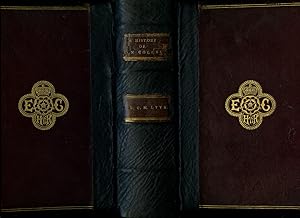
Lyte, H. C. Maxwell [Sir Henry Churchill Maxwell Lyte (or Maxwell-Lyte) KCB, FBA (29 May 1848 - 28 October 1940) was an English historian and archivist. He served as Deputy Keeper of the Public Records from 1886 to 1926, and was the author of numerous books including this book A History of Eton College]. Illustrations by P. H. Delamotte and a Steel Engraving by C. H. Jeens, etc. [Hilary Philip Chadwyck-Healey (1888 - 1976) Eton College. British Composer and Amateur Musician; Member of the Committee of Management of the Royal Academy of Music from 1939 to 1961]. Francis Hay Rawlins 1860-1954. (James John Harper Clark)
Verlag: Published by Macmillan and Co. London Third Edition . 1899., 1899
- Hardcover
Anbieter: Little Stour Books PBFA Member, Canterbury, Vereinigtes KönigreichLittle Stour Books PBFA Member
Verkäufer/-in kontaktierenVerkäufer/-in mit 5 SternenVerbandsmitglied: PBFA
Zustand: Gebraucht
EUR 151,48
EUR 35,30 VersandVersand von Vereinigtes Königreich nach USAAnzahl: 1 verfügbar
In den WarenkorbThird edition revised throughout and greatly enlarged hard back binding in deep burgundy leather bound by Spottiswoode and Co. Ltd., rebacked preserving the parts of the original gilt labels, Eton College crest and parallel lines to both the front and rear covers, all page edges gilt, marble paper end papers. Thick 8vo. 9'' x 6¼…''. Contains [xxv] + 3; 640 pages with illustrations by P. H. Delamotte, a steel engraving by C. H. Jeens, etc. 4 colour plates and many wood engravings to the text, includes a colour fold out plan of Eton, errata leaf. Sir Henry Churchill Maxwell Lyte was educated at Eton 1861-1865 (The Reverend Francis Furse Vidal's House). Two inscriptions to the second front free end paper Firstly: 'Hilary Philip Chadwyck-Healey from Francis Hay Rawlins, Eton 1906', secondly ' This book - together with a silver napkin ring - was presented to James John Harper Clark by the Chadwyck-Healey family in gratitude for his friendship with Hilary Philip Chadwyck-Healey who died 30th March 1976. John Chadwyck-Healey, 30th July 1976.' Member of the P.B.F.A. ETON (Old Etonians).

- Softcover
Anbieter: moluna, Greven, Deutschlandmoluna
Verkäufer/-in kontaktierenVerkäufer/-in mit 5 SternenZustand: Neu
EUR 58,00
EUR 48,99 VersandVersand von Deutschland nach USAAnzahl: 1 verfügbar
Kartoniert / Broschiert. Zustand: New. Der schottische Physiker James Clark Maxwell (1831-1879) gilt als der Naturwissenschaftler des 19. Jahrhunderts mit dem groessten Einfluss auf die theoretische und experimentelle Physik des 20. Jahrhunderts. James Clark Maxwell studierte Naturphilosophie, Mor.

- Softcover
Anbieter: preigu, Osnabrück, Deutschlandpreigu
Verkäufer/-in kontaktierenVerkäufer/-in mit 5 SternenZustand: Neu
EUR 58,00
EUR 70,00 VersandVersand von Deutschland nach USAAnzahl: 1 verfügbar
Taschenbuch. Zustand: Neu. James Clerk Maxwell | Substanz und Bewegung | James Clark Maxwell | Taschenbuch | Edition Classic | Einband - flex.(Paperback) | Deutsch | 2012 | VDM Verlag Dr. Müller | EAN 9783865508683 | Verantwortliche Person für die EU: OmniScriptum GmbH & Co. KG, Bahnhofstr. 28, 66111 Saarbrücken, info[at]akademi…kerverlag[dot]de | Anbieter: preigu.
- Softcover
- Erstausgabe
Anbieter: Antiq. F.-D. Söhn - Medicusbooks.Com, Marburg, DeutschlandAntiq. F.-D. Söhn - Medicusbooks.Com
Verkäufer/-in kontaktierenVerkäufer/-in mit 5 SternenZustand: Gebraucht
EUR 530,00
EUR 36,45 VersandVersand von Deutschland nach USAAnzahl: 1 verfügbar
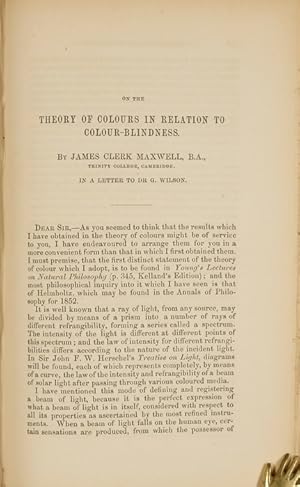
In den WarenkorbEdinburgh, Sutherland & Knox, 1855, 8°, XX, 180 pp., Leinenband d.Zt.; Einband etwas fleckig, innen frisches Expl. FIRST EDITION "THE FIRST BOOK ON COLOR-BLINDNESS," ALSO CONTAINING THE FIRST PRINTING OF MAXWELL'S THEORY OF COLOURS Wilson's groundbreaking work "on color-blindness and the most important monograph on the subject,"… also containing James Clerk Maxwell's major early work on physiological optics, On the Theory of Colours, 1855. George Wilson's Researches on Colour-Blindness is "the first book on color-blindness and the most important monograph on the subject. [as well as] the first in Britain publicly to point out the potential hazards of color-blindness in railwaymen and seamen" led to compulsory testing for colour-blindness in many critical jobs. Becker, p.422. In 1843 this Edinburgh professor began studying "color-blindness from a practical standpoint. Wilson's work was of great importance, as his constant aim was to direct attention to color-blindness in its connection with practical life" Jennings, Colour-Vision, pp. 4-5. "James Clerk Maxwell, then working at his colour-top, contributed an appendix to Wilson's book, of which he thought highly" (DNB). That printing of Maxwell's 'On the Theory of Colours '(pp.153-159) herein is "the first account of Maxwell's researches. [on] physiological optics". DSB "At the meeting of the British Association, held at Glasgow in September 1855, Maxwell. exhibited his Colour-Top. [and] renewed his intercourse with Wilson. [who] brought out immediately afterwards a little book on Colour-Blindness, in which the substance of his conversations with Maxwell is recorded," along with Maxwell's key essay. - Campbell, Lewis, The Life of James Clerk Maxwell, by his former schoolfellow and lifelong friend Professor Lewis Campbell, p.119 This is the first collected publication in book form of Wilson's influential work, incorporating revisions to papers that appeared "in the Edinburgh Monthly Journal [1853-4]. and continued in the Transactions of the Royal Society [1854-5]," including his "Supplement. On Railway and Ship Signals". DNB. George Wilson (1818 - 1859) Scottish chemist and author; Regius Professor of Technology at the University of Edinburgh, and the first Director of the Industrial Museum of Scotland. James Clerk Maxwell (1831-1879) Scottish scientist in the field of mathematical physics. His most notable achievement was to formulate the classical theory of electromagnetic radiation, bringing together for the first time electricity, magnetism, and light as different manifestations of the same phenomenon. Maxwell's equations for electromagnetism have been called the "second great unification in physics" after the first one realised by Isaac Newton. Waller 10343.

Anbieter: Antiq. F.-D. Söhn - Medicusbooks.Com, Marburg, DeutschlandAntiq. F.-D. Söhn - Medicusbooks.Com
Verkäufer/-in kontaktierenVerkäufer/-in mit 5 SternenZustand: Gebraucht
EUR 530,00
EUR 36,45 VersandVersand von Deutschland nach USAAnzahl: 1 verfügbar
In den WarenkorbProc. roy. Soc., 15 (1866/67). - London, Taylor and Francis, 1867, 8°, IX, (1), XLVII, 553 pp., Abbildungen, Tab., 11 Taf., Halbleinband. First print of James Clark Maxwell's (1831-1879 "mathematical theory of dynamo-machines". Wheeler No. 3553 Siemens, Carl Wilhelm (1823-1883): On the Conversion of Dynamical into Electrical For…ce without the aid of Permanent Magnetism (pp.367-369). "This paper is remarkable for the introduction of the cumulative principle in the generation of the powerful currents. The paper is dated Febr. 4, 1867, whilst that of Wheatstone announcing the same is dated Febr. 14." Wheeler No.3562 This paper was released in print before his first announcement read by Magnus "Über die Umwandlungskraft von Arbeitskraft in elektrischen Strom ohne Anwendung permanente Magnete" on the 17.Januar 1867 which wasn't published just in 1868 in the "Monatsberichte der Königlichen Preußischen Akademie der Wissenschaften zu Berlin" . Wheatstone, Sir Charles (1802-1875): On the Augmentation of the Power of a Magnet by the reaction theron of Current induced by the Magnet itself (pp.369-372). "The cumulative principle in the production of powerful currents clearly enunciated." Wheeler Gift No.3570 Valery, Cromwell Fleetwood (1828-1883): On certain Points in the Theory of the Magneto-electric Machines of Wilde, Wheatstone, and Siemens (pp.403-404). "The remarks refer principally to the employment of shunts." Wheeler Ladd, William: On the Mangneto-electric Machine (pp.404-405). "Improvements made by the author on a Wilde machine." Wheeler Robinson, T. Romney (1792-1882): On the means of increasing the Quantity of Electricity given by Induction-Machines (pp.171-182). "Practical observations on the construction of induction-coils for the purpose of increasing the heating power of the discharge." Wheeler Gift No.3559 Siemens and Wheatstone dynamo (1867) - "The first practical designs for a dynamo were announced independently and simultaneously by Dr. Werner Siemens and Charles Wheatstone. On January 17, 1867, Siemens announced to the Berlin academy a "dynamo-electric machine" (first use of the term) which employed a self-powering electromagnetic armature. On the same day that this invention was announced to the Royal Society Charles Wheatstone read a paper describing a similar design with the difference that in the Siemens design the armature was in series with the rotor, but in Wheatstone's design it was in parallel. The use of electromagnets rather than permanent magnets greatly increases the power output of a dynamo and enabled high power generation for the first time. This invention led directly to the first major industrial uses of electricity. For example, in the 1870s Siemens used electromagnetic dynamos to power electric arc furnaces for the production of metals and other materials." wiki Please see: Otto Mahr, Die Entstehung der Dynamomaschine (1941), pp.129-149.


