
James captain thomas (15 Ergebnisse)

- Softcover
Anbieter: Ria Christie Collections, Uxbridge, Vereinigtes KönigreichRia Christie Collections
Verkäufer/-in kontaktierenVerkäufer/-in mit 5 SternenZustand: Neu
EUR 18,00
EUR 14,04 VersandVersand von Vereinigtes Königreich nach USAAnzahl: Mehr als 20 verfügbar
Zustand: New. In.

Thrilling Stories of the Great War - Heroic Incidents and Startling Events of the World War on Land and Sea, in the Air and Under the Sea - Profusely Illustrated with Photographs, Maps and Drawings
Howard-Smith, Captain Logan; Trusler, Thomas F; Bryce, Viscount James
- Softcover
Anbieter: Ria Christie Collections, Uxbridge, Vereinigtes KönigreichRia Christie Collections
Verkäufer/-in kontaktierenVerkäufer/-in mit 5 SternenZustand: Neu
EUR 29,49
EUR 14,04 VersandVersand von Vereinigtes Königreich nach USAAnzahl: Mehr als 20 verfügbar
Zustand: New. In.

Verlag: Coles Canadiana Collection, 1973
- Softcover
Anbieter: Old Goat Books, Waterloo, ON, KanadaOld Goat Books
Verkäufer/-in kontaktierenVerkäufer/-in mit 4 SternenVerbandsmitglied: IOBA
Zustand: Gebraucht - Gut bis sehr gut
EUR 13,54
EUR 15,77 VersandVersand von Kanada nach USAAnzahl: 1 verfügbar
In den WarenkorbTrade Paperback. Zustand: Near Fine. Zustand des Schutzumschlags: Near Fine. Condition: 'Near Fine' Notes: In his intended discovery of a North West passage into the South Sea. Reprint.
Thrilling Stories of the Great War - Heroic Incidents and Startling Events of the World War on Land and Sea, in the Air and Under the Sea - Profusely Illustrated with Photographs, Maps and Drawings
Howard-Smith, Captain Logan/ Trusler, Thomas F./ Bryce, Viscount James
- Softcover
Anbieter: Revaluation Books, Exeter, Vereinigtes KönigreichRevaluation Books
Verkäufer/-in kontaktierenVerkäufer/-in mit 5 SternenZustand: Neu
EUR 45,37
EUR 14,65 VersandVersand von Vereinigtes Königreich nach USAAnzahl: 2 verfügbar
Paperback. Zustand: Brand New. illustrated edition. 526 pages. 8.50x5.50x1.17 inches. In Stock.

Verlag: Coles Publishing, Toronto, 1973
- Hardcover
Anbieter: Attic Books (ABAC, ILAB), London, ON, KanadaAttic Books (ABAC, ILAB)
Verkäufer/-in kontaktierenVerkäufer/-in mit 5 SternenZustand: Gebraucht - Sehr gut
EUR 27,08
EUR 13,14 VersandVersand von Kanada nach USAAnzahl: 1 verfügbar
In den WarenkorbHardcover. Zustand: Fine. Very good +. Coles Canadiana Collection. 142 p. 22 cm. Map at rear. Burgundy cloth in dustjacket. Facsimile Edition. Originally published in 1740 by O. Payne, London.
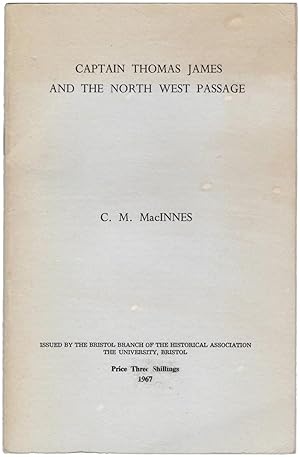
Verlag: Issued by the Bristol Branch of the Historical Association, the University, Bristol,, 1967
- Softcover
- Erstausgabe
Anbieter: Meridian Rare Books ABA PBFA, London, Vereinigtes KönigreichMeridian Rare Books ABA PBFA
Verkäufer/-in kontaktierenVerkäufer/-in mit 5 SternenZustand: Gebraucht - Gut
EUR 12,07
EUR 29,30 VersandVersand von Vereinigtes Königreich nach USAAnzahl: 1 verfügbar
In den WarenkorbSoft cover. Zustand: Very Good. 1st Edition. First edition. 8vo. pp. 28; map and illusts.; very good in the original card wrappers, somewhat discoloured.

Discoveries | The Voyages of Captain Cook
Thomas, Nicholas [Captain James Cook FRS (7 November 1728 - 14 February 1779) British explorer, navigator, cartographer, and captain in the Royal Navy].
Verlag: Published by Penguin Books Ltd., 80 Strand, London First Edition . 2004., 2004
- Erstausgabe
Anbieter: Little Stour Books PBFA Member, Canterbury, Vereinigtes KönigreichLittle Stour Books PBFA Member
Verkäufer/-in kontaktierenVerkäufer/-in mit 5 SternenVerbandsmitglied: PBFA
Zustand: Gebraucht - Gut
EUR 7,24
EUR 35,16 VersandVersand von Vereinigtes Königreich nach USAAnzahl: 1 verfügbar
In den WarenkorbZustand: Very Good. First Penguin edition in publisher's original illustrated card wrap covers, (soft back). 8vo. 8½'' x 6''. Printer's code number 1 to the copyright page. Contains [xxxvii], 468 pp with monochrome illustrations. In Very Good condition, no dust wrapper as issued. Member of the P.B.F.A. COOK, Captain James.
James, Capt. Thomas - Adventurer - Attempted the North-west Passage - A Rare and Original Antique Portrait
JAMES , CAPTAIN THOMAS, OF BRISTOL - An Antique Original Engraved Portrait
Sprache: Englisch
Anbieter: K Books Ltd ABA ILAB, York, YORKS, Vereinigtes KönigreichK Books Ltd ABA ILAB
Verkäufer/-in kontaktierenVerkäufer/-in mit 5 SternenZustand: Gebraucht - Gut
EUR 30,18
EUR 22,86 VersandVersand von Vereinigtes Königreich nach USAAnzahl: 1 verfügbar
In den WarenkorbNo Binding. Zustand: Very Good. A fine, scarce engraved portrait. Mounted/matted and ready to frame. Attractive, decorative and unusual. Portrait of Captain Thomas James of Bristol, who left a record of his voyage of 1632. Impressed library stamp to top corner of print, covered by the mount - print was part of a collection legal…ly disposed of by the library in question.
James, Captain Thomas - Engraved from a Print in a Map for the Discovery of a North West Passage Into the South Sea - an Original Antique Engraved Portrait
JAMES, CAPTAIN THOMAS - an original Antique Engraved Portait
Sprache: Englisch
Anbieter: K Books Ltd ABA ILAB, York, YORKS, Vereinigtes KönigreichK Books Ltd ABA ILAB
Verkäufer/-in kontaktierenVerkäufer/-in mit 5 SternenZustand: Gebraucht - Gut
EUR 36,22
EUR 22,86 VersandVersand von Vereinigtes Königreich nach USAAnzahl: 1 verfügbar
In den WarenkorbNo Binding. Zustand: Very Good. A splendid antique engraved portrait. Mounted/matted and ready to frame. Attractive and decorative. Printed circa 1800.
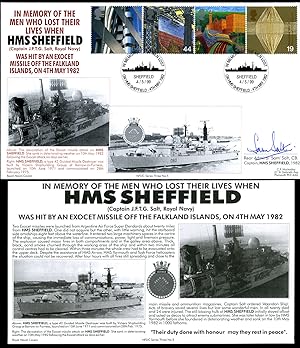
Falklands Conflict | The Argentinian (Argentinean) Invasion | Signed First Day Royal Navy Cover Stamped Envelope | In Memory of the Men Who Lost Their Lives When HMS Sheffield Was Hit by an Exocet Missile off The Falkland Islands on 4th May 1982
Rear Admiral James Frederick Thomas George "Sam" Salt, CB (19 April 1940 - 3 December 2009) was a senior Royal Navy officer of the late twentieth century. He was the captain of HMS Sheffield during the Falklands War, the first British warship to be sunk by enemy action since the end of the Second World War.
Verlag: 4th May ., 1999
- Signiert
Anbieter: Little Stour Books PBFA Member, Canterbury, Vereinigtes KönigreichLittle Stour Books PBFA Member
Verkäufer/-in kontaktierenVerkäufer/-in mit 5 SternenVerbandsmitglied: PBFA
Zustand: Gebraucht - Sehr gut
EUR 36,22
EUR 35,16 VersandVersand von Vereinigtes Königreich nach USAAnzahl: 1 verfügbar
In den WarenkorbZustand: Fine. 8½'' x 5''. Certified Copy No. 103 of 150 first day Royal Navy cover stamped envelope. SIGNED 'Sam Salter'. One cachet insert. In Fine condition. Member of the P.B.F.A. FALKLAND ISLANDS.
 Weitere Bilder
Verlag: Charles H. Kelly, London, 1891
- Hardcover
- Erstausgabe
Anbieter: Rooke Books PBFA, Bath, Vereinigtes KönigreichRooke Books PBFA
Verkäufer/-in kontaktierenVerkäufer/-in mit 5 SternenVerbandsmitglied: PBFA
Zustand: Gebraucht - Gut
EUR 102,62
EUR 22,26 VersandVersand von Vereinigtes Königreich nach USAAnzahl: 1 verfügbar
In den WarenkorbCloth. Zustand: Very Good. First edition. A wonderful autobiographical account on the life of Captain JAmes Payen and his adventures at sea, edited by Thomas Durley. First Edition, Scarce.In the publisher's original cloth binding.Illustrations include a frontispiece depicting Captain James Payen, as well as vignette initials to…the beginning of each chapter.This is an exciting autobiographical account of Payen's life at sea, including his time as a fisherman as well as a captain for a merchant ship on behalf of the East India Company.Contents include 'First Days at Sea', 'Jacko, the Monkey', 'Cod Fishing', and 'Fishermen on Strike'.Edited by Thomas Durley, who describes himself as 'the Captain's amanuensis'.Two pages of publisher's adverts to rear of text.Collated, complete. In the publisher's original cloth binding. Externally, smart. A bit of edge wear to the extremities with fading and wear to the raised bands of front joint. Light bumping to head and tail of spine as well as a few marks to boards. Front hinge is starting. Pastedowns and endappers are lightly age-toned. Internally, firmly bound. Pages are very bright and clean throughout, with light age-toning to margins. Frontispiece and title page are beginning to detach from the binding starting from the bottom of the pages. Very Good. Not Stated (illustrator). book.
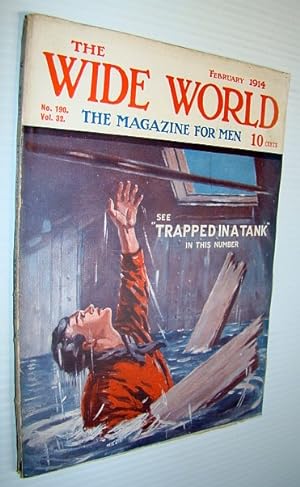
The Wide World Magazine - The Magazine for Men: February, 1914 - Volume 32, Number 190 - Gun-Running with Zapata
Barr, William; Dunn, H.H.; Nicholls, G. Heaton; Grenfell, Wilfred T.; Fagan, D.W.O.; Pratt, A.E.; Burton, Colonel R.G.; Talbot, P. Amaury; Blake, Harry M.; Guinand, W.B.; Villepion, Guy De; Barracliffe, Captain James
Verlag: George Newnes Limited, London, 1914
- Softcover
- Erstausgabe
- Magazin / Zeitschrift
Anbieter: RareNonFiction, IOBA, Ladysmith, BC, KanadaRareNonFiction, IOBA
Verkäufer/-in kontaktierenVerkäufer/-in mit 5 SternenVerbandsmitglied: IOBA
Zustand: Gebraucht - Befriedigend
EUR 270,73
EUR 17,52 VersandVersand von Kanada nach USAAnzahl: 1 verfügbar
In den WarenkorbSingle Issue Magazine. Zustand: Good. First Edition. Pages 303-396 plus 28 pages of ads, many wonderfully illustrated. Numerous black and white illustrations and photos in text. Features: Saved by Two Inches - How a big-horn sheep brought a veteran hunter to the verge of destruction in Montana; Gun-Running with Mexican Outlaw Em…iliano Zapata - article with great photos; A Terrible Trip - Gold Searching in German New Guinea; Twenty Years in Newfoundland (Part II) - article with nice photos; Fishermen's Luck - a story from New Zealand involving T. Colthart, H. Hewlett and D.G. FitzGibbon; Across the Andes and Down the Amazon - the story of an adventurous journey (part II); The Well of Skulls - a story from Hyderabad; The Lake of Life - the Idiong secret society in Africa; The King Who Met His Match - a story from Sierra Leone; Trapped in a Tank (cover illustration); Captured by the Monkey-Men - an explorer's tale from the Orinoco River; The Smugglers of Gibraltar; Pete the Pup - an adventurous dog in New Mexico. Clean and unmarked with moderate wear. Minor chipping to back strip. Three inch opening between front cover and base of spine. Overall a pleasing copy of this wonderful vintage issue.; 4to - over 9¾" - 12" tall; Barr, William; Dunn, H.H.; Nicholls, G. HeatonGrenfell, Wilfred T.; Fagan, D.W.O.; Pratt, A.E.; Burton, Colonel R.G.; Talbot, P. Amaury; Blake, Harry M.; Guinand, W.B.; Villepion, Guy De; Barracliffe, Captain James The Wide World Magazine - The Magazine f. Illustrated by Evison, G. Henry; Robinson, Wyndham P.; Wigfull, W.E.;Somerfield, Thomas; Peddie, Tom; Holmes, Fred; Burton, H.M. (illustrator).
Swan River Settlement. Copies of the Correspondence of the Colonial Department with Certain Gentlemen proposing to form a Settlement in the Neighbourhood of Swan River, in Western Australia
STIRLING, Captain James (1791-1865) - PEEL, Thomas (1793-1865)
Verlag: [London]: House of Commons, 13 May 1829., 1829
- Softcover
Anbieter: Arader Galleries - AraderNYC, New York, NY, USAArader Galleries - AraderNYC
Verkäufer/-in kontaktierenVerkäufer/-in mit 5 SternenZustand: Gebraucht
EUR 24.369,93
Versand nach gratisVersand innerhalb von USAAnzahl: 1 verfügbar
In den WarenkorbSoft cover. Folio (13 6/8 x 8 4/8 inches). 12 pages. Folding lithographed map of the Western Australian coastline as far as Geographe Bay (showing a proposed grant to Stirling of 90,000 acres), Rottnest Island, as far inland as "General Darlings's Range", all with fine original hand-colour in full by J. Basire after Stirling, pu…blished by Hansard (light oxidisation, short marginal separations at folds in top edge). FINE original blue printed paper wrappers (small chip to upper cover). THE FIRST PUBLISHED CHART OF THE PROPOSED COLONIAL DEVELOPMENT AT SWAN RIVER IN WESTERN AUSTRALIA A fine and attractive copy of the map and accompanying correspondence published as blue paper number 238. The beautiful map is based directly on the 1827 surveys by Captain James Stirling who was directly responsible for persuading the British government to attempt a strategic settlement in Western Australia to forestall an announced French settlement. "In October 1828 he was appointed by Sir George Murray, the colonial secretary and an old family friend, to command a party of intending colonists. The expedition sailed in spring 1829 and reached its destination in June. The sites of two towns, Fremantle and Perth, were marked out, and within four months of its foundation the colony had a population of 1300. Stirling returned to England in 1832 for two years, and was knighted in 1833. His commitment and ingenuity preserved the fledgling colony during a decade of difficulties, many of which reflected the over-optimistic report of 1827. He was also given 100,000 acres of land, and remained committed to the colony for the rest of his life. Stirling remained governor of Western Australia until 1839, when the apparent imminence of a war with France, and disappointment at the lack of progress in the colony, led him to resign in order to return to active service" (J. K. Laughton, rev. Andrew Lambert for DNB online). With13 articles of correspondence, mostly to and from Thomas Peel concerning his proposals to help settle the new colony: "In 1828 Peel went to London and was planning to emigrate to New South Wales, when reports of the new free colony to be founded at Swan River changed his mind. He joined a syndicate of financiers in proposing to the government a plan whereby they would transfer ten thousand settlers with requisite stock and stores to the new colony within four years, and place them each on 200 acres of land, in return for which the syndicate wished to receive four million acres of land. The Colonial Office, however, was under pressure from Captain (Sir) James Stirling, who had explored the Swan River in 1827, either to grant him the right to develop the place under a proprietary charter, or to proclaim it a new crown colony of which he would be the governor. When Sir George Murray took charge at the Colonial Office in May 1828 he did not wish to grant a charter, or to incur the expense of forming a colony. The interest of Thomas Peel's association of investors seems to have been a deciding factor in persuading the government that the place could be a crown colony and at the same time be largely developed by outside capital. The government, however, felt it could not agree to the amount of territory the investors wished to receive, and could sanction only a grant of one million acres. At this, all the financiers interested withdrew, except Thomas Peel. While he hesitated, Solomon Levey proposed a ten-year partnership with him in the venture, to which he agreed. A deed of co-partnership was drawn up between them, a long and complicated document by which Levey was to finance the scheme and Peel, not being as wealthy as was thought, was to be the salaried manager of it in the colony, although he was to apply for the title deeds to the land in his own name, it being understood that these lands, with the exception of 25,000 acres, were in joint ownership" (Australian Dictionary of Biography online). Ferguson 1265. Catalogued by Kate Hunter.
Verlag: Saint Clement Danes, 1774
- Signiert
Anbieter: Richard M. Ford Ltd, London, Vereinigtes KönigreichRichard M. Ford Ltd
Verkäufer/-in kontaktierenVerkäufer/-in mit 5 SternenZustand: Gebraucht
EUR 458,76
EUR 5,27 VersandVersand von Vereinigtes Königreich nach USAAnzahl: 1 verfügbar
In den WarenkorbAlso signed on the reverse by [A.C. Cuddon?] AND the Earl of Rochford [William Henry Nassau de Zuylestein, 4th Earl of Rochford (1717 O.S. -1781) courtier, diplomat and statesman.]. TWO PAGES, sm. fol., fold marks, edges stained, discreet repairs, text clear and complete, commencing "To the Kings most Excellent Majesty | The Hum…ble Petition of Thomas Short [] That your Petitioner hath invented a method of making Reflecting Telescopes with more than two Speculums to be used by the same person at the same time [] or enabling two Persons to view the same object at the same time []". SEE IMAGE for full (signed) text. One the verso, [A.C. Cuddon?] gives a statement about Short Swearing on 14 March 1774. Followed by a signed statement by the Earl of Rochford commencing "His Majesty is graciously pleased to refer this Petition to Mr. Attorney or Mr. Solicitor General to consider thereof, and report his Opinion what may be properly done therein, whereupon His Majesty will declare His further Pleasure. [signed] Rochford". Note: Bennet Woodcroft, "Titles of Patents of Invention: Chronologically Arranged []", (1854), p.194: "[27 April 1774; 1069] A grant unto THOMAS SHORT, of the parish of Saint Clement Danes, in the county of Middlesex , optician , of his new invented method of making reflecting telescopes with more than two speculums , to be used by the same person [.]".
 Weitere Bilder
Verlag: House of Commons, 13 May 1829, London,, 1829
Anbieter: Daniel Crouch Rare Books Ltd, London, Vereinigtes KönigreichDaniel Crouch Rare Books Ltd
Verkäufer/-in kontaktierenVerkäufer/-in mit 4 SternenZustand: Gebraucht
EUR 14.487,03
EUR 23,44 VersandVersand von Vereinigtes Königreich nach USAAnzahl: 1 verfügbar
In den Warenkorb"The capabilities of this most important possession to the British interest are too numerous for the undersigned here to set forth" (Peel) Large folding panoramic lithographed chart (280 by 630mm to the neatline) with contemporary hand-colour in full, bound into parliamentary "Hansard" paper, number 238, 'Swan River Settlement.…Copies of the Correspondence of the Colonial Department with Certain Gentlemen proposing to form a Settlement in the Neighbourhood of Swan River, in Western Australia'; folio, original blue printed paper wrappers, stabbed and sewn as issued. One of the first published charts of the first detailed survey of what would be the Swan River Colony, now Perth in Western Australia, extending as far as Cape Naturaliste in the south, and to about 200 miles north of Rottnest Island. Only preceded by the very rare chart published by Joseph Cross in January of 1829, and a 'Sketch of the New Settlement of Swan River', published in the 'Quarterly Review' of April 1829, each based on the same survey. The beautiful map is annotated with useful information regarding topography and vegetation, and colour-coded: green areas highlight land intended for settlers and "public purposes"; yellow areas have been granted to Peel, "on condition of his landing 400 Persons before the 1st of November, 1829"; and red, about 90,000 acres at Geographe Bay, to Stirling himself. The map extends as far inland as "General Darlings's Range". Fearful of French colonization in the Pacific, in April of 1826,James Stirling(1791-1865) was given command of the newHMS 'Success' with instructions to take a supply of currency to Sydney and then to move the misplaced and unsuccessful garrison at Melville Island. Once at Sydney, Stirling was soon persuaded by Governor, Sir Ralph Darling, to sail west instead and examine the coast with the idea in mind of establishing a defensive garrison or other settlement that might open trade with the East Indies.Stirling"sailed in 1827 and during a fortnight's visit was much impressed with the land in the vicinity of the Swan River. So also, was the New South Wales government botanist,Charles Frazer, whose report added weight toStirling's political and commercial arguments in favour of its immediate acquisition andStirling's appointment to establish a new colony there? under the direct control of the British government, and superintended initially byStirling: a bill would soon be brought before parliament to provide for its government; private capitalists and syndicates would be allotted land in the proposed settlement according to the amount of capital and the money they spent on fares and equipment; priority of choice would be given only to those who arrived before the end of 1830, and no syndicate or company would be the exclusive patron and proprietor of the settlement. On 2 May 1829 Captain C. H. Fremantle of the'Challenger'took possession, at the mouth of the Swan River, of the whole of Australia which was not then included within the boundaries of New South Wales.Stirling, who arrived later with his family and civil officials in the store-shipParmelia, proclaimed the foundation of the colony on 18 June" (Crowley). The accompanying report consists of twelve articles of correspondence, mostly to and from Thomas Peel (1793-1865), concerning his proposals to help settle the new colony: "In 1828 Peel went to London and was planning to emigrate to New South Wales, when reports of the new free colony to be founded at Swan River changed his mind. He joined a syndicate of financiers in proposing to the government a plan whereby they would transfer ten thousand settlers with requisite stock and stores to the new colony within four years, and place them each on 200 acres of land, in return for which the syndicate wished to receive four million acres of land. The Colonial Office, however, was under pressure from Captain (Sir) James Stirling, who had explored the Swan River in 1827, either to grant him the right to develo.


