

Gesamtpreis (1 Artikel Artikel):
Versandziel:

igor barsukov (5 Ergebnisse)
Direkt zu den wichtigsten Suchergebnissen
Suchfilter
Produktart
- Alle Product Types
- Bücher (5)
- Magazine & Zeitschriften (Keine weiteren Ergebnisse entsprechen dieser Verfeinerung)
- Comics (Keine weiteren Ergebnisse entsprechen dieser Verfeinerung)
- Noten (Keine weiteren Ergebnisse entsprechen dieser Verfeinerung)
- Kunst, Grafik & Poster (Keine weiteren Ergebnisse entsprechen dieser Verfeinerung)
- Fotografien (Keine weiteren Ergebnisse entsprechen dieser Verfeinerung)
- Karten (Keine weiteren Ergebnisse entsprechen dieser Verfeinerung)
- Manuskripte & Papierantiquitäten (Keine weiteren Ergebnisse entsprechen dieser Verfeinerung)
Zustand Mehr dazu
- Neu (4)
- Wie Neu, Sehr Gut oder Gut Bis Sehr Gut (Keine weiteren Ergebnisse entsprechen dieser Verfeinerung)
- Gut oder Befriedigend (Keine weiteren Ergebnisse entsprechen dieser Verfeinerung)
- Ausreichend oder Schlecht (Keine weiteren Ergebnisse entsprechen dieser Verfeinerung)
- Wie beschrieben (1)
Einband
Weitere Eigenschaften
- Erstausgabe (Keine weiteren Ergebnisse entsprechen dieser Verfeinerung)
- Signiert (Keine weiteren Ergebnisse entsprechen dieser Verfeinerung)
- Schutzumschlag (Keine weiteren Ergebnisse entsprechen dieser Verfeinerung)
- Angebotsfoto (3)
Sprache (1)
Preis
- Beliebiger Preis
- Weniger als EUR 20 (Keine weiteren Ergebnisse entsprechen dieser Verfeinerung)
- EUR 20 bis EUR 45
- Mehr als EUR 45
Gratisversand
- Kostenloser Versand nach USA (Keine weiteren Ergebnisse entsprechen dieser Verfeinerung)
Land des Verkäufers
Verkäuferbewertung
-

New Carbon Based Materials for Electrochemical Energy Storage Systems: Batteries, Supercapacitors and Fuel Cells.
Buch 168 von 241: NATO Science Series II: Mathematics, Physics and ChemistrySprache: Englisch
Verlag: Dordrecht, Springer Netherland., 2006
ISBN 10: 1402048106 ISBN 13: 9781402048104
Anbieter: Universitätsbuchhandlung Herta Hold GmbH, Berlin, Deutschland
Verbandsmitglied: GIAQ ILAB VDA
Verkäuferbewertung 4 von 5 Sternen

2006. 16 x 24 cm. XXIV, 523 S. XXIV, 523 p. HC Versand aus Deutschland / We dispatch from Germany via Air Mail. Einband bestoßen, daher Mängelexemplar gestempelt, sonst sehr guter Zustand. Imperfect copy due to slightly bumped cover, apart from this in very good condition. Stamped. (NATO Science Series II: Mathematics, Physics and Chemistry). Sprache: Englisch.
-

New Carbon Based Materials for Electrochemical Energy Storage Systems: Batteries, Supercapacitors and Fuel Cells (NATO Science Series II: Mathematics, Physics and Chemistry)
Buch 168 von 241: NATO Science Series II: Mathematics, Physics and ChemistryAnbieter: Ria Christie Collections, Uxbridge, Vereinigtes Königreich
Verkäuferbewertung 5 von 5 Sternen

EUR 310,64
EUR 13,86 Versand
Versand von Vereinigtes Königreich nach USAAnzahl: Mehr als 20 verfügbar
In den WarenkorbZustand: New. In.
-

Taschenbuch. Zustand: Neu. New Carbon Based Materials for Electrochemical Energy Storage Systems: Batteries, Supercapacitors and Fuel Cells | Igor V. Barsukov (u. a.) | Taschenbuch | xxiv | Englisch | 2006 | Springer | EAN 9781402048111 | Verantwortliche Person für die EU: Springer Verlag GmbH, Tiergartenstr. 17, 69121 Heidelberg, juergen[dot]hartmann[at]springer[dot]com | Anbieter: preigu.
-
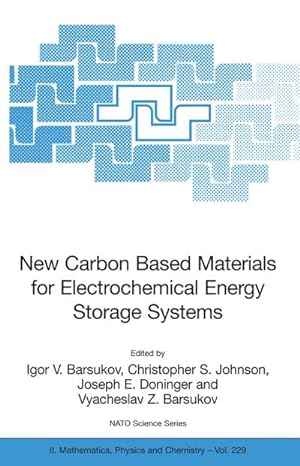
New Carbon Based Materials for Electrochemical Energy Storage Systems: Batteries, Supercapacitors and Fuel Cells
Buch 168 von 241: NATO Science Series II: Mathematics, Physics and ChemistryAnbieter: AHA-BUCH GmbH, Einbeck, Deutschland
Verkäuferbewertung 5 von 5 Sternen
Buch. Zustand: Neu. Druck auf Anfrage Neuware - Printed after ordering - Carbonaceous materials play a fundamental role in electrochemical energy storage systems. Carbon in the structural form of graphite is widely used as the active material in lithium-ion batteries; it is abundant, and environmentally friendly. Carbon is also used to conduct and distribute charge effectively throughout composite electrodes of supercapacitors, batteries and fuel cells. The electronic conductive pathways are critical to delivering and extracting current out of the device. However, many challenges and the understanding of the role of carbon and its stability and efficiency in charge storage applications still exists. This NATO-ARW volume contains a diverse collection of papers addressing the role of carbon in some key electrochemical systems, both conventional and emerging. These papers discuss the latest issues associated with development, synthesis, characterization and use of new advanced carbonaceous materials for electrochemical energy storage. Such systems include: metal-air primary and rechargeable batteries, fuel cells, supercapacitors, cathodes and anodes of lithium-ion and lithium polymer rechargeable batteries, as well as nanocarbon materials of the future.
-
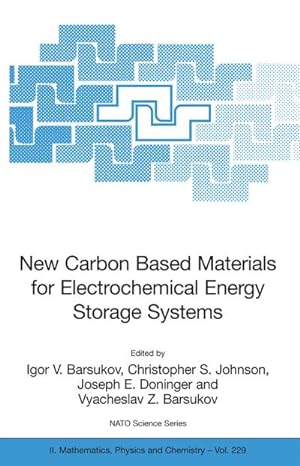
New Carbon Based Materials for Electrochemical Energy Storage Systems: Batteries, Supercapacitors and Fuel Cells
Buch 168 von 241: NATO Science Series II: Mathematics, Physics and ChemistryAnbieter: AHA-BUCH GmbH, Einbeck, Deutschland
Verkäuferbewertung 5 von 5 Sternen
Taschenbuch. Zustand: Neu. Druck auf Anfrage Neuware - Printed after ordering - Carbonaceous materials play a fundamental role in electrochemical energy storage systems. Carbon in the structural form of graphite is widely used as the active material in lithium-ion batteries; it is abundant, and environmentally friendly. Carbon is also used to conduct and distribute charge effectively throughout composite electrodes of supercapacitors, batteries and fuel cells. The electronic conductive pathways are critical to delivering and extracting current out of the device. However, many challenges and the understanding of the role of carbon and its stability and efficiency in charge storage applications still exists. This NATO-ARW volume contains a diverse collection of papers addressing the role of carbon in some key electrochemical systems, both conventional and emerging. These papers discuss the latest issues associated with development, synthesis, characterization and use of new advanced carbonaceous materials for electrochemical energy storage. Such systems include: metal-air primary and rechargeable batteries, fuel cells, supercapacitors, cathodes and anodes of lithium-ion and lithium polymer rechargeable batteries, as well as nanocarbon materials of the future.

