

Gesamtpreis (1 Artikel Artikel):
Versandziel:

hunwick joseph (14 Ergebnisse)
Direkt zu den wichtigsten Suchergebnissen
Suchfilter
Produktart
- Alle Product Types
- Bücher (14)
- Magazine & Zeitschriften (Keine weiteren Ergebnisse entsprechen dieser Verfeinerung)
- Comics (Keine weiteren Ergebnisse entsprechen dieser Verfeinerung)
- Noten (Keine weiteren Ergebnisse entsprechen dieser Verfeinerung)
- Kunst, Grafik & Poster (Keine weiteren Ergebnisse entsprechen dieser Verfeinerung)
- Fotografien (Keine weiteren Ergebnisse entsprechen dieser Verfeinerung)
- Karten (Keine weiteren Ergebnisse entsprechen dieser Verfeinerung)
- Manuskripte & Papierantiquitäten (Keine weiteren Ergebnisse entsprechen dieser Verfeinerung)
Zustand Mehr dazu
- Neu (Keine weiteren Ergebnisse entsprechen dieser Verfeinerung)
- Wie Neu, Sehr Gut oder Gut Bis Sehr Gut (5)
- Gut oder Befriedigend (4)
- Ausreichend oder Schlecht (Keine weiteren Ergebnisse entsprechen dieser Verfeinerung)
- Wie beschrieben (5)
Einband
Weitere Eigenschaften
- Erstausgabe (2)
- Signiert (Keine weiteren Ergebnisse entsprechen dieser Verfeinerung)
- Schutzumschlag (11)
- Angebotsfoto (11)
Sprache (2)
Gratisversand
- Kostenloser Versand nach USA (Keine weiteren Ergebnisse entsprechen dieser Verfeinerung)
Land des Verkäufers
Verkäuferbewertung
-

A Guide To The Temple of Kom-Ombo
Verlag: The Palm Press, Cairo, Egypt, 2001
ISBN 10: 9775089387 ISBN 13: 9789775089380
Anbieter: Ground Zero Books, Ltd., Silver Spring, MD, USA
Verkäuferbewertung 5 von 5 Sternen

Erstausgabe
Wraps. Zustand: Very good. Zustand des Schutzumschlags: No dust jacket issued. Joseph Hunwick (Photography) (illustrator). Presumed First Edition, First printing. Format is approximately 6.25 inches by 8.25 inches. 24 pages, plus covers. Illustrations (some in full color). Map. Diagram. Drawings. One of the most unusual temples of Ancient Egypt, Kom Ombo was mainly built during the Ptolemaic Dynasty from 180 - 47 BCE, although there is evidence that it is stood upon an earlier temple. The temple is unique for its dedication to two different deities: the local crocodile-headed god Sobek, and the first "god of the Kingdom", the falcon-headed god Horus the Elder (also called Haroeris). This double dedication was deliberate. Not only is it architecturally duplicated, with two sets of courts, hypostyle halls and sanctuaries, the twin temple is symbolic of the local and universalist themes that the two different deities represented. While much of Kom Ombo temple has been destroyed over the millennia, it has been reconstructed in part, and it is still home to a number of well-preserved and fascinating reliefs, including some intricately carved columns and friezes divided between the two gods. The layout of the complex - apart from being a double temple - is similar to that of the Temple of Edfu. The Temple of Kom Ombo is an unusual double temple in the town of Kom Ombo in Aswan Governorate, Upper Egypt. It was constructed during the Ptolemaic dynasty, 180-47 BC. Some additions to it were later made during the Roman period. The building is unique because its 'double' design meant that there were courts, halls, sanctuaries and rooms duplicated for two sets of gods. The southern half of the temple was dedicated to the crocodile god Sobek, god of fertility and creator of the world with Hathor and Khonsu. Meanwhile, the northern part of the temple was dedicated to the falcon god Haroeris ("Horus the Elder"), along "with Tasenetnofret (the Good Sister, a special form of Hathor or Tefnet/Tefnut) and Panebtawy (Lord of the Two Lands)." The temple is atypical because everything is perfectly symmetrical along the main axis. The texts and reliefs in the temple refer to cultic liturgies which were similar to those from that time period. The temple itself had a specific theology. The characters invoked the gods of Kom Ombo and their legend. Two themes were present in this temple: the universalist theme and the local theme. The two combine to form the theology of this temple. A temple was already built in the New Kingdom to honor these gods, however, this site gained in importance during the Ptolemaic Kingdom. Little remains of the New Kingdom temple. The existing temple was begun by Ptolemy VI Philometor (180-145 BC) at the beginning of his reign and added to by other Ptolemies, most notably Ptolemy XIII Theos Philopator (51-47 BC), who built the inner and outer hypostyles. The scene on the inner face of the rear wall of the temple is of particular interest, and "probably represents a set of surgical instruments." Much of the temple has been destroyed by the Nile, earthquakes, and later builders who used its stones for other projects. Some of the reliefs inside were defaced by Copts, who once used the temple as a church. All the temples buildings in the southern part of the plateau were cleared of debris and restored by Jacques de Morgan in 1893. A few of the three hundred crocodile mummies discovered in the vicinity are displayed in The Crocodile Museum. In April 2018, the Egyptian Ministry of Antiquities announced the discovery of the head of the bust of Roman Emperor Marcus Aurelius during work to protect the site from groundwater. In September 2018, the Egyptian antiquities ministry announced that a sandstone sphinx statue had been discovered at the temple. The statue, measuring approximately 11 in in width and 15 in in height, likely dates to the Ptolemaic Dynasty.
-

A Guide To The Temples of Edfu and Esna
Verlag: The Palm Press, Cairo, Egypt, 2001
ISBN 10: 9775089352 ISBN 13: 9789775089359
Anbieter: Ground Zero Books, Ltd., Silver Spring, MD, USA
Verkäuferbewertung 5 von 5 Sternen
Erstausgabe
Wraps. Zustand: Very good. Zustand des Schutzumschlags: No dust jacket issued. Joseph Hunwick (Photography) (illustrator). Presumed First Edition, First printing. Format is approximately 6.25 inches by 8.25 inches. 24 pages, plus covers. Illustrations (some in full color). Map. Diagram. Drawings. The Temple of Edfu is an Egyptian temple located on the west bank of the Nile in Edfu, Upper Egypt. The city was known in the Hellenistic period in Koin Greek: and in Latin as Apollonopolis Magna, after the chief god Horus, who was identified as Apollo under the interpretatio graeca. It is one of the best preserved shrines in Egypt. The temple was built in the Ptolemaic Kingdom between 237 and 57 BC. The inscriptions on its walls provide information on language, myth and religion during the Hellenistic period in Egypt. The Temple's inscribed building texts "provide details [both] of its construction, and also preserve information about the mythical interpretation of this and all other temples as the Island of Creation." There are also "important scenes and inscriptions of the Sacred Drama which related the age-old conflict between Horus and Seth." Edfu was one of several temples built during the Ptolemaic Kingdom, including the Dendera Temple complex, Esna, the Temple of Kom Ombo, and Philae. The temple of Esna, dedicated to the god Khnum, his consorts Menhit and Nebtu, their son, Heka, and the goddess Neith, was remarkable for the beauty of its site and the magnificence of its architecture. It was built of red sandstone, and its portico consisted of six rows of four columns each, with lotus-leaf capitals, all of which however differ from each other. The temple contains very late hieroglyphic inscription, dating from the reign of Decius (249251 AD). The present temple, which was begun "on 23 August 237 BC, initially consisted of a pillared hall, two transverse halls, and a barque sanctuary surrounded by chapels."[5] The building was started during the reign of Ptolemy III Euergetes and completed in 57 BC under Ptolemy XII Auletes. It was built on the site of an earlier, smaller temple also dedicated to Horus, although the previous structure was oriented eastwest rather than northsouth as in the present site. A ruined pylon lies just to the east of the current temple; inscriptional evidence has been found indicating a building program under the New Kingdom rulers Ramesses I, Seti I and Ramesses II. A naos of Nectanebo II, a relic from an earlier building, is preserved in the inner sanctuary, which stands alone while the temple's barque sanctuary is surrounded by nine chapels. The temple of Edfu fell into disuse as a religious monument following Theodosius I's persecution of pagans and edict banning non-Christian worship within the Roman Empire in 391. As elsewhere, many of the temple's carved reliefs were razed by followers of the Christian faith which came to dominate Egypt. The blackened ceiling of the hypostyle hall, visible today, is believed to be the result of arson intended to destroy religious imagery that was then considered pagan. Over the centuries, the temple became buried to a depth of 12 metres (39 ft) beneath drifting desert sand and layers of river silt deposited by the Nile. Local inhabitants built homes directly over the former temple grounds. Only the upper reaches of the temple pylons were visible by 1798, when the temple was identified by a French expedition. In 1860 Auguste Mariette, a French Egyptologist, began the work of freeing Edfu temple from the sands. The Temple of Edfu is nearly intact and a very good example of an ancient Egyptian temple. Its archaeological significance and high state of preservation have made it a center for tourism in Egypt and a frequent stop for the many riverboats that cruise the Nile. In 2005, access to the temple was revamped with the addition of a visitor center and paved carpark. A sophisticated lighting system was added in late 2006 to allow night visits. The temple of Edfu is the largest temple dedicated to Horus and Hathor of Dendera. It was the center of several festivals sacred to Horus. Each year, "Hathor travelled south from her temple at Denderah to visit Horus at Edfu, and this event marking their sacred marriage was the occasion of a great festival and pilgrimage.".
-
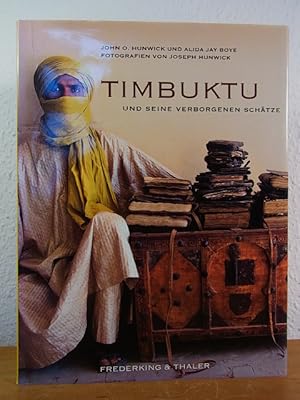
Timbuktu und seine verborgenen Schätze
Sprache: Deutsch
Verlag: München: Verlag Frederking & Thaler, 2009
ISBN 10: 3894057556 ISBN 13: 9783894057558
Anbieter: Antiquariat Weber, Hamburg, HH, Deutschland
Verbandsmitglied: GIAQ
Verkäuferbewertung 5 von 5 Sternen
Pp. Zustand: Gut. 33 cm ; Fotografien von Joseph Hunwick. Aus dem Englischen von Verena Küstner. Großformatige Hardcoverausgabe mit Schutzumschlag, 175 Seiten mit zahlreichen eindrucksvollen Fotos. Leeres Vorsatzblatt mit Stempel. Gutes Exemplar. hw1220 ISBN: 9783894057558.
-

Timbuktu und seine verborgenen Schätze
Sprache: Deutsch
Verlag: Frederking & Thaler, München :, 2009
ISBN 10: 3894057556 ISBN 13: 9783894057558
Anbieter: Gebrauchtbücherlogistik H.J. Lauterbach, Gummersbach, NRW, Deutschland
Verkäuferbewertung 5 von 5 Sternen
Leinen. Zustand: Sehr gut. 33x25cm; 175 S. Hardcover oder Leinen. zahlr. Ill., Kt. Zustand: Sehr Gut, eher ungelesen; * Die Photos sind original von uns erstellt worden, u.a. erkennbar an einem kleinen weißen Stück Papier im oberen Schnitt. Ab und an verwenden Suchmaschinen Verlagsphotos, bei den Portalen selbst, werden aber nur unsere Originalphotos gezeigt.
-

Timbuktu und seine verborgenen Schätze;
Sprache: Deutsch
Verlag: Frederking & Thaler, München, 2009
ISBN 10: 3894057556 ISBN 13: 9783894057558
Anbieter: Peter-Sodann-Bibliothek eG, Staucha, Deutschland
Verkäuferbewertung 5 von 5 Sternen
Zustand des Schutzumschlags: mit Schutzumschlag. 25 x 33 cm 175 S. sonstiger Gewebeeinband. Bilder (Fotos) farbig und Abbildungen. kaum Gebrauchsspuren; Umschlag etwas eingerissen;
-

Timbuktu und seine verborgenen Schätze
Sprache: Deutsch
Verlag: München Frederking & Thaler, 2009
ISBN 10: 3894057556 ISBN 13: 9783894057558
Anbieter: philobuch antiquariat susanne mayr, Friedberg, Deutschland
Verkäuferbewertung 5 von 5 Sternen
Großformatiger Bildband (33 x 25 cm), aus dem Englischen übersetzt, 175 S., mit sehr zahlreichen farbigen Abbildungen, Papp-Einband gebunden mit illustr. Schutzumschlag Schutzumschlag etwas lichtrandig, sonst sehr gut erhaltenes Exemplar. 1800 g gr.
-

Timbuktu und seine verborgenen Schätze. John O. Hunwick und Alida Jay Boye. Fotogr. von Joseph Hunwick. Aus dem Engl. von Verena Küstner.
Sprache: Deutsch
Verlag: München : Frederking & Thaler, 2009
ISBN 10: 3894057556 ISBN 13: 9783894057558
Anbieter: Borkert, Schwarz und Zerfaß GbR, Berlin, Deutschland
Verkäuferbewertung 5 von 5 Sternen
Zustand: Gut. 175 S. : zahlr. Ill., Kt. ; 33 cm. Gutes Ex.; Umschlag stw. gering berieben. - Das sagenumwobene Timbuktu hat im Mittelalter goldene Zeiten erlebt. Hier kreuzten sich sowohl die Routen der Sklavenhändler als auch die Karawanenwege, die durch die Sahara vom Mittelmeer bis Timbuktu und über den Niger weiter nach Süden führten. Gold, Elfenbein, Stoffe, Leder, Papier und Salz wurden auf dem Markt getauscht. Doch der materielle Reichtum der Stadt wurde noch vom geistigen übertroffen: Timbuktu zählte damals zu den wichtigsten Zentren einer blühenden islamischen Kultur und Wissenschaft. Es besaß zahlreiche Koranschulen, eine riesige Bibliothek und lockte mit seiner renommierten Universität Gelehrte und Schüler sogar von der fernen arabischen Halbinsel an. Pilger brachten aus Mekka Manuskripte in die Stadt, die hier debattiert, kopiert und weiterverbreitet wurden. So entstanden einzigartige Familienbibliotheken und Archive. Bis heute übt Timbuktu eine große Faszination aus. Die Vergangenheit, die die jahrhundertealten Manuskripte schildern, scheint in der traditionellen Lehmarchitektur und den in prachtvolle boubous gehüllten Bewohnern weiter zu leben. Die Handschriften bieten einen lebhaften Einblick in das tägliche Leben der Nomadengesellschaften von damals, sie berichten über religiöse Diskurse und wissenschaftliche Erkenntnisse, deren Themen von Astronomie über Medizin, Philosophie, Geschichte bis Musik und Jurisprudenz reichen. . (Verlagstext) / INHALT : EINFÜHRUNG ----- Ort des Geschehens ----- WO DAS KAMEL DAS KANU TRIFFT ----- Bewohner der Stadt ----- EIN REFUGIUM FÜR GELEHRTE ----- Timbuktus Manuskripte ----- BIBLIOTHEKEN UND GELEHRTE - EINST UND JETZT ----- Anmerkungen ----- Glossar ----- Zeittafel ----- Literaturverzeichnis ----- Register. ISBN 9783894057558 Sprache: Deutsch Gewicht in Gramm: 1566 Originalleinen mit illustr. Schutzumschlag.
-

Timbuktu und seine verborgenen Schätze
Anbieter: Celler Versandantiquariat, Eicklingen, Deutschland
Verbandsmitglied: GIAQ
Verkäuferbewertung 5 von 5 Sternen
Frederking & Thaler, München, 2009. 176 S. mit einem Frontispiz und zahlreichen, teils ganzseitigen Abbildungen, Pappband mit Schutzumschlag, quart---- gutes Exemplar / Aus dem Englischen von Verena Küstner - 1515 Gramm.
-

Timbuktu und seine verborgenen Schätze. John O. Hunwick und Alida Jay Boye. Fotogr. von Joseph Hunwick. Aus dem Engl. von Verena Küstner
Sprache: Deutsch
Verlag: München : Frederking & Thaler,, 2009
ISBN 10: 3894057556 ISBN 13: 9783894057558
Anbieter: Die Wortfreunde - Antiquariat Wirthwein Matthias Wirthwein, Mannheim, Deutschland
Verkäuferbewertung 5 von 5 Sternen
Gewebe. 175 S. : zahlr. Ill., Kt. ; 33 cm Schutzumschlag etwas berieben, sonst sehr gut erhalten. Sprache: Deutsch Gewicht in Gramm: 1566.
-

Timbuktu und seine verborgenen Schätze
Sprache: Deutsch
Verlag: Frederking & Thaler, München, 2009
ISBN 10: 3894057556 ISBN 13: 9783894057558
Hardcover. Zustand: Sehr gut. n/a. Dieses Buch befindet sich in gutem Zustand, was bedeutet, dass es zwar bereits genutzt wurde, aber insgesamt noch gut gepflegt ist. Der Einband zeigt leichte Gebrauchsspuren, wie kleinere Kratzer oder leichte Abnutzung an den Ecken, ist jedoch intakt und ohne größere Beschädigungen. Der Buchrücken ist stabil und weist keine lose oder gebrochene Bindung auf, obwohl eine leichte Lesefalte sichtbar sein kann. Die Seiten des Buches sind vollständig, ohne größere Mängel wie Risse oder Flecken, und zeigen ein wenig Verfärbungen oder eine mögliche Vergilbung an den Rändern, die aufgrund des Alters normal sind. Auch die Ecken und Kanten des Buches sind leicht abgenutzt, jedoch nicht stark beschädigt. Falls ein Schutzumschlag vorhanden ist, weist dieser möglicherweise kleine Knicke oder Verfärbungen auf, ist jedoch nicht zerrissen oder stark beschädigt. Insgesamt ist das Buch in einem Zustand, der es weiterhin zu einem angenehmen Leseerlebnis macht.(mehr Informationen den Bildern entnemen---. nein.
-

Timbuktu und seine verborgenen Schätze
Anbieter: Antiquariat Wortschatz, Markt Hartmannsdorf, Österreich
Verkäuferbewertung 5 von 5 Sternen
Softcover/Taschenbuch. Zustand: Sehr gut. kA (illustrator). kA. Auflage. Anzahl Bände: 1 - Bd.Nr.: kA - Sprache: de - Einband: Paperback - Gewicht: 1520 - Illust.: kA - Zustand: Sehr gut - Buch hat leichte Lager- und Gebrauchsspuren, vollständig, Bindung intakt, ohne häufige Anstreichungen o.ä., inkl. Schutzumschlag.
-

Timbuktu und seine verborgenen Schätze. John O. Hunwick und Alida Jay Boye. Fotogr. von Joseph Hunwick. Aus dem Engl. von Verena Küstner
Sprache: Deutsch
Verlag: München : Frederking & Thaler, 2009
ISBN 10: 3894057556 ISBN 13: 9783894057558
Anbieter: Antiquariat Biebusch, Lilienthal, Deutschland
Verbandsmitglied: GIAQ
Verkäuferbewertung 5 von 5 Sternen
Gewebe. Zustand: Sehr gut. 175 S. : zahlr. Ill., Kt. ; 33x25 cm Zustand: Leineneinband mit Schutzumschlag, sehr guter Zustand --- Inhalt: Timbuktu - bis heute klingt dieser Name nach abenteuerlichem Entdeckergeist und unschätzbaren Reichtümern. Die Stadt aus Lehm galt Jahrhunderte lang als Zentrum der islamischen Kultur und Wissenschaft. Während in den meisten Teilen Afrikas Wissen mündlich überliefert wurde, brachte man hier alles sorgfältig zu Papier. Dieses Buch schildert die beeindruckende Geschichte dieser sagenumwobenen Stadt und öffnet die Tür zu einer Schatzkammer - außergewöhnliche Handschriften von ungeahntem historischem Wert und seltener Schönheit. Ein faszinierendes Porträt des UNESCO-Weltkulturerbes Timbuktu, das eindrucksvoll Vergangenheit und Gegenwart verbindet. SIL1-1 ISBN: 9783894057558 Sprache: Deutsch Gewicht in Gramm: 1600.
-
Timbuktu und seine verborgenen Schätze. John O. Hunwick und Alida Jay Boye. Fotogr. von Joseph Hunwick. Aus dem Engl. von Verena Küstner
Sprache: Deutsch
Verlag: München : Frederking & Thaler, 2009
ISBN 10: 3894057556 ISBN 13: 9783894057558
Anbieter: BBB-Internetbuchantiquariat, Bremen, Deutschland
Verkäuferbewertung 5 von 5 Sternen
Gewebe, Broschiert. Zustand: Sehr gut. 175 S. : zahlr. Ill., Kt. ; 33 cm Zustand: neuwertig; Original-Schutzumschlag; v11169 9783894057558 Wenn das Buch einen Schutzumschlag hat, ist das ausdrücklich erwähnt. Rechnung mit ausgewiesener Mwst. Sprache: Deutsch Gewicht in Gramm: 1700.
-

Timbuktu und seine verborgenen Schätze
Anbieter: Celler Versandantiquariat, Eicklingen, Deutschland
Verbandsmitglied: GIAQ
Verkäuferbewertung 5 von 5 Sternen
Frederking & Thaler, München, 2009. 175 S. mit zahlr. Abb. und Tafeln, Leinen mit Schutzumschlag. Quart--- - sehr gutes Exemplar - 1530 Gramm.

