

Gesamtpreis (1 Artikel Artikel):
Versandziel:

hevesy hahn (4 Ergebnisse)
Direkt zu den wichtigsten Suchergebnissen
Suchfilter
Produktart
- Alle Product Types
- Bücher (4)
- Magazine & Zeitschriften (Keine weiteren Ergebnisse entsprechen dieser Verfeinerung)
- Comics (Keine weiteren Ergebnisse entsprechen dieser Verfeinerung)
- Noten (Keine weiteren Ergebnisse entsprechen dieser Verfeinerung)
- Kunst, Grafik & Poster (Keine weiteren Ergebnisse entsprechen dieser Verfeinerung)
- Fotografien (Keine weiteren Ergebnisse entsprechen dieser Verfeinerung)
- Karten (Keine weiteren Ergebnisse entsprechen dieser Verfeinerung)
- Manuskripte & Papierantiquitäten (Keine weiteren Ergebnisse entsprechen dieser Verfeinerung)
Zustand Mehr dazu
- Neu (Keine weiteren Ergebnisse entsprechen dieser Verfeinerung)
- Wie Neu, Sehr Gut oder Gut Bis Sehr Gut (2)
- Gut oder Befriedigend (1)
- Ausreichend oder Schlecht (Keine weiteren Ergebnisse entsprechen dieser Verfeinerung)
- Wie beschrieben (1)
Einband
- alle Einbände
- Hardcover (Keine weiteren Ergebnisse entsprechen dieser Verfeinerung)
- Softcover (3)
Weitere Eigenschaften
- Erstausgabe (2)
- Signiert (Keine weiteren Ergebnisse entsprechen dieser Verfeinerung)
- Schutzumschlag (Keine weiteren Ergebnisse entsprechen dieser Verfeinerung)
- Angebotsfoto (1)
Sprache (1)
Preis
- Beliebiger Preis
- Weniger als EUR 20 (Keine weiteren Ergebnisse entsprechen dieser Verfeinerung)
- EUR 20 bis EUR 45
- Mehr als EUR 45
Gratisversand
- Kostenloser Versand nach USA (Keine weiteren Ergebnisse entsprechen dieser Verfeinerung)
Land des Verkäufers
Verkäuferbewertung
-

EXCHANGE OF CELLULAR POTASSIUM
Erscheinungsdatum: 1941
Anbieter: Xerxes Fine and Rare Books and Documents, Glen Head, NY, USA
Verkäuferbewertung 5 von 5 Sternen

Erstausgabe
Zustand: Near Fine. Kobenhavn 1941 first edition. Det. Kgl. Danske Videnskabernes Selskab. XVI, 1. Octavo, 27p., original printed wraps. Geological Society name stamped on cover. Near Fine, just fading of green cover color along spine. No owner marks; no wear. Hevesy won Nobel in Chemistry in 1943.
-
TURNOVER OF LECITHIN, CEPHALIN AND SPHINGOMYELIN
Erscheinungsdatum: 1940
Anbieter: Xerxes Fine and Rare Books and Documents, Glen Head, NY, USA
Verkäuferbewertung 5 von 5 Sternen
Erstausgabe
Zustand: VG. Kobenhavn 1940 first edition. Det. Kgl. Danske Videnskabernes Selskab. VIII, 6. Octavo, 60p., original printed wraps. Geological Society name stamped on cover. VG. Hevesy won Nobel in Chemistry in 1943.
-
COLLECTION OF 6 MONOGRAPHS BY HEVESY
Erscheinungsdatum: 1937
Anbieter: Xerxes Fine and Rare Books and Documents, Glen Head, NY, USA
Verkäuferbewertung 5 von 5 Sternen
Zustand: Near Fine. Kobenhavn 1937 - 1940. All octavo wraps. All from Det Kgl. Danske Videnskabernes Selskab. Biologiske Meddelelser. All in Near Fine condition. Range from 24 to 60 pages per monograph. Some text illus. Largely uncut. Most have small old library name stamp on cover or tp. All in English. Titles in lot: Studies on the Metabolism of Phosphorus in Animals (1937); Origin of Phosphorus Compounds in Hens' Eggs (1938); Excretion of Phosphorus (1939); Rate of Renewal of Acid Soluble Organic Phosphorus (1940); Interactcion of Plasma Phosphate (1939); Turnover of Lecithin, Cephalin (1940). Geroge de Hevesy was awarded the Nobel in Chemistry in 1943. Six pamphlets:
-
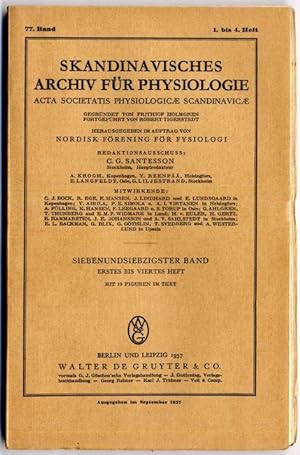
The Formation of Phosphatides in the Bain Tissue of Adult Animals. By L.Hahn and G.Hevesy. (From the Institute of Theoretical Physics, Copenhagen.) (pp.148-157).
Erscheinungsdatum: 1937
Anbieter: Antiq. F.-D. Söhn - Medicusbooks.Com, Marburg, Deutschland
Verkäuferbewertung 5 von 5 Sternen
Skand. Arch. Physiol., 77/1-4. - Berlin & Leipzig, Walter de Gruyter, 1937, 8°, 178 pp., 19 Fig., orig. broschiertes, unafigeschnittenes, verlagsfrisches, Exemplar. First Print! Georg von Hevesy (1885-1966), Hungarian physicist and chemist. He received the 1943 Nobel Prize in Chemistry for his work on the use of isotopes as tracers in studying chemical processes. Hevesy was the first to apply the radioactive tracer technique to biology, and he later used it in medical research. He also discovered X-ray fluorescence analysis. He was codiscoverer of hafnium, element 72 in the periodic table. Hevesy became an associate of the Institute of Theoretical Physics, Copenhagen, in 1920 and also of the Institute for Research in Organic Chemistry, Stockholm, in 1943. "It is generally assumed that no regeneration of the brain tissue of'adult animals takes place. To test the validity of this assumption we investigated whether any formation of phosphatides takes place in the brain tissue of adult animals. This problem-cannot be attacked by ordinary chemical methods because these do not permit the making of a distinction between phosphatide molecules formed at different dates; this is, however, possible if we introduce a labelled phosphate into the animal body (Chievitz and Hevesy, 1935, 1937), labelled sodium phosphate for example, and investigate whether the formation of labelled phosphatides can be established in the brain of the animal. We carried out experiments on rats, mice, and rabbits." Hahn & Hevesy.

