
Hermann busche (13 Ergebnisse)

- Softcover
Anbieter: PBShop.store US, Wood Dale, IL, USAPBShop.store US
Verkäufer/-in kontaktierenVerkäufer/-in mit 5 SternenZustand: Neu
EUR 33,69
Versand nach gratisVersand innerhalb von USAAnzahl: 15 verfügbar
PAP. Zustand: New. New Book. Shipped from UK. Established seller since 2000.
- Softcover
Anbieter: PBShop.store UK, Fairford, GLOS, Vereinigtes KönigreichPBShop.store UK
Verkäufer/-in kontaktierenVerkäufer/-in mit 5 SternenZustand: Neu
EUR 29,77
EUR 5,82 VersandVersand von Vereinigtes Königreich nach USAAnzahl: 15 verfügbar
PAP. Zustand: New. New Book. Shipped from UK. Established seller since 2000.

- Hardcover
Anbieter: PBShop.store US, Wood Dale, IL, USAPBShop.store US
Verkäufer/-in kontaktierenVerkäufer/-in mit 5 SternenZustand: Neu
EUR 43,21
Versand nach gratisVersand innerhalb von USAAnzahl: 15 verfügbar
HRD. Zustand: New. New Book. Shipped from UK. Established seller since 2000.
- Hardcover
Anbieter: PBShop.store UK, Fairford, GLOS, Vereinigtes KönigreichPBShop.store UK
Verkäufer/-in kontaktierenVerkäufer/-in mit 5 SternenZustand: Neu
EUR 38,12
EUR 6,80 VersandVersand von Vereinigtes Königreich nach USAAnzahl: 15 verfügbar
HRD. Zustand: New. New Book. Shipped from UK. Established seller since 2000.

Briefe von Dunklemännern (German Edition)
Hutten, Ulrich Von; Crotus Rubeanus, Johannes; Busche, Hermann Von Dem
- Softcover
Anbieter: Ria Christie Collections, Uxbridge, Vereinigtes KönigreichRia Christie Collections
Verkäufer/-in kontaktierenVerkäufer/-in mit 5 SternenZustand: Neu
EUR 39,76
EUR 13,88 VersandVersand von Vereinigtes Königreich nach USAAnzahl: Mehr als 20 verfügbar
Zustand: New. In.

Epistolarum obscurorum virorum ad dom. M.Ortuinum Gratium,volumina II. ex tam multis Libris, congluntinata, quod unus pinguis Cocus per decem annos, oves, boves, sues, grues, passeres, anseres, &c. coquere, vel aliquis fumosus Calefactor centum magna hypocausta per viginti annos ab eis calefacere posset.
Crotus Rubianus ; Hutten, Ulrich von ; Busche, Hermann von dem
Verlag: Londini. impensis Hen. Clements 1742
- Hardcover
Anbieter: Riverby Books, Fredericksburg, VA, USARiverby Books
Verkäufer/-in kontaktierenVerkäufer/-in mit 5 SternenZustand: Gebraucht - Befriedigend
EUR 135,63
EUR 6,10 VersandVersand innerhalb von USAAnzahl: 1 verfügbar
Hardcover. Zustand: Good. Hardcover. Original leather boards. Stiff brown binders tape reinforced spine. Marbled endpapers. Speckled foredeges. Text block good and tight. 5 lines handwritten on the first blank page, in French. 352 pages. Text is in Latin, published in London. Commonly referred to as Letters of Obscure Men, these… satirical essays were written in the early 16th century. This is volume 2 only. Please email with questions or to request photos.
Verlag: Stuttgart, Hallberger. 1846
- Hardcover
Anbieter: Books & Art, Reichenbach, DeutschlandBooks & Art
Verkäufer/-in kontaktierenVerkäufer/-in mit 5 SternenZustand: Gebraucht
EUR 100,00
EUR 98,00 VersandVersand von Deutschland nach USAAnzahl: 1 verfügbar
Lex.8°, VIII, 1632 Spalten, OHLederbd. d. Zeit, Ebd. berieben u. bestoßen, Rückenleder an Gelenk unten eingerissen, kleinere Fehlstellen an Leder u. Deckelüberzug, Gelenke an Vorsatz gelockert (Bindung aber gut), Schnitt u. S. teilw. wasser.-, stock.- oder fingerfleckig, einige S. m. Knitterfalten o. kl. Einrissen, mehrere NaV.,… Kinderkritzeleien auf Vorsatz hinten, sonst guter Zustand. Sprache: Deutsch.
 Weitere Bilder
Verlag: Hallberger, Stuttgart 1846
- Hardcover
- Erstausgabe
Anbieter: Bücherwurm | Buch- und Graphikantiquariat, Kiel, DeutschlandBücherwurm | Buch- und Graphikantiquariat
Verkäufer/-in kontaktierenVerkäufer/-in mit 5 SternenZustand: Gebraucht - Gut
EUR 250,00
EUR 60,00 VersandVersand von Deutschland nach USAAnzahl: 1 verfügbar
Zustand: Gut. 1. Auflage. Sehr selten Versandhinweis: Aufgrund aktueller EPR-Verpackungsregelungen ist der Versand in einzelne EU-Länder derzeit nicht möglich. Details siehe Händlerprofil. Pappband der Zeit, 397 S., ExLibris. Einband leicht berieben u bestoßen, durchgehend etwas braunfleckig. Noch guter Zustand. 8°.
 Weitere Bilder
Verlag: (colophon:) Andreas Cratander,, [Basel], 1520
- Hardcover
Anbieter: Antiquariaat FORUM BV, Houten, NiederlandeAntiquariaat FORUM BV
Verkäufer/-in kontaktierenVerkäufer/-in mit 5 SternenZustand: Gebraucht
EUR 2.500,00
EUR 25,00 VersandVersand von Niederlande nach USAAnzahl: 1 verfügbar
First and only edition of a work defending Erasmus against the accusations of Edward Lee, Archbishop of York. Lee had repeatedly complained about Erasmus's translation of the New Testament, criticising not only his knowledge of the Greek language, but also accusing him of heresy, and of stealing Lee's own ideas. In response, Era…smus and his friends, including Johannes Gertophius (dates unknown), ridiculed him on several occasions, such as in the present work. The title refers to the author as an "adolescens Germanus", but nothing more seems to be known about him. Other than a defence of Erasmus's New Testament against Lee's charges, the present work also includes a satirical poem, consisting of eleven distichs, by Herman von dem Busche (1468-1534).The boards have been somewhat rubbed. A water stain on the leaves, which decreases in size towards the end of the work. Otherwise in good condition.l Adams G 511; BM STC German p. 948; USTC 690074; VD 16 G 1635. Modern quarter vellum in older style, mid to late 18th-century marbled paper sides, with the manuscript author, title, and year of publication in red ink on the spine. With an elaborate woodcut title border, a decorated woodcut initial, and a woodcut printer's device on the final page. Pages: 25, [3] pp.
 Weitere Bilder
Verlag: Cologne, (Nicolaus Caesar, 12 April 1518). 1518
- Hardcover
Anbieter: Antiquariat INLIBRIS Gilhofer Nfg. GmbH, Vienna, A, ÖsterreichAntiquariat INLIBRIS Gilhofer Nfg. GmbH
Verkäufer/-in kontaktierenVerkäufer/-in mit 5 SternenZustand: Gebraucht
EUR 12.500,00
EUR 30,00 VersandVersand von Österreich nach USAAnzahl: 1 verfügbar
4to (145 x 202 mm). (60) ff. With woodcut capitals and printer's device on title-page. Numerous handwritten annotations in very early contemporary hand of Otto von Pack. Modern marbled boards. A defining humanist manifesto by a controversial figure from the circle of Erasmus and Thomas More, owned by the forger and conspirator O…tto von Pack (1480-1537), who famously almost triggered a civil war among the German princes. - This is the principal work of Hermann von dem Busch(e) (1468-1534), a manifesto for the humanist movement of his time which stresses the importance of classical studies in education. E. P. Goldschmidt, who later would own this copy, called the work one of the "best achievements" of the early 16th century's "gay anti-barbarous humanists", and one of the few "that can still be read with pleasure": a "spirited formulation of the humanist ideal" (The First Cambridge Press in Its European Setting, p. 39). Well-travelled and open-minded, Busch sided with Johann Reuchlin in the humanist's notorious dispute with the Dominican friars over the burning of the Talmud, and he has sometimes been tipped as one of the authors of the satirical "Epistolae obscurorum virorum" which lampooned the scholastic fanatics. - This copy's likely first owner, Otto von Pack, had been involved in several cases of minor and major fraud before he, in 1527, floated to the Protestant Landgrave Philip of Hesse an alleged plot by the Catholic German princes to attack members of the Reformation. He even produced a forged document to bolster these claims, leading Protestant princes to consider a pre-emptive strike. When he was found out, Pack fled to the Netherlands, where he was apprehended and executed. Still, questions remain surrounding the identity of possible co-conspirators (including Philip of Hesse himself). The incident did much to further poison the already soured and distrustful relationships between Protestant and Catholic German princes, as well as with the Emperor. - Pack left few records for scholarship: the marginal notes, in several hands including his own, must be regarded as one of the very few surviving primary source documents of his ideas in his own words. Even his signature, present here on the title-page in a bold hand, is vanishingly rare. It is dated in Leipzig, shortly after publication, though two final Roman numerals have apparently been trimmed at the edge of the leaf to read "Kalend. Janua. MDXVII": this must have been "MDXVIIII", or less than nine months after the publication of the book. At this time, Pack was studying at the University of Leipzig for a law degree. - Several annotations very slightly trimmed by the binder's knife. Final leaf somewhat soiled, chip to lower corner (without loss) and repaired closed tear. Altogether bright and clean, with both text and important annotations quite well preserved. - With the ownership inscription and notes of Otto von Pack, ca. 1519. Later 20th century bookplates of the famed bookseller Ernst Philip Goldschmidt (1887-1954) and of the Cologne merchant and collector Hanns-Theo Schmitz-Otto (1908-92) on front pastedown. Sold by Venator & Hanstein, Cologne, in 2022 (lot 396) and acquired in the German trade. - VD 16, B 9954. BM-STC German 171. Adams A 3339. Proctor 10593. ADB III, 640.
 Weitere Bilder
Verlag: per Matinum de werdena 1509
- Hardcover
Anbieter: Symonds Rare Books Ltd, London, Vereinigtes KönigreichSymonds Rare Books Ltd
Verkäufer/-in kontaktierenVerkäufer/-in mit 2 SternenZustand: Gebraucht - Gut
EUR 2.983,73
EUR 34,76 VersandVersand von Vereinigtes Königreich nach USAAnzahl: 1 verfügbar
Hardcover. Zustand: Very Good. INNOCENTIUS III, Pope (Busche, Hermann von dem, Ed.) Fundamentum eterne felicitatis Cum libro de Miseria conditionis humane. Köln, per Matinum de werdena, 1509. 8vo, unnumbered leaves, A-F8 G4 H8. Black letter, 32 lines. Large woodcut vignette on title page repeated on verso of last: Jesus as a chi…ld between Saint Anne and Mary in the presence of the dove of the Holy Spirit. Capital spaces with small guide-letters, printed maniculae indicating the heading of each paragraph. Small paper repair to outer margin of t-p and metal clip to margin of D6 bookmarking the table of contents. Evenly soiled, yet lightly, and a little darkened to margin edges. In modern gilt red morocco, title and date on front cover and spine. An excellent copy. Pope Innocent III (1160-1216), alias Loatrio di Segni, studied at the universities of Paris and Bologna. This very learned man of austere manners first became cardinal in 1190 and then pope as the successor of Celestine III. He fostered the moral and disciplinary reform of the Church, the fight against heresy, and the re-conquest of the Holy Land. He promoted the fourth crusade, which diverted from its original aim and concluded with the sack of Constantinople in 1204. He undertook the Albigesian crusade in order to supress the Cathar heresy, which had spread to large areas of the Pyrenees, Southern France and Northern Italy. Moreover, he crowned the Holy Roman Emperor Frederick II in 1212. Even though he was a skilled politician, he was moved by deeply religious purposes. Innocent wrote several theological and ascetic treatises, of which De miseria humane conditionis was the most renown, especially following his rule, when it was known with the title De contemptu mundi. This pope resumed the theocratic ideas of Gregory VII, according to which the pope is the vicar of Christ and the king of all kings; as spiritual power is superior to secular power, so the human soul rules over the body and the sun over the moon; both the spiritual and the secular swords are of the pope, who nevertheless concedes that the emperor uses one of the two, since the latter is advocatus Ecclesiae. Given that the pope must look after and take care of all men, by cause of the perpetual sinful condition of humanity, he has the power of control over everything and, therefore, he is legitimated to intervene in every field directly by God. The editor of the present work was Hermann von dem Busche (1468-1534), a German humanist who studied in Heidelberg, Tubingen and Italy. He is given as one of the authors of the Epistolae obscurorum virorum. He was a close friend to Ulrich von Hutten and an early enthusiast of the Reformation.
 Weitere Bilder
Verlag: Valentin Curio, Basle [Basel] 1522
Anbieter: Second Story Books, ABAA, Rockville, MD, USASecond Story Books, ABAA
Verkäufer/-in kontaktierenVerkäufer/-in mit 4 SternenZustand: Gebraucht
EUR 1.356,27
EUR 6,14 VersandVersand innerhalb von USAAnzahl: 1 verfügbar
Other. Sexto, aa-hh6, ii1, ii1, ii3-ii6, kk-mm6. In Fair condition. Bound in contemporary limp vellum, front cover reads in ink: "Dictiones Latinae Graecis Expositae." Remnants of paper library label to spine. Vellum with significant staining and rubbing. Ties lacking. Front free endpaper with book plate. Remnants of non-archiva…l tape to first two front free end papers. Entire textblock with wear to lower fore corner, most severe along beginning and end of text block. Provenance tipped onto rear pastedown. Scattered but consistent Greek marginalia, usually adding on to the translations. Lacking a-z6, A-F6, Î'-Î6. Contains only the section on Latin to Greek. ii1 in duplicate, with ii2 missing. Each new alphabet letter is done into a wooden engraving depicting an animal. Errata in rear. Colophon with Latin, Greek, and Hebrew, with the Hebrew diacritical signs (nikud). Shelved case 4. USTC: 689208, listing 12 copies of the full text, none in the United States. Provenance on rear pastedown: This book entitled "EARLY LATIN AND GREEK LEXICON" printed in Basle, Switzerland in 1522 by Valentinus Curio, has been deposited in trust in the Library of Oberlin College by Harlan F. Burket of the class of 1882 in memory of his warm, personal college friends and associates Professor Azariah Root of the class of 1884, President Henry Churchill King of the class of 1879, and Dr. Edward Increase Bosworth of the Theological class of 1886 who was my close personal college friend during the year 1881." 1376209. Shelved Dupont Bookstore.
 Weitere Bilder
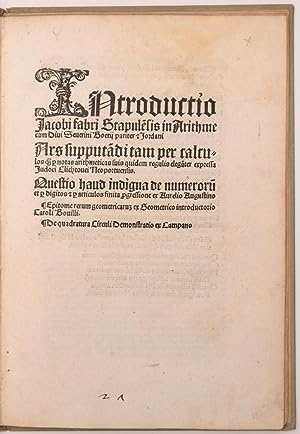
[Epitome.] Introductio Jacobi fabri Stapule[n]sis in arithmecam Divi Severini Boetii pariter [et] Jordani Ars supputa[n]di tam per calculos q[uem] p[er] notas arithmeticas suis quidem regulis elega[n]ter expressa Judoci Clichtouai Neoportuensis. Questio haud indigna de numeroru[m] et p[er] digitos et p[er] articulos finita ,p[ro]gressione ex Aurelio Augustino[.] Epitome rerum geometricaru[m] ex Geometrico introductorio Caroli Bouilli. De quadratura Circuli Demonstratio ex Campano
Lefèvre d'Étaples, Jacques [Faber Stapulensis]; Clichtove, Josse van [Judocus Clichtoveus]; Caesarius, Johannes; Bovelles, Charles de; Campanus, Johannes Antonius; Busche, Hermann von dem; Augustine of Hippo; Jordanus Nemorarius
Verlag: [Heinrich Quentel (heirs of)], [Köln (Cologne)] 1507
- Erstausgabe
Anbieter: Földvári Books, Budapest, UngarnFöldvári Books
Verkäufer/-in kontaktierenVerkäufer/-in mit 5 SternenZustand: Gebraucht
EUR 16.500,00
EUR 19,50 VersandVersand von Ungarn nach USAAnzahl: 1 verfügbar
First edition (under this title, and collection of the texts), second as Lefèvre's Epitome (1503, Paris). In later cardboard. Title lettered in ink to the spine. Wide margin copy. Coll: AD6 EF4; ff. [32]. Extremely scarce Cologne edition of "Lefevre's Epitome" and other mathematical treatises, the first edition of this combinati…on of the texts. Includes Bovelles' Epitome rerum geometricarum the earliest study on geometry by a French writer. An uncommon Cologne edition of this early collection of treatises on arithmetic, geometry, and astronomy intended for the use of university students. The book contains the French humanist and theologian Jacques Lefèvre d'Étaples' (14551536) introduction to the works of Boethius and Jordanus, together with treatises by his disciples: Josse van Clichtove's (14721543) Ars suppuntandi; Johannes Caesarius' (14681550) a prologue on geometry; and Charles de Bovelles' (c. 14751566) Epitome rerum geometricarum which is regarded as the earliest study on geometry by a French writer. The book also includes excerpts from De musica by Augistine, and De quadratura circuli demostratio by Campanus (c. 14291477), as well as poems by Hermann von dem Busche (14681534) and Caesarius, who is also the author of the text of the dedication to Heinrich Einhorn (Monoceros). A somewhat different collection of texts was published in 1503 in Paris, (Epitome compendiosaque introductio in libros arithmeticos did Severini Boetii []; Wolfgang Hopyl and Henri Étienne), which is considered as the first edition of the present book. We firmly assume that this, the 1507 Cologne edition is the titular second edition, which due to the lack of the colophon in certain bibliographies and sources described and referred either as a Paris (Smith), or a Deventer edition (J. Oosterhoff, 2018). Despite extensive and thorough research, we could not find copies with either of those imprints thus we strongly believe that both are bibliographical ghosts. Scarce, USTC lists only 5 copies (Germany 3, Austria 1, Russia 1) VD16 L 952; Smith Rara Arithmetica, pp. 802 Literature: J. Oosterhoff, R.: Making Mathematical Culture. University and Print in the Circle of Lefèvre d'Étaples. Oxford: Oxford University Press, 2018. pp. 968 . Ex libris label of Hanns-Theo Schmitz-Otto. Bibliographical and other notes in pencil on front pastedown and flyleaf. Number "21" lettered in ink by an old hand on the title page. Light discoloration to the pages at the upper edge of the first half. Overall in fine condition. In later cardboard. Title lettered in ink to the spine. Wide margin copy First edition (under this title, and collection of the texts), second as Lefèvre's Epitome (1503, Paris).


