

Gesamtpreis (1 Artikel Artikel):
Versandziel:

hammerschmidt karl (27 Ergebnisse)
Direkt zu den wichtigsten Suchergebnissen
Suchfilter
Produktart
- Alle Product Types
- Bücher (25)
- Magazine & Zeitschriften (Keine weiteren Ergebnisse entsprechen dieser Verfeinerung)
- Comics (Keine weiteren Ergebnisse entsprechen dieser Verfeinerung)
- Noten (Keine weiteren Ergebnisse entsprechen dieser Verfeinerung)
- Kunst, Grafik & Poster (2)
- Fotografien (Keine weiteren Ergebnisse entsprechen dieser Verfeinerung)
- Karten (Keine weiteren Ergebnisse entsprechen dieser Verfeinerung)
- Manuskripte & Papierantiquitäten (Keine weiteren Ergebnisse entsprechen dieser Verfeinerung)
Zustand Mehr dazu
- Neu (10)
- Wie Neu, Sehr Gut oder Gut Bis Sehr Gut (1)
- Gut oder Befriedigend (9)
- Ausreichend oder Schlecht (Keine weiteren Ergebnisse entsprechen dieser Verfeinerung)
- Wie beschrieben (7)
Einband
Weitere Eigenschaften
- Erstausgabe (1)
- Signiert (Keine weiteren Ergebnisse entsprechen dieser Verfeinerung)
- Schutzumschlag (1)
- Angebotsfoto (14)
Sprache (4)
Gratisversand
Land des Verkäufers
Verkäuferbewertung
-

Ueber Die Grundbedeutung Von Koniunktiv Und Optativ Und Ihr Verh?ltnis Zu Den Temporibus
Anbieter: PBShop.store US, Wood Dale, IL, USA
Verkäuferbewertung 5 von 5 Sternen

PAP. Zustand: New. New Book. Shipped from UK. Established seller since 2000.
-
Ueber Die Grundbedeutung Von Koniunktiv Und Optativ Und Ihr Verh?ltnis Zu Den Temporibus
Anbieter: PBShop.store UK, Fairford, GLOS, Vereinigtes Königreich
Verkäuferbewertung 4 von 5 Sternen

EUR 21,55
EUR 3,80 Versand
Versand von Vereinigtes Königreich nach USAAnzahl: 15 verfügbar
In den WarenkorbPAP. Zustand: New. New Book. Shipped from UK. Established seller since 2000.
-

Deutsches Lied und Deutscher Sang. Deutsche Sangeskunst in Vergangenheit und Gegenwart.
Sprache: Deutsch
Verlag: Wilhelm Schille, Karlsruhe, Dortmund, 1930
Anbieter: Antiquariat Seibold, Schorndorf, WN, Deutschland
Verkäuferbewertung 3 von 5 Sternen

Hardcover. Zustand: Befriedigend. OLn., 4°, 397 (3) S., mit zahlreichen Tafeln (davon 15 in Tiefdruck) und zahlreichen Textabb., Einband leicht angestaubt, Kapitale leicht bestoßen, vorders Innengelenk gelockert, Seiten leicht gebräunt.
-

Die Ornithologie Des Aristoteles
Anbieter: PBShop.store US, Wood Dale, IL, USA
Verkäuferbewertung 5 von 5 Sternen
PAP. Zustand: New. New Book. Shipped from UK. Established seller since 2000.
-

Deutsches Lied und Deutscher Sang. Deutsche Sangeskunst in Vergangenheit und Gegenwart.
Sprache: Deutsch
Verlag: Wilhelm Schille, Karlsruhe, Dortmund, 1930
Anbieter: Antiquariat Seibold, Schorndorf, WN, Deutschland
Verkäuferbewertung 3 von 5 Sternen
Hardcover. Zustand: Befriedigend. OLn., 4°, 397 (3) S., mit zahlreichen Tafeln (davon 15 in Tiefdruck) und zahlreichen Textabb., Rücken etwas verblasst, Exlibris.
-
Die Ornithologie Des Aristoteles
Anbieter: PBShop.store UK, Fairford, GLOS, Vereinigtes Königreich
Verkäuferbewertung 4 von 5 Sternen
EUR 22,09
EUR 3,80 Versand
Versand von Vereinigtes Königreich nach USAAnzahl: 15 verfügbar
In den WarenkorbPAP. Zustand: New. New Book. Shipped from UK. Established seller since 2000.
-

Ueber die Grundbedeutung von Koniunktiv und Optativ und Ihr Verhltnis zu den Temporibus Auf Grund der Homerischen Epen Classic Reprint
Anbieter: PBShop.store US, Wood Dale, IL, USA
Verkäuferbewertung 5 von 5 Sternen
HRD. Zustand: New. New Book. Shipped from UK. Established seller since 2000.
-

Die Ornithologie des Aristoteles Programm zum Jahresbericht des Kgl Humanistischen Gymnasiums Speier fr das Schuljahr 189697 Classic Reprint
Anbieter: PBShop.store US, Wood Dale, IL, USA
Verkäuferbewertung 5 von 5 Sternen
HRD. Zustand: New. New Book. Shipped from UK. Established seller since 2000.
-
Ueber die Grundbedeutung von Koniunktiv und Optativ und Ihr Verhltnis zu den Temporibus Auf Grund der Homerischen Epen Classic Reprint
Anbieter: PBShop.store UK, Fairford, GLOS, Vereinigtes Königreich
Verkäuferbewertung 4 von 5 Sternen
EUR 27,39
EUR 4,80 Versand
Versand von Vereinigtes Königreich nach USAAnzahl: 15 verfügbar
In den WarenkorbHRD. Zustand: New. New Book. Shipped from UK. Established seller since 2000.
-

Das deutsche Sängerbuch. Wesen und Wirken des Deutschen Sängerbundes in Vergangenheit und Gegenwart.
Verlag: Karlsruhe. Wilhelm Schille, 1930
Anbieter: Versandantiquariat Ingo Lutter, Buchholz, Deutschland
Verkäuferbewertung 3 von 5 Sternen
Gebunden. Buch hat leichte Gebrauchs spuren ( Lese spuren ) Kanten leicht bestoßen Lichtrandig 162 Deutsch - Frakturschrift 1800g.
-
Die Ornithologie des Aristoteles Programm zum Jahresbericht des Kgl Humanistischen Gymnasiums Speier fr das Schuljahr 189697 Classic Reprint
Anbieter: PBShop.store UK, Fairford, GLOS, Vereinigtes Königreich
Verkäuferbewertung 4 von 5 Sternen
EUR 27,92
EUR 4,80 Versand
Versand von Vereinigtes Königreich nach USAAnzahl: 15 verfügbar
In den WarenkorbHRD. Zustand: New. New Book. Shipped from UK. Established seller since 2000.
-

Ueber die Grundbedeutung von Koniunktiv und Optativ: und ihr Verhältnis zu den Temporibus (German Edition)
Anbieter: Ria Christie Collections, Uxbridge, Vereinigtes Königreich
Verkäuferbewertung 5 von 5 Sternen
EUR 19,76
EUR 13,83 Versand
Versand von Vereinigtes Königreich nach USAAnzahl: Mehr als 20 verfügbar
In den WarenkorbZustand: New. In.
-

Roman aus der Nachkriegszeit. 298 Seiten. Wegener. Berlin. 1926. Guter Zustand/Good condition. Leinen/Hardcover. Einband etwas verblichen,Widmung auf Vorsatzblatt, Sprache: deutsch/german.
-

Das deutsche Sängerbuch.
Sprache: Deutsch
Verlag: München, Zürich : Delphin-Verlag,, 1930
ISBN 10: 3773550758 ISBN 13: 9783773550750
Halbleder. Zustand: Gut. XIII, 397 S., Fraktur, zahlr. s/w Abb., einige im Tiefdruck, sowie einige Notenbeispiele, 29 cm Lese- und Lagerspuren. Titelblatt fehlt. Buch gebräunt. Einband berieben und bestoßen. Schnitt etwas fleckig. Gutes Exemplar (Mus.Wiss.) A-Z 32608 Mus.Wiss ISBN 3773550758 Sprache: Deutsch Gewicht in Gramm: 2100.
-

DAS DEUTSCHE SANGERBUCH WESEN UND WIRKEN DES DEUTSCHEN SANGERBUNDES IN VERGANGENHEIT UND GENENWART
Erscheinungsdatum: 1930
Anbieter: Xerxes Fine and Rare Books and Documents, Glen Head, NY, USA
Verkäuferbewertung 5 von 5 Sternen
Zustand: Good. Marburg no date (c. 1930) Johann Gruneberg. In German. Hardcover. 4to., 397pp., over 100 illustrations, blue cloth with gilt. Owner name stamp on title page. Good plus, hinges tender, slight bump on cover, no DJ.
-

Deutsches Lied und deutscher Sang : Deutsche Sangeskunst in Vergangenheit und Gegenwart. Eingeleitet von Karl Hammerschmidt. Herausgegeben von Franz Josef Ewens.
Sprache: Deutsch
Verlag: Erschienen in Marburg, Lahn : Grüneberg [Karlsruhe] : [Schille] im Jahre 1930., 1930
Anbieter: Galerie Antiquariat Schlegl, Weiden i. d. OPf., Deutschland
Verkäuferbewertung 3 von 5 Sternen
Erstausgabe
Insgesamt 397 Seiten, über 100 Illustrationen in Buchdruck, viele Textzeichnungen, sowie 15 Tiefdruck- Bilder. Zustand: Einband leicht berieben, Ecken und kanten wenig bestoßen. Innen: Name (Bleistift) auf der Vorderdeckel- Rückseite. Sprache: Deutsch Gewicht in Gramm: 1050 4°(Quart- Format bis 35 cm.) Ziegelroter Original- Ganzleinen- Einband mit dunkelbrauner Rücken- und Vorderdeckel- Beschriftung, hellgrüner Kopffarbschnitt. Erstausgabe, 1. Auflage, gedruckt in Berlin bei Gebr. Mann, Ganymed und R. Boll.
-
1. Symbolik des orthodoxen Christentums und der kleineren christlichen Kirchen in Ost und West. Tafelband; 2. Symbolik des orientalischen Christentums. Tafelband.
Verlag: Stgt: Anton Hiersemann 1968, 1966
Anbieter: Libresso - das Antiquariat in der Uni, Koethel, KREIS, Deutschland
Verkäuferbewertung 5 von 5 Sternen
Oln. Beide mit Abbildungsnachweisen, Registern, herabgesetzt von ehemals 85,00 Euro. Sprache: dt. ca. 1500 Gramm. Buch.
-

Das deutsche Sängerbuch. Wesen und Wirken des Deutschen Sängerbundes in Vergangenheit und Gegenwart
Anbieter: Celler Versandantiquariat, Eicklingen, Deutschland
Verbandsmitglied: GIAQ
Verkäuferbewertung 5 von 5 Sternen
Verlagsbuchhandlung Wilhelm Schille & Co., Karlsruhe und Dortmund, 1930. XIII, 397 S. mit über 100 Illustrationen in Buchdruck, viele Textzeichnungen sowie 15 Tiefdruckbildern, goldgeprägter Leineneinband mit farbigem Kopfschnitt, quart, (etwas fleckig/Rücken leicht eingerissen/Widmung auf Vorsatz)---- sonst gutes Exemplar - 1675 Gramm.
-
Deutsches Lied und deutscher Sang Dt. Sangeskunst in Vergangenheit u. Gegenwart.
Sprache: Deutsch
Verlag: Marburg, Lahn : Grüneberg Karlsruhe, 1930
Anbieter: BBB-Internetbuchantiquariat, Bremen, Deutschland
Verkäuferbewertung 5 von 5 Sternen
Hardcover/Pappeinband; Leinen. Zustand: Gut. 397 S. : UÌber 100 Ill. in Buchdruck, viele Textzeichn., 15 Tiefdruckbilder, mit Abb. ; 4 Zustand: gut; S-Hh1976 Wenn das Buch einen Schutzumschlag hat, ist das ausdrücklich erwähnt. Rechnung mit ausgewiesener Mwst. Sprache: Deutsch Gewicht in Gramm: 1700.
-

Programmheft Jean Gilbert: DIE KEUSCHE SUSANNE. Operette. Spielzeit 1951 / 52
Verlag: Halle, 1951, 1951
Anbieter: Programmhefte24 Schauspiel und Musiktheater der letzten 150 Jahre, Görlitz, Deutschland
Verkäuferbewertung 5 von 5 Sternen
Zustand: Befriedigend. original Heft, nicht paginiert, ca. 12 Seiten, Zeichnungen, 3 Fotos. Zustand: befriedigend, kleiner Einriss unten am Rücken Inszenierung: Heinz Starck. Musikalische Leitung: Wilhelm Licht. Bühne: Rudolf Heinrich. Kostüme: Anneliese Eigendorff. Tanzleitung: Margot Kirmse. Mitwirkende: Paul Herlt, Ellen Weber, Peter Paul Lindemann, Fritz Veit, Erich Heimbach, Ingeborg Möller, Hans Gerstadt, u.a. ------- Program booklet Jean Gilbert: THE CHASTE SUSANNE State Theatre Halle 1951 - Original booklet, unpaginated, approx. 12 pages, drawings, 3 photos. Condition: fair, small tear at the bottom of the spine. - Directed by Heinz Starck. Musical direction by Wilhelm Licht. Set design by Rudolf Heinrich. Costume design by Anneliese Eigendorff. Dance direction by Margot Kirmse. Featuring: Paul Herlt, Ellen Weber, Peter Paul Lindemann, Fritz Veit, Erich Heimbach, Ingeborg Möller, Hans Gerstadt, and others. deu.
-

Programmheft Richard Strauss SALOME Spielzeit 1951 / 52
Verlag: Halle, 1951, 1951
Anbieter: Programmhefte24 Schauspiel und Musiktheater der letzten 150 Jahre, Görlitz, Deutschland
Verkäuferbewertung 5 von 5 Sternen
Zustand: Befriedigend. original Heft, nicht paginiert, ca. 14 Seiten, einige Abbildungen ( Radierung von Alois Kolb, Bühnenbildentwurf, Portraitfotos, etc. ). Zustand: befriedigend Musikdrama nach Oskar Wildes gleichnamiger Dichtung. Musikalische Leitung: Horst-Tanu Margraf Inszenierung: Heinz Rückert. Gesamtausstattung: Albrecht Langenbeck. Kostümherstellung: Werkstätten des Landestheaters unter Anneliese Eigendorff und Fritz Seifert. Mitwirkende: Alois Orth, Lydia Dertil, Maria Trieloff, Hans Ullrich Schaefer, Karl-Friedrich Hölzke, Ursula Kretschmer, u.a. ------- Program booklet Richard Strauss SALOME State Theatre Saxony-Anhalt in Halle 1951 - Original booklet, unpaginated, approx. 14 pages, some illustrations (etching by Alois Kolb, stage design, portrait photos, etc.). Condition: fair - A musical drama based on Oscar Wilde's poem of the same name. Musical direction: Horst-Tanu Margraf. Stage direction: Heinz Rückert. Set design: Albrecht Langenbeck. Costume design: Workshops of the State Theatre under Anneliese Eigendorff and Fritz Seifert. Cast: Alois Orth, Lydia Dertil, Maria Trieloff, Hans Ullrich Schaefer, Karl-Friedrich Hölzke, Ursula Kretschmer, and others. deu.
-
Taschenbuch. Zustand: Neu. Ueber die Grundbedeutung von Koniunktiv und Optativ | und ihr Verhältnis zu den Temporibus | Karl Hammerschmidt | Taschenbuch | 52 S. | Deutsch | 2016 | hansebooks | EAN 9783743348394 | Verantwortliche Person für die EU: Hansebooks GmbH, Trakehner Weg 52, 22844 Norderstedt, gb[at]hansebooks[dot]com | Anbieter: preigu.
-

Das deutsche Sängerbuch. Wesen und Wirken des Deutschen Sängerbundes in Vergangenheit und Gegenwart. Eingeleitet von Karl Hammerschmidt. Hrsg. von Franz Josef Ewens, unter Benutzung des amtlichen Materials des Deutschen Sängerbundes.
Sprache: Deutsch
Verlag: Wilhelm Schille & Co, Karlsruhe und Dortmund,, 1930
Anbieter: Antiquariat J. Hünteler, Hamburg, Deutschland
Verbandsmitglied: GIAQ
Verkäuferbewertung 5 von 5 Sternen
4°, Leinen-O. Zustand: Gut. 399 S., Mit über 100 Illustrationen in Buchdruck, vielen Textzeichnungen sowie 15 Tiefdruckbilder. Dunkelblauer Einband mit reicher Goldprägung, Einband etwas berieben und bestossen, Seiten leicht nachgedunkelt, sonst sauberes Exemplar. 115543_Musik Sprache: Deutsch Gewicht in Gramm: 2000.
-
Zustand: Sehr gut. Zustand: Sehr gut | Seiten: 52 | Sprache: Deutsch | Produktart: Bücher | Keine Beschreibung verfügbar.
-

Deutsches Lied und deutscher Sang : Dt. Sangeskunst in Vergangenheit u. Gegenwart. Eingel. v. Karl Hammerschmidt. Hrsg. v. Franz Josef Ewens
Sprache: Deutsch
Verlag: Marburg, Lahn : Grüneberg - [Karlsruhe] : [Schille],, 1930
Anbieter: Schürmann und Kiewning GbR, Naumburg, Deutschland
Verkäuferbewertung 5 von 5 Sternen
Lw. Zustand: Gut. 397 S. : Über 100 Ill. in Buchdruck, viele Textzeichn., 15 Tiefdruckbilder, mit Abb. ; 4 private Widmung im Vorsatz Sprache: Deutsch Gewicht in Gramm: 2100.
-
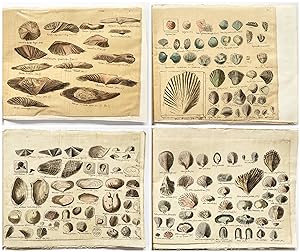
Manuscript catalogue with drawings of Devonian fossils from the Abdullah Bey's collection
Sprache: Französisch
Verlag: Istanbul, 1869
Anbieter: Antiquariat Steffen Völkel GmbH, Seubersdorf, Deutschland
Verkäuferbewertung 5 von 5 Sternen
Kunst / Grafik / Poster
EUR 4.800,00
EUR 30,00 Versand
Versand von Deutschland nach USAAnzahl: 1 verfügbar
In den WarenkorbCollection of 3 manuscripts with over 600 watercolor and ink drawings of Devonian fossils in the Bosporus Strait from the collection of Abdullah Bey (Karl Eduard Hammerschmidt). Each drawing is numbered according to the corresponding specimen in the collection and includes the species name. The interesting aspect is that the specimens are not ordered by number, but by species/family. Signed and dated (Constantinople, 22.09.1869) by Eloi Beral on one of the manuscripts. This is in various regards almost a manuscript catalogue of a part of Abdullah Bey's extensive fossil collection. This collection is especially valuable as it serves as a testament to this part of his specimen collection, given that most of the geology collection from Istanbul and the Bosporus region has been lost due to multiple fires and a recent earthquake in 1999. It includes drawings of fossils found in the following locations: Arnavutköy (Istanbul), Kuruçesme, Baltalimani, Rumeli Hisari, Kartal, Pendik, Kanlidja, Tchauchbachi, Yusa Tepe, Tchiboukly. Abdullah Bey, originally Karl Eduard Hammerschmidt, (1800-1874) was an Austrian-born Ottoman scientist and physician. He specialized in mineralogy, geology, and fossil science.Engaged in the Vienna Uprising of 1848, Abdullah Bey sought refuge in the Ottoman Empire following its suppression, adopting Islam and the name Abdullah upon arrival in Istanbul. He represented the Ottoman government at the Paris Exhibition of 1867. He brought 3 collections to the Exposition Universelle: the first one, the one who contains the specimens included in our manuscripts, was formed of around 1200 Devonian fossils from the Bosporus region and earned him the gold medal of that year's exhibition. At that moment, this was the greatest and largest fossile collection from Istanbul. Since the number of specimens listed in our collection (1189) is very similar to the declared numbers of specimens that won him the gold medal in the Paris exhibition of 1867, we believe it is safe to assume that the drawings depict the specimens exhibited in Paris. Part of this collection ended up being gifted by Abdullah Bey to the Paris Natural History Museum. The other two collection were: one of entomology (for which he received another gold medal), and a herbarium of 20 leaves (for which he received the bronze medal). In 1872, Abdullah Bey decided to donate another part of his collection of Devonian fossils from the Bosphorus area to the Cabinet of Natural History of Madrid, a collection now located in the Museo Nacional de Ciencias Naturales de Madrid. The reason for this was most likely his wish to foster international connections between museums. On the way from Turkey to Madrid, some parts of the shipment have been lost: most importantly, the inventory list of the specimens, but also 1 of 3 other publications regarding his collection, as well as possibly 26 plates with illustrations pertaining to one of the 2 publications that have been delivered. Other parts of his collection have been donated to museums in St. Petersburg, Italy and Austria. He is unanimously considered a pioneer in the ares of Turkish geology, entomology and paleontology, having first introduced the terms and concepts of geology to Turkey. Geological mappings and findings in Turkey were scarce and significantly delayed. The first crude geological map of the city was created by French entomologist Guillaume-Antoine Olivier in 1801. The second geological map, produced by Philippe Edouard Poulletier de Verneuil, appeared in 1837, while the first modern colored geological map was made years later by Russian Prince Piotr Alexandrovich de Tchihatcheff (1856-1869). This highlights the significance of Abdullah Bey's contributions, as his work provided crucial insights into an area that, at the time, was largely geologically unexplored. At the Imperial School of Medicine in Istanbul. in 1871, the Ottoman Empire inaugurated its first natural history museum under the name 'Le Musée d'Histoire Naturelle d'École Impériale de Médecine de Constantinople'. Dr. Abdullah Bey facilitated the transportation of thousands of samples to Istanbul through his collaboration with European naturalists. Not only did he establish a prestigious museum in the Ottoman Empire, but he also cemented his place in history as a pioneer of one of the most significant impacts of the French Enlightenment on scientific endeavors within the Islamic world. After Abdullah Bey's sudden death in 1874, the museum's activities slowed, and the collection was moved to Istanbul University's Geology Faculty. Unfortunately, the collection was destroyed in the Vefa Fire of 1918, leading to the permanent loss of Istanbul's only natural history museum. Éloi Béral (1838-1908) was a French engineer and politician. After graduating from the École Polytechnique, he became a mining engineer in 1861 and later served as the prefect of Lot. Although unsuccessful in his initial bid for a legislative seat in 1877, he eventually became a senator in 1883, focusing on mining issues. In 1869, as noted in one of these notebooks, Eloi Beral was sent on a mission to the Ottoman Empire. During this assignment, he explored Abdullah Bey's collection of Bosporus fossils and created drawings of the exhibited specimens. You can find more pictures on our website. --- -Fossiles Devoniens de la rive droite du Bosphore / Arnautkeuy Kourou-Tchesme Bebek Balta Liman (801 a 850) et (901 a 979) Roumely-Hissar (877 a 890). 93 drawings on 8 sheets [ca. 15 x 18 cm.]. Species included: Cryphoeus, Eulima, Loxonema, Eronyptalus, Pterinoea Pentamerus Cerebratula, Pterina, Bivalve, Spirifer, Orthis, Leptoena, Strophonema. --- - Fossiles Devoniens des Rives de la Mer de Marmara a Kartal et Pandyk comprenant les n.os 980 a 1190. (Constantinople, 22. 09.1869). 165 drawings on 9 sheets [ca. 15 x 20 cm]. Species included: Phacops, Cryphoeus, Ortoceras, Rhynconella, Calyptroea, Cerebratula, Spirifer, Orthis, Leptoena. --- - Fossiles Devoni.
-
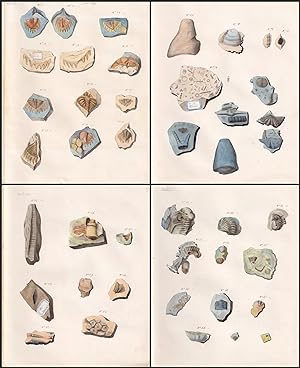
Collection of over 100 watercolor drawings of fossils from the Bosporus Strait, most probably collected by Abdullah Bey.
Sprache: Deutsch
Verlag: (Turkey) ca. 1870., 1870
Anbieter: Antiquariat Steffen Völkel GmbH, Seubersdorf, Deutschland
Verkäuferbewertung 5 von 5 Sternen
Kunst / Grafik / Poster
EUR 4.800,00
EUR 30,00 Versand
Versand von Deutschland nach USAAnzahl: 1 verfügbar
In den WarenkorbSize of the sheets: ca. 25,5 x 20,5 cm. The drawings depict fossil specimens collected from various places around the Bosporus Strait and Istanbul: Arnavutköy, Kartal, Kanlidja, Stenia, Yeni-Keui, Guenk-Sou, Tarabya. With an additional contemporary ink and watercolor drawing on thin linen, that shows a few of the fossils included on 3 of the other sheets. Probably made by the same person perhaps an initial drawing. Very beautiful, finely executed drawings of numerous fossils from the Bosporus region. The place where the specimens were collected is noted on the upper part of the sheet, in pencil handwriting. The specimes are numbered (1-73) with the exception of the last 13 drawings which remain unnumbered - and ordered according to number and location, but lacking any taxonomic rank. Some of the specimens are drawn with their respective labels, which indicates they were part of an extensive collection of fossils. In the case of one label, the number in the collection is mentioned as well and it corresponds to the numbering within the manuscript, which further proves that the numbering associated to the drawings correspondents to the number in the actual classification of the specimens. As there have not been many collections of fossils recorded in Turkey during the second half of the 19th century, we will put forward the hypothesis that the drawings depict a part of Abdullah Bey's collection of fossiles, which, at that time, was the largest collection of fossils in Turkey. We were not able to locate drawings of the same fossil specimens in other documents of Abdullah Bey's collection. These drawings are different from the fossils in the other collection (1869) we are in posession of and that depicts the specimens which won him the gold medal in the Paris exhibition of 1867 (although the place of collection often overlaps). This means these drawings were most likely made on another ocassion and by another person, possibly by Abdullah Bey himself. It is already known that he has made drawings of the specimens in his collection before there are manuscript drawings by him in the posession of the Natural History Museum in Vienna. Since the drawings lack any form of classification - other than by where they were collected - we can assume this collection of drawings shows rare, at that time unidentified specimens. The manuscript seems to have been done intentionally with the purpose of serving as a kind of catalogue for the unidentified species of those respective areas. Abdullah Bey, originally Karl Eduard Hammerschmidt, (1800-1874) was an Austrian-born Ottoman scientist and physician. He specialized in mineralogy, geology, and fossil science.Engaged in the Vienna Uprising of 1848, Abdullah Bey sought refuge in the Ottoman Empire following its suppression, adopting Islam and the name Abdullah upon arrival in Istanbul. He represented the Ottoman government at the Paris Exhibition of 1867. He brought 3 collections to the Exposition Universelle: the first one was formed of around 1200 Devonian fossils from the Bosporus region and earned him the gold medal of that years exhibition. At that moment, this was the greatest and largest fossile collection from Istanbul. Part of this collection ended up being gifted by Abdullah Bey to the Paris Natural History Museum. The other two collections were: one of entomology (for which he received another gold medal), and a herbarium of 20 leaves (for which he received the bronze medal). In 1872, Abdullah Bey decided to donate another part of his collection of Devonian fossils from the Bosphorus area to the Cabinet of Natural History of Madrid, a collection now located in the Museo Nacional de Ciencias Naturales de Madrid. The reason for this was most likely his wish to foster international connections between museums. On the way from Turkey to Madrid, some parts of the shipment have been lost: most importantly, the inventory list of the specimens. Other parts of his collection have been donated to museums in St. Petersburg, Italy and Austria. He is unanimously considered a pioneer in the areas of Turkish geology, entomology and paleontology, having first introduced the terms and concepts of geology to Turkey. Geological mappings and findings in Turkey were scarce and significantly delayed. The first crude geological map of the city was created by French entomologist Guillaume-Antoine Olivier in 1801. The second geological map, produced by Philippe Edouard Poulletier de Verneuil, appeared in 1837, while the first modern colored geological map was made years later by Russian Prince Piotr Alexandrovich de Tchihatcheff (1856-1869). This highlights the significance of Abdullah Beys contributions, as his work provided crucial insights into an area that, at the time, was largely geologically unexplored. At the Imperial School of Medicine in Istanbul, in 1871, the Ottoman Empire inaugurated its first natural history museum under the name Le Musée dHistoire Naturelle dÉcole Impériale de Médecine de Constantinople. Dr. Abdullah Bey facilitated the transportation of thousands of samples to Istanbul through his collaboration with European naturalists. Not only did he establish a prestigious museum in the Ottoman Empire, but he also cemented his place in history as a pioneer of one of the most significant impacts of the French Enlightenment on scientific endeavors within the Islamic world. After Abdullah Beys sudden death in 1874, the museums activities slowed, and the collection was moved to Istanbul Universitys Geology Faculty. Unfortunately, the collection was destroyed in the Vefa Fire of 1918, leading to the permanent loss of Istanbuls only natural history museum. The fact that specimens of fossils from the Bosporos Strait are so scarce mainly due to the consequent poor luck of the geology museums that housed them makes the present collection even more valuable. This offers important insight into the early days of the development of the paleontology and geology fields.


