

Gesamtpreis (1 Artikel Artikel):
Versandziel:

hailes william (4 Ergebnisse)
Direkt zu den wichtigsten Suchergebnissen
Suchfilter
Produktart
- Alle Product Types
- Bücher (4)
- Magazine & Zeitschriften (Keine weiteren Ergebnisse entsprechen dieser Verfeinerung)
- Comics (Keine weiteren Ergebnisse entsprechen dieser Verfeinerung)
- Noten (Keine weiteren Ergebnisse entsprechen dieser Verfeinerung)
- Kunst, Grafik & Poster (Keine weiteren Ergebnisse entsprechen dieser Verfeinerung)
- Fotografien (Keine weiteren Ergebnisse entsprechen dieser Verfeinerung)
- Karten (Keine weiteren Ergebnisse entsprechen dieser Verfeinerung)
- Manuskripte & Papierantiquitäten (Keine weiteren Ergebnisse entsprechen dieser Verfeinerung)
Zustand Mehr dazu
- Neu (1)
- Wie Neu, Sehr Gut oder Gut Bis Sehr Gut (Keine weiteren Ergebnisse entsprechen dieser Verfeinerung)
- Gut oder Befriedigend (1)
- Ausreichend oder Schlecht (1)
- Wie beschrieben (1)
Einband
Weitere Eigenschaften
- Erstausgabe (Keine weiteren Ergebnisse entsprechen dieser Verfeinerung)
- Signiert (Keine weiteren Ergebnisse entsprechen dieser Verfeinerung)
- Schutzumschlag (Keine weiteren Ergebnisse entsprechen dieser Verfeinerung)
- Angebotsfoto (2)
Sprache (2)
Gratisversand
Land des Verkäufers
Verkäuferbewertung
-

Small Business Management
Anbieter: ThriftBooks-Dallas, Dallas, TX, USA
Verkäuferbewertung 5 von 5 Sternen

Paperback. Zustand: Fair. No Jacket. Readable copy. Pages may have considerable notes/highlighting. ~ ThriftBooks: Read More, Spend Less.
-

EUR 36,84
EUR 48,99 Versand
Versand von Deutschland nach USAAnzahl: Mehr als 20 verfügbar
In den WarenkorbGebunden. Zustand: New.
-

Russias Democratic Moment? : Defining US Policy to Promote Democratic Opportunities in Russia
Verlag: AIR UNIV PRESS, 1995
Zustand: Gut. Zustand: Gut | Seiten: 319 | Produktart: Bücher | Keine Beschreibung verfügbar.
-
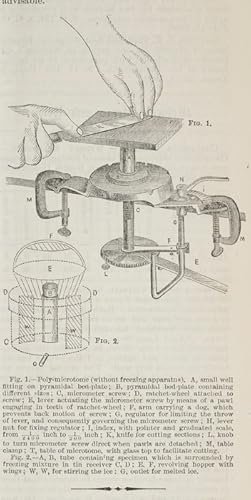
An Improved Micotome. Two hundred sections a minute each 1/1200 of an inch in thickness (p.109, 1 fig.).
Erscheinungsdatum: 1880
Anbieter: Antiq. F.-D. Söhn - Medicusbooks.Com, Marburg, Deutschland
Verkäuferbewertung 5 von 5 Sternen
Med. Rec., 18. - New York: William Wood & Company, 1880, 8°, IV, 742 pp., Figs., Leinenband d.Zt. First Print! "Hailes's microtome. - A very ingenious and excellent instrument has been devised by Dr. William Hailes (1849-1912), Professor of Histology and Pathological Anatomy at the Albany Medical College. Objections to it will be mainly on the ground of price. Dr. Hailes uses it as a simple instrument or as a freezing microtome, arranged either for ice and salt, ether-spray, rhigoline, etc. The employment of ice and salt (coarse) is preferred, because it costs but little and freezes the mass solid and quickly, and, if desired, 500 or 1,000 sections can be obtained in a few moments, depending, of course, upon the rapidity and skill of the operator. The time of freezing is about seven minutes, except in very warm weather, when it requires a few moments longer. The instrument does not work quite so satisfactorily in very warm weather, owing to the rapid melting at the surface of the preparation. It is absolutely necessary that the mass should be frozen solid, or the sections cannot be cut smoothly. An extra freezer may be employed, and while one specimen is being cut the other is being frozen; by exchanging cylinders (they being interchangeable) no delay is necessary. The art of cutting is readily acquired. Two hundred or two hundred and fifty sections have been made in a minute, and of a uniform thickness of 1/1200 inch. It is not necessary to remove the sections from the knife each time, but twenty or thirty may be permitted to collect upon the blade. They lie curled or folded up upon the knife, and when placed in water, straighten themselves out perfectly in the course of a few hours. The knife employed is an ordinary long knife from an amputating case. Perfectly fresh tissues may be cut without any previous preparation, using ordinary mucilage (acacia) to freeze in, but most specimens require special preparation. " Satterthwaite, Thomas E.: Manual of Histology (1882): p.19.

