Gesamtpreis (1 Artikel Artikel):
Versandziel:

guido monte (17 Ergebnisse)
Direkt zu den wichtigsten Suchergebnissen
Suchfilter
Produktart
- Alle Product Types
- Bücher (17)
- Magazine & Zeitschriften (Keine weiteren Ergebnisse entsprechen dieser Verfeinerung)
- Comics (Keine weiteren Ergebnisse entsprechen dieser Verfeinerung)
- Noten (Keine weiteren Ergebnisse entsprechen dieser Verfeinerung)
- Kunst, Grafik & Poster (Keine weiteren Ergebnisse entsprechen dieser Verfeinerung)
- Fotografien (Keine weiteren Ergebnisse entsprechen dieser Verfeinerung)
- Karten (Keine weiteren Ergebnisse entsprechen dieser Verfeinerung)
- Manuskripte & Papierantiquitäten (Keine weiteren Ergebnisse entsprechen dieser Verfeinerung)
Zustand Mehr dazu
- Neu (8)
- Wie Neu, Sehr Gut oder Gut Bis Sehr Gut (2)
- Gut oder Befriedigend (2)
- Ausreichend oder Schlecht (Keine weiteren Ergebnisse entsprechen dieser Verfeinerung)
- Wie beschrieben (5)
Einband
Weitere Eigenschaften
- Erstausgabe (5)
- Signiert (1)
- Schutzumschlag (Keine weiteren Ergebnisse entsprechen dieser Verfeinerung)
- Angebotsfoto (9)
Sprache (3)
Gratisversand
Land des Verkäufers
Verkäuferbewertung
-

Handbook for Curates
Sprache: Englisch
Verlag: Catholic University of America Press, 2011
ISBN 10: 0813218691 ISBN 13: 9780813218694
Anbieter: PBShop.store UK, Fairford, GLOS, Vereinigtes Königreich
Verkäuferbewertung 5 von 5 Sternen

EUR 29,99
EUR 5,81 Versand
Versand von Vereinigtes Königreich nach USAAnzahl: 2 verfügbar
In den WarenkorbPAP. Zustand: New. New Book. Shipped from UK. Established seller since 2000.
-
Handbook for Curates A Late Medieval Manual on Pastoral Ministry
Anbieter: Revaluation Books, Exeter, Vereinigtes Königreich
Verkäuferbewertung 5 von 5 Sternen
EUR 35,44
EUR 14,47 Versand
Versand von Vereinigtes Königreich nach USAAnzahl: 2 verfügbar
In den WarenkorbPaperback. Zustand: Brand New. 350 pages. 8.25x5.50x1.00 inches. In Stock.
-

Meret Oppenheim: Works in Dialogue from Max Ernst to Mona Hatoum
Anbieter: Black Gull Books (P.B.F.A.), St Leonard's on Sea, Vereinigtes Königreich
Verbandsmitglied: PBFA
Verkäuferbewertung 5 von 5 Sternen
EUR 35,76
EUR 15,05 Versand
Versand von Vereinigtes Königreich nach USAAnzahl: 1 verfügbar
In den WarenkorbHardcover. Zustand: As New.
-

Di prima e di poi (Robin&sons)
Anbieter: libreriauniversitaria.it, Occhiobello, RO, Italien
Verkäuferbewertung 4 von 5 Sternen

Zustand: NEW.
-
Handbook for Curates: A Late Medieval Manual on Pastoral Ministry (Medieval Texts in Translation)
Sprache: Englisch
Verlag: The Catholic University of America Press, 2011
ISBN 10: 0813218691 ISBN 13: 9780813218694
Anbieter: Kennys Bookstore, Olney, MD, USA
Verkäuferbewertung 5 von 5 Sternen
Zustand: New. Translator(s): Thayer, Anne T. Series: Medieval Texts in Translation. Num Pages: 384 pages. BIC Classification: HRCX4. Category: (P) Professional & Vocational. Dimension: 229 x 152 x 28. Weight in Grams: 557. . 2011. 1st. Paperback. . . . . Books ship from the US and Ireland.
-

Senza filtro (Varianti)
Anbieter: libreriauniversitaria.it, Occhiobello, RO, Italien
Verkäuferbewertung 4 von 5 Sternen
EUR 16,15
EUR 17,95 Versand
Versand von Italien nach USAAnzahl: Mehr als 20 verfügbar
In den WarenkorbZustand: NEW.
-
DI PRIMA E DI POI (Italian)
Anbieter: Brook Bookstore, Milano, MI, Italien
Verkäuferbewertung 4 von 5 Sternen
Zustand: new.
-
SENZA FILTRO (Italian)
Anbieter: Brook Bookstore, Milano, MI, Italien
Verkäuferbewertung 4 von 5 Sternen
EUR 15,09
EUR 27,99 Versand
Versand von Italien nach USAAnzahl: Mehr als 20 verfügbar
In den WarenkorbZustand: new.
-

EUR 47,99
EUR 48,99 Versand
Versand von Deutschland nach USAAnzahl: Mehr als 20 verfügbar
In den WarenkorbKartoniert / Broschiert. Zustand: New. KlappentextrnrnAnne T. Thayer is the Paul and Minnie Diefenderfer Associate Professor of Mercersburg and Ecumenical Theology and Church History at Lancaster Theological Seminary. Katharine J. Lualdi is professor of history and on the faculty of .
-

Meret Oppenheim: Works in Dialogue from Max Ernst to Mona Hatoum
Sprache: Englisch
Verlag: Skira Editore, Milano, 2017
Anbieter: Antiquariat Im Seefeld / Ernst Jetzer, Zürich, Schweiz
Verkäuferbewertung 4 von 5 Sternen
Erstausgabe
Zustand: Wie neu. Erstausgabe. 4°, 199 pp., foldout-brochure, with b/w and colour ill., editor: Ligniti, Emily., transl. By Toohey, Meaghan. Practically new, still with original wrapper.
-

Meret Oppenheim Works in Dialogue from Max Ernst to Mona Hatoum
Anbieter: Mooney's bookstore, Den Helder, Niederlande
Verkäuferbewertung 4 von 5 Sternen
Zustand: Very good.
-
Manipulus curatorum.
Sprache: Englisch
Verlag: per Wynandum de Worde, 13 February, London, 1509
Anbieter: Sokol Books Ltd. ABA ILAB, London, Vereinigtes Königreich
Verkäuferbewertung 5 von 5 Sternen
EUR 29.920,18
EUR 48,61 Versand
Versand von Vereinigtes Königreich nach USAAnzahl: 1 verfügbar
In den WarenkorbHardcover. Zustand: Very Good. 8vo. ll. 133 (iii). Blackletter. T-p with woodcut depicting two tonsured priests with a monstrance, within woodcut border, woodcut printer's device to last verso. T-p with repair to upper margin, restored to outer margin with small portion supplied in ink, 18 further ll. expertly restored to margins, one or two letters occasionally supplied in ink, K8 and L1-2 with portions of a few lines supplied in ink. Last quire browned, washed and pressed, possibly from another copy, last few ll. restored at gutter and outer margin. Occasional dustiness, the odd small spot, else a very good, clean copy in C20 antique brown crushed morocco by Riviere, joints lightly rubbed, spine gilt, all edges gilt, leather booklabel of Estelle Doheny to front pastedown. Contemp. ownership inscription to colophon, 'John Foster,' contemp. 6-line inscription to verso of t-p on baptism, 'Caveat sacerdos' etc., a few letters obscured at gutter, price note to next, 'iiijd' (i.e. 4 pence). C18 or C19 shelfmark of York Cathedral Library to t-p and next, 'XV.O.39,' purchased 1930 by A.S.W. Rosenbach. Very rare second Wynkyn de Worde edition of this popular manual for priests by the fourteenth-century Spanish cleric and canonist Guido de Mont Rochen, first printed in England by Pynson around 1500, and by de Worde in an earlier edition of 1502. This copy has excellent provenance, being from the library of Estelle Doheny, originally purchased from the York Minster Library by private treaty in 1930 by A.S.W. Rosenbach, with evidence of early English ownership (see Leslie A. Morris, Rosenbach Abroad (Philadelphia: 1988), p. 59, no. 55). Monte Rochen's book went through hundreds of editions in the late medieval period and circulated widely in manuscript: 'It sold twice as many copies as Gratian's Decretum, three times more than Thomas Aquinas's Summa theologiae, and six times more than Boccaccio's Decameron or Augustine's City of God. Yet Guido de Monte Rochen and his manual for priests have long been overlooked by historians of the period' (Michael Milway, 'Forgotten Best-Sellers from the Dawn of the Reformation' in eds Bast, Gow and Oberman, Continuity and Change (Leiden: 2000), p. 117). It was finally superseded by the establishment of the Roman Catholic catechism in the Council of Trent in 1566. The manual is divided into three parts: the first covers the chief sacraments of baptism, confirmation, the Eucharist, marriage, extreme unction, and the ordination of holy orders; the second covers penance and confession; the third contains crucial doctrines to be conveyed to the people: the Lord's Prayer, the Ten Commandments, etc. Monte Rochen is particularly concerned with when things go wrong, for example noting the penances associated with mistreatment of the Eucharist, such as spilling the chalice, or when someone vomits up the Host because they are ill or, worse, drunk. Another major concern is the baptism of a child who is in danger of immediate death, a crisis regularly encountered by midwives as well as priests. Monte Rochen notes that in such cases, not only women but also atheists, Jews, pagans and heretics can baptise a child. However, only pure water should be used: children should never be baptised in meat broth, he says, but baptism in a well is allowed in extreme circumstances. The early owner of this copy merely noted that children should not be baptized a second time, and that prayers should be said over them in church. Pre-Elizabethan English imprints, of all sorts, are now commercially rare. This ed. is very scarce: OCLC notes Princeton and Simon Fraser only in North America; of the 1502 de Worde edition, OCLC notes three copies in North America, at Simon Fraser, Illinois and the New York Society Library. Lowndes IV, 1590. Ames II, 149. ESTC S111296.
-
Manipulus curatorum.
Verlag: [(Colophon:) London, Wynkyn de Worde, 22 April 1502.], 1502
Anbieter: Bernard Quaritch Ltd ABA ILAB, London, Vereinigtes Königreich
Verbandsmitglied: ABA ILAB PBFA
Verkäuferbewertung 5 von 5 Sternen
Erstausgabe
EUR 20.860,68
EUR 37,03 Versand
Versand von Vereinigtes Königreich nach USAAnzahl: 1 verfügbar
In den WarenkorbFirst Edition. 8vo, ff.cxxxiv, [4]; AQ8 R18, quire E missigned 'G' as in BL copy but foliation continuous; gothic letter, Wynkyn's Caxton device (McKerrow 10b) to title; title dusty and laid down with some loss to edges, repairs to head and tail of A27 with loss to headlines of A2 and a few others shaved, closed tear to A2 affecting a dozen words, tear to inner margin of A3 with a handful of words lost, minor losses to head of C1D2 not affecting text, small wormtrack to quire A affecting a few letters on 2 ff., small wormtrack to last 3 quires affecting a couple of words per page, light damp-stains to head throughout and a few other minor blemishes; else a very good, crisp copy in nineteenth-century sheep over wooden boards; neatly rejointed, endcaps and -bands lost; contemporary ownership inscription to f.cxxviiiv ('of this bo[ke] Raulffe Wyller ys the ower'), offsetting from an early inscription to f.lviv, 'Pope' struck out in red on ff.xxxiiv and xxxixr, pencil manicule to f.xcviiiv, marks in red crayon to a couple of leaves, ink stamp of Stonyhurst College to title and rear flyleaf.First Wynkyn de Worde edition of this immensely popular medieval handbook for priests, one of only four complete copies known. Composed in the 1330s by Guido de Monte Rochen (also Monte Rocherii or Roterio), the Manipulus curatorum met the growing need for pastoral guidance and the training of priests in the wake of the Fourth Lateran Council (1215). Aimed at simple curates and written in a suitably unadorned style, the work is in three parts: the first on six of the seven sacraments; the second on penance (the remaining sacrament and a matter of particular complexity for parish priests); and the third on catechesis. 'Although Guido's manual had much in common with contemporary pastoralia, it stood out from the pack by adapting and simplifying the genre's basic features to serve its audience more effectively. The Handbook is long enough to be comprehensive, but short enough to be truly useful' (Thayer and Lualdi, p.xxiv). 'More than 250 manuscript copies of the Handbook for Curates are still extant, but it truly came into its own with the advent of printing. Between circa 1468 and 1501, some 122 editions of the Handbook rolled off European presses both big and small, making it the eleventh most printed title in the period' (ibid., pp.xiiiiv). Only the Inquisition in the Catholic world and the Reformation in the Protestant put an end to its widespread use, as witnessed by the anti-papal deletions in our copy. The present edition was the third to be printed in England, preceded by two from the press of Richard Pynson (1498 and 1500). All English editions (of which there are seven, the last printed in 1517) are very rare, with copies often found imperfect. Of the present edition, only three other complete copies are recorded by ESTC (BL, Glasgow, Rylands). Two imperfect copies are at Stonyhurst and Illinois, and Bodley holds a made-up copy of the 1517 edition with two quires supplied from the 1502. They are also very scarce in commerce no complete copies of the present edition appear in auction records, and of the others we can trace only the York MinsterDoheny copy of the 1509 edition (last sold in 2024, $9500), the Stonyhurst copy of the 1500 edition (sold Sotheby's 2003, £6600), and another copy of the same (sold Sotheby's 1983, £1078) in the last century. ESTC S111275; STC 12472. See Anne T.Thayer and Katherine J.Lualdi, introduction to Guido of Monte Rochen, Handbook for Curates (2011). Language: Latin.
-

IMOLA VIVENTE. In occasione della Esposizione pittori imolesi - Imola 5-20 febbraio XI
Verlag: [in fine:] Cooperativa Tipografico - Editrice "Paolo Galeati",, 1933
Anbieter: Libreria Antiquaria Pontremoli SRL, Milano, MI, Italien
Verkäuferbewertung 5 von 5 Sternen
Erstausgabe
Imola, [in fine:] Cooperativa Tipografico - Editrice "Paolo Galeati", 1933 (febbraio), Edizione originale. Più che buon esemplare, quasi ottimo, con normali lievi segni del tempo perimetrali, particolarmente sul bordo esterno delle pagine, con il segno della piegatura orizzontale e un principio di separazione lungo lo stesso segno. Rarissimo numero unico organizzato dall'ex futurista Guido Dal Monte, passato a un originale versione molto moderna del Novecentismo, a pari merito con il collega passatista Anacleto Margotti; ospiti i due giovani ventenni Arrigo Visani e Walter Martelli. Notevole impaginato in puro stile futurista secondo i dettami del gruppo torinese di Fillia, Diulgheroff, Oriani, Pozzo etc. Una sola localizzazione istituzionale in Italia, secondo ICCU, alla Comunale di Imola; nessuna all'estero. -- Contiene un «Chiarimento» sulle ragioni della mostra, «Problemi dell'artigianato imolese» di Dal Monte, «Ottocento e falso Ottocento» di Margotti, articoli redazionali non firmati e brevi prose aforistiche di Romano Romanelli, Bruno Barilli, Roberto Papini. In ultima pagina il catalogo della mostra, con 20 opere di Dal Monte, 29 di Margotti, 13 di Visani e 8 di Martelli. -- Importante e notevole l'apparato iconografico, con le opere «Autoritratto», «Venezia (La salute)», «Natura morta» di Dal Monte, «Facchini», «Maternità», «Azdori» di Margotti. in 4° (h. 355 mm), leggera brossura color carta da zucchero, a contenuto pubblicitario ma con testata disegnata in stile razionalista molto moderno; pp. [8] con illustrazioni in bianco e nero nel testo. Edizione originale. Più che buon esemplare, quasi ottimo, con normali lievi segni del tempo perimetrali, particolarmente sul bordo esterno delle pagine, con il segno della piegatura orizzontale e un principio di separazione lungo lo stesso segno. leggera brossura color carta da zucchero, a contenuto pubblicitario ma con testata disegnata in stile razionalista molto moderno;
-
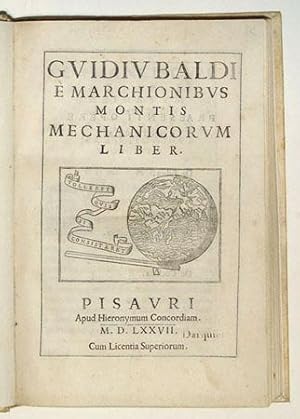
Mechanicorum Liber.
Verlag: Pesaro H. Concordia 1577., 1577
Anbieter: Martayan Lan, New York, NY, USA
Verkäuferbewertung 4 von 5 Sternen
Erstausgabe
Folio [29.4 x 19.6 cm], (8) ff. (the last blank), 130, (1) f. [colophon], 1 integral blank, with numerous woodcut diagrams and illustrations in text. Old ownership stamp "Darquier" neatly stenciled on title (the Toulousain astronomer Antoine Darquier de Pellepoix 1718-1802?) Bound in 18th century vellum over paste boards, covers a bit soiled and abraded. Inconsequential soiling and a little spotting to title; even toning to some quires, but generally a fresh and appealing copy. Rare first edition of the author's first work, generally regarded as the most important treatise on mechanics since Archimedes and a critical influence on Galileo. The work is notable for its commitment to establishing mechanics on a rigorously mathematical basis, for its powerful argument that mechanics and statics are separate sciences and for its insistence that mechanics should not consider abstract and/or abstruse entities but the activity of machines. Stillman Drake particularly emphasizes the importance of the section on pulleys, where Monte reduces them (as he does most other simple machines) to a lever. As such, the work has technological implications for navigation, manufacture, the plastic arts and medicine (f. 245)."From the time of its publication in 1577. [it was] the most authoritative treatise on statics to emerge since antiquity, and it remained pre-eminent until the appearance of Galileo's Two New Sciences in 1638. It marks the high point of the Archimedean revival of the Renaissance" (Rose, Italian Renaissance of Mathematics, p. 222).Monte (1545-1607) studied mathematics at Padua and subsequently at Urbino, where he studied with Commandino, editing and publishing the latter's translation of Pappus. He conducted an extensive scientific correspondence with Galileo, securing for the Florentine his chairs at Pisa and later at Padua.* Adams U-7; Riccardi II.178; P.L. Rose, DSB IX.487-89, & The Italian Renaissance of Mathematics, pp. 222ff.; Biblioteca Mechanica, pp. 228-9.
-

Libellus valde utilis vulgo inscriptus, manipulus curatorum. In quo necessaria officia eorum, quibus animarum cura incumbit, compendio tractantur, a Guidone de Monte Rocherii, ante CC annos editus, nunc demum exemplarium collatione sublatis mendis pristino nitori restitutus. Accessit Ioannis Viguerii opusculum de consolatione agonizantium
Verlag: apud Hieronymum Cavalcalupum, Venetiis, 1559
Anbieter: Libreria Antiquaria Giulio Cesare di Daniele Corradi, Roma, RM, Italien
Verkäuferbewertung 2 von 5 Sternen

Vecchi percorsi di tarlo estinto alla copertina, dorso coevo rinforzato, ottimo stato di conservazione interno c.c. 288 + (12) p. 110x90 mm p.perg. coeva con titolo manoscritto al dorso.
-
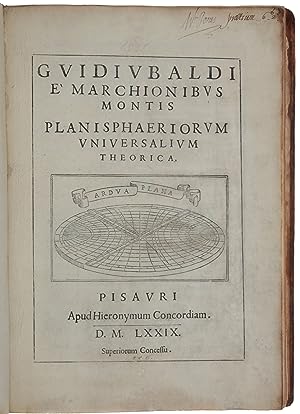
Planisphaeriorum universalium theorica
Verlag: Girolamo Concordia, Pesaro, 1579
Anbieter: SOPHIA RARE BOOKS, Koebenhavn V, Dänemark
Verkäuferbewertung 4 von 5 Sternen
Erstausgabe Signiert
First edition. THEORY OF THE PLANISPHERE - THE JONES-MACCLESFIELD COPY . First edition, very rare, the Jones-Macclesfield copy, signed by William Jones, of the first modern theoretical treatise on the planisphere, an instrument for representing the celestial sphere on a plane surface. Guidobaldo was one of the most prominent figures in the renaissance of the mathematical sciences, and is famous for his Mechanicorum liber (1577), generally regarded as the most important treatise on mechanics since Archimedes and a critical influence on his friend and disciple Galileo. "Two years after the publication of the Mechanicorum Liber, Guidobaldo released the Planisphaeriorum Universalium Theorica (1579), re-edited after another two years later at Cologne. The treatise attended to the mathematical branch in which Guidobaldo seems to have been most interested besides mechanics, namely to perspective . Guidobaldo's treatise of 1579 is subdivided in two books and is dedicated to the explication of various types of planispheres. Planispheres had the function to represent in the plane the celestial sphere with all his significant circles - a procedure that obviously posed problems relative to stereographic or orthogonal projection, according to the type of planisphere. Fundamental for their construction were the empirical guidelines given in Ptolemy's Planisphaerium. A different way of stereographic projection had been found by Gemma Frisius (1508-55), exposed in De astrolabio catholico (1556), by assuming the centre of projection on the equinoctial circle, while in Ptolemy it was fixed in one of the two poles. The advantage of this method consisted in the possibility to adapt the planisphere to an arbitrary latitude (for that reason it was called 'universal'), while Ptolemy's was valid only for a specific horizon.In the first book, Guidobaldo attends to comment on Gemma Frisius's planisphere furnishing geometrical demonstrations of what had remained unproven by the Dutch mathematician. Furthermore, he gave the necessary indications to construct the described device. In the second book, Guidobaldo approached the analysis of the planisphere of Juan De Rojas, considered the inventor of the universal astrolabe. As the projection exposed by the Spanish mathematician refers to a point of observation at infinite distance, his planisphere poses problems relative to orthographic projection. Guidobaldo addressed himself to the topic with the usual mathematical rigour, inter alia proving that the section of a cylinder and a plane (not parallel to the axis of the cylinder) is generally an ellipse - a fact unknown both to De Rojas and to Frisius. Here, again, he exposed a scientific instrument appropriate to draw ellipses, with a clear and detailed theoretical justification. This fact confirms Guidobaldo's interest in the practical aspects connected with mathematics, besides his unquestioned skill to present theorisations of mathematical fields" (Frank, pp. 40-41). ABPC/RBH lists only one other complete copy in a contemporary binding in the last 40 years. Provenance: William Jones (1675-1749) (signature on title), probably acquired by him from John Collins (1626-83); the Earls of Macclesfield (South Library bookplate on front paste-down, embossed stamp on first two leaves); sold Sotheby's, 13 April 2005, lot 1434, £3,360 ($6,372). As the Macclesfield catalogue notes (A-C, p. 12), "It is not unreasonable to suppose that anything published before 1683 [in the Macclesfield library] belonged to him [i.e., Collins]". It would seem very likely that Collins would have owned a copy of this book, given his own interest in mathematical instruments - he wrote The sector on a quadrant (1658); Geometrical dyalling (1659); and The mariner's plain scale (1659). Jones acquired Collins's books and papers some time before he edited Newton's Analysis per quantitatum series (1711). "Painters were well acquainted with the representation of a three-dimensional object by three two-dimension. Signed.